• Skip to primary navigation
  • Skip to main content
  • Skip to primary sidebar

  • Basketball Plays
    • Ball Screen Sets
    • Horns Sets
    • Man to Man Post Up
    • Man to Man Isolations
    • Backdoor Plays
    • Man to Man 3 Point Shot Plays
    • 2-3 Zone Attack
    • Baseline Inbound Plays
    • Sideline Inbound Plays
    • Combination Defense Attack
  • Drills
    • Defensive Drills
    • Offensive Drills
    • Competitive Drills
    • Passing Drills
    • Rebounding Drills
    • Shooting and Scoring Drills
    • Toughness Drills
    • Transition & Conversion Drills
    • One on One Drills
  • Blueprint
  • Practice
  • Mental Toughness
  • Skill Development
  • Offense
  • Defense
  • Store

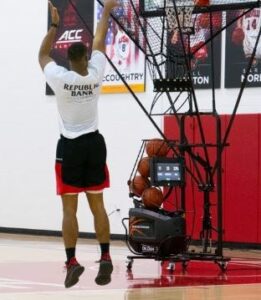
3 Second Spot Shooting

3 Second Spot Shooting

By Brian Williams on December 9, 2019

This shooting drill is provided by Dr. Dish Basketball.

The drill is with Louisville women’s associate coach Sam Purcell.

You can and should modify any of the drills to make them fit your needs or to add variety to your skill development work.

Please make sure your sound is on to see the video.

This drill is hosted on YouTube, so you will need to be on a server that allows you to access YouTube to see the drill.

Click the play arrow so see the drill.
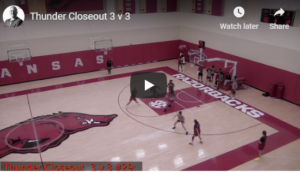
Thunder Closeout 3 on 3

By Brian Williams on December 8, 2019

This post is with Mike Neighbors.

Like all drills that you see other programs use, you can either modify it or take parts of these ideas for your use and your needs. I hope to provide food for thought for you to use as a place to start for ideas to improve your program.

Please make sure your sound is on to see the video.

Click the play arrow to see the drill.

The drill is a YouTube video, so you will need to be on a server that allows you to access YouTube to see the drill.

Pistol Transition Offense

By Brian Williams on December 5, 2019

Coach Stephen Gentry, previously at Oklahoma State, now on the Illinois Staff.

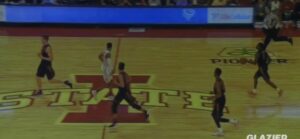
The content is located on the Glazier Coaching Vault at this link: Transition Pistol Offense

All of the basketball content in the Glazier Vault at this link: Basketball Glazier Vault Access

You will need to click on the image of the video to start it.

This is a Vimeo video, so you will need to be able to access Vimeo in order to view it.

PUT YOUR CURSOR OVER THE LOWER RIGHT CORNER OF THE VIDEO AND CLICK (IMAGE LOOKS LIKE THIS) TO WATCH THE VIDEO ON FULL SCREEN TO BE ABLE SEE LARGER DIAGRAMS AND VIDEOS
Weak Stack Zone Offense Quick Hitter

By Brian Williams on December 3, 2019

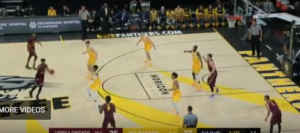
Army Men’s Assistant Coach Zak Boisvert has assembled some clips of a zone offense quick hitter used by Loyala of Chicago.

Zak has an outstanding site with posts on various coaching topics at www.pickandpop.net

His YouTube channel has several videos with various types of man to man plays, zone sets, and inbounds plays as well as clips on various defensive coverages.

You can subscribe to receive an update when he posts a new video Zak Boisvert You Tube Channel

You can follow him on Twitter at this link: @ZakBoisvert

Click play to see the video

This is a YouTube video, so you will need to be on a server that allows you YouTube access.

Playing with Purpose on Purpose Part 2 “Advanced Purpose”

By Brian Williams on December 1, 2019

This article was written and submitted by retired High School Coach Dave Millhollin.

I have included more information about his coaching career at the end of the article.

Caoch Millhollin has contributed several insightful articles to the site. You can find links to more of them at the bottom of this post under the “Related Posts” tab.

If you would like to contact Coach Millhollin, email me and I will put you in touch with him.

Playing with Purpose on purpose (Part 2) “Advanced Purpose”

Teaching basketball language and vocabulary

There are three kinds of basketball language; “regular basketball language”, this language includes formal and slang basketball terms and is used by commentators, coaches, players, social media and on the playground.  Most players understand this language fairly well by the time you will get them as high school or college players.


The second language is “the language of your opposition”, here your players only really need to know what certain words the opposition might use to describe a strategy or tactic they might use such words as “Bronco” meaning flex, or “23” meaning 2-3 zone, or “fist” pick and roll, etc.

By knowing your oppositions’ vocabularies, your team can intercept verbal cues in order to counter opposing tactics and strategies.

The third language is “your team’s language”; the language of your program.  This is the most important language you can teach and most coaches don’t realize how important this one can be.  As you teach the elements of your program, based on your Purpose and goals, you can develop a vocabulary and language unique to your team.  For example: regarding the concept of “matching up”, we used two different phrases/words to communicate that idea; “divide up” and “meba” (which is short for Amoeba).  In this case nobody else we ever played used these words, for our opposition it was a different language, for our guys they understood what those words meant and for some reason, our guys did a better job of “matching up” quickly and effectively using our language.

As your team learns the language, coaches should use that language not just in teaching and communicating your programs stuff but also when discussing the stuff opposing teams run as well; you describe their stuff in your language.  For example: if your half-court trap is called “2red” and the team you are playing runs a 1-2-2 half court trap, you would refer to it as “12red” on a scouting report.

Pre-game goals and scouting reports

Before every game our coaching staff prepares scouting reports, these reports contain the following things for our players to understand:

  • Paragraph describing an overall profile of our opponent
  • List of opponent offenses and press breaks
  • List of opponent defenses and presses
  • Inbounds plays (if significant)
  • Breakdown of each of their important players
  • Your offensive keys and goals (what you have to do offensively to win)
  • Your defensive keys and goals (what you have to do defensively to win)
  • A list of what offenses you are going to open the game with
  • A list of what defenses you are going to open the game with
  • A brief motivational message at the bottom of the page

If possible, we would hand out our pre-game goals and scouting reports the before the game so players had a chance to go over it prior to our game day pre game meeting.

Teaching the philosophy and style of play of your opponents

(player empowerment)

Taking the time to explain your opponents’ style of play and the philosophy behind those styles of play is a very important part of playing with purpose.  As you teach each style and philosophy, it is crucial that you also teach the strengths and weaknesses of each style of play with comparisons to your team’s style and philosophy.  This process makes it much easier for your team to understand your keys to success against each of your opponents.

Example;

For athletic teams that like to score from defensive pressure into offensive transition and from offensive rebounds; we used to use the phrase; “Take their legs away”.  Our players understood that this meant that if we took shots that are difficult for opponents to fast break from and if we played great contain defense; helping on drives allowing only poor quality mid-range shots and blocked out for every defensive rebound; we would have a good chance of winning, (even though our opponent may be much more athletic than us).

A big part of teaching the philosophy and style of play of our opponents, we came up with “Categories”, examples such as:

  • Athletic teams that like to press, drive, fast break and crash the offensive boards
  • Methodical, (mostly “suburban teams”) that execute half-court offense well and have good offensive and defensive fundamentals
  • Teams with one or two dominant scorers
  • Zone teams
  • Teams with one or more big men that like to pound it inside
  • Perimeter oriented teams

Our players would learn the essential keys we must execute in order to be successful against any of the teams on our schedule.

For pre-season games, especially tournaments; we would quickly develop a “categorical profile” of each opponent as we developed our scouting reports, for league and playoffs, we would develop more comprehensive and detailed scouting reports.

At tournaments or if we took out team to scout a pre-season opponent (or by the use of film) we would divide the team into two groups. For bracketed tournaments we would have one group focus on one team and the other group focus on the other team.  Each group would be assigned a leader to coordinate the group and the groups would sit separately with their binders out and have scouting report paper to take notes on and for diagram purposes.

At half time they would compare notes and put the teams into categories.  Then they would talk about our “keys for success” against those teams.

Single games where we were scouting only one of the teams playing; one group would scout the team’s offense and the other group would scout their defense, then after the game we get pizza and discuss what we observed and come up with our “keys”

We found this process to be quite intimidating and impressive to our opponents; a group of guys dressed in team gear coming into the gym, sitting in an organized manner with binders out evaluating the game in an organized “PURPOSFUL” manner; no headphones or earbuds on, no cell phones out, no goofing around with great chemistry and focus.

Coaches who take the time to comprehensively teach this stuff can create teams that understand their opponents’ philosophies and styles of play better than opponents themselves do. 

Prioritizing skills and concept teaching over scouting and film

I’ve just covered quite a bit of information on pre-game scouting preparation and I believe it is very important; it’s a coaching protocol that pre-occupies many coaches and puts a huge emphasis on scouting, film breakdown, scout teams and “scout recognition” execution.

While I believe these things are important and should be addressed; my background as a player and coach has been much more pre-occupied by fundamental skills and concept teaching with an emphasis understanding the various ways the game is played then developing a particular style of play most conducive to success with our teams (this style will differ some depending on our players any given season).

That being said, I believe coaches should spend most of their time teaching their players how to play and how to play against all different kinds of situations and circumstances.  Teams, players and coaches should be able to adjust to every circumstance their opponents throw at them and adapt without having to spend countless hours ahead of time breaking down film, going over scouting reports and conducting walk throughs.

This “balanced approach” is the one I took during my coaching career and all my coaching role models and mentors from the time I played to throughout my coaching career had similar priorities.

Stay tuned for Part 3; Communication, Control, Coaching to Win and Credibility (in progress).

© Dave Millhollin

About the author of this article, Coach Dave Millhollin In fourteen years at Ponderosa High School, Coach Dave’s teams won 260 games (.665). From 2000 through 2009 Ponderosa won 207 games over a ten year stretch which included four SVC Conference Championships and two CIF Section final four appearances. Over his 27 year Boys Varsity Coaching career, Coach Dave posted 391 wins, produced 20 college basketball players and was named SVC Coach of the Year four times. At Ponderosa, Coach Dave’s teams were #1 in California in team defense five times and in 2008 Ponderosa was the top defensive team in the Nation among shot clock states. Over Coach Millhollin’s last five seasons (2005-6 through 2009-2010; 136 games) Ponderosa averaged a composite 50% total field goal percentage, 58% two point field goal percentage and 32% three point field goal percentage. Since retiring from High School coaching in 2010, Coach Dave has been actively involved in coaching Jr High level School and AAU teams as well as and running instructional basketball clinics from the primary grades through the College level.

Small Sided Game: Drive and React

By Brian Williams on November 26, 2019

This small sided game came from the following pages of the FastModel Sports Plays and Drills Library:

Drive React SSG with DHO – FastModel Sports.

You can also find out more about FastModel Play Diagramming software by clicking this link: FastDraw

The drill was contributed by Zachary Weir, Head Boys Coach at Keller HS (TX). You can follow him on Twitter @WEIRbasketball.

Here is what Coach Weir said about the drill:

“This is a competitive small sided game that works on both offensive and defensive skills all in one. This ultra competitive ssg that starts with a 1 v 1 competition , easily progresses to 5 v 5. The possibilities for progressions are endless.”

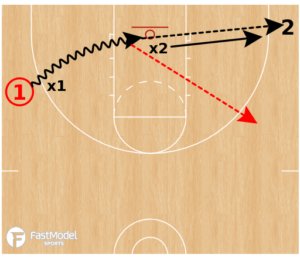
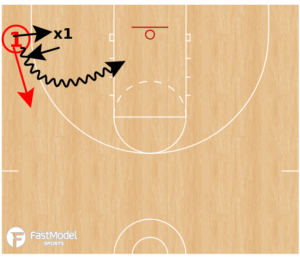
The 1 and the x1 will toss the ball back and forth as they move from the corner towards the free throw line extended area. 1 is the offensive player and will drive the ball when they choose and try to score. x1 will defend.

Rule: the offensive player must throw it to the defense at least 1 time before driving.

Areas of the floor to use:

1. Corner to free throw line extended.
2. Slot to Slot
3. Half Court stripe to the top of the key as to simulate transition.

SSG will progress to 5 v 5

Same beginning as 1 v 1.

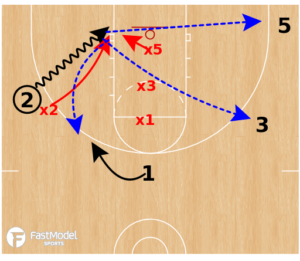
The 1 will drive the ball and look to score or pass to the 2 player.

x2 will try to deflect the pass and then take/closeout on the first pass.

Live 2 v 2.

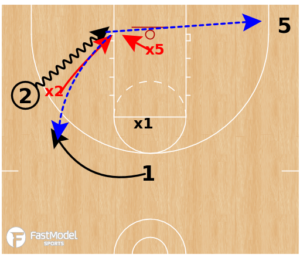
Same start as 1 v 1.

In this frame the 2 will drive the ball to score or pass to the 1 or the 5 player.

x5 will try to deflect the pass and then take/closeout on the first pass.

x1 and x2 will communicate and scramble to match up and it is 3 v 3 live.


Same setup as the pervious frame.

Red will scramble to match up and black will make quick decisions to get the best shot.


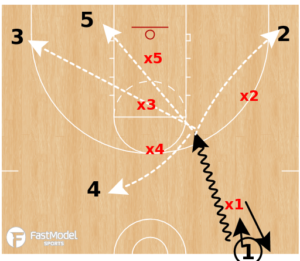
5 v 5 will start with the with the 1 player at half court. x1 will back pedal or move backwards and simulating a toss back and forth with the 1 player. The 1 will attack off the toss back that he chooses.

Setup in your offensive alignment. In this frame we are using Dribble Drive spots.

Progression:

Have all players play from all positions. As you can in season or closer to the season tailor it to your system that you run.

Mix up the defensive coverage.

  • « Go to Previous Page
  • Page 1
  • Interim pages omitted …
  • Page 43
  • Page 44
  • Page 45
  • Page 46
  • Page 47
  • Interim pages omitted …
  • Page 288
  • Go to Next Page »

Primary Sidebar

  • Twitter
  • Facebook
  • Linkedin
coachestoolbox
personaldevelopmenttoolbox
basketballplayerstoolbox
basketballtrainer
athleticperformancetoolbox
coachingbasketball

© Copyright 2026 Coaching Toolbox

Privacy Policy