• Skip to primary navigation
  • Skip to main content
  • Skip to primary sidebar

  • Basketball Plays
    • Ball Screen Sets
    • Horns Sets
    • Man to Man Post Up
    • Man to Man Isolations
    • Backdoor Plays
    • Man to Man 3 Point Shot Plays
    • 2-3 Zone Attack
    • Baseline Inbound Plays
    • Sideline Inbound Plays
    • Combination Defense Attack
  • Drills
    • Defensive Drills
    • Offensive Drills
    • Competitive Drills
    • Passing Drills
    • Rebounding Drills
    • Shooting and Scoring Drills
    • Toughness Drills
    • Transition & Conversion Drills
    • One on One Drills
  • Blueprint
  • Practice
  • Mental Toughness
  • Skill Development
  • Offense
  • Defense
  • Store

Evidence of Excellence

Evidence of Excellence

By Brian Williams on April 13, 2020

This article was written by Mike Neighbors, Head Women’s Coach at Arkansas.

Coach Neighbors previously coach at Washington and he produced this document while there.

He puts out an incredibly good newsletter several times each year.

If you would like me to forward your email address to him to be added to his newsletter, please reply to this email and let me know.

You can enlarge the view of the document by scrolling your cursor over the frame and then clicking the arrow that displays at the top right of the frame.

There is a link at the end of the frame that the document is in to be able to download the entire 24 page PDF document.

If the document does not show up for you, please refresh your page.

Loader Loading...
EAD Logo Taking too long?

Reload Reload document
| Open Open in new tab

Download [254.72 KB]

Player-Led Leadership

By Brian Williams on April 12, 2020

Dr. Cory Dobbs
The Academy for Sport Leadership

How Coaches Turn Students into Smart Leaders

Looking back on 2019 we’re going to refer to it as the year of Player-Led Leadership. Go ahead, Google it. Many major universities

(Click here to see
UCLA

UTSA

Nebraska)

have begun to identify the need to involve the student-athlete in a more holistic manner. To compete in today’s athletic arena, high performance is built around player-led leadership.

As a field researcher and facilitator of player-led leadership I am rooting for more coaches to open up to the process and practice of player-led team building.

However, often times it’s the case that player-led leadership is undermined because coaches are lacking a growth mindset in this area and lacking the skills and abilities to transform their operating system.
[thrive_leads id=’36827′]
The driving assumptions are that a player-led process will lead to a (1) collectively, (2) reflectively, and (3)relationally smarter team; that all student-athletes are capable of learning to lead; and that team leadership is grounded in a team learning together.

For the serious coach, it takes commitment to really create a dynamic player-led team. Many coaches mistakenly assume they’re new role will be taking a back seat to student-athlete leadership.

If you believe, as I do, that student-athletes are capable of much more leadership than we’ve asked for in the past, you must read Coaching for Leadership. It’s about the real work of transforming your team’s culture, the work of implementation of player-led team leadership.

New to the Second Edition of Coaching for Leadership!

We are pleased to announce a new chapter to the second edition of the best-selling Coaching for Leadership. The chapter, The Big Shift: Unlock Your Team’s Potential by Creating Player-Led Teambuilding, connects the previous edition of this book to its origin, as well as to the future of team sports.

The new chapter sets forth a practical and applicable agenda for change and improvement. The reader is introduced to seven vital elements of change; seven shifts of traditional mental models that lead to the new core principles necessary for creating a player-led team culture. Click here for more information about Coaching for Leadership

About Cory Dobbs, Ed.D.

Cory Dobbs is the founder of The Academy for Sport Leadership and a nationally recognized thought leader in the areas of leadership and team building.  Cory is an accomplished researcher of human experience. Cory engages in naturalistic inquiry seeking in-depth understanding of social phenomena within their natural setting.

A college basketball coach, Cory’s coaching background includes experience at the NCAA DII, NJCAA, and high school levels of competition.  After a decade of research and development Cory unleashed the groundbreaking Teamwork Intelligence program for student-athletics. Teamwork Intelligence illuminates the process of designing an elite team by using the 20 principles and concepts along with the 8 roles of a team player he’s uncovered while performing research.

Cory has worked with professional athletes, collegiate athletic programs, and high schools teaching leadership and team building as a part of the sports experience and education process.  As a consultant and trainer Dr. Dobbs has worked with Fortune 500 organizations such as American Express, Honeywell, and Avnet, as well as medium and small businesses. Dr. Dobbs taught leadership and organizational change at Northern Arizona University, Ohio University, and Grand Canyon University.

Villanova Shot Fake Drill

By Brian Williams on April 9, 2020

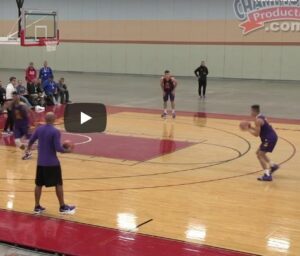
This video is with Northern Iowa Coach Ben Jacobson.

The drill is named “Villanova” because he created it for his time from watching the way that Villanova utilizes shot fakes.

You will need to be on a network that allows you to access YouTube to view the video.

Click the play arrow to view the video.

There is narration with the video, so please make sure that your sound is on.

You can find out more about the Championship Productions video that this clip is from at this link: Daily Practice Structure + 14 Drills for Any Team.

The video with Coach is available in both DVD and online format.

Click the play arrow to start the video.

Spin Elevator Man to Man Play

By Brian Williams on April 5, 2020

This man to man quick hitter came from the following pages of the FastModel Sports Plays and Drills Library:

Spin elevator – FastModel Sports.

You can also find out more about FastModel Play Diagramming software by clicking this link: FastDraw

Contributed by Zach Weir:

This is how Coach Weir described the play:

This is a good set to use if you need a 3 during the game or as an ATO.

This is also an easy set to implement when using dribble drive motion.


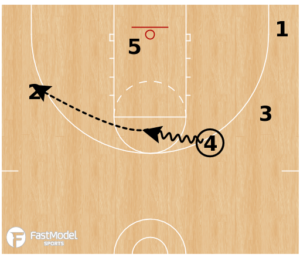
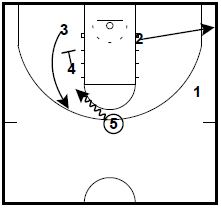
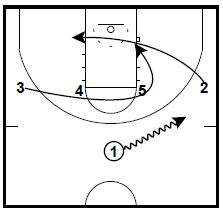
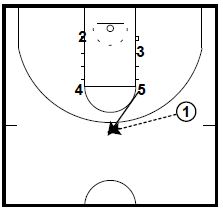
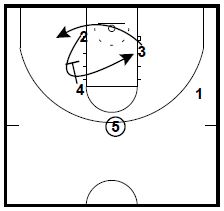
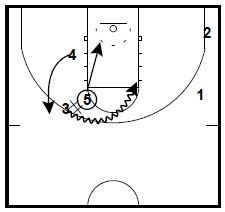
4 cuts through opposite

1 cracks the 3 point line and pitches to the 3

5 moves opposite the 4


2 cuts blurs into an elevator

3 attacks nail off the blur and kicks to the 4 lifting


4 hits 2 for the shot


Creighton Bluejays Man to Man Quick Hits

By Brian Williams on April 2, 2020

These two man to man plays are from the Basketball HoopScoop’s Creighton Bluejays Basketball Playbook.

The book was assembled by Chris Filios

It features 150 pages of information and diagrams about the Creighton philosophy, half court man to man and zone sets, baseline inbounds plays against both man to man and zone defense, and sideliine inbounds plays.

You can find out more information about the digital eBook at this link: Creighton Bluejays Man to Man Quick Hits

Or, you can purchases any four of our digital playbooks for $35 (62 titles in all–Virginia, Texas Tech, Duke, Kentucky, Brad Stevens, and many others included!)

Click this link for all choices! 4 digital playbooks for $35

Diagrams created with FastDraw

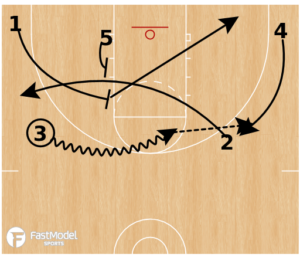
Single Tag

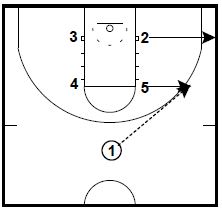
1 dribble enters to the wing.

2 cuts underneath to opposite block.

3 Iverson cuts over top and curls off 5 to the ball side block.


5 pops.

1 passes to 5.


4 pins for 2.

2 curls the screen.


4 pins for 3.

5 dribbles at 3.


5 runs a dribble hand off with 3.

4 replaces behind.


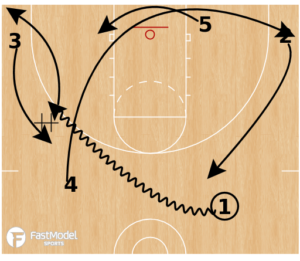
Single Tag

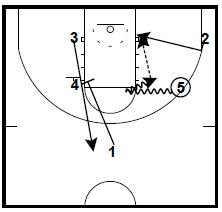
5 pops to wing.

2 pops to corner.

1 passes to 5.


5 dribble to elbow and reverses.

2 fakes up and goes backdoor.

4 and 1 set double screen for 3 to occupy the defense.


These two man to man plays are from the Basketball HoopScoop’s Creighton Bluejays Basketball Playbook.

The book was assembled by Chris Filios

It features 150 pages of information and diagrams about the Creighton philosophy, half court man to man and zone sets, baseline inbounds plays against both man to man and zone defense, and sideliine inbounds plays.

You can find out more information about the digital eBook at this link: Creighton Bluejays Man to Man Quick Hits

If you are interested in adding to your Coaching Toolbox take look at what I believe is our best offer.

CLICK HERE to select from a list of more than 70 eBooks.


Translating In-practice Repetition into In-game Statistical Performance Improvement

By Brian Williams on March 31, 2020

High-Performance Mindfulness: How to better translate in-practice repetition for in-game statistical improvement

By Jake Rauchbach –  founder of MindRight Pro® Coaching Program

Top 5 ways for players translating in-practice repetition into in-game statistical performance improvement

There are players at all levels of basketball, including the NBA, that struggle to connect the dots on how to translate their practice repetitions into actual statistical performance improvement
during the game.

In past columns, we have discussed how unconscious performance blocks can derail a player’s improvement. A refresher for some of the most commonly held subconscious barriers to performance can be found here and here.

Unconscious barriers to success can affect a player’s ability to consistently perform at optimum levels. This being said, we have all seen players that seem to be able to seamlessly migrate practice repetition over to in-game performance improvement, while other equivalently talented
players seemingly struggle to do so.

So, what is the underlying reasons for this dichotomy in player development? What’s the differentiating factor for translating practice repetition into in-game performance improvement?

The answer is mental focus.

Mental Focus is Key.
[adinserter name=”Basketball in article display ad 2 rebecca”]
The consistency with which a player remains mentally locked-in is crucial. A player’s ability to interface with his present moment awareness during their timeline for preparation (practice, individuals’ workouts, film study, and the game) directly influences how much translatable on-court performance improvement will be had by the player come game-time.

One of the main things that coaches tell players is: Come ready to play! Interpreted more literally, this means Come Focused. However, many players do not have a repeatable process for getting the most out of their preparation process.

There Are Levels to This

It is important to note that there are levels of application for High-Performance Mindfulness techniques. Just like progressions in an on-court skill-development series, a similar process is employed when teaching players how to sharpen focus to statistically improve performance.

There are foundational tools and skill-sets that players can pick up and begin to employ straightaway.

There are also leading-edge Energy Psychology – Integrated Player Development processes, specific to each player, that zero in on statistically improving specific parts of a player’s game that the player, coach, or General Manager pre-determines. This is the next level of HighPerformance Mindfulness. We will break these down at a later date.

For this column, we outline some foundational HPM tools that players can begin to employ immediately to begin to sharpen focus and influence in-game improvement upwards.

Foundational Techniques for Improving Mental Focus

Meditation

Meditation has been scientifically shown to help improve focus and attention, creative thinking, and regulation of emotions; all of which are critical elements for successfully processing through split-second reads during the game. Meditation has also been shown to decrease depression and anxiety.

There are many types of meditation practices. However, what I have seen to work best for highlevel basketball players is through employing a 15-minute meditation sessions twice a day, once in the morning, and once at night. Twenty years ago there were very few athletes who would touch a Yoga practice.

Look for Meditation to become the new Yoga, helping athletes sharpen focus and master internal peace of mind. The effects of this technique, when fed into an overall focus for on-court performance, is immense.

Affirmations

Affirmations are an unbelievable way for players to clear and reprogram their deep subconscious minds of the toxic performance blockages stemming from experience. I have found “I AM” statements to be most powerful when working with players who employ these techniques on the
court during the game.

The reason for this is that it reaffirms a new mental program, while simultaneously counteracting emotional baggage, which has the effect of sharpening mental focus. When mental focus improves, so too does overall performance.

Visualization

Visualization re-trains a player’s mind to expand the boundaries for what is deemed possible. One of the more profound experiences is observing players who manifest virtually the same play on the court that they have mentally rep’ed during visualization. We are talking about the over
the top plays that they haven’t been pulled off in months, maybe sometimes years.

Common examples of plays that high-major college and professional basketball players often visualize and then directly thereafter manifest on-court are:

1. The Pick-Six: Denying the passing lane – Creating a Stealing – Going for an uncontested finish on the other end. This play is common for players who begin to focus on improving ballpressure through visualization techniques.

2. The Big-Time Block: Rotating over to pin the ball against the glass – above the square versus an unsuspecting offender. This is a big-time energy play that happens frequently when
leveraging visualization to optimize defensive efficiency.

3. The Dunk-On: Dunking on or over someone maybe one the most energizing plays in basketball. When visualization is employed to rep this specific play, often the player capable of such finishes performs it in real-time on the court.

Generally, this is an eye-opening experience for the player. There is a level of connection made by the player between the mental rep and the on-court execution of said play that helps to reinforce the High-Performance Mindfulness training.

These types of plays give the player a discernible cause and effect experience. From implementing the mental rep, to manifesting the specific play on the court. Experiences like these help players connect the dots on how mental training positively correlates to improvement
on the court.

Breath-Work

The implementation of Breath-work deepens awareness and has been employed by different cultures around the globe for years. Foundational breathing techniques are also the building blocks for many of Martial Arts such as Qigong, Tai Chi, and Karate.

These types of techniques have been shown to help players hone focus by becoming more present, getting the athlete out of their head and into their present moment of awareness.

Improving focus this way can have the overall effect of helping to move the dial when it comesto on-court performance improvement.

Practicing Detached Observation

Observation is a key component in every technique mentioned herein. It is important to mention that it as a standalone technique.

Once players are better able to recognize that they are not their thoughts, they are generally able to make the shift in detaching from the performance blocking thoughts and emotions that have historically been holding them back.

This creates peace of mind and facilitates greater present moment poise and focus.

In Closing

Improving in-game performance comes down to consistent mental focus over the preparation timeline. Employing foundational techniques mentioned above will begin the process, helping players prioritize focus as a way to optimize performance efficiencies during the game.


If you would like to learn more from Jake check out his course:

Mindfulness for Basketball Coaches 101™

Learn High-Performance Mindfulness tools that can take your team to the next level!

What you’ll get:

  • Virtual Coaching by Elite Mental Skills Coach to the Pro’s, Jake Rauchbach
  • Pre-Game Visualization #1
  • Pre-Game Visualization #2
  • « Go to Previous Page
  • Page 1
  • Interim pages omitted …
  • Page 32
  • Page 33
  • Page 34
  • Page 35
  • Page 36
  • Interim pages omitted …
  • Page 288
  • Go to Next Page »

Primary Sidebar

  • Twitter
  • Facebook
  • Linkedin
coachestoolbox
personaldevelopmenttoolbox
basketballplayerstoolbox
basketballtrainer
athleticperformancetoolbox
coachingbasketball

© Copyright 2026 Coaching Toolbox

Privacy Policy