• Skip to primary navigation
  • Skip to main content
  • Skip to primary sidebar

  • Basketball Plays
    • Ball Screen Sets
    • Horns Sets
    • Man to Man Post Up
    • Man to Man Isolations
    • Backdoor Plays
    • Man to Man 3 Point Shot Plays
    • 2-3 Zone Attack
    • Baseline Inbound Plays
    • Sideline Inbound Plays
    • Combination Defense Attack
  • Drills
    • Defensive Drills
    • Offensive Drills
    • Competitive Drills
    • Passing Drills
    • Rebounding Drills
    • Shooting and Scoring Drills
    • Toughness Drills
    • Transition & Conversion Drills
    • One on One Drills
  • Blueprint
  • Practice
  • Mental Toughness
  • Skill Development
  • Offense
  • Defense
  • Store

Help and Recover with Shooting Skill Development Drill

Help and Recover with Shooting Skill Development Drill

By Brian Williams on June 4, 2020

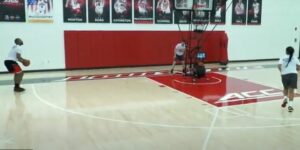
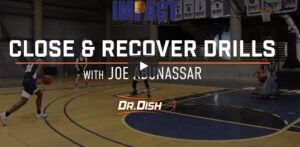
This skill development drill is provided by Dr. Dish Basketball.

The drill is coached by Joe Abunassar of Impact Basketball,

You can and should modify any of the drills to make them fit your needs or to add variety to your skill development work.

Please make sure your sound is on to see the video.

This drill is hosted on YouTube, so you will need to be on a server that allows you to access YouTube to see the drill.

Click the play arrow so see the drill.
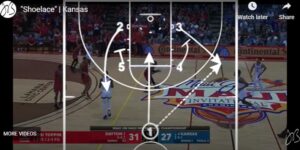
Kansas Shoelace Backdoor

By Brian Williams on June 3, 2020

These video was edited by Coach Justin Brandt.

The other resources he has to share can be found at CoachJB.Weebly.com or you can follow his Instagram at @CoachJustinBrandt for daily posts.

You will need to be on a network that allows you to access YouTube to view the video.

Click the play arrow to view the video.

There is narration with the video, so please make sure that your sound is on.

You don’t have to run the play exactly as presented, but hopefully this gives you an idea for a way to get a slip and a layup when you need a score.

Score vs. Closeouts: Competitive One on One Drill

By Brian Williams on June 2, 2020

This individual skill development drill came from the FastModel Sports Plays and Drills Library.

It was posted by Tony Miller.

Tony is the Head Men’s Coach at Bob Jones University.


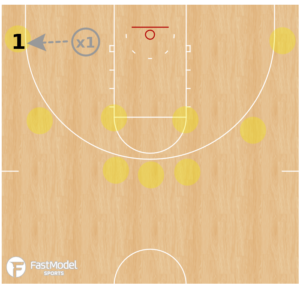
x1 begins with the ball.

x1 tosses the ball to 1 and closes out to 1.

1 reads x1’s closeout and either shoots, drives right, or drives left.

“Best of 9” scoring (1 scoring opportunity originating at each of the yellow spots).

Are You Really Leading?

By Brian Williams on May 21, 2020

Slow Down and Take a Look at How You are Leading.

Dr. Cory Dobbs
The Academy for Sport Leadership

The primary purpose of leadership is to create more leaders, not more followers.  Pause for a moment, think deeply about this declarative statement.  More leaders.

Now…

How are you doing as a leader? The answer is how are the student-athletes you lead doing? Do they learn?  Do they lead? Do they manage conflict? Do they change—grow and improve? Do you really create more leaders? When reflecting on how you are doing as a leader, find out how the student-athletes you lead are doing.

In their best-selling book, _The Leadership Challenge_, authors James Kouzes and Barry Posner set forth a fundamental ingredient of all leadership endeavors—that of modeling the way. The authors contend that “Your value as a leader is determined not only by your guiding beliefs but also by your ability to act on them….To be a leader, you have to Model the Way for others by demonstrating intense commitment to your beliefs with each and every action.”
[thrive_leads id=’36827′]
Team leadership is not an easy role for many young student-athletes.  Peer leadership is often an uncomfortable challenge.  The desire to be liked has been the downfall of many adult leaders.  So don’t gloss over the fact that a student-athlete will often be driven by their need to be liked by teammates.  Expect the first hurdle for your emerging team leaders to be overcoming the need to be liked.  Young leaders will also have to overcome emotional issues such as the internal conflict that might occur because of their desire for acceptance. As a leader they will at times need to take actions that temporarily separate them from their teammates—the followers. This is but one example of some of the inherent difficulties in peer leadership.

As a coach, you present a compelling model that young athletes will intensely observe.  They are constantly seeking cues on how they should lead (wanting to please you) and informing them how to act in a given situation. Team leaders will imitate many of your behaviors and attitudes. They will, for example, watch what you do and then imitate or adapt what you do. The less experienced the team leader the more likely they’ll study you closely to help them figure out “how” you want them to lead. When faced with inconsistencies between what you say and what you do, the young and developing team leader will tend to give greater reliance on what you do.

Your status as a model increases the necessity of having a healthy interpersonal relationship with all your players, but the relationship with team leaders will generally be a little more involved as you assume the role of leadership mentor.  Mentors are role models. As a mentor your impact will come from more than just what you tell your team leaders, they will assimilate and emulate many of your behavioral traits and copy many of your values and attitudes.

A healthy relationship and a positive approach to teaching leadership will shape your team leaders. How you model leadership and mentor leaders will go a long way in helping a young and emerging leader understand leaders and leadership.

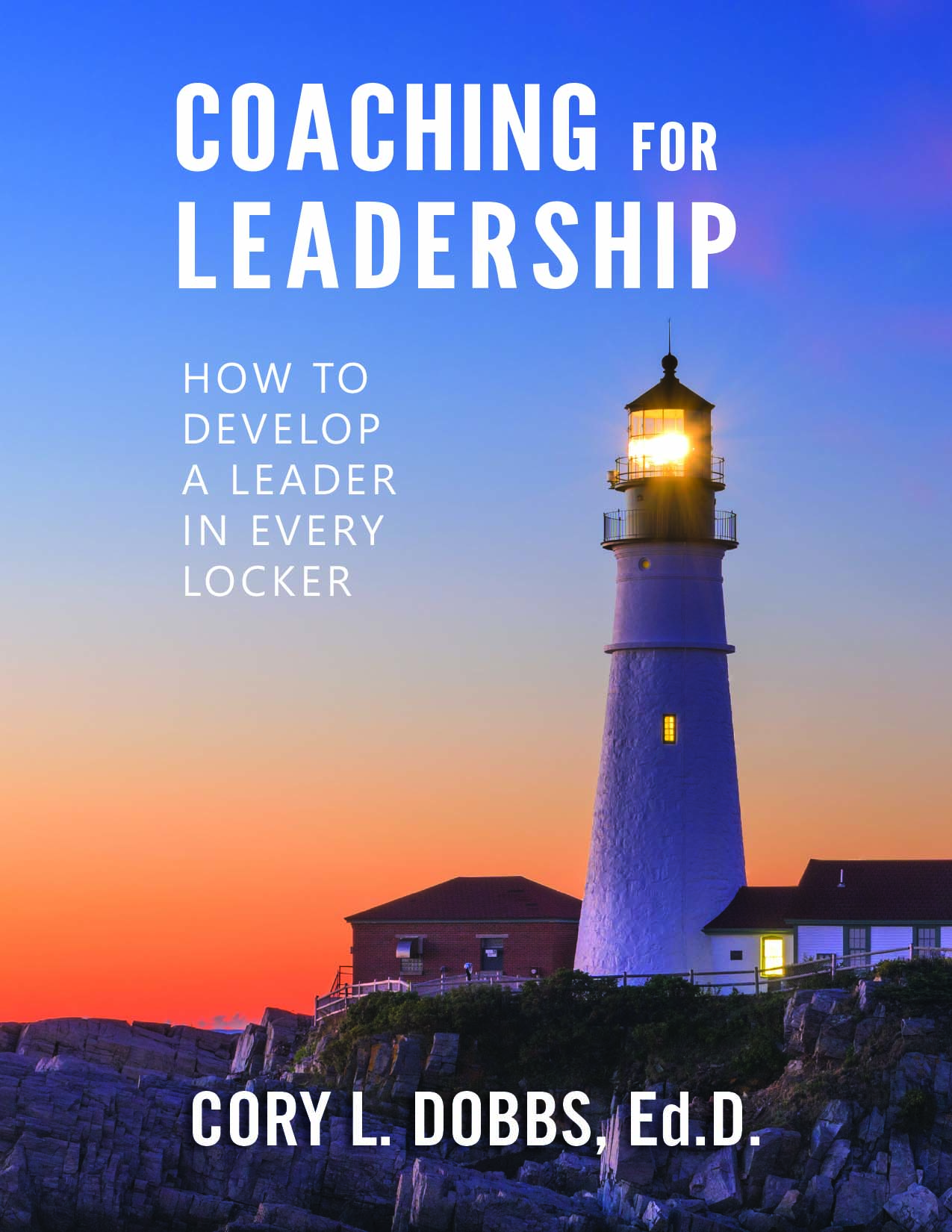
New to the Second Edition of Coaching for Leadership!

We are pleased to announce a new chapter to the second edition of the best-selling Coaching for Leadership. The chapter, The Big Shift: Unlock Your Team’s Potential by Creating Player-Led Teambuilding, connects the previous edition of this book to its origin, as well as to the future of team sports.

The new chapter sets forth a practical and applicable agenda for change and improvement. The reader is introduced to seven vital elements of change; seven shifts of traditional mental models that lead to the new core principles necessary for creating a player-led team culture. Click here for more information about Coaching for Leadership

About Cory Dobbs, Ed.D.

Cory Dobbs is the founder of The Academy for Sport Leadership and a nationally recognized thought leader in the areas of leadership and team building.  Cory is an accomplished researcher of human experience. Cory engages in naturalistic inquiry seeking in-depth understanding of social phenomena within their natural setting.

A college basketball coach, Cory’s coaching background includes experience at the NCAA DII, NJCAA, and high school levels of competition.  After a decade of research and development Cory unleashed the groundbreaking Teamwork Intelligence program for student-athletics. Teamwork Intelligence illuminates the process of designing an elite team by using the 20 principles and concepts along with the 8 roles of a team player he’s uncovered while performing research.

Cory has worked with professional athletes, collegiate athletic programs, and high schools teaching leadership and team building as a part of the sports experience and education process.  As a consultant and trainer Dr. Dobbs has worked with Fortune 500 organizations such as American Express, Honeywell, and Avnet, as well as medium and small businesses. Dr. Dobbs taught leadership and organizational change at Northern Arizona University, Ohio University, and Grand Canyon University.

Double Man to Man Play

By Brian Williams on May 17, 2020

This man to man play came from the FastModel Sports Plays and Drills Library.

It was posted by Zachary Weir, South Grand Prairie HS (Texas).

Coach Weir’s Twitter account is @WEIRbasketball.

Double – FastModel Sports.

You can also find out more about FastModel Play Diagramming software by clicking this link: FastDraw

Comments from Coach Weir:

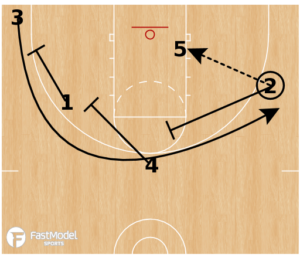
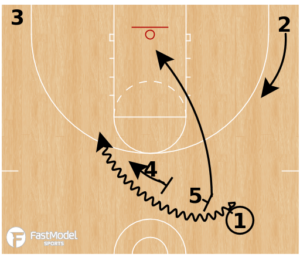
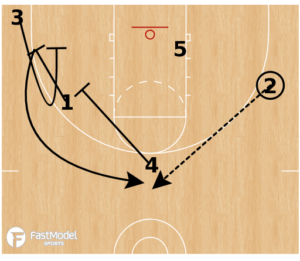
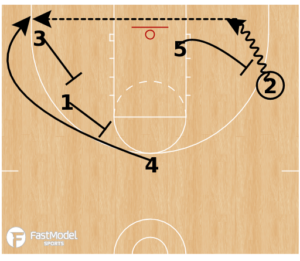
Double” is a double ball screen set, that is very difficult to guard, with multiple options to flow into various different actions depending on the personnel of your team.


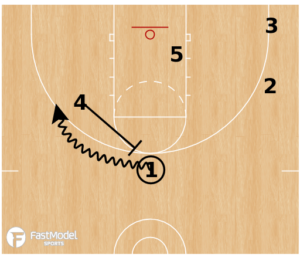
4 and 5 set a double ball screen for the 1


1 can come off the double screen and look to it the 4 popping.

This is a great option if your 4 is a play maker or shooter

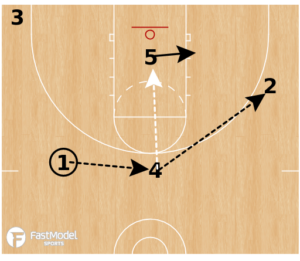
4/5 Hi-Lo

5 posting ball side


After 4 reverses to the 2

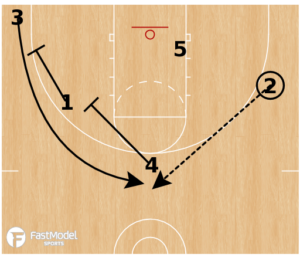
4 and 1 will set a double stagger for the 3


2 post entry to the 5

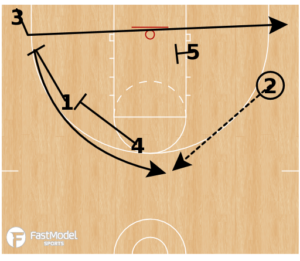
2 will set the post split screen for the 3

Option for the 4 to slip to the basket


If x3 overplays the stagger 3 has the option to cut to the opposite corner

1 will then receive a single screen from the 4

5 can post or screen in for the 3
 

If 1 does not shoot 4 off of the pin down

4 can set a step up screen

Many options here:

4 can Pop

4 and 5 can roll replace

4 can ball screen and single screen for 2 for shot


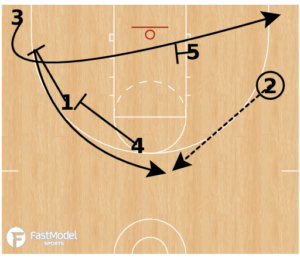
If x3 trails 3 has the option to curl off of the 1 screen

1 will then receive a single screen from the 4

5 can post or screen in for the 3


“Hook” Option

3 will curl into the first screen of the double stagger for 1

4 will set the second screen of the double stagger


3 and 1 will set a double hammer screen for the 4

5 will set a step up screen for 2


7 in the Pot Shooting Drill

By Brian Williams on May 11, 2020

This shooting drill is provided by Dr. Dish Basketball.

It is a drill used by the Louisville women’s program and is narrated by Associate Coach Sam Purcell.

You can and should modify any of the drills to make them fit your needs or to add variety to your skill development work.

Please make sure your sound is on to see the video.

This drill is hosted on You Tube, so you will need to be on a server that allows you to access You Tube to see the drill.

Click the play arrow so see the drill.
  • « Go to Previous Page
  • Page 1
  • Interim pages omitted …
  • Page 29
  • Page 30
  • Page 31
  • Page 32
  • Page 33
  • Interim pages omitted …
  • Page 288
  • Go to Next Page »

Primary Sidebar

  • Twitter
  • Facebook
  • Linkedin
coachestoolbox
personaldevelopmenttoolbox
basketballplayerstoolbox
basketballtrainer
athleticperformancetoolbox
coachingbasketball

© Copyright 2026 Coaching Toolbox

Privacy Policy