• Skip to primary navigation
  • Skip to main content
  • Skip to primary sidebar

  • Basketball Plays
    • Ball Screen Sets
    • Horns Sets
    • Man to Man Post Up
    • Man to Man Isolations
    • Backdoor Plays
    • Man to Man 3 Point Shot Plays
    • 2-3 Zone Attack
    • Baseline Inbound Plays
    • Sideline Inbound Plays
    • Combination Defense Attack
  • Drills
    • Defensive Drills
    • Offensive Drills
    • Competitive Drills
    • Passing Drills
    • Rebounding Drills
    • Shooting and Scoring Drills
    • Toughness Drills
    • Transition & Conversion Drills
    • One on One Drills
  • Blueprint
  • Practice
  • Mental Toughness
  • Skill Development
  • Offense
  • Defense
  • Store

Basketball Plays Illini

Basketball Plays Illini

By Brian Williams on January 15, 2010

This play was contributed by Creighton Burns.

He has made coaching stops in four states including Georgia, Indiana, Kentucky, and Michigan at both the high school and college levels.

Coach Burns has coached both Men and Women.


Creighton has received numerous coaching honors including Indiana Basketball Coaches Association Coach of the Year in 1988.
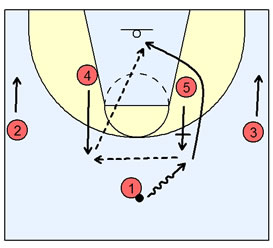


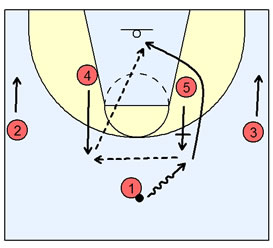
#1 enters the ball to #4, who steps outside the 3-point line to receive the ball.

#5 back screens for #1, and #1 runs a back cut to the rim.

If #1 is wide open, #4 should get him the ball.
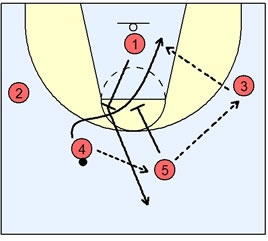
 

If #1 is not open, #4 will pass to #5, who steps to the ball after setting his screen.

#5 swings the ball on to #3.

On the pass from #5 to #3, #1 will back screen for #4 and #4 will run a shuffle cut, over or, under the screen.

If #4 is open, he should get the ball from #3.

After making the pass to #3, #5 will screen for the screener, #1.

#1 will fill the point.
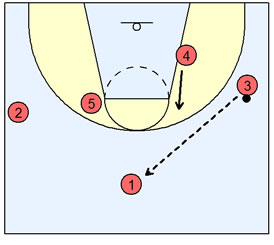
If #4 is not open, #3 will make the pass to #1.

On the wing to point pass, the low post will flash back up to the high side post.

The offense is now reloaded and ready to be executed once again.
Thoughts from Rick Carlisle

By Brian Williams on December 29, 2009

These are some ideas from Rick Carlisle that he presented at a Florida basketball coaching clinic in August 2009.

When you make a mistake be honest with the players.  Coach Carlisle felt that when he started with the Mavericks he made an error in judgment and installed an offense that was not conducive to their talents.  He told them that they were either going to have to stick with it or make adjustments, but that either road would be tough for them.

At some point, players will complain about their roles.  Carlisle uses laminated cards.  For an example, here is what Jermaine O’Neal’s said: “Leader, scorer, rebounder, defender, game closer.”

Some ideas while you are watching film:  To keep players on their toes, ask them questions.  Make players accountable to know their game assignments.  Break films into three segments 1) How bad we were 2) What we did well 3) How we want to do it–if you don’t have a lot of your team for this segment–substitute another team.   Many times you need to be more positive than negative.  Show them how close they are to winning.  Show them mistakes that change the outcomes of games.

On losing:  You find out more about your team (and yourself) when you are in the middle of a losing streak.  Losing gives you a sense of urgency to make changes.  At the beginning of the season, talk about winning and losing and how they both can cause problems so that you will be prepared for either as the season unfolds.

On stretching:  When teams do it well, it is the springboard to a great practice.

On communication:  Tape yourself talking to your team.  You probably won’t like what you see.  Pause mid sentence when you speak–  less is more.  Pausing keeps the audience engaged, generates anticipation, and helps you to become a clear thinker.

The Coaching Toolbox has hundreds of resources for basketball coaching including basketball practice, basketball plays, basketball drills, basketball quotes, basketball workouts, basketball poems, and more!

Basketball Special Teams Concepts

By Brian Williams on December 18, 2009

These are some notes I wanted to share from an article written by Coach Don Hawkins of Nashville (IL) High School.  The article was sent to me by Coach Ken Sartini.  The red text are my additions to what Coach Hawkins presents.

Basketball is situation specific and how a teams handles those situations often makes the difference between winning and losing.

Coach Hawkins uses a “special teams” concept much like a football team and looks to find the players who are best for each situation.

He finds that it has been a confidence builder for his substitutes because he feel that he can find situations in which most of them can be successful.

He allocates time in each weekly practice for offense, defense, and special teams.

His Specialty areas are:

1)  Sideline inbounds (“pecking order” of players to inbound the ball, plays for end of game or period, defending sideline inbounds)

2)  Underneath inbounds (“pecking order” of players to inbound the ball, plays for end of game or period, defending sideline inbounds)

3)  Jump Ball (hold, rotate, defend) This is an area that makes a difference to start an overtime

4)  Delay (purpose, pattern, defense)

5)  1-10 seconds left in game (full court, back court, half court, front court, baseline–all of these offensively and defensively

6)  End of period both offense and defense

7)  Free Throws (ahead and behind by one, two, and three)

8)  Time Situations (60 seconds, 90 seconds, two minutes)

Early in the season he covers when and what they will do in each situation and what the roles needed for success in each one are.

Weekly practice breakdown:

Monday:  (10 minutes of practice time) End of game situations ahead and behind by one, two, and three points.   Involves as many players as he can.  After two or three weeks will settle on the best players in each situation and then work those players as units.

Tuesday (10 minutes of practice time) Two minute situations.  ahead and behind by different point spreads.  If the first unit that starts out ahead and loses, they must repeat the process.  I would add to this to  make sure to define the number of fouls for both teams and individuals, possession arrow, and time outs remaining.  This is a good time to practice how to foul by taking the ball away and possibly being called for a foul to stop the clock as opposed to getting called for an intentional foul.  You can also practice fouls to give in this situation.

Wednesday (10 minutes) End of period.  Delay game to get the last shot of the period and transition into the last shot.  You can execute this at the end of a game without having to call timeout if it is practiced. Again, work both sides of the ball. I like to start our play at 12 seconds and shoot at 5 seconds in the first three quarters. I like to shoot with 3 seconds at the end of the game and have found that if you expect that to happen and practice it, players will execute it in a game.

Thursday (15 minutes of practice time) Specialty review.  Reviews all of his specialty items and emphasizes the ones he feels will be significant in their next game.

Coach Hawkins usually uses 8 to 10 players each game and looks for where each one can be successful.  The special teams approach encourages player participation.   Having practiced the areas that come up in a game he can tell his players that “we have a plan and have been here before,” which is a confidence builder.

The Coaching Toolbox has hundreds of resources for basketball coaching including basketball practice, basketball plays, basketball drills, basketball quotes, basketball workouts, basketball poems, and more!

Basketball Defensive Conversion Concepts

By Brian Williams on December 3, 2009

Here are some ideas and drills that I have picked up from various sources and used to build our conversion defense.

I have always referred to going from offense to defense as conversion, and going from defense to offense as transition for the sake of clarity in communicating with our players.

Del Harris taught that half court defense begins full court.  We have not been a pressing program, but we do place a major emphasis on full court defensive conversion each practice.  Our goal is to force the opponent to play against our set pack line style defense each possession by executing our half court offense and full court conversion defense every possession of every practice and every game.

Depending on the level you coach, you will be converting to defense 40 – 60 times per game on average, so it is essential to practice it regularly.

We practice converting off of made and missed shots, off turnovers, and off of made and missed free throws. We use the “change” drill to simulate a turnover. (Coach yells change, offense drops balls and converts to defense, team on defense picks up the ball as if transitioning after a steal.)

Conversion defense begins when we shoot the ball.  We send our three best rebounders to the block, block, and front of the rim when we shoot.  The remaining two players go to the half court line (we call him our fullback) and to the top of the key (we call him our halfback).  Those are Don Meyer terms I borrowed.  The fullback is responsible for sprinting to the lane to guard the basket.   The halfback is responsible for slowing the ball if it is being dribbled.  I use the term slow the ball because if he attempts to make a stand and stop the ball out on the floor, he is likely to get beat and then we have only the fullback to stop their break.  If the halfback slows the dribble, that gives our three offensive rebounders time to sprint back and become a part of our conversion defense.  The rule for those 3 rebounders (Coach Don Meyer called them “tailbacks”) is that they must be past mid court in two and a half seconds after the shot hits the rim.

If the pass is made to the wing, the hoop defender must read the situation: is there another offensive player coming from the weak side (if so you will have to delay a count until the ball defender can replace you) or is it a 2-on-2 situation (in this case the hoop defender will begin his/her closeout to the wing as the ball defender now replaces the hoop defender).

When we substitute we make sure to communicate our halfback, fullback, and offensive rebounder roles as well as the man we are guarding between the player going in the game and the player coming out of the game.

One of my points of emphasis for our offense is that we must be able to defend the shots we take and the turnovers we make.  That means to me that we need to take shots that our teammates are expecting us to take so they will be ready to rebound.  Jay Bilas says that a bad shot is the first pass in your opponent’s fast break.  I think that is a great teaching phrase on the value of shot selection.

It is also a major point of emphasis for us to not make risky passes that have a 50/50 chance of being caught by us.  We never want to throw the ball away when we are making a pass going away from our basket and toward the opponents.  That just gives them a head start on their break and puts us in a position of chasing from behind which is no defense.r

Here are some of the special rules we use from time to time if our second team has a hard time pushing our first team in practice:

When we are scrimmaging, the second team does not have to take the ball out of bounds after a basket, they just take it out of the net and play it to force our first team to convert quickly.  We also run a play until the whistle practice, so if the JV travels, throws the ball out of bounds, etc.. we don’t blow the whistle, we just keep playing to work on our conversion.

When preparing for an upcoming opponent with a very good fast break, we place two JV players at half court–one of them on each sideline as we are running our half court offense.  When the varsity turns the ball over or the defense gets a rebound, those players at half court take off toward the opposite end (the basket we are defending) in order to force our conversion defense to play at a quicker pace.  If that is not enough to push our first team, we move the half court players to the free throw line extended at the opposite end or even to the baseline corners at the opposite end.

One drill that I really like is to play at a 4 on 5 disadvantage in a transition drill.  We have always played 4 on 5 in the half court, but playing it in conversion is a great way to improve your conversion through the disadvantage principle as well.  Put 5 second team players on the baseline, put 15 seconds on the clock, and have the first team run your offense 5/0.  When the shot is taken, the offense should go to the rebound/conversion defense spots described above.  Have the offensive rebounders put back any missed shot.

When the ball goes through the basket, the 15 seconds starts on the clock and the second team (who are on the baseline) take the ball out of the net.  The coach calls the name of one of the first team players.  That player steps off the court and is no longer in the drill.  The 5 offensive players then push the ball up against the 4 defenders as the clock counts down from 15 seconds.  Having a numbers disadvantage forces better communication among the conversion defenders.  The defense wins the possession if they can force a turnover or keep the second team from taking a shot that hits the rim before the 15 seconds run out.  If the offense does shoot an airball, the defense must get the rebound to win the possession.  Even if the rebound takes place after the horn goes off at the end of the 15 seconds–we always play until the whistle, not the horn.  The offense wins the possession if they can hit the rim with a shot in the 15 seconds.  You can play to 3 or 5 or however many possession wins to win the drill.  The losers run at the end of the drill.

convert

Click the image or here: Defensive Conversion Drill for a video of a very simple, but very good conversion drill.  You will be able to see a video on the Championship Productions website.  You do not have to purchase anything to see the video.


\

Building the Villanova Defense

By Brian Williams on November 12, 2009

One more item from the e-mail sent out by Eric Musselman

BUILDING THE VILLANOVA DEFENSE

Jay Wright

Starts with basic man principles of ball-you-man.

Win or lose – make sure you played “your way.” No one ever likes to lose, but when you watch game film, you always want to see that you played “your way,” win or lose.

The trapping and switching nature of their defense is based on “Calculated Risk.” They don’t want to miss an opportunity to “Blitz and Step-Up.”

Situations where Calculated Risks are appropriate for Blitzing include: 1) anytime the ball is dribbled toward you as a defender. 2) Your man brings you to the ball. 3) The ball is dribbled to the baseline setting up a trap from behind.

They want to Blitz all ball screens or dribble hand-offs when defenders react to the Calculated Risk situations. Teaching point is that the trappers should never foul or get steals. Trappers are deflectors.

When a 2-man game occurs, the other three players “load” to the 2-man game.

Man guarding the screener calls the “Blitz” or “Switch.” If you are guarding the ball-handler, always assume “Blitz” and he must step over the top to trap, or to be put in a ball-you-man position on the roll man if a switch occurs. If a big switches on to a small, the other three defenders should “load to the iso.”

Never want to switch for convenience, would always prefer to “Blitz” if they can.

These rules are all applicable in the scoring area, approximately three feet beyond the three-line and in.

Coach Del Harris commented that it is an effective technique to teach someone going over a ball screen to do so by crowding the man with the ball and then throwing his leg and arm over the top in one motion.

The two videos below came from the Jay Wright: 1-2-2 and 1-1-2-1 Three-Quarter Court Pressure Defense. You can click the link for more information about the DVD.

Here is a short video of some of the concepts of their 2-3 Zone Defense.

Click the play arrow to start the You Tube video. Please make sure that your sound is on.

Click the play arrow to start the You Tube video. Please make sure that your sound is on.

VILLANOVA ATTITUDE CLUB AND SPECIAL SITUATIONS:

Attitude Club is a way to reward players who are doing the critical things that they put a premium on. A good play per minute ratio is .8 or above. Categories include: pass to the assist (hockey concept of 2 assists), screen assist, loose ball retrieval, paint pass, o-board, tap-back on FT, quick outlet, paint catches, deflections, shot contest to change shot.

They like to practice Base OB, Side OB, Endline OB, with specific situations based on clock ( 0-3 seconds, 4-7 seconds). Can run their regular stuff in 8 seconds or more.

The Coaching Toolbox has hundreds of resources for basketball coaching including basketball practice, basketball plays, basketball drills, basketball quotes, basketball workouts, basketball poems, and more!

Steve Nash Advice for Point Guards

By Brian Williams on November 6, 2009

Words of wisdom for point guards (presented by Steve Nash at the Nike Point Guard Academy)

“You should always want your coach to be critical.  It gives you an opportunity to learn and to overcome adversity.”

“You maximize your potential by being humble develop a work ethic, strive to be a good person, and to be the best teammate you can be.”

“Use your scoring ability to be a better passer, and your passing skills to become a better scorer.”

“You can’t be a point guard who gets into the lane and always passes. Capitalize on the real estate you have gained.”

“Point Guard must be able to pass with both hands equally off the dribble.”

‘”I am always thinking how can I get myself  better.”

“On the fast break, after 2 or 3 hard dribbles you should see the whole floor and know where all your teammates are.”

These ideas from Steve Nash were sent to me by Coach Eric Musselman

The video below was contributed by Mason Waters. Mason is a college student and aspiring basketball coach.

The video is 11 minutes long. I know that most guards will not be able to make all of the moves, but I hope you can find an idea or two that will help your guards play better.

Please make sure that your sound is on.

  • « Go to Previous Page
  • Page 1
  • Interim pages omitted …
  • Page 277
  • Page 278
  • Page 279
  • Page 280
  • Page 281
  • Interim pages omitted …
  • Page 288
  • Go to Next Page »

Primary Sidebar

  • Twitter
  • Facebook
  • Linkedin
coachestoolbox
personaldevelopmenttoolbox
basketballplayerstoolbox
basketballtrainer
athleticperformancetoolbox
coachingbasketball

© Copyright 2026 Coaching Toolbox

Privacy Policy