• Skip to primary navigation
  • Skip to main content
  • Skip to primary sidebar

  • Basketball Plays
    • Ball Screen Sets
    • Horns Sets
    • Man to Man Post Up
    • Man to Man Isolations
    • Backdoor Plays
    • Man to Man 3 Point Shot Plays
    • 2-3 Zone Attack
    • Baseline Inbound Plays
    • Sideline Inbound Plays
    • Combination Defense Attack
  • Drills
    • Defensive Drills
    • Offensive Drills
    • Competitive Drills
    • Passing Drills
    • Rebounding Drills
    • Shooting and Scoring Drills
    • Toughness Drills
    • Transition & Conversion Drills
    • One on One Drills
  • Blueprint
  • Practice
  • Mental Toughness
  • Skill Development
  • Offense
  • Defense
  • Store

Basketball Drills Full Court Shooting

Basketball Drills Full Court Shooting

By Brian Williams on October 17, 2012

This shooting along with conditioning drill was posted on the FastModel Sports Basketball Plays and Drills Library.

You can also find out more about FastModel Play Diagramming software by clicking this link: FastDraw

5 Minute Full Court Shooting

This drill was contributed by Wes Kosel, assistant coach for men’s basketball at Colorado College.

This is what he said about the drill:

This is another great drill to get your players running the length of the floor and shooting a bunch of shots at the beginning of practice.

Editor’s Note: You could also use it as a competition/conditioner at the end of practice.
 

5-minute-full-court-shooting-drill1


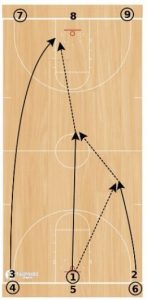
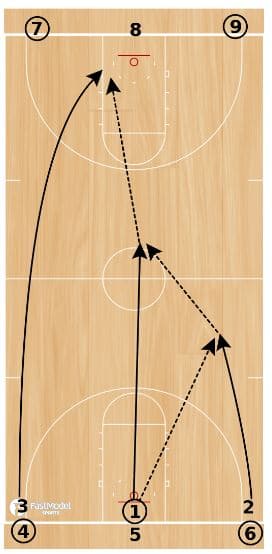
Players 1, 2, and 3 start the drill. Players should not dribble during the drill.

Player 1 passes to 2 running up the floor. 1 and 3 moves up the floor as well. 2 passes back to 1 who passes to 3 for a lay-up.

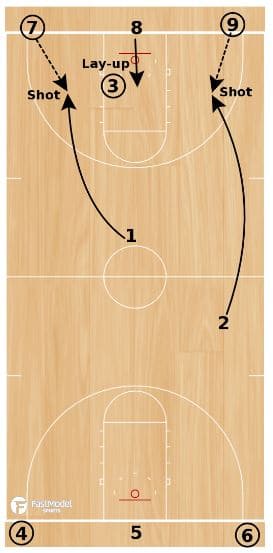
1 moves behind 3 and receives a pass from 7 for a shot. 2 receives a pass from 9 for a shot.


5-minute-full-court-shooting-drill2


Players 1 and 3 rebound their shot and fill the lines left vacant by 7 and 9.

8 takes the ball out of the net and picks a side to pass to first.


5-minute-full-court-shooting-drill3


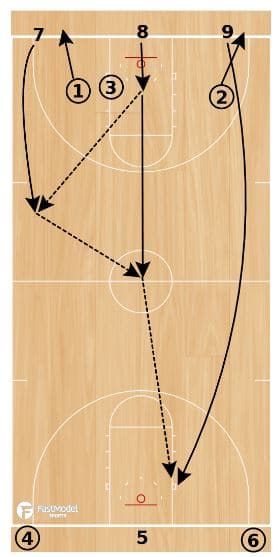
8 passes to 7. 7 passes back to 8 running up the floor.

8 then passes to 9 for a lay-up.


5-minute-full-court-shooting-drill4


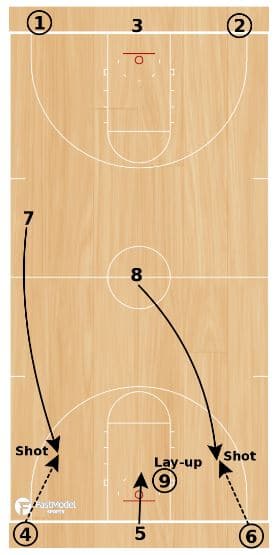
4 passes to 7.

6 passes to 8.

7 and 8 then take a shot, and the drill continues with 4, 5, and 6 running up the floor.


Basketball Coaching Special Situations Checklist

By Brian Williams on October 11, 2012

I posted a chart to use in planning your special situations in practice.

Today, I have a checklist of items that I cover every year.

You can Click here to: Download the chart as a word document.

Click here to: Download the chart as a pdf.

The planning sheet and checklist are a part of my 130 Situations eBook.

I will be providing a sample of 12 ideas from the book in that email.

This is my checklist that I use each season.It is a part of my 130 Situations ebook that I released on October 12, 2012. Click this link to read a sample of the ebook.

Philosophy

  1. Do I want to save my timeouts for the end of the game?
  2. How long do I keep a player on the bench with foul trouble?
  3. What are the tendencies of our opponents?
  4. How do I emphasize the importance of every possession and every situation?
  5. Practice situations at the end of every practice.
  6. End of game confidence comes from success and in practice.
  7. Planning ahead for special situations and practicing them allows you to think more clearly and in more detail
  8. No one can plan for and practice every scenario—but don’t let that keep you from planning for and practicing all of the situations that you can
  9. Spend some practice time experimenting with new ideas and plays for special situations
  10. Make every situation that you practice as game-like as possible.
  11. Have an overall season plan
  12. Use special rules during your special situations in practice so that your second team can compete with your first
  13. Some of our situations are Automatic Situations (always played a certain way without a coach calling it)
  14. Coach’s call situations (only executed when the coach calls for it)
  15. When do you remove a player in foul trouble in the first half ?
  16. Will you put a bad free throw shooter at the line at the end of the first half ?
  17. When will you begin to hold the ball for the last shot if the game is tied?
  18. When will you take the last shot of a tie game?
  19. When will you put the ball in the deep freeze with a lead?
  20. Do you continue to “play to win” even if the game is over for practice?
  21. Do you switch defenses to protect a lead?
  22. When do we start catch up mod?
  23. When to put a player back in with 4 fouls

Situations to cover and to practice

  1. When to and when not to call timeout to save a possession
  2. Jump ball
  3. Timeout procedure
  4. Saving a loose ball
  5. Defending a 1-4 low
  6. Shortening the game when necessary
  7. Regular Side, Under, and Full Court Inbounds
  8. Game Winner Side, Under, and Full Court Inbounds
  9. Inbound ball in dead corners. Full court and Half court
  10. Playing against combination defenses
  11. Tip outs on free throws and field goals
  12. 2 on 1 situations
  13. Who is your best technical free throw shooter?
  14. Throwing the long lead pass to the old free throw line circle
  15. Inbounds plays with your backup inbounder
  16. Defending under out
  17. Playing against a great shooter
  18. Rebounding a defensive Free Throw
  19. Break away layups
  20. Converting to defense off a missed free throws
  21. Yell “Clock to signal short time at the end of a quarer, not “Time”
  22. Force the ball to the sideline in defensive conversion
  23. Take the last shot of each quarter. Plays vs. man to ma and zon
  24. Throw the ball long inside our arc if the opponent scores at the end of quarters 1, 2, or 3
  25. Do not try to beat the clock with a last second shot
  26. Timeout when we score with the clock running in the last two minutes of a game where we are behind.
  27. End of the Game Communication.
  28. Calling timeout with possession in Doubt
  29. Calling Timeout the Right Way
  30. Milk a Minute
  31. Jump ball to start overtime
  32. Jump ball play
  33. Player safety leaving the court
  34. Miss a free throw on purpose with a lead.
  35. Miss a free throw on purpose needing to score.
  36. Full court game winner no timeouts
  37. Nothing but a layup or free throws = “4!’
  38. Over the back on a free throw that your team misses
  39. Get the ball in full court at the end against a man to man press.
  40. Throw or dribble to half court and call timeout
  41. Inbounding ball with no timeouts.
  42. Gain possession of the ball in last 5 seconds on other end of court
  43. “Hands” team—5 ballhandlers and ft shooters in together
  44. Reminder to inbounder spot or move
  45. End of game winner set play vs. man different from what you use during the course of the game
  46. End of game winner set play vs. zone different from what you use during the course of the game
  47. Unintentional Intentional Foul
  48. Put your best defender on a different player if you know they are going to run a set play
  49. Don’t foul
  50. Trap a Ball Screen to prevent a 3
  51. Guarding a dead 3 point shooter after an offensive rebound with a 2 point lead
  52. Put a man on the inbounder or not at the end of the game when the other team has to throw a full court pass

Time and score situations to cover and to practice

  1. Practice with and without timeouts remaining
  2. Possession arrow to first team
  3. Fouls to give ahead
  4. Fouls to give when you are behind
  5. Playing Through Bad Calls
  6. Whether you are or are not in the bonus yourself
  7. Best player in foul trouble
  8. Best player not available due to injury
  9. Playing through a bad play—personal and teammate
  10. 30 seconds to go in a quarter other than the 4th
  11. Down 4, your ball at half court, 30 seconds to go, clock stopped
  12. Up 1, opponent scores to take the lead. 10 seconds, clock running
  13. Underneath your basket inbounding. down 2, 5 seconds left
  14. Underneath your basket inbounding. down 2, 2 seconds left
  15. Sideline Inbounds from half court, trailing by 2 with 15 seconds to go
  16. Sideline Inbounds from half court, trailing by 2 with 3 seconds to go
  17. Down 2 Full length inbounds (94 feet) 3 seconds to go, clock stopped, no timeouts
  18. Down 2 Full length inbounds (94 feet) 3 seconds to go, clock stopped, one timeout
  19. Up 2 and the ball 1:00 minute to go
  20. Tied with ball 1:00 to go
  21. Down 10 3 minutes to go with the ball
  22. Down 5 1 minute to go with the ball
  23. Down 3, you shooting two free throws, 3 seconds, clock stopped
  24. Let the other team score
  25. Defending the last shot of a tie game
  26. Up 1 inbounding ball no timeouts
  27. Other team miss a ft on purpose
  28. Up 3 other team ball under their basket 2 seconds to go
  29. Your ball going full court up 1 5 seconds to go opponent is pressing—need to get the ball inbounds.
  30. Converting to defense when your player misses a free throw where the lead is 1 or 2 with 10 seconds to go

This is my checklist that I use each season.It is a part of my 130 Situations eBook. Click this link to read a sample of the ebook.

Basketball Coaching Special Situations

By Brian Williams on October 10, 2012

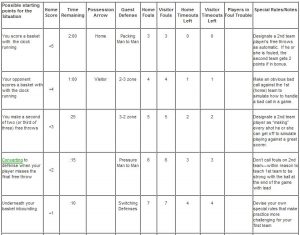
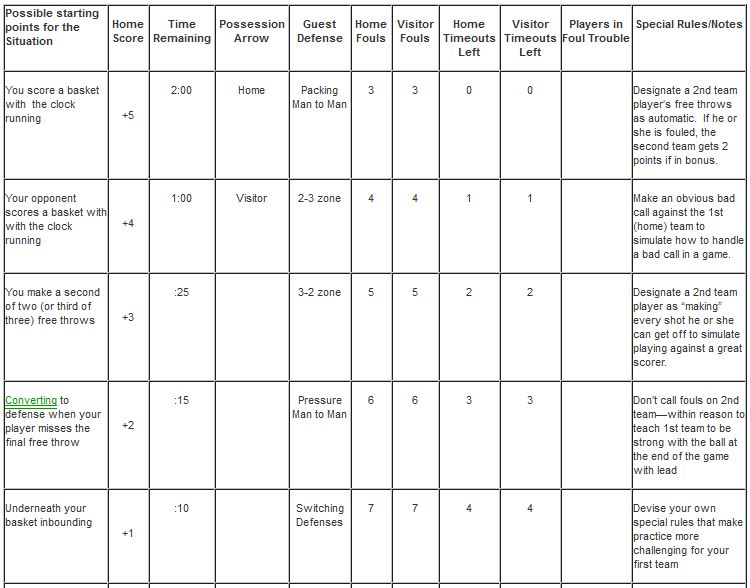
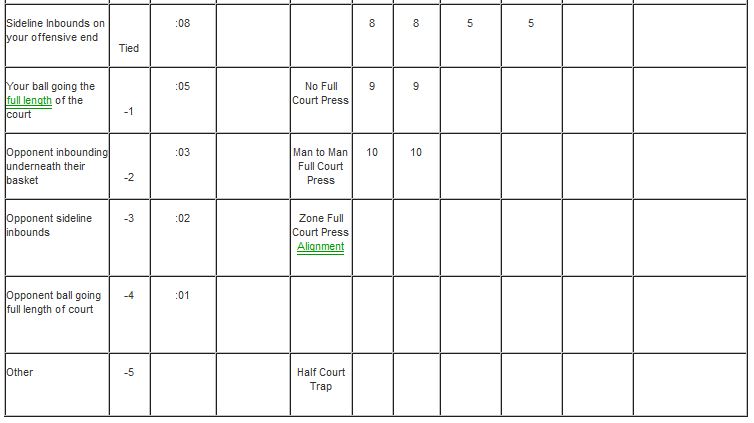
The chart below is something that I use to quickly plan and organize the segment of our practices. I believe in practicing situations at the end of every practice–even if for only five minutes.

Do not stick to the rows going straight across. For instance, you could circle these for your plan:

As an example:

Sideline Inbounds On Your Offensive End, Down 2, 20 seconds remaining, possession arrow to guests, guest defense 2-3 zone, home fouls 7, guest fouls 5, both teams 1 timeout remaining.Your leading scorer is fouled out of the game

I have download links at the end of the post if you would like to download this document either in word or pdf format.

This chart is a part of my 130 Situations eBook. Click this link to read a sample of the eBook.

My objective is to make every situation that we practice as game-like as possible. Have assistant coaches (or managers if they are capable) officiate during your situation work. Have a manager—or a player who is out of the scrimmage–run the clock. Specify who is in the bonus or double bonus and how many timeouts each team has remaining. Who is in foul trouble? Who has the possession arrow?

If a timeout is called in the situations have it like a game—set the timeout timer and have the players report to the bench. Have an assistant coach, coach the second team. The more game-like, you can make your practice segments, the better your preparation will be. On game night, the players will know that they have been through this before. Go through your practice timeouts just like the game. Draw the play on your whiteboard that you use during game timeouts. Remind each player of his spot and what his role is for the situation you are facing or the play you are running. Remind them of the foul situation, timeouts remaining, and who you are going to foul on the other team if that is appropriate.

The home team refers to the first team or starters, the guest team refers to the second unit.

Make 50 copies of these and attach one each night to your practice plan. Circle one criteria from each column and you can quickly come up with an end of game situation to rehearse at the end of each night’s practice.

The blank spaces are for you to insert your own ideas in any of the columns.


This chart is a part of my 130 Situations eBook. Click this link to read a sample of the eBook.

The blank spaces are for you to insert your own ideas in any of the columns.

Click here to: Download the chart as a word document.

Click here to: Download the chart as a pdf.

Feel free to email me if you have trouble downloading and I will email it to you in whichever format you specify.

Basketball Coaching Quotations

By Brian Williams on October 5, 2012

Here are some thoughts from some very successful Basketball Coaches.  I hope you can use them to help your program at some time.

“A Loser says, “Well at least I tried!” When in reality, at most he tried; A Winner doesn’t have to say it, he just does it…be a doer, not a trier..”–Randy E. Johnson

“To encourage the taking of good shots, we sometimes scrimmaged without keeping score on the board. I secretly gave the score to a manager, and all the scoring was based on shot selection. A great shot (layup), even if it didn’t go in, was worth three points; a good shot, even if it didn’t fall, was two points; for a shot that was merely acceptable because of the shot clock winding down, one point. If a player made a tough three-point shot that shouldn’t have been taken, zero points. Loss of ball without getting a shot was minus two points. We defined a good shot as one the shooter could make most of the time that was taken with our rebounders in position, unless it was an open layup.”–Dean Smith

“Defense doesn’t break down on the help, it breaks down on the recovery.” — Chuck Daly

“We clearly define “roles” that help players play to their strengths and away from their weaknesses. I specifically tell each individual what we need from him, where his shots should be taken from, and where he stands at that particularly point in the year.  Before the first game, I call a team meeting and define each player’s role as it stands at the moment. Each player must know exactly where he stands with the team. I have found that players would rather know where they are than to guess and be disappointed after the first game.”–John Calipari

“It is as big a mistake to turn down a good shot as it is to take a bad one.”–Ed Murphy

“You are always teaching your players something. When you scream at them, what are you teaching them? Before every practice or game, you need to decide, “WHAT WILL YOU TEACH YOUR KIDS TODAY, AND HOW WILL YOU TEACH IT?”–Unknown

“We Must OUTLAST the offense on every possession! Great defense takes consistent effort and commitment to excellence, every second of every practice and every game. It is not good enough to just go through the motions, to give the impression that you are trying, that you care. You must take PRIDE in your defense, in your effort, and be committed to OUTLASTING your opponent. You have to believe that! Anything less gives our opponents the edge. Gentlemen, we must OUTLAST the offense on every possession. That must be our foundation.”–Dick Bennett

“The coach should be the absolute boss, but he still should maintain an open mind.”–Red Auerbach

“We all want to be important. However the person who thinks I am the most important part of the team should remember this. Life is like a buck of water. We are a part of the whole. But how big is the hole that is left when we take away a large cup of water? The hole suddenly fills up and…so life goes. The nature of life is that there is always someone who can and will take your place, when you think you are irreplaceable.” –Unknown

“The more your players have to think on the basketball court, the slower their feet get.” — Jerry Tarkanian

“A successful team is like an iceberg, everyone sees the star, but underneath it all is that big, wide, strong base: the rest of the team. Without that base, the star sinks too.”–Unknown

Online-Basketball-Drills.com

Coaching Basketball Team Defense

By Brian Williams on October 4, 2012

These are some questions for your coaching staff to use to plan the upcoming basketball season. You can use to develop a defensive system and to tweak the system so that it fits your changes in personnel and the changes in your opponents’ personnel from year to year

Philosophy

  • Defensive Adjustments for a team or an Individual?
  • Scouting or System?
  • Do we want to have any “junk” in our system?
  • What are the strengths of our players and how can we best utilize those strengths while hiding their weaknesses?
  • What is the optimal number of possessions per game for this group?
  • Can we defend for that number of possessions at that pace?
  • How is our ability compared to the best teams in our region of the state tournament? our conference? our area?
  • How do we need to play to advance as far as possible in the state tournament?
  • What is our depth like?
  • How does our depth affect our style and pace of play?
  • What will our substitution pattern be?

Conversion Defense

  • How many players are we going to send to the offensive glass?
  • Do we need to add any rules that will improve our conversion?
  • Do we like the drills we have to teach conversion defense?

 
Man Defense

  • What hurt us most last year defensively?
  • How do we defend dribble penetration better?
  • What screening actions created problems for us?
  • Where do we want to pick up the dribbler?
  • How do we want to defend the post?
  • How do we want to defend ball screens?

Zone Defense

  • How much zone do we want to play?
  • Would it help us to have an even front and odd front zone so we can attack them both offensively during practice?
  • Do we want to be able to trap out of our zone defenses?
  • How do we best teach rebounding out of our zone?

1/2 Court Trap

  • How much do we want to play it?
  • How big are our trappers?
  • How do we want to rotate out of the trap?
  • Do we want to stay in the trap or go “one and done”?
  • When do we want to look to play it – dead balls, FT’s, end of half…
  • Do we have a better trapping line-up than others?

Presses

  • How much do we want to use the press?
  • When do we want to press?
  • How aggressive do we want to be with our press?
  • Do we have a better pressing line-up than others? Who are our best trappers?
  • Do we deny the point guard back once they pass out of the trap?

Inbound Defense

  • Do we want to play strictly man?
  • Do we want to trap the inbound pass?
  • How do we want our inbound defender to play UOOB and SOOB?

Special Situations

  • Who would be our best denial defender?
  • Does any team on our schedule potentially warrant a special defensive tactic?

Inventory of Success

By Brian Williams on October 3, 2012

  • Successful athletes earnestly want to succeed, and they do something about it.
  • They set goals for themselves.
  • Successful athletes realize that everything worth having in athletics has a price-tag in terms of training and competitive effort. They understand that success has its cost, but they pay their way knowingly, keeping their eyes on their goals.
  • They realize their future success in the final analysis will depend upon their own personal efforts.
  • Successful athletes consider work a privilege, not a chore.
  • They accept personal responsibility for their own success.
  • Successful athletes don’t depend upon luck, They Know that success goes only where it’s invited.
  • They know that willpower, not magic, turns dreams, into reality.
  • Successful athletes have a high frustration tolerance. They don’t become discouraged at temporary setbacks. They learn from these setbacks and look ahead to the next competition with optimism.
  • They don’t waste time thinking the grass is greener on the other side of the fence. They don’t complain about what they haven’t got. They develop to the maximum what they have.
  • Though willing to change for the better, successful athletes do not flit from one training method or technique to the other from day to day. They determine a long-range course of action and follow through on it with faith in its effectiveness.
  • Successful athletes profit by their own mistakes, and they profit by the mistakes of others.
  • They avoid negative thoughts and defeatist thinking.
  • Successful athletes don’t have head-trouble, but they do have guts.
  • They are totally reliable and responsible in training matters.
  • They don’t alibi. They know the best excuse is the one you never make.
  • Successful athletes set examples for others.
  • They are cooperative with both coaches and teammates.
  • Successful athletes are by far the easiest to coach.
  • They are not injury prone. They have far fewer injuries than the less successful.
  • Successful athletes are enthusiastic. They generate their own enthusiasm. They don’t grumble, moan, groan, and complain.

Athletes who fail tend to be cynical. They believe their coaches are not leading them properly. They are unwilling to be impressed or inspired. This is expected of the phony, the snobbish, the pseudo-intellectual, … but it dooms an athlete when the coach tries to inspire him and he just sits there saying this is a lot of nonsense. The good athlete does not ridicule the capacities and the ideas of the coach … HE RESPONDS!

  • « Go to Previous Page
  • Page 1
  • Interim pages omitted …
  • Page 249
  • Page 250
  • Page 251
  • Page 252
  • Page 253
  • Interim pages omitted …
  • Page 288
  • Go to Next Page »

Primary Sidebar

  • Twitter
  • Facebook
  • Linkedin
coachestoolbox
personaldevelopmenttoolbox
basketballplayerstoolbox
basketballtrainer
athleticperformancetoolbox
coachingbasketball

© Copyright 2026 Coaching Toolbox

Privacy Policy