• Skip to primary navigation
  • Skip to main content
  • Skip to primary sidebar

  • Basketball Plays
    • Ball Screen Sets
    • Horns Sets
    • Man to Man Post Up
    • Man to Man Isolations
    • Backdoor Plays
    • Man to Man 3 Point Shot Plays
    • 2-3 Zone Attack
    • Baseline Inbound Plays
    • Sideline Inbound Plays
    • Combination Defense Attack
  • Drills
    • Defensive Drills
    • Offensive Drills
    • Competitive Drills
    • Passing Drills
    • Rebounding Drills
    • Shooting and Scoring Drills
    • Toughness Drills
    • Transition & Conversion Drills
    • One on One Drills
  • Blueprint
  • Practice
  • Mental Toughness
  • Skill Development
  • Offense
  • Defense
  • Store

Basketball Practice Statistics

Basketball Practice Statistics

By Brian Williams on April 10, 2013

This article was written by Coach Bob Starkey.Bob Starkey is an assistant coach for the LSU Tigers women’s basketball team. He served as an assistant under head coach Gary Blair at Texas A&M from 2012 to 2021.

This article is from his blog HoopThougts which has a lot of great basketball coaching resources.

I am a big believer in that which is important must somehow be measured. We keep score during a game to measure who wins the game and who loses the game. Because we are so processed involved, it is important to measure things that are important to the process of developing what we do as a team.

We have blogged before about the need to create stats that support the parts of your game that are important for you to be successful. Good, bad or indifferent, kids are very stat conscience. They see them constantly on ESPN and in the newspapers. Your goal must be to create stats that tell a story of your success or lackthereof in what you are attempting to execute.

Now to go one step forward, if practice is the place that you lay the foundation of your system of play — and we certainly believe it is — than you need to stat your practices.

Beyond keeping stats that matter, it is important that you post those stats for your players to read and that you actually discuss them so that they understand what you are trying to get across to them. You can incorporate it in other ways. If you have an emphasis of the day, you may want to stat it so that you can talk to your team about how successful they were in that area. You can also back up your stats with video — another strong, visual support system.

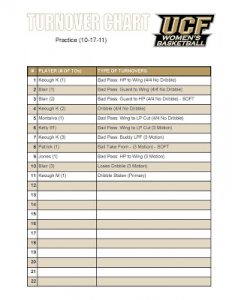
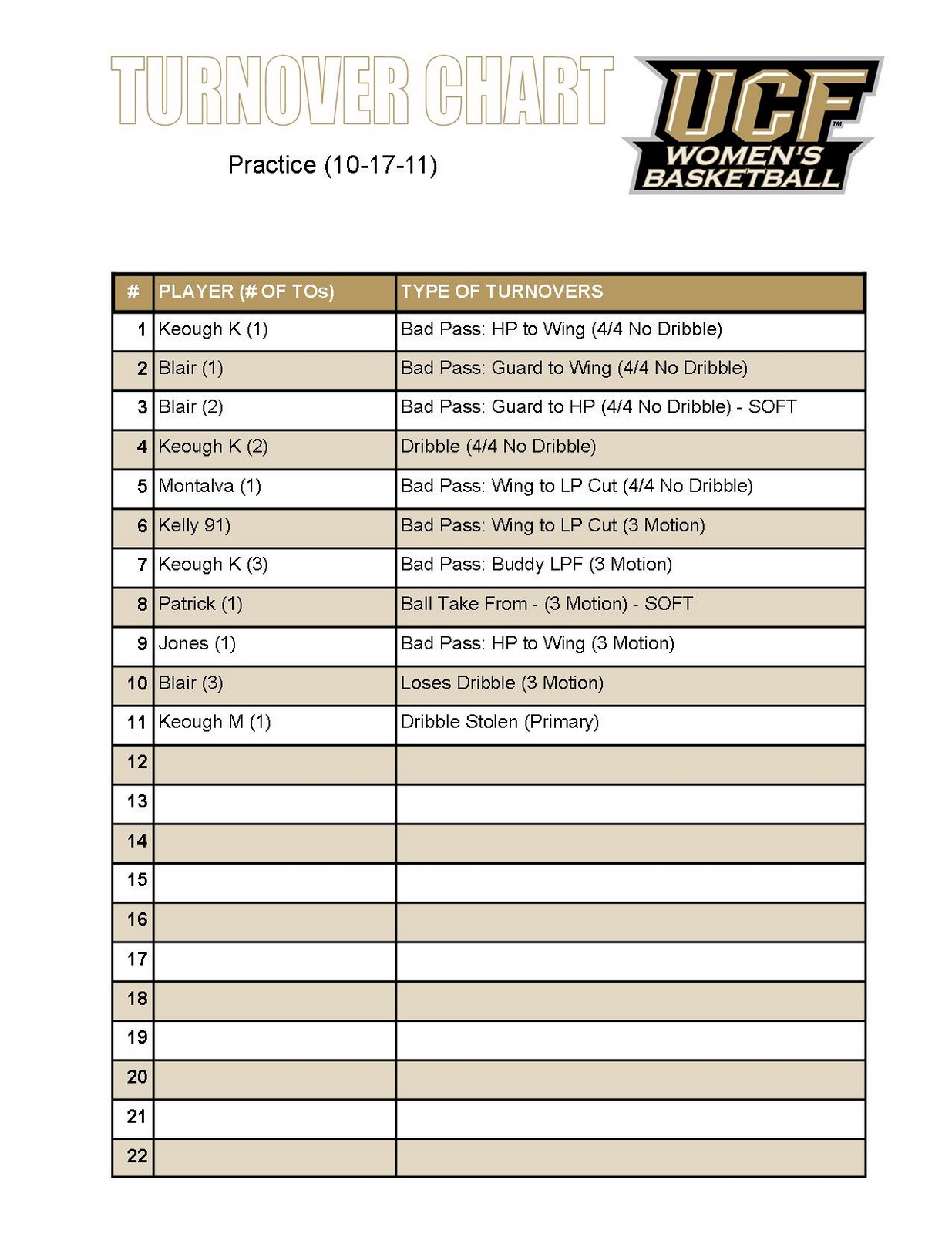
For us at UCF, as we develop our motion offense, a couple of stat sheets that are important would be our “Turnover Chart” and our “Screening Chart.”

The Turnover Chart doesn’t just tell us the number of turnovers we have committed.
1. It goes in order of the turnovers
2. Tells us the player and what number of turnovers she has committed
3. Tells us what type (bad pass, bad catch, travel, etc.)
4. Tells us how (Ex: Guard to Guard Pass)
5. Tells us what phase (Motion, Primary Break, Press Offense, etc.)

What this does is show us if there is a pattern for a player or our team. If a player has four turnvers and three are LPF (low post feeds) we know that we must work on that area with that player and maybe tell her to stay away from LPF until she improves in that area. Maybe as a team we created 5 of our 12 turnovers in Transition. Then we know this is an area that we can address in video and practice.

Click the image below to enlarge it
de

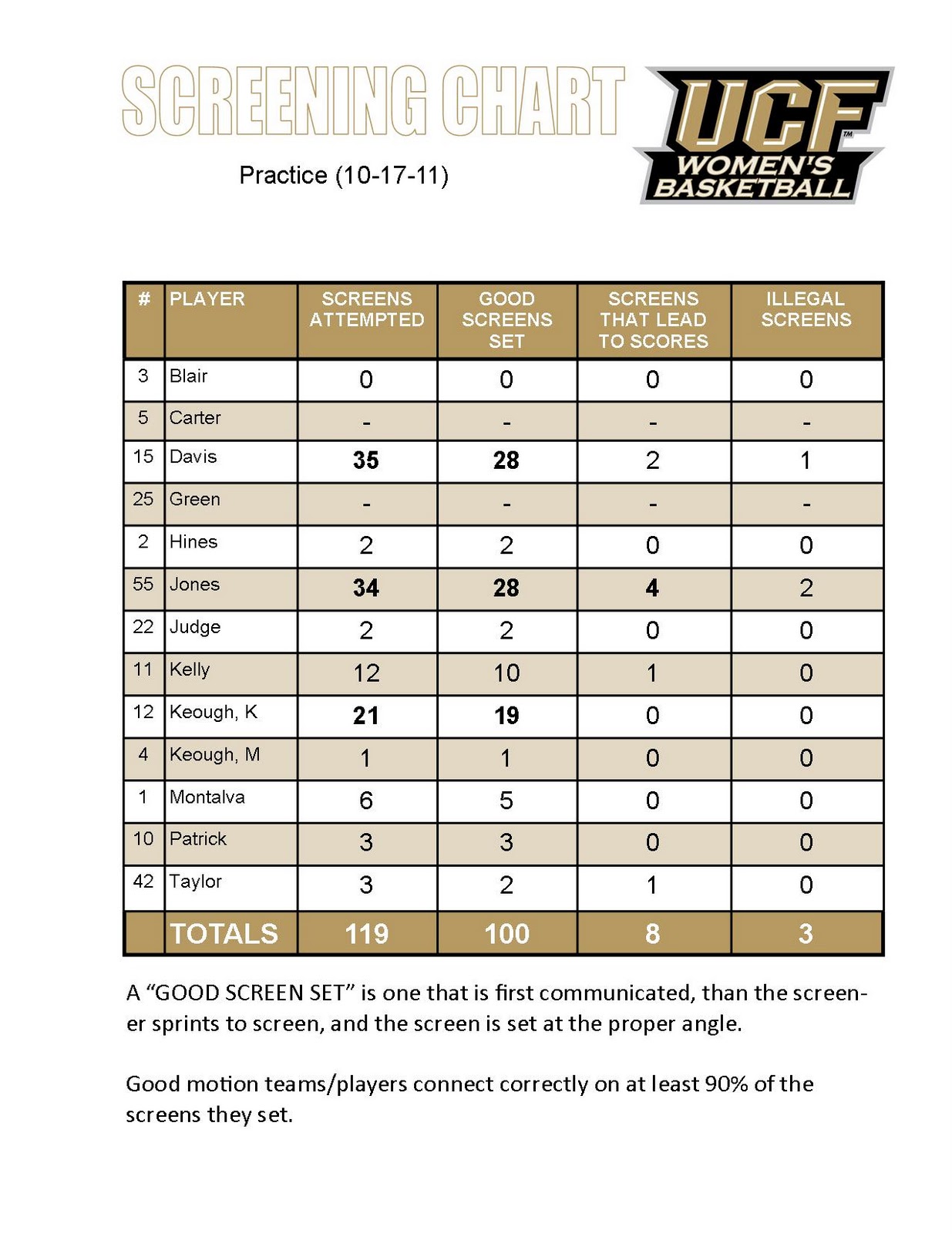
Another chart for us that is important is the Screening Chart. On this stat sheet, we are going to chart the number of screens you set, how many of them were set properly, how many lead to scores and how many of them were illegal screens.

This is a great stat sheet to help develop roles. If you run motion, setting continual, correct screens is critical. Players that can set screens and get key people in your offense open on a consistent basis are very important — but also under appreciated by many. This stat sheet allows them to shine. It also of course, tells you who is setting screens and setting them properly.

One note: we chart illegal screens. They don’t have to be whistled by the official. If it is illegal, we will mark it so that we can correct before an official has a chance to call it.


Click the image below to enlarge it
de

These are just a couple of stat sheets that are relevant to the way we play. I encourage you to use your imagination. If I was a press coach, I’d have a stat sheet to chart deflections, steals and lay-ups that we give up. If I was a “pound-it-inside” coach, I’d chart paint touches — who got ’em and who threw ’em. It’s a great way to make your players think about what’s important.
Basketball Plays Texas

By Brian Williams on April 9, 2013

This play was sent to me by Coach Brandon Rosenthal.

Coach Rosenthal is currently serving as the assistant basketball coach in charge of video coordination for both the men’s and women’s basketball programs at Santa Clara University.

Prior to moving to Santa Clara, Brandon was an assistant coach at St. Edward’s University in Austin, Texas.

The play came from the University of Texas.


Basketball Plays

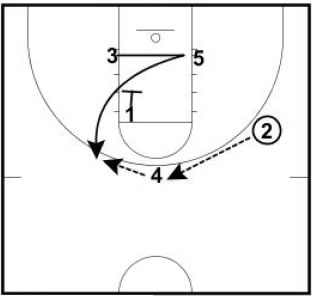
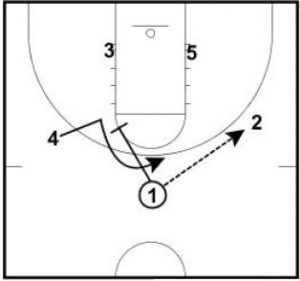
(1) passes to (2) and screens away for (4).


Basketball Plays

(3) sets his man up and receives a down screen from (1).

(2) hits (4).

(3) uses the down screen from (1) and then receives the ball from (4).


Basketball Plays

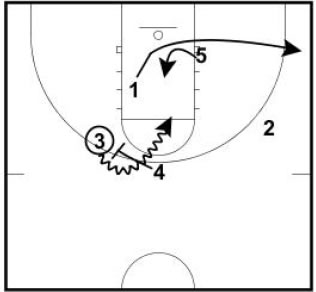
(4) follows the pass with a sprint screen.

(1) spaces and (5) works for post position.

(3) uses the ball screens and attacks the T, ready to read the defense.

Note: 5 should be shaping up on the block. The diagram is not intended to have the 5 player moving up and getting in the way of 3.

I have posted several other diagrammed plays, animated basketball plays, and videos of basketball plays to run against man to man defense.

Basketball Defense Syracuse 2-3 Zone

By Brian Williams on April 8, 2013

These notes and diagrams On Jim Boeheim’s 2-3 Zone defense came from Mike Neighbors newsletter. Email me if you would like me to pass your email address along to Coach Neighbors to add to his newsletter.

Here is a link to the second part of this post with some trapping ideas

Syracuse 2-3 zone Part 2

If a team is shooting 42% from 3, what would your assistants tell you to play?

They will tell you to play man. The opponent is shooting 42% against man to man, so they figured out how to get good shots against man to man, not necessarily against a zone.


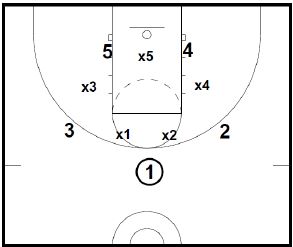
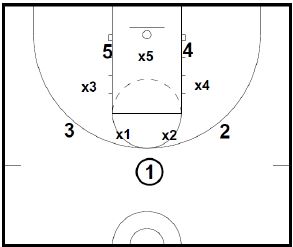
2-3 Initial Alignment

Basketball Defense

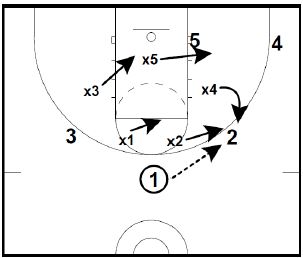
5 defenders should be moving guards try to keep the ball out of the high post

On the perimeter, play 3 players with 2 guards and help from forwards

The top 2 guys must be close enough to touch hands.

2-3 Rotation on Pass to the Wing

Basketball Defense

Take away the 3 point shot–pressure shooters, get them off their spots.

Designate who to stop and all 5 guys are responsible for stopping him. Match up with him, no matter where he is.

The forward rule is if a man is open in front of you, pick him up.

First forward must close out on outside lane.

Forward bumps back into passing lane once guard gets there.

Center rotates to ballside block.

Helpside forward goes ot helpside block.

Helpside guard drops to foul line.

2-3 Rotation on Pass to High Post

Basketball Defense

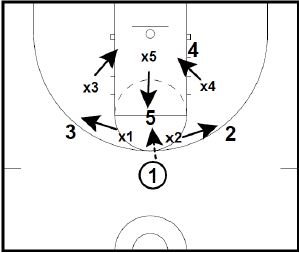
If the ball goes to the high post, the center is responsible for playing the ball.

X3 and X4 drop to blocks.

X5 hesitates while the forwards drop to the blocks,then picks up the ball.

 
X1 and X2 go to the wings to take away the shooters.

If the ball is up top, the guard is up top against a shooter, but gives space against a penetrator or passer.

2-3 Rebounding Responsibilities

Basketball Defense

Weak side forward is alone on the weak side

If a team plays 4 out, they will not be as strong rebounding

There is no block out on the weak side, the weak side forward gets position on the edge

If the offense crashes the boards hard, Syracuse looks to run.

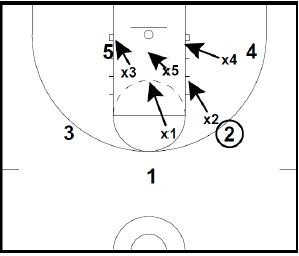
X5 gets position in the middle of the lane,

Ball side forward gets to the ball side block

The guard in the high post gets to the middle.

Ball side guard gets to the lane line.

Start teaching the zone with:

5 guys on the perimeter

Offense passes the ball for 25 to 30 seconds (this is how
long most teams take to attack the zone)

Defense moves on every pass.

Then, add two offensive players in the post and
play 5 defense on 7 offense

Here is a link to the second part of this post with some trapping ideas Syracuse 2-3 zone Part 2

Basketball Workouts Perimeter Players

By Brian Williams on April 5, 2013

This basketball workout with skill development drills for perimeter players is from a Xavier Men’s Basketball Newsletter. You can see the archives of the newsletter by clicking the blue link above.

40 minute workout
(Shoot free throws in between drills for the total of 40 minutes)

1. 6MIN: SIDELINE TOUCHES (Warm-up)
2. 5MIN: TRIANGLE SHOOTING
3. 5MIN: 50 SERIES
4. 1OMIN: FULL. COURT PITINO
5. 1OMIN: VEGAS CLOSEOUTS

Sideline Touches: Player starts in corner facing halfcourt with a ball, passes the ball to the elbow to a coach, sprints wide/sideline and touches halfcourt. Player turns and sprints wide sideline to coaches box and angles toward the block receiving a return pass from the coach.

He executes the following and can be repeated in the opposite corner:

• 1 Dribble powerlay up
• 2 or 3 dribbles, baby hook (lay up on opposite side of the basket)
• 2or3 dribbles pull up bank shot
• 2 or 3 dribbles, stride stop step thru
• Catch at Half Court, speed dribble, reach out lay up (Steve Nash)
• Catch at Half Court, drive to block, back defender down (perimeter to post

Triangle Shooting: Triangle Shooting is a drill that gets players a lot of shots in a short period of time as well as working on their conditioning. We teach al of our guys to use a “one, two step” (Left/Right) on every shot. This consistency in their footwork ultimately leads to more consistent results. The repetition of Triangle Shooting alows players to really focus on improving their footwork.

• Shooter has to start at the top of the key
• After each shot the shooter must touch the top of the key
• Shots are taken from the elbows
• One, two step into every shot (left/right shoot)
• 2:00 shooting, passer is under the basket

50 Series: 50 Series is a quick drill that really works on a players ability to control the basketball. The use of a heavy ball (If available) during the first set makes the regular ball seem much lighter during the second set. This contrast allows plays players to pound the ball quicker, faster, and harder, which ultimately results in improved ball control.

• Two Sets of 50 (1st set use Heavy BalI, 2nd set use regular ball)
• 10 V dribbles In front with left hand (right to left In front of body)
• 10 V dribbles in front with right hand
• 10 Push/Pull dribbles with left hand (back/forth dribbles on side of body)
• 10 Push/Pull dribbles with right hand
• 10 Behind back dribbles

Full Court Pitino: Players begin in the corner at the full court level.

They execute the following movements and repeat these movements from the opposite corner, then returning.

A dummy defender is at the 25 ft. marker from each basket.

Movements: Begin with three dribbles in place, then a hard stutter at the coach’s box, dribbling with the hand closest to the sideline.

• Inside out, power lay up
• Inside out, cross over baby hook (lay up on opposite side of the basket)
• Hesitation, stride stop, step through
• Through the legs, runner or floater
• Euro Step
• Speed dribble into Bank Shot (last dribble must be pounded into floor then pull up)
• Speed dribble into 3 pt shot (same as above)

Vegas Close Outs: Vegas Close Outs is a great drill to simulate the perfect close out technique. The player starts with his head under the rim. A coach/manager will be positioned on the wing just behind the 3 pt line. The play tosses the ball out to the coach to begin the drill. All the teaching points should be explained prior to the first close out. You can place coaches at various positions around the 3 pt line which will allow multiple reps to take place at the same time.

• Run 1st, then short, choppy steps
• High hands, bent elbows, butt down, head back
• Yell “shot”/Play drive
• Touching distance in stance (defender should be able to touch the ball)
• Take shooter out of rhythm

Coaching Basketball Playing in the Present

By Brian Williams on April 4, 2013

By Alan Stein, Stronger Team Blog (re-posted with permission)

“Basketball is a complex dance that requires shifting from one objective to another at lightning speed. To excel, you need to act with a clear mind and be totally focused.”

Phil Jackson

If you want to maximize your play on the court you have to learn how to ‘Play Present.’ There are as many as 150 individual plays over the course of a game (roughly half on offense and half on defense). The best players in the world are totally focused on the present moment – because that is all they can control.

Great players don’t worry about a missed shot or a bad call. They don’t get distracted by trying to think about winning and losing. They focus on the here and now. They ‘Play Present.’

The ability to ‘Play Present’ is a skill that takes practice – just like shooting and ball handling. Basketball is a highly cerebral game. As Coach Jones has said, ‘you can’t just play the game; you have to think the game.” That is where mental training comes in.

Whether you are a player or a coach, you need to practice ‘Playing Present.’ You need to constantly remind yourself to be focused on the task at hand. Build your self-awareness so you recognize immediately when your mind starts to drift. Over time, you will be able to sustain focus and concentration during the chaos that occurs during a game. This will drastically improve your performance.

Think about this hypothetical scenario. Imagine if at a random time in the beginning of practice or in the first quarter of a game, you called your players over and said, “If you get a stop on the next possession, I will buy each of you a brand new pair of Jordan’s.”

Do you think they would get a stop? I do! Why? Because your players wouldn’t be thinking about anything in the world except for getting that stop. They would have razor sharp focus and make sure they were in position, were playing as hard as possible, and were communicating. They would be ‘Playing Present.’ The key to success is learning how to achieve that level of focus every possession!

Like any skill, if you want to learn how to ‘Play Present’ – you have to practice!

A mental training exercise you can do at home is called “100.” Find a quiet spot to sit and relax. Close your eyes. Breathe in through your nose and out through your mouth. When you breathe in, say the number 1. When you breathe out, say the number 2. Repeat all the way to 100. In the beginning, your mind will be elsewhere and you will be thinking of all kinds of distracting thoughts. But the goal is to ‘Play Present’ and bring your focus back to your breathing and to the next number. Do this every day (only takes a couple of minutes) – when you first wake up or right before you go to sleep.

Another powerful mental training exercise is called the MVP (Meditate – Visualize – Positive Talk). This is perfect to do before your team’s pre-game talk and warm-up.

Meditate: Sit in silence with your eyes closed, take 15-20 slow breaths, and focus on the moment. Let the day’s distractions leave with each exhale. Get present.

Visualize: Using all of your senses, recall a time when you played in the zone, a time when you played (or coached) your best basketball. See it and feel it.

Positive Talk: Repeat your favorite motivational affirmations and quotes to yourself.

Another concept that goes along with ‘Playing Present’ is the concept of ‘Next Play.’ Whether good or bad… the last play doesn’t matter… let it go… focus on the ‘Next Play.’

Learning to move to the ‘Next Play’ is the foundation of how you ‘Play Present.’

I learned about the concept of ‘Playing Present’ (as well as the exercises above), from my friend and colleague Graham Betchart. Graham is the founder of GB Performance Coaching (www.GBPerformanceCoaching.com) and is a wealth of knowledge. I am extremely thankful for everything Graham has shared with me. He has made me a better coach.

In the past 20 years, few college programs have played with the mental toughness (and thus success) of the Duke Blue Devils. Coach K is a firm believer in the concept of ‘Next Play.’

Train hard, train smart.

Alan Stein

www.StrongerTeam.com

www.Twitter.com/AlanStein

www.Facebook.com/StrongerTeam

Basketball Drills Scoring

By Brian Williams on April 4, 2013

This post contains 3 shooting and scoring drills for your players to use in their spring and summer workouts.

I found the drills on the Jes Basketball Playbook site.

It contains several other drills that can be used in your practices and also in individual skill development workouts.

There are several types of drills in addition to shooting drills.

There site also contains a section with plays to run against various types of defenses.


6 Spot Perimeter Shooting Drill

basketball-drills-6-spots

Submitted by : Brett Coxsedge

Player sprints and picks up the basketball from each of the 4 chairs and shoots from that spot.


After shooting the 4 shots, player 1 then sprints to midcourt and picks up the basketball, dribbles it to the elbow and shoots, then sprints back the ten second line to pick the other basketball up and repeats the dribble to the elbow and shot.

There are several ways to make this drill competitive. One way is time players form start to the release of the 6th shot. Add 2 seconds to the time for each missed shot.

7s Drill

basketball-drills-drew-7s-drill

This drills is from retired Valparaiso Coach Homer Drew and was submitted by Matthew Dunstan

• One dribble lay-ups with a catch and pivot, at each of the seven pylons.

 
• 2 free throws then repeat, this time with one dribble jump shots.

Speed up the drill by adding a rebounder that passes to the coach.

W Shooting Drill

basketball-drills-w-shooting

Play submitted by : Brett Coxsedge
Five shots are taken in the following order:
• Right wing
• Left wing
• Right elbow
• Left elbow
• 3pt straight ahead

The shooter should return to home base (X) after each shot. Drill will require a coach to rebound and pass the ball.

  • « Go to Previous Page
  • Page 1
  • Interim pages omitted …
  • Page 234
  • Page 235
  • Page 236
  • Page 237
  • Page 238
  • Interim pages omitted …
  • Page 288
  • Go to Next Page »

Primary Sidebar

  • Twitter
  • Facebook
  • Linkedin
coachestoolbox
personaldevelopmenttoolbox
basketballplayerstoolbox
basketballtrainer
athleticperformancetoolbox
coachingbasketball

© Copyright 2026 Coaching Toolbox

Privacy Policy