• Skip to primary navigation
  • Skip to main content
  • Skip to primary sidebar

  • Basketball Plays
    • Ball Screen Sets
    • Horns Sets
    • Man to Man Post Up
    • Man to Man Isolations
    • Backdoor Plays
    • Man to Man 3 Point Shot Plays
    • 2-3 Zone Attack
    • Baseline Inbound Plays
    • Sideline Inbound Plays
    • Combination Defense Attack
  • Drills
    • Defensive Drills
    • Offensive Drills
    • Competitive Drills
    • Passing Drills
    • Rebounding Drills
    • Shooting and Scoring Drills
    • Toughness Drills
    • Transition & Conversion Drills
    • One on One Drills
  • Blueprint
  • Practice
  • Mental Toughness
  • Skill Development
  • Offense
  • Defense
  • Store

Basketball Workouts Stephen Curry

Basketball Workouts Stephen Curry

By Brian Williams on May 16, 2013

These 5 basketball skill development drills came from the Stephen Curry Skills Academy and are a part of Alan Stein’s 12 Volume Basketball Coaching Nuggets.

The entire Curry Academy volume has 82 pages of basketball skill development drills.

If you like these drills and think that other basketball coaches would be interested in seeing them, please consider clicking the Facebook like button or using the Twitter button (both are to the left of this text) to tweet the link to this page. Thank you!


Contact Drill
Basketball Workouts

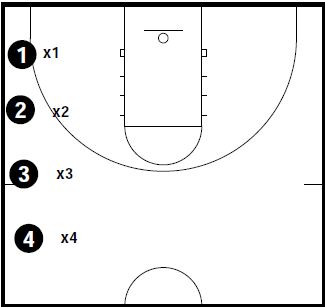
Players partner up and start on sideline.
1. Defenders put hands on Offense shoulders while Offense drives across the floor through the pressure.
2. Offense takes power dribble stance and faces baseline. Player 2 puts forearm on Player 1’s inside shoulder and gives contact. Player 1 then step-slides up the court.

3. Player 1 will be advancing the ball while Player 2 is trying to ride him out on his inside shoulder. It’s Player 1’s goal to cut into the path of Player 2 and veer behind him. Once there his goal is to stay on the inside position by keeping contact.

Contact is never an excuse to lose the ball!!

Straight Line Cat and Mouse
Basketball Workouts

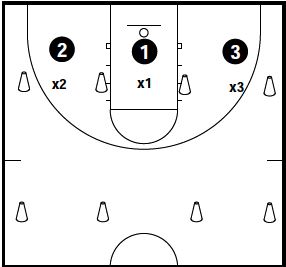
1 on 1. Offense and defense each have two basketballs.

The boundaries are marked by cones.

If the offense gets their shoulders past the defense they receive a point.

If the defense forces the offense to change directions, lose the basketball or go out of bounds they receive a point.

Play to seven, then change offense to defense.

React to Penetration
Basketball Workouts

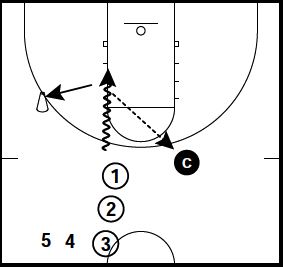
Slot Euro Pass: 1 minute on the clock. Player will attack off the dribble from the slot, pivot and pass to coach on opposite slot.

If Player delivers pass on target to coach, he will be rewarded with a shot on the weakside wing.

If the pass is not on target, coach will drop pass and let it roll away.

Hitting the shooter in his or her “shooting pocket” makes a huge difference in the shot going in. Even in the NBA when players have to reach up, down, or sideways to catch the ball, it throws off shot preparation.

You can run this drill from any area on the floor where your offense has penetration opportunities for passes to where your drive and space spots are.

Dribble Attack 1 on 1
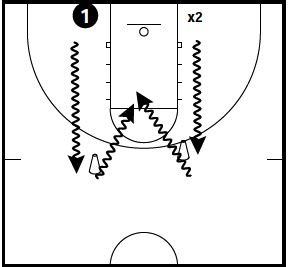
Basketball Workouts

Players will start on the baseline. One on offense with a basketball and the other on defense.

Player one must dribble around a chair which is outside the 3pt arc, player 2 must sprint around a corresponding chair at the same distance from baseline.

Then it’s live 1 on 1. You only get one shot. Offense stays if they score.

Jab Series 1 on 1
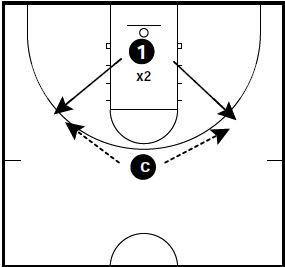
Basketball Workouts

Player 1 starts under the rim. He must find a way to get open, if he does the coach will deliver a pass.

It’s then 1 on 1 with a limit of three dribbles and one shot. Offense stays if they score. If Player 1 fails to get open within a time limit of five seconds, then his possession is over.
Basketball Drills Helpside Recover

By Brian Williams on May 14, 2013

I like skill improvement basketball drills that are competitive and or put pressure on our players while being drills we can use either during practices or during individual workouts.

I also like having many different drills to work on closing out. I feel that it is such an important part of man to man defense and needs to be drilled daily. I also feel that if you use the same drill each day, it loses effectiveness, so it is good to have a variety of drills to work on the skill of closing out.

Make sure your speakers are on to see and hear the YouTube videos This is a YouTube video, so please make sure that you are on a server that allows YouTube access.

This drill is provided by BasketballHQ.com. To see more of their resources, click the link.

I personally like the idea of scoring by getting a defensive stop. That player then stays on defense and has another chance to earn a stop point. No points awarded on offense in the drill.

As with everything I send out, whether you like the drill or not, agree or disagree, I hope it gives you food for thought and inspires you to think about your basketball program and what you can do to improve.

Basketball Plays 43 Curl Pop

By Brian Williams on May 13, 2013

Coach Vonn Read has submitted several plays from his playbook series The Basketball Encyclopedia of Plays to the Coaching Toolbox. Vonn is currently serving as an assistant coach in the Women’s at Houston.

He has also served as an assistant coach in the WNBA with the Phoenix Mercury, Orlando Miracle, and San Antonio Silver Stars. He was an advanced scout for the Orlando Magic as well as The Charlotte Sting.

Please like this page or use the Twitter button to share!


Basketball Plays


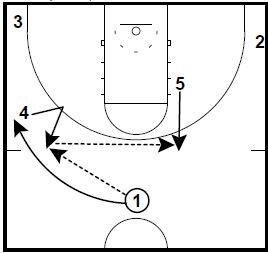
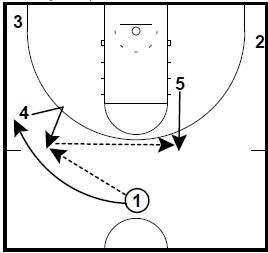
1 Passes to the 4 player and cuts to the wing.

The 4 player passes to the 5 player.


Basketball Plays


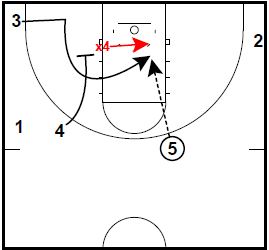
The 4 player will downscreen for the 3 player, who will curl to the basket for the layup if open

This curls forces X4 to help to prevent the layup.


Basketball Plays

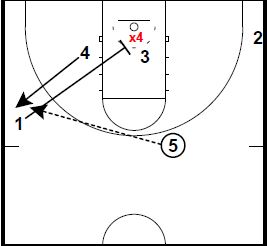
At the same time X4 is helping on the curl, the 1 player will screen X4 in the paint.

The 4 player will pop out to the wing for a wide open 3-pointer.

X4 cannot help and get through the screen to defend the shooter.

Coach Read has also put together The Basketball Encyclopedia of plays. You can check them out here: The Basketball Encyclopedia of Plays or read more about the books:

Any coach looking for the latest and innovative plays from the Professional, College, or High School levels can stop looking. With a compilation of over 7,700 different plays, you will never need to purchase another basketball playbook again. These playbooks can be used as a great reference tool for years to come. This 2 Volume Book includes plays from 19 different play categories, and they are the most extensive playbooks on the market.

The Basketball Encyclopedia of Plays (Platinum Series) contains over 7,700 Plays (Both Volumes combined) from the NBA, WNBA, USBL, and College levels from someone who has worked as an Advanced Scout or Coach on each level!!! This book has been intensely compiled over the last 21 years, with plays taken from a lot of NBA Coaches (past and present), WNBA coaches, and College coaches (Men’s and Women’s) from around the country.

Any coach that is serious about improving their knowledge of the game from an X and O standpoint will benefit tremendously from these books. These Books can be used to discover New Quick hitters, add a New Package to your playbook, or develop an entire Offensive System. There are a lot of new ideas and concepts in these books to study, and the Basketball Encyclopedia of Plays can be a great resource for coaches on all levels!!! This book is definitely for those X and O junkies who are always looking to improve as a Coach.

“THE GAME IS ALWAYS CHANGING? ARE YOU?” Vonn Read

Here is the link: The Basketball Encyclopedia of Plays

Great Basketball Players 2

By Brian Williams on May 10, 2013

These observations are from Alan Stein.

This excerpt from the series was originally put together by 5 Star Basketball Camps.

Today’s lists are part 2 of my posts. Here is a link to part 1 in case you missed it.

Great Players (Part 1)

Today’s list includes:

Thoughts on Great Defenders and Great Scorers.


GREAT DEFENDERS

  • Great Defenders take pride in deflecting passes.
  • Great Defenders have their heads on a swivel and see the entire court (always see their man and the ball).
  • Great Defenders play the pick & roll effectively – they hedge with a purpose!
  • Great Defenders delay the other team from getting into their offensive sets. They keep the offense out
    of rhythm and control the tempo.
  • Great Defenders pay attention to the scouting report and film sessions. They know who the other
    team’s best players are
  • Great Defenders are CONSTANTLY talking – they relay information quickly & efficiently.
  • Great Defenders are NOT afraid to take a charge – in fact, they embrace it.
  • Great Defenders dive on the floor for loose balls whenever the situation presents itself.
  • Great Defenders communicate when they are double-teaming or when a screen is coming.
  • Great Defenders don’t gamble. They make the right play, the easy play, the smart play.
  • Great Defenders know that THIS possession is THE most important possession of the game –
    regardless of time and score.
  • Great Defenders play aggressively but intelligently.
  • Great Defenders never take a play off. Resting is NOT in their vocabulary.
  • Great Defenders dictate what the offense is going to do.
  • Great Defenders approach each game thinking ‘I’m going to shut my guy down tonight.’
  • Great Defenders do not let the ball go to the middle of the floor on penetration.
  • Great Defenders understand the concept of ‘ball-you-man.’
  • Great Defenders keep the offense uncomfortable and off balance as often as they can.
  • Great Defenders understand that defense wins championships. If the other team can’t score, they can’t win.
  • Great Defenders don’t commit lazy or stupid fouls.

GREAT SCORERS

  • Great Scorers can beat you in a myriad of ways – they are not one dimensional.
  • Great Scorers develop exceptional concentration and focus.
  • Great Scorers don’t get discouraged if they miss a shot or two. They always think ‘my next shot is good.’
  • Great Scorers know how to keep the defense off-balance.
  • Great Scorers attack their opponent’s weaknesses.
  • Great Scorers have multiple weapons and keep defenses guessing.
  • Great Scorers finish strong, even through contact. They embrace getting fouled!
    Great Scorers know how to control, read and react to their defender.
  • Great Scorers know the moves, angles and tricks to create space.
  • Great Scorers recognize scoring opportunities and get open easily.
  • Great Scorers practice game-like situations against tough competition.
  • Great Scorers make great ball fakes and shot fakes. They use their eyes to deceive.
  • Great Scorers are comfortable in the paint and can finish around the bucket.
  • Great Scorers have confidence in their game. A bad game doesn’t phase them.
  • Great Scorers can score from all three levels. They have their 3-pt, mid-range, and interior games on lock.
  • Great Scorers run hard on the break and get points off of offensive rebounds. They always look for ‘easy’ buckets.
  • Great Scorers make free throws. Period.
  • Great Scorers can get their shots off quickly, but without ‘rushing.’

Great Basketball Players

By Brian Williams on May 9, 2013

These observations are from Alan Stein’s blog. This excerpt from the series was originally put together by 5 Star Basketball Camps.

Today’s lists are part 1 of the entire group. There is a link to part 2 at the bottom of this article.

I hope these are some thoughts you can use to give more purpose to the roles you have defined for your team.

GREAT GUARDS

  • Great Guards are relentless on both ends of the court.
  • Great Guards use pump-fakes and ball fakes often. They set up the defense to go one way and pass/go the other way.
  • Great Guards know not to telegraph their passes. They use their eyes to create deception.
  • Great Guards welcome defensive pressure. They see it as an opportunity to score an easy bucket for their team.
  • Great Guards are patient with the basketball. They read the defense & act accordingly.
  • Great Guards facilitate every facet of the offense.
  • Great Guards don’t try to find the ball, they let the ball find them!
  • Great Guards are ALWAYS communicating with their teammates to ensure cohesiveness.
  • Great Guards hustle back on D when they get beat. They set the defensive tone!
  • Great Guards rebound their position – they don’t leave that to the ‘big guys.’
  • Great Guards push the ball up the floor and try to find an opening in the defense for themselves or a teammate.
  • Great Guards get everybody involved by sharing the basketball.

GREAT POST PLAYERS

  • Great Post Players knock down their free throws when they get to the line.
  • Great Post Players have go-to moves with either hand to use in the paint. They also have a countermove for every move.
  • Great Post Players enjoy banging on the interior and setting solid screens.
  • Great Post Players are exceptional at help defense. They stop the ball when it’s in the paint!
  • Great Post Players can hedge on the perimeter and get back to their man QUICKLY.
  • Great Post Players draw double-teams, recognize them and react quickly to get the ball to an open teammate.
  • Great Post Players never over dribble.
  • Great Post Players run the floor – rim to rim – on offense and defense.

GREAT TEAMMATES

  • Great Teammates call out screens so their teammate doesn’t get clobbered.
  • Great Teammates don’t care whether they start or come off the bench – they just want to win!
  • Great Teammates HYPE their team UP before the game and during halftime.
  • Great Teammates are an extension of the coach – on and off the court.
  • Great Teammates are positive, supportive, honest, and enthusiastic.

GREAT TEAMS

  • Great Teams dig in on defense until they get the ball or the buzzer sounds. They NEVER give in because they’re tired.
  • Great Teams listen to their coach – they understand that he/she is looking out for their best interests!
  • Great Teams know who they want to get the ball to in the clutch – they have a game-plan.
  • Great Teams close out games and know how to play with a lead. They also know how to fight back when they are down
  • Great Teams are willing to share the ball on offense – they don’t care who scores they just care that they
    score.

GREAT PASSERS

  • Great Passers make scoring easy. They put the ball where it needs to be, when it needs to be there.
  • Great Passers can throw every type of pass – with either hand – depending on the situation.
  • Great Passers make the simple play, not the flashy play. All they care about is a positive outcome, not
    how it looks.
  • Great Passers fake a pass to make a pass.

GREAT REBOUNDERS

  • Great Rebounders are quick off the floor – they anticipate where the ball is going and go get it!
  • Great Rebounders just don’t want the other team to get the ball – they clear out space for teammates to
    get the rebound.
  • Great Rebounders assume ‘shot is taken, shot is missed.’
  • Great Rebounders protect the ball after the rebound.
  • Great Rebounders attack the glass on both ends of the floor.
  • Great Rebounders have soft hands and great body balance.
  • Great Rebounders always think the ball belongs to them.
  • Great Rebounders find their man when the shot goes up, make contact, block out, then pursue the ball.

Click here for Part 2 of Characteristics of Great Basketball Players

Basketball Coach’s 3 Most Costly Mistakes

By Brian Williams on May 8, 2013

This article was written by Coach Randy Brown. He is a former D1 Assistant Coach at Iowas State and Arizona. His 18 years in college basketball highlights a successful 23-year career. Mentored by Basketball Hall of Fame coach Lute Olson at Arizona.

He has passion for the game of basketball and works as a basketball consultant and mentor for coaches. You can see his site at CoachRB.com

Randy’s coaching resume includes positions at Arizona, Iowa State, Marquette, Drake, and Miami of Ohio, 5 Conference Championships and 5 NCAA appearances. His efforts have helped develop 12 NBA players including Steve Kerr, Sean Elliott, and Jaamal Tinsley. To contact Randy, email him at [email protected]

A player is not the only one that makes mistakes. Coaches make many mistakes every day, even though most of them are not noticed. A costly mistake by a coach can be the difference between winning and losing. It also can lead to an underachieving, dysfunctional team. The three most costly mistakes of coaches are highlighted in this article.

Coaching basketball these days at any level is a very difficult job. Many books are written about successful qualities of excellent coaches and leaders. Most coaches will not take a deep look into their own coaching ability to discover their weaknesses. If you are serious about your coaching ability, take an objective look at the factors that keep you from reaching your potential.

1. Coaching without Clarity–

This is by far the biggest mistake made by coaches in basketball. This flavor-of-the-day approach has no base and leads to failure. The ultimate test of coaching clarity is defined by your ability to answer this question;

  • What are your three areas of concentration in coaching? If your practice was observed for 30 minutes, would your Top 3 be easily identified? Why is this such an important part of coaching? Having a Top 3 given your coaching and your program the direction and clarity it needs. If your drills, terminology, practice, and daily focus are tied directly to your Top 3, your players will execute at a high level and time will be greatly maximized.

If your coaching or your program are without a Top 3, you are like a ship in the ocean without a map, compass or rudder. You will try hard every day, but you will not consistently travel the path to success. The Top 3 is the key to successful basketball coaching, consistent winning, and program development.

2. Priority Imbalance— I have yet to meet a coach that said his family, parents, or significant other was not his Number 1 priority in life. This commitment is repeated so much we all begin to believe it after a while! This is “coaching blindness” at its best. I call it the “Coaches Biggest Lie”. Coaches confuse provision with priority. The paycheck that arrives home each month is important for all of us. This check, though, in no way means that by supporting our loved ones financially we have given them top priority in our life. We say they are important but rarely find the kind of quality time and communication needed, especially during the season. To illustrate this point, it is said that time is the true test of our priorities. The things we spend most time on we value the most. It is a cut and dry proposition.

  • Do you spend more time at work or with basketball than your family?
  • Do you carry your job home with you and pretend to be present when your mind is elsewhere?
  • Do you work as hard satisfying your wife’s needs as you do preparing for practice or games?
  • What do you do with your free time; spend it on selfish pursuits or with family or friends?
  • How many hours a week do you watch television as compared to quality time with your family?
  • Do you know the name of your children’s teachers at school better than your next opponent?
  • Do you feel that you have to watch tape at home at night?
  • How often do you tell your loved ones why they are your loved ones?

3. Paralysis by Analysis— Coaches are famous for analyzing the game to the point of exhaustion. Many times we are the only ones who truly understand what is being taught. The philosophy, “Keep it Simple Stupid” gets massive lip service from coaches. This is a tough battle for most coaches, including myself. Our insecurity often leads to a catalog of drills, offenses and defenses that stagger the mind of young players. We stuff file cabinets with thousands of keys, teaching points, and magic late game plays. The knowledge well gets bigger and deeper by the year. At this point it is very important to ask a question: What is the goal of coaching?

I believe the answer to this question is execution. Coaching is the task of getting your players to play the game and execute the way you want them to. At its purest level, getting players to execute what you have taught and drilled them is the key. Some have said that execution is doing what you are suppose to do, when to do it, and with the greatest effort. If all of this is valid, simplicity is the only way to success.

The Simplicity Test for players—

1. Do your players know your Top 3 as a coach?

2. Do your players know exactly what they must do to get on the floor?

3. Do your players know exactly what they must do to stay on the floor?

To do justice to your own coaching, ask your players these three questions? The answers will provide a map for the future of your coaching. Are you a confusing coach to play for? If so, humble yourself and step back for a while. Carefully analyze your coaching approach and philosophy and get the opinion of assistants, administrators, and players. What seems like weakness can actually be the strength of your coaching! Congratulations to all coaches that take on this challenge. Please share your results with me and make next season your best one ever!

  • « Go to Previous Page
  • Page 1
  • Interim pages omitted …
  • Page 230
  • Page 231
  • Page 232
  • Page 233
  • Page 234
  • Interim pages omitted …
  • Page 288
  • Go to Next Page »

Primary Sidebar

  • Twitter
  • Facebook
  • Linkedin
coachestoolbox
personaldevelopmenttoolbox
basketballplayerstoolbox
basketballtrainer
athleticperformancetoolbox
coachingbasketball

© Copyright 2026 Coaching Toolbox

Privacy Policy