• Skip to primary navigation
  • Skip to main content
  • Skip to primary sidebar

  • Basketball Plays
    • Ball Screen Sets
    • Horns Sets
    • Man to Man Post Up
    • Man to Man Isolations
    • Backdoor Plays
    • Man to Man 3 Point Shot Plays
    • 2-3 Zone Attack
    • Baseline Inbound Plays
    • Sideline Inbound Plays
    • Combination Defense Attack
  • Drills
    • Defensive Drills
    • Offensive Drills
    • Competitive Drills
    • Passing Drills
    • Rebounding Drills
    • Shooting and Scoring Drills
    • Toughness Drills
    • Transition & Conversion Drills
    • One on One Drills
  • Blueprint
  • Practice
  • Mental Toughness
  • Skill Development
  • Offense
  • Defense
  • Store

Well Coached Teams

Well Coached Teams

By Brian Williams on July 18, 2013

This article was written by Arkansas Women’s Coach Mike Neighbors when he was an assistant at Xavier.

This post is only a portion of his entire article.Click here to see Part 2

Coach Neighbors has a weekly newsletter that is outstanding. If you would like to subscribe, email me and I will forward your interest on to him.

Well Coached teams are motivated: These teams play with an energy and a visible passion that proves they are engaged in the process that their team and coaches have established. These teams display fight and toughness and you usually cannot tell the score of the game by simply watching the actions and reactions of their players and coaches.

Well Coached teams have good shot selection: These teams have the most shot attempts by their best scorers. Those best players know when to take a shot and what shots should be taken based on time and score. Rarely do you see well coached teams without their best scorers having the ball when it counts.

Well Coached teams have little or no game slippage from practice: These teams are able to execute and they are able to play at a high intensity level. They seem to make things look easy in their execution. Their timing and spacing are usually impeccable and their movements appear rehearsed because they are in practice every single day at game speed. Few missed lay-ups, few mishandled passes, limited turnovers when dribbling all a result of having practiced at game speed.

Well Coached teams players hold the ball when their coach speaks: In viewing a practice when a coach speaks the gym is silent and all eyes are on the speaker. (I personally played for a coach that would glare down a dribbled ball across the gym even if that person were not part of our squad). It’s not the actual act of the players holding the balls as much as it is that coach commanding that respect.

Well Coached teams have genuine enthusiasm because the are invested and bought in: We can all tell the difference between genuine and manufactured enthusiasm. Have the person that films your games dedicate an extra camera to your bench one game to see if you really have your team INVESTED…Be prepared for what you might see on the video…

Well Coached teams don’t have to be coached on effort: Very rarely do you see the coach of a well
coached team spending valuable game (or practice) time convincing their players to play hard, to give effort, to give extra effort. They just do it. Obviously those desires have been instilled at some point and time in the past but there is not one second wasted during a timeout for a well coached team with a coach using time to talk about effort, energy, or enthusiasm.

Well Coached teams players display proper techniques in fundamental areas of the game: Inside pivot foot on the catch, triple threat position, butt down on defense, chin on shoulder in post defense, take a charge, dribble with their eyes up, pivot from pressure rather than dribble,

make two handed passes, post with a purpose, cut hard off of screens, hold their box out on the FT line, dribble with left hand up left side, use shot fakes, make back door cuts, etc. They LOOK like players.

Well Coached teams have great spacing and timing on offense: Regardless of what style of offense a well coached team incorporates they utilize tremendous floor spacing among their players and execute with precision timing. Shot selection is also a component of this attribute.

Well Coached teams don’t leave trash in visiting locker rooms, benches, or on the bus: One of the most well coached teams I ever saw was at a team camp in Neosho, MO. After each game, their players (without instruction by the way) walked the length of their bench AND their opponent’s bench picking up every piece of trash they could find. That stuck with me and two good things came from it in the near future. On that trip home from camp when I got the bus back to the bus shop, I picked up every single piece of trash and put it into a box. At our next team workout, I emptied the box onto the floor of their clean locker room and told them where it came from.

I then told them I was going to walk out of the room for 30 seconds and every piece of trash that was still on the floor when I got back would equal one set of dribble pull backs before practice started. (Dribble pull backs were our form of punishment rather than straight running. Start on end line. They get two dribbles forward then one dribble backward until they complete a down and back. Great conditioner/reminder/ball handling all at once) Needless to say they about killed each other picking up the trash in 30 seconds. The 2nd thing is something we still do at our Summer Camps to this very day. During the first break I walk around and drop a piece of trash on the floor near the concession area. I watch until some camper picks it up and throws it away. Before the next session begins, that camper is called up and receives a $10 gift certificate to the concession stand. The rest of the week campers are fighting with each other to pick up trash around our counselors!!

Well Coached teams execute set actions coming out of timeouts/quarter changes/halftimes: We all have faced those teams who were lethal coming out of situations in which their coach had time to diagram an action that their players could then come out and execute for a timely basket. This might also be changing a defense to off-set a play that you have expertly drawn up to use. Regardless of the situation, these teams always seem to be able to take what they had practiced and/or talked about onto the floor at a crucial time.

Well Coached teams don’t lose their poise/composure others might become distracted: Time/score, home/away, loud gym/silent gym, good refs/bad refs, slick basketball/flat basketball, slick floor/sticky floor, fan shaped backboards/wooden backboards, chain nets/colored nets… didn’t matter…well coached teams PLAY

Well Coached teams don’t react to calls that go against them or their teams: Even in the most crucial of times, well coached players and teams hand the ball to the official and play the next play. There is no
wasted time/energy on something that can’t be changed anyway. Not to say they play without emotion. It just isn’t wasted on a official and a call that didn’t go their way.

Well Coached teams utilize drills in practice that emphasize many facets of the game: When you observe a practice of a well coached team their standards of play become obvious through their drills. Drills are either game situation, game speed, or game technique… Sometimes the drill is all three, sometimes just two, but never less than one. There is ZERO wasted time in a well coached team practice or game preparation.

Nothing to “fill in” there to reach a desired length. My all time favorite was watching a boys team at a school I coached do ten minutes of 2-line lay-ups before workouts every single day of the season. I then kept count of how many lay-ups their defense created and their offense created on the year… FIVE… So, for over 1000 minutes of practice time, they got FIVE lay-ups… They didn’t press, they didn’t deny passes in half-court… Does that seem like time well invested? Did I mention they actually missed one of the FIVE?

Well Coached teams move on the air time of passes on defense: It seems like well coached defensive teams have an extra player on the court. They are moving as a unit in constant harmony with effective communication. When the basketball is in the air, all players are on the move and talking about it!!

Well Coached teams use different things in practice to condition than they do to punish/remind: As a result the players understand the importance of being in condition and being reminded. Running does NOT motivate or remind every player. Well coached teams have a coach who takes the time to recognize these areas and remind/punish accordingly.

Well Coached teams have a sharp, crisp pre-game warm-up: The time leading up to tip off is an extension of these teams practices and preparation. They are moving… there is energy… there is enthusiasm… I spoke with several WELL COACHED teams coaches who mentioned they believed a sharp warm up was worth 3-5 points come game time. Another coach said it was a team goal to have the opponents glance down to their end more than once and “wish their warm-ups” were like theirs… I have seen intricate passing drills (many of which we have shared in our Newsletters). I have seen coaches physically out their putting them through a series of defensive slides… I have seen teams diving on the floor in unison to simulate going for loose balls.

Well Coached teams can run 5-on-0 offense with players going game speed: I was actually written up at one high school for calling this portion of our practice DUMMY OFFENSE, so to this day I try to call it something else… dry offense, 5 on 0, ghost defense, etc… Regardless of what you call it, most every team has this time dedicated to their practices to go over their SET actions or even their MOTION read/reacts…

Well coached teams can do it at GAME SPEED

This post is only a portion of his entire article.Click here to see Part 2
Basketball Coaching Defensive Stoppers

By Brian Williams on July 17, 2013

This article was written by Brian Anglim. Brian has coached basketball at both the high school and college levels. He has several articles on The Coaching Toolbox

Basketball Defensive Stoppers

by Coach Brian Anglim

Finding and developing a defensive stopper should be a priority item for a coach. Having a player that can limit a star player is invaluable and this player has a tremendous effect on developing the intensity and focus to becoming a championship level defense.

  • Don’t be confused with athletic ability. A long/athletic player who has a lot of activity might seem like a good defender, but how effective is he one-on-one versus a top offensive player. Great athletes often get in bad positions because they don’t know how to use their quickness effectively, they often overcommit.
  • Get a buy in from the player. Let him know that he is special, he/she can do things his teammates do not have the ability and toughness to accomplish.  They require more praise than any other player because their contributions aren’t apparent.
  • If you can get that buy in then you need to give this player individual time, great man defense is a skill. Learn and teach all the nuances of the arm bar, closeouts, expanding and closing gaps with hop steps, holding, pushing to weak hands, etc. Give them extra time in the scouting report. It should be a sense of pride when in your scouting report. It should be a point in your pre-game speech that they are going to face a key defensive challenge.
  • Fouling is a sin – some players see it as a badge of their physical nature. They need to see it as a mistake and strive to correct it.
  • Teach them to be physical while being subtle in his/her approach. A term I got from Better Basketball’s Dynamic Defense was ESP – External Signs of Passivity.
  • A stopper needs to be able to concentrate the entire possession, demand it. How often do you see a defender fall asleep when his man passes the ball or doesn’t make that last slide to cut off the baseline. The conditioning level of a stopper must be at the highest level, he needs to relish in wearing out his opponent mentally and physically.
  • They understand the game within the game, they love seeing the frustration level in their opponent.
  • They must be tough mentally and physically. It is great to have athletic ability but with concentration, toughness, and intensity it will be wasted.

A final defensive thought to leave you with, if you have an offensive player you can’t control don’t waste your best defender on him.

Put your worst defender on him and have your best defenders in position to help and control him when he/she penetrates.

Basketball Drills Ray Allen 2 Minute Shooting

By Brian Williams on July 16, 2013

This drill was posted in FastModel’s library.

The library has hundreds of plays and drills from coaches all over the world and from various levels of coaching. You can check it out here:

Fast Model Plays and Drills Library

Drill #1, Ray Allen 2 minute shooting drill, was posted by Jim Ponchak who said: “Here is a great shooting drill that I picked up from PGC Basketball. 

Check them out on the web at pgcbasketball.com

Drill #2 was posted by Kyle Gilreath and is a great shooting drill that ends with a set of free-throws “under pressure”.

Drill #1 Ray Allen 2 Minute Shooting

Basketball Drills

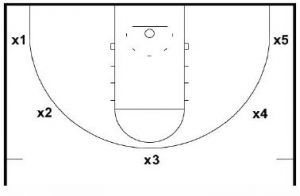
There are 5 ladders on the floor – right baseline, right wing, middle, left wing, and left baseline

Players begin shooting at 1 on each ladder

If a player misses a shot while moving up the ladder, they must start over at 1

The goal is to complete all 5 ladders in 2 minutes or less

Drill #2 200 point shooting

Basketball Drills

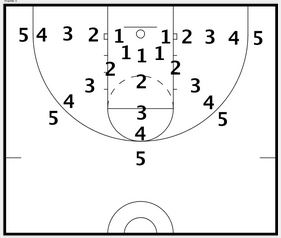
Use each of the 7 shooting areas.

Each player takes 3 shots from each area – 3pt shot (behind arc), 2pt shot (10-15 feet), and a drive for a layup (1pt). Total of 6 possible pts at each spot.

Shoot at all 7 spots (42 possible points), then each player shoots 8 free throws, leaving 50 possible points for that quarter (each round is 1 quarter).

Basketball Drills

Keep score for 4 quarters (200 possible points) and determine a winner.

Can also play 2 halves for 100 points


Basketball Plays Zipper up Runner

By Brian Williams on July 15, 2013

Coach Vonn Read has submitted several plays from his playbook series The Basketball Encyclopedia of Plays to the Coaching Toolbox. Vonn is currently serving as an assistant couch in the Women’s at Houston.

He has also served as an assistant coach in the WNBA with the Phoenix Mercury, Orlando Miracle, and San Antonio Silver Stars. He was an advanced scout for the Orlando Magic as well as The Charlotte Sting.

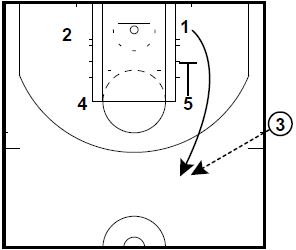
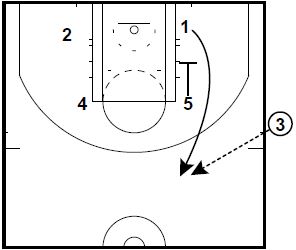
This is a very good play to run at the end of a game to get a 3 point shot


Basketball Plays

The 5 player will set a Zipper screen for the 1 player popping to the top.


Basketball Plays

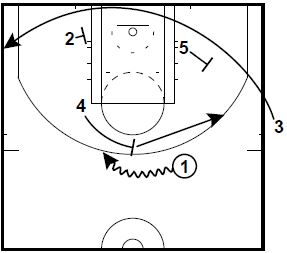
The 4 player will set a Brush Ball Screen for the 1 player.

The 3 player will run off a double screen by the 5 and 2 player along the baseline.


Basketball Plays

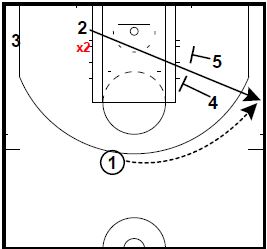
As soon as 2 sets the fake screen for the 3 player on the baseline, the 2 player will sprint hard opposite through the elevator screen set by the 4 and 5 players for the 3-point shot.


Coach Read has also put together The Basketball Encyclopedia of plays. You can check them out here: The Basketball Encyclopedia of Plays or read more about the books:

Any coach looking for the latest and innovative plays from the Professional, College, or High School levels can stop looking. With a compilation of over 7,700 different plays, you will never need to purchase another basketball playbook again. These playbooks can be used as a great reference tool for years to come. This 2 Volume Book includes plays from 19 different play categories, and they are the most extensive playbooks on the market.

The Basketball Encyclopedia of Plays (Platinum Series) contains over 7,700 Plays (Both Volumes combined) from the NBA, WNBA, USBL, and College levels from someone who has worked as an Advanced Scout or Coach on each level!!! This book has been intensely compiled over the last 21 years, with plays taken from a lot of NBA Coaches (past and present), WNBA coaches, and College coaches (Men’s and Women’s) from around the country.

Any coach that is serious about improving their knowledge of the game from an X and O standpoint will benefit tremendously from these books. These Books can be used to discover New Quick hitters, add a New Package to your playbook, or develop an entire Offensive System. There are a lot of new ideas and concepts in these books to study, and the Basketball Encyclopedia of Plays can be a great resource for coaches on all levels!!! This book is definitely for those X and O junkies who are always looking to improve as a Coach.

“THE GAME IS ALWAYS CHANGING? ARE YOU?” Vonn Read

Here is the link: The Basketball Encyclopedia of Plays

Basketball Drills 3-2-1 Shooting

By Brian Williams on July 12, 2013

This drill is from the Arizona Basketball Coaching newsletter.

If you would like to be added to their mailing list, please email me you

1) Name
2) School or team
3) Coaching Position

I will pass the information along to the Arizona coaching staff.  Their monthly newsletter includes plays, basketball drills, and information about their basketball program.

You don’t have to run the drill in this exact format and can modify it to meet the needs and skills of the players you coach and your objectives.

3 IN A ROW:

Diagram created with FastDraw

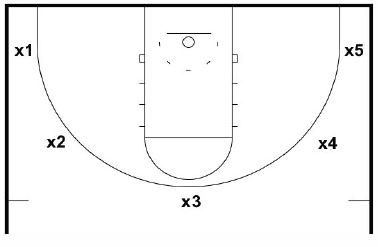
Player/Group starts on Spot X1. They must make 3 consecutive shots before moving to Spot X2.

On Spot X2, the player/group must make 3 consecutive shots to advance to Spot X3. They have two opportunities to make 3 consecutive shots before they return to the previous Spot X1.

Each spot begins on a make. (i.e. The player/group completes Spot X1 advancing to Spot X2.

Basketball Drills1

At Spot X2 the player/group misses their first two shots but makes two consecutive shots. On the opportunity to make the third shot at Spot X2, the shooter misses, counting as one chance.


The player/group misses again followed by making two consecutive shots. If the player/group makes their third consecutive shot they advance to Spot X3. If the player/group misses the third shot they return to Spot X1.)

2 IN A ROW :

Upon completing 3 IN A ROW at Spot X5, the player/group remains at Spot X5 continuing the pattern back to the initial starting position, Spot X1. The player/group must make two consecutive shots before moving to the next spot.

They now have one opportunity to make two consecutive shots before they return to the previous spot X1. Each spot begins on a make. If the player/group does not complete 2 IN A ROW on the first Spot X5, they must remain on Spot X5 but return to the first portion of the drill completing 3 IN A ROW.

1 IN A ROW :

The player/group does not start on a make. (i.e. On Spot X3,)

On the first attempt the player/group makes their shot, the player/group advance to Spot X4. If on the first attempt at Spot X4 the player/group misses, they return to Spot X3.

If on the first attempt at Spot X4 the player/group makes their shot, they advance to Spot X5.) If the player/group does not complete 1 IN A ROW on the first Spot X1, they must remain on Spot X1 but return to the first portion of the drill completing 2 IN A ROW.

Upon completing 2 IN A ROW at Spot X1, the player/group remains at Spot X1 continuing the pattern back to Spot X5. The player/group must make 1 IN A ROW before moving to the next spot. They now have zero opportunities to make 1 IN A ROW before they advance to the next spot.

The first player to complete the sequence wins. The drill should be timed and charted for accuracy.

Basketball Coaching Using Statistics

By Brian Williams on July 11, 2013

This article was written by Coach Randy Brown. He is a former D1 Assistant Coach at Iowas State and Arizona. His 18 years in college basketball highlights a successful 23-year career. Mentored by Basketball Hall of Fame coach Lute Olson at Arizona.

He has passion for the game of basketball and works as a basketball consultant and mentor for coaches. Click on the link below to subscribe to his daily email that includes links to his blog posts, plays, videos and other free resources:

Randy has a free eBook that is a great resource for basketball coaches. Cick here to download a copy:

Coach RB 100 Vital Coaching Questions and Answers

Randy’s coaching resume includes positions at Arizona, Iowa State, Marquette, Drake, and Miami of Ohio, 5 Conference Championships and 5 NCAA appearances. His efforts have helped develop 12 NBA players including Steve Kerr, Sean Elliott, and Jaamal Tinsley. To contact Randy, email him at [email protected]

Using Statistics to Effectively Evaluate Your Team

by Coach Randy Brown

Statistics are a valuable tool for coaches in all sports. A common fault is to keep general statistics that illustrate only part of the true picture of your team. To properly glean specific information from statistics you must first decide what you hope to learn from them. This article provides guidelines on how to effectively use statistics to improve your team on a daily basis.

Recently I received an email from a coach asking for advice on keeping offensive statistics for his team. Here is my response to his questions.

1. I challenged him to first decide what specific statistics he wanted to effectively evaluate his team.

2. Offensive options include shot selection, shot chart, turnovers, post touches, penetration, number of passes, set play effectiveness, and use of inside out components.

3. Defensive options include defensive transition, easy baskets, defensive block outs, contested shots, help and recover, defensive rules, and fouling.

4. Once you decide what specific items you want to see from your team you can then devise a specific statistics strategy.

5. Your staff size will determine how many different statistics you can chart during practice or games.

6. Limit your scope to one or two things on offense and defense.

7. OER is a valuable offensive measurement tool but takes time to keep and analyze.

Once you determine what specific statistics to chart you must decide how to use them.

1. Use them with your staff only to make decisions on playing time and making adjustments in practice.

2. Share with your players to help them understand exactly what you want from them.

3. Help crystallize your own coaching philosophy and develop your own Top 3!

If used properly, statistics can be very beneficial to your coaching effectiveness and your team’s ultimate success. Use these ideas to begin developing your own system of evaluation using statistics for games and practices.

Keeping Statistics in Practice Provides Many Benefits

It is said often in sports that the number do no lie. Statistics are the ultimate indicator of player productivity and effectiveness. Most basketball coaches use statistics to evaluate their games, but how many take advantage of them in practice? Discover the benefits of this approach to evaluating practice.

The high school coach faces many obstacles in terms of practice. A shortage of coaches or managers limit the amount of statistics that can be kept. If you are in this situation, get creative and do all you can to have students keep statistics for you. It will pay off exponentially for you and your team.

Four benefits of keeping practice stats are below. Hopefully one or two of them can help you.

  1. If you evaluate game stats only you are dealing with a set of numbers from a particular setting; games. Think of the number of shots, rebounds, fouls, turnovers, free throws, offensive rebounds, and fast break baskets that occur in practice.
  2. Practice stats can give a more valid picture of a player’s production due to dealing with three to four times the amount of information.
  3. It is good for players to know that practice is much more than just “practicing. They will approach their play in practice differently when they know stats are being kept. If you do take the time to keep them during practice also share them with the team at different times during practice. If you make player decisions that affect playing time, you will indeed have the attention of your entire team.
  4. Practice can fool you. At times, effort alone will fool us to think a certain player is doing a good job on the floor in practice. Stats help a coach by proving the productivity with numbers.

For example, you may feel that your starters are rebounding well. When you check the stats you realize that one of your post players had three rebounds in 32 minutes of practice action. This stat amazes you because his productivity “seemed” much higher. Remember, the stats do not lie. This lack of rebounding must be addressed. IF you have a second team player getting 9 rebounds in the same amount of time, you can use this as motivation for your starter. You may also switch the two and see how the rebounding numbers change.This is a huge benefit to keep stats in practice and has been useful for years in my experiences.

I am convinced that the level of effort, concentration, and execution in practice will be replicated in the game. Rarely have I coached a dog in practice that could be all-world when the lights come on. Players think they can do this, but they are sadly mistaken. Test them in practice and share stats with them often during practice. Keep stats for everything, especially in competitive drills and play.

The stats do not lie and will give you a better idea of how your players are playing according to the numbers. This way the numbers that are produced in the game will not be a surprise. Game production will mirror practice effort, concentration and execution every time!

  • « Go to Previous Page
  • Page 1
  • Interim pages omitted …
  • Page 223
  • Page 224
  • Page 225
  • Page 226
  • Page 227
  • Interim pages omitted …
  • Page 288
  • Go to Next Page »

Primary Sidebar

  • Twitter
  • Facebook
  • Linkedin
coachestoolbox
personaldevelopmenttoolbox
basketballplayerstoolbox
basketballtrainer
athleticperformancetoolbox
coachingbasketball

© Copyright 2026 Coaching Toolbox

Privacy Policy