• Skip to primary navigation
  • Skip to main content
  • Skip to primary sidebar

  • Basketball Plays
    • Ball Screen Sets
    • Horns Sets
    • Man to Man Post Up
    • Man to Man Isolations
    • Backdoor Plays
    • Man to Man 3 Point Shot Plays
    • 2-3 Zone Attack
    • Baseline Inbound Plays
    • Sideline Inbound Plays
    • Combination Defense Attack
  • Drills
    • Defensive Drills
    • Offensive Drills
    • Competitive Drills
    • Passing Drills
    • Rebounding Drills
    • Shooting and Scoring Drills
    • Toughness Drills
    • Transition & Conversion Drills
    • One on One Drills
  • Blueprint
  • Practice
  • Mental Toughness
  • Skill Development
  • Offense
  • Defense
  • Store

Basketball Plays Japan Double Rip

Basketball Plays Japan Double Rip

By Brian Williams on September 2, 2013

This play was in the Fast Model Plays and drills library

The play was posted by Coach Lason Perkins.

He saw it while watching Japan play in the FIBA Asia Championships.

I have also included more links to other diagrams of plays at the bottom of this post.

Coach Perkins has worked at the high school, college, and semi-pro level for over 20 years.

He is currently the Head Boys Basketball Coach at Cary Academy in North Carolina.


He has created over 20 instructional videos and 5 books on basketball offenses.

He has built a reputation for being an expert on international offenses and styles of play.
Basketball Drills

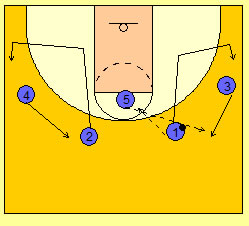
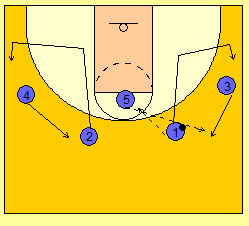
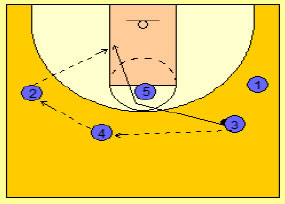
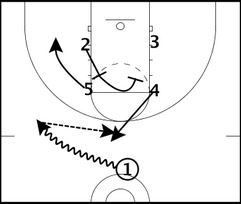
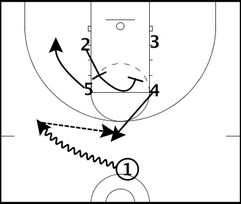
#1 dribbles to the side as #2 back picks #5.

#2 continues over and screens for #4.

#1 reverses to #4.
 

Basketball Drills

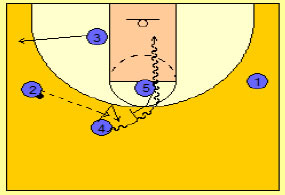
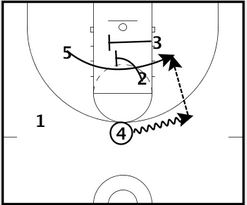
On the reversal pass #3 and #2 set a double cross screen for #5.

#4 dribbles to get passing angle for post feed.


Basketball Drills

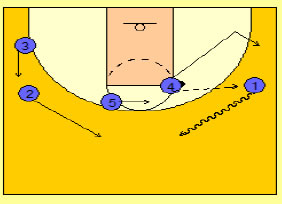
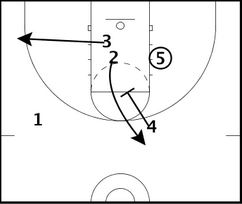
#3 clears as #4 screens for #2 coming to the top


Basketball Drills 3 on 3 Competitive Defense

By Brian Williams on August 30, 2013

Ben Jacobsen from Northern Iowa coaches a 3 on 3 competitive defensive drill to work on keeping the ball out of the paint.

Keeping the ball out of the paint is one of the six areas that I emphasize each defensive possession.

This drill is a good way to work on that or to add some variety to your 3 on 3 drills.

This is a YouTube video, so you will need to be on a server that allows you to access YouTube videos.

You will need to click the play arrow to see the video.

Make sure your sound is on as you watch.

Here is a link to all 6 of my defensive areas of emphasis if you are interested looking at those.

If you are interested in seeing more information about the DVD that the samples are taken from, click here: Competitive Drills for Man to Man Defense

Make sure your sound is on as you watch.

Coaching Basketball Del Harris Part 2

By Brian Williams on August 29, 2013

This is the second part of this article. You can click here to read the first part.

  • The best teams are the ones where the coach and the team leaders are united (requires some ego reduction on part of coach) and these players work the hardest and articulate the team message to others.
  • It is hard for a general to win without support from within the ranks. Encourage and develop leaders and relationships with them
  • Former Chuck Daly Assistant, Brendan Suhr: Fill up your players “emotional Bank Accounts”. Make 4 deposits to one
    withdrawal.
  • Encourage your players to take responsibility. The best ones have often been allowed too much freedom from this at lower levels. “My Bad” is not sufficient.
  • You can help, but players must know that they are in charge of their own attitudes, work ethic, enthusiasm, and mental/physical approaches.
  • Many times I have been asked how a coach gets an NBA player to listen. The answer is that you must be willing and able to help them get better. If you can do that, they will listen because they do want to improve. Once you quit helping them, you can lose them. Keep improving and learning yourself, therefore.
  • Learn to read body language to be able better to deal with a player that day.
  • Watch your own body language in practice and especially during games. Do not slump over at the bench or go goofy when things go wrong or a player makes a mistake. Stay in control of your body language no matter what you are feeling inside.
  • Why do coaches react so strongly to a player’s mistakes in many cases? Trust this. It is because the coach wants to divorce himself from that mistake and thus that player at that time. It is his way of telling the fans that it is not his fault. The same coach will give a body language reaction fist pump that says, “That is what I coached him to do” when the player scores.
  • One of your main goals with each player is to coach him to become the best teammate he can be. When we interviewed a player pre-draft, we always asked him about his relationship to his coaches and to his teammates. When we talked to his coach we wanted to know what kind of teammate he was.
  • When I coached college, I coined a term called “Teammanship” and in that concept we tried to inculcate things that would honor team membership and encourage team building. (On one occasion for each of my two top scorers I had to put them to the brink of elimination in order to get them to know I was serious. Thankfully, both stayed but one came in the day before he was to enroll at another college to tell me he wanted to come back and be a good team member. He led the team in scoring and we went 25-3, 6th in nation).
  • When my first of two college teams that were inducted into their own Hall of Fame en masse, all 13 players came from as far as Europe to be there. I had started with that team nearly 40 years previously, but they were still a team.
  • Other books of value—The Outliers, The Talent Code (maybe the best relative to teaching/coaching technique I have ever read), Training Camp by Jon Gordon,Leadership Secrets of Attila the Hun (great quick read), Red and Me by Bill Russell, Talent is not Enough by John Maxwell (any of his leadership books such as the Servant Leader, etc.), the magazine entitled SUCCESS, and many more.
  • Allow enough shooting time. Still the most singly important factor in the game. Bad plays look good when ball goes in and vice versa.
  • Encourage your shooters to get in their 300 or so reps every day. Nowitzki and Jason Terry get in 500 every day—every day—and they are the best for obvious reasons.
  • These players came into the NBA as poor shooters—Jordan, Dr. J., Clyde Drexler and they became Hall of Famers and good shooters. Most players become much better shooters in the NBA due to reps. Check any player’s career stats.
  • Avoid trying to keep your team at half court too much so that you can stop them and do more teaching. The game is played full court.
  • Too much time at half court will stifle a teams fast break game as the initial reaction to go to the other end is the difference in a successful break most often.
  • A team that spends too much time at half court teaching will not be as good a transition defensive team as it needs to be in most cases.
  • So more scrimmage-like situations but control the scrimmages and fulfill what you want as a teacher and what the team needs for transition offense and defense.
  • Best scrimmage teaching drills are starting with a specific situation at half court and then letting there be that possession and two more. This three-possession game is called O-D-O for Offense-Defense-Offense. On the second and third possession the teams can do whatever comes up, as that is the way the game is played.
  • Limiting the scrimmage to three possessions allows you to teach the pluses and minuses of the three possessions better because everyone can remember that short of a series.
  • Drill also some 5-possession games and do the same way. You start with a controlled half court and then the players play out four more possessions, ending up on the end they started. The game is generally played in spurts of no more than 5 possessions before a whistle is blown and this allows game feel and coach control.
  • Be inventive with these controlled sessions. Have each possession be only with 10 seconds, or have them run a particular set when they don’t have a fast break or have them go vs. man/man some and zone on other sets, and start the initial possession from out of bounds, etc.
  • You can score these by giving a point for a score and a point for a stop. With 3 possessions (or 5) there will always be a winner since there are an uneven number of points available. The winner of each one can start the next set if you want. Or you can keep track of the number of sets each team wins to determine a winner. Award the winners.
  • You never waste time when you do the defensive shell drills.
  • Remember that you must emphasize defense, but offense is more involved because it involves ball skills and exact timing. Thus, offense takes more time.
  • I always doubt coaches who say they spend far more time on defense than offense. Why would you do that when offense requires much more teaching and time?
  • Hopefully, anyone should realize that you could teach both offense and defense at the same time, as you generally have players on both sides of the ball in drills unless they are just defensive slide drills. So teach both at the same time.
  • Even in the most dedicated of offensive drills, if a player does well or poorly on defense, you cannot overlook that. More time on offense, more emphasis on defense.
  • Your team will reflect what you emphasize.
  • You are an offensive or defensive coach relative to what upsets you. If you say you are a defense coach but never sub for poor defense by your better players, you are not a defense coach. (If he is really good, you don’t have to leave him out for long—you made a point).
  • If you are an execution coach but don’t get upset at the lack of execution, then you really are not what you say you are.
  • Summary Note

  • Over the years your teams will be identified by about 3-5 things that they do well—not 10-15 things. Those are the things you teach well and that are important to you.
  • With the great coaches you always know what their teams will do well. So decide how you want to be typified and stick with that as long as you are successful. Make subtle changes as you go, but stick with your winning core.

Basketball Drills 3 Lane Sureness

By Brian Williams on August 28, 2013

Taking care of the basketball requires many skills as well as a mindset of toughness.

The video in this drill is a 3 on 3 drill to work on sureness with the basketball being conducted by Coach Dave Paulsen. At the time this video was filmed, Coach Paulsen was at Bucknell. He is currently the Head Men’s Coach at Holy Cross.

Make sure your sound is on. I also have the rules for the drill listed to go along with the video.

To learn more about the entire DVD that this sample came from, click here: All Access Bucknell Basketball Practice. Anyone who purchases anything from the store receives one of my basketball coaching eBooks as a bonus. Just email me and let me know which one you would like to receive!


3 Lane Sureness Drill Rules

– Court is divided into 3 lanes

– Offense must stay in their lane and pass to the player in the lane next to them

– Offense is trying to go the length of the court

– Get open, don’t dance

– Make your man change planes and directions to get open

– Hold your man off

– If your man overplays you, back cut

– Defense is trying to get a steal or deflection, steals and deflections count as 1 point for the defense and ends the offensive possession

– After a turnover, the next group goes

– Switch offense and defense on the way back

To learn more about the entire DVD that this sample came from, click here: All Access Bucknell Basketball Practice. Anyone who purchases anything from the store receives one of my basketball coaching eBooks as a bonus. Just email me and let me know which one you would like to receive!

Coaching Basketball Del Harris

By Brian Williams on August 27, 2013

Some insights from former Lakers, Rockets, and Bucks Head Coach Del Harris

Before You Start

  • Be sure you have a mission statement that is current with your current thinking and then stay committed to that statement. Be sure your staff and players understand.
  • Make sure your philosophy of coaching, of defense, of offense and of dealing with players and other constituents is clear-cut and understood by yourself and staff.
  • Leave a paper trail. Keep copies of important communications with all relevant parties. Notes, dates and times of any significant meeting with players, media, etc can be of value.
  • Be sure you have a plan for the first day, week and rough copy for first month of your practices.
  • Be sure any staff is up to date on current trends in conditioning, nutrition, etc. These change.
  • Be sure to read current books and old standards on leadership, management skills, time management, significant biographies of important people and successful coaches in any sport. You must continue to grow mentally and spiritually.
  • Revise your drill book (you have one don’t you?) to add any new concepts you have picked up and to discard needless ones.
  • The best drills are the ones you make up that teach specifically the exercise you are trying to teach/correct.
  • Your drill book should be divided into categories such as: warmup, shooting, fundamentals of offense/defense, fast break buildups for offense and transition defense, half court offense, post offense/defense, trap drills, defense shell drills, situation drills for 1-1, 2-2 and 3-3, game ending situations drills, etc.
  • Be sure to be clear on all basic defense issues such as you initial and backup coverages relative to pick and roll defense, low post defense, and methods of rotation to cover breakdowns.
  • Make sure your coaches and players understand the concepts of switching on defense such as which teammates will be able to switch with each other on their own as needed or desired unless the game plan or a timeout changes it—have switching partners which normally means that equal size players will switch with one another as needed.
  • Know that the concept of switching to keep your bigger players inside and your smaller ones outside is often very productive, i.e. “Bigs in, Littles out”. Thus you would not switch a big man out off of a downpick or pindown for a small player.
  • Your team will reflect what you emphasize. Take your pick, but only about 4 or 5 will be the limit as to what they will attach themselves to, so choose wisely.

    1. Defense
    2. Rebounding
    3. Unselfish play—team unity—team attitude
    4. Running game
    5. Half court game
    6. Pressing team—running team
    7. Physical team
    8. 3-pt team
    9. Zone team
    10. Ball and player movement team, etc.

    Game Time:

    • Be sure you have a helpful game card with you at all times such as quarterbacks have on their sleeve or arm.
    • A good game card will not only have all your play calls, but will have categories that will get you a post up as needed and that tell you what plays you have that will get each position (1 through 5) a shot when you want one of those players to have the ball.
    • On the back of the card of on a special situations card you can have in your pocket or an assistant will keep be sure to have plays already diagrammed that are for special late game situations such as: when you need a 3 pointer, or a quick 2, or you have differing amounts of time on the clock to get a shot.
    • Be smart on what you chart and have accountable chart keepers. A possession chart can tell you the pace and momentum of the game because it will tell you how many possessions you have had at every time interval and once you know your best pace, you can tell if you are dictating or if the opponent is.
    • Momentum is revealed by a possession chart in that it shows how many times you and your opponent have scored or failed to score in the most recent possessions.
    • Other charted items may be the fast break game on both sides of the ball, the low post game (scores allowed/how traps have worked, etc), the pick and roll game (percentage of scores/stops), deflections, penetrations allowed, uncontested shots allowed, and whatever else you deem to be of real value.

    As you go along:

    • Prove you are valuable and success will happen for you. Forget about the entitlements.
    • Be careful of the player who insists he is all about winning, but doesn’t work like a winner. He is usually happy when things are going his way, whether the team is or not.
    • The team that will accept we over me (we/me) as a group has a chance to achieve all they are capable of.
    • There is no “I” in team but there is “ME” but it tears up TEAM to get it. META spells disaster for the team; it says that the “ME Trumps All” the rest of the team.
    • Doc Rivers: Try to keep the “chemistry guy” on your team. Doc moves the lockers around occasionally to keep the right people together or separated as needs be.
    • Del Harris: Speak to players often, but more on the conversational level than any other. Get to know them and then prove that you care about them.
    • Del Harris: The Caring-Trust-Loyalty Dynamic is of utmost importance to a successful organization. First show you do care consistently. Caring leads to trust. Trust breeds loyalty and loyalty is of true value.
    • Jerry Sloan coaches with the idea that he wants to be a friend of his player/s 20 years down the road. Now you know he is not a softie, but he cares and his players know it. They trust him and are loyal to him and they just find a way to win every year. That is true coaching.

    Del Harris: There are five levels of communication with players—use each one less than the one before it as you go down the levels.

    1. Conversational level—you have the give and take whereby you get to know the player and he learns you as well. You demonstrate you care. Use this the most.
    2. Encouragement level—voice is animated and enthusiastic. Use it as much as you can, but it has to be a result of real achievement, not just blowing smoke. But the worst person to be with is the one you simply cannot please. Be real.
    3. Instructional level—voice is slightly animated as you attempt to pass on teaching points that may help your player get better, or that may help him understand the team concept. Use often, but mostly in practice or in certain 1-1 situations.
    4. Correctional level—voice increases somewhat in urgency, but this is not to be confused with screaming. Naturally, this is used on important issues in practices and games to help eliminate errors. Use it as needed,
    but if it overwhelms the encouragement level, the team will tune you out sooner than later.
    5. “Go Nuts” level—yes, there is a place for letting them know that they have crossed the line in terms of lack of effort or execution or attitude, etc. They must know you really care about certain issues. But, of course you
    must maintain control here, as it should be a purposeful act. Overdo this level and you will lose your team by Christmas unless you are winning every game.

    Click here for a more detailed article written by Coach Harris on the Five Levels of Communication

    • You need a “closer” in every business, someone who can seal the deal often. Know who yours are. This is not an equal opportunity situation. Be able to run your stuff to get the ball to the “closer” in need situations.
    • Do not underestimate the value of a player who can inbound the ball in pressure situations. Lack of this ability will beat you in the close games. The chances are you will have no more than two of these, if you actually have anyone. Develop one.
    • Every team wants to win the championship. Talk about it on the first day, and then forget the talk until you are playing for it. Your goals must become closer at hand and the main one is to get better every day/game. That is the path to championships, not talk.
    • Most of your players will be role players. Most will think they are key players. As coach you must laud the roles you assign; make them be understood and appreciated. Without the dedicated role players you cannot succeed.
    • Have simple goals for your role players. Just 1 or 2 stats per quarter can add up to being the difference—a steal, a rebound, a free throw, a deflection, an assist, etc. Just a little goes a long way.
    • Check it out—NBA teams seldom have more than 3 players who are more than role players—ones who produce consistently across the stat sheet and make others better. The 80+ percent are role players.
    • Coaches who talk too much in practice can kill the team’s ability/need to communicate. Coaches who chatter too much give the appearance of working hard but actually stifle the players in developing their own skills of communication.
    • Simplify your teaching and communication. This will reduce confusion. An athlete that is not decisive and confident in what he is to do will be hesitant and a hesitant athlete will fail.
    • NBA asst. coach Brendan Suhr (Daly disciple): you must coach each player differently. It’s about their strengths and needs, not yours. Read books: Strength Finders and Strength Finder 2.0.
    • Identify your leaders and lieutenants. You must connect early with them and get them to understand and promulgate your mission and goals for the team.

    Click here to read part two of the article

Basketball Plays Chin Set

By Brian Williams on August 26, 2013

These diagrams came from one of Creighton Burns’ newsletters.

This is an offense that John Beilein has used over the years of his coaching career.

Coach Burns gave Jamie Angeli credit for sharing this set.

Start in 2 – 3 set. There are 3 different ways to get into this set.


Basketball Plays

Guard to Center Pass – #1 passes to #5
#1 and #2 then both cut hard to the basket.
If #5 can pass to either #1 or #2, he passes to them for a backdoor lay-up.
#3 and #4 come out to replace #1 and #2.
If the backdoor is not open, #5 passes to #3 or #4.


Basketball Plays

After #5 passes to #3.
#3 passes to #4.
#4 reverses to #2.
#3 then rubs off #5 on a hard cut to the basket.
#2 passes to #3 for the lay-up.


Basketball Plays

If #3 is not open:
After #4 reverses to #2, #4 v-cuts towards the basket and then pops back out.
#5 banana cuts to screen #4’s defender.
#2 passes to #4 after he pops back.
#4 shoots the 3-pointer or drives hard off #5’s screen for the lay-up.

Basketball Plays

If #4 is cut off by his defender, #4 passes to #1 for a 3-pointer.
If #1 is not open for a shot, he dribbles high.
#2 comes high on the left side.
#3 moves up to the left wing.
#4 after passing goes to the corner and then moves up to the right wing.
 
#5 moves toward the middle of the free throw line.

Basketball Plays

Now the same pattern is run on the right side of the floor.

#1 passes to #4.
#2 rubs cuts off #5 and cuts hard to the basket.
#4 passes to #2 for the lay-up.


Basketball Plays

If #2 is not open:
After #1 passes to #4, he v-cuts towards the basket and then pops back out.
#5 banana cuts to screen #1’s defender.
#1 shoots the 3-pointer or drives hard off 5’s screen for the lay-up.


Basketball Plays

If #1 is cut off by his defender, #1 passes to #3 for the 3-pointer.
If #3 is not open for a shot, he dribbles high.
#4 comes high on the right side.
#2 moves up to the right wing.
#1 after passing goes to the corner and then moves up to the left wing.
 
#5 moves toward the middle of the free throw line.

The same pattern now starts on the left side.

  • « Go to Previous Page
  • Page 1
  • Interim pages omitted …
  • Page 218
  • Page 219
  • Page 220
  • Page 221
  • Page 222
  • Interim pages omitted …
  • Page 288
  • Go to Next Page »

Primary Sidebar

  • Twitter
  • Facebook
  • Linkedin
coachestoolbox
personaldevelopmenttoolbox
basketballplayerstoolbox
basketballtrainer
athleticperformancetoolbox
coachingbasketball

© Copyright 2026 Coaching Toolbox

Privacy Policy