• Skip to primary navigation
  • Skip to main content
  • Skip to primary sidebar

  • Basketball Plays
    • Ball Screen Sets
    • Horns Sets
    • Man to Man Post Up
    • Man to Man Isolations
    • Backdoor Plays
    • Man to Man 3 Point Shot Plays
    • 2-3 Zone Attack
    • Baseline Inbound Plays
    • Sideline Inbound Plays
    • Combination Defense Attack
  • Drills
    • Defensive Drills
    • Offensive Drills
    • Competitive Drills
    • Passing Drills
    • Rebounding Drills
    • Shooting and Scoring Drills
    • Toughness Drills
    • Transition & Conversion Drills
    • One on One Drills
  • Blueprint
  • Practice
  • Mental Toughness
  • Skill Development
  • Offense
  • Defense
  • Store

Basketball Drills Stephen Curry Shooting

Basketball Drills Stephen Curry Shooting

By Brian Williams on October 25, 2013

I hope that you are able to use this drill in practice for some of your better shooters. Or better yet, can adapt it to the skills that your shooters have or need to acquire.

These drills were originally posted on FastModel Sports Plays and Drills Library by Coach Greg White. Here is what he said about the drill:

I saw Stephen Curry doing this before a game so we decided to make a drill out of it. This is a great drill because you (1) get conditioning and game type shots, (2) movement and (3) you can use both sides of the floor.
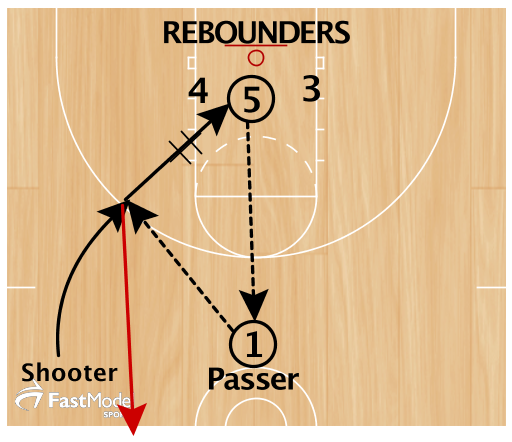


Basketball Drills

Drill starts with pass to the shooter for a wing 3. After the shot the shooter runs back to half court. The rebounder with the ball passes to the passer so the drill doesn’t lag
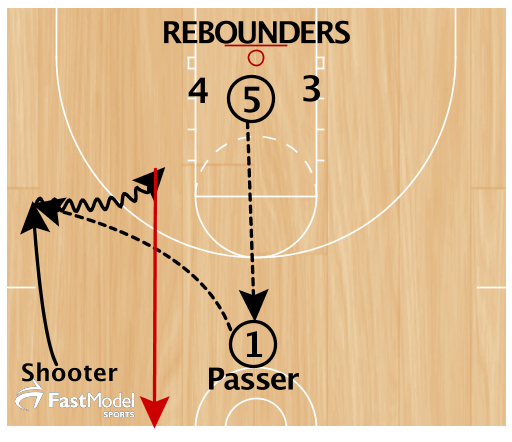


Basketball Drills

On a make the routine is the same. After a miss, the passer throws the ball out in front of the shooter. The shooter must catch, make a move and take a mid-range shot.

We set the scoring as follows:


The Shooter must make 3 3pt shots to complete the drill. They do not have to be in a row. Mid range Shots do not count as a make.

Advanced: The Shooter must make 4/5 shots including the mid-range if they miss a 3pt shot.

Expert: The Shooter must make 3 consecutive 3pt shots.
Basketball Drills Duke Defensive Drill

By Brian Williams on October 24, 2013

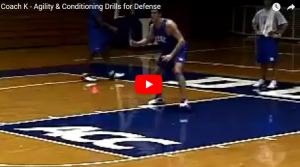
This video is of an individual defensive drill used by Duke to work on help and recover, closing out, and conditioning.

The video is a YouTube video so make sure that you are on a server that allows YouTube access.

If you are not, I have a link to be able to watch the video on the Championship Productions site.

I have also listed some other drills from the Duke program at the end of the post

Please use the like or tweet buttons on the right to share this post with others!


The video is a little over a minute long.

To find out more about the DVD that this sample came from, click here: Mike Krzyzewski: Duke Basketball – Agility & Conditioning Drills for Defense

Make sure your sound is on.

Del Harris 8 Point Transition Offense

By Brian Williams on October 24, 2013

Del Harris is the former head coach of the Lakers, Bucks, and Rockets. Coach Hariis guided the Rockets to teh 1981 NBA Finals.

I have had a couple of email correspondences with him and he has gracioulsy provided me with a few articles for the site that I will be posting in the coming weeks.

He went to high school and started coaching in Indiana and I have crossed paths with a few of his former students and players. They all say that even with the success he has enjoyed, he has remained loyal to those who knew him on his way up the coaching ladder.

8 Points for Transition Offensive

Del Harris

There are some basic things that help these things to happen. You may do any or all of them already or in the future.


1. Always have the ballhandler “loop” to get open either when the ball is ob after scores or after the Rebound when possible. Hopefully, you understand looping, but it is mainly that to prevent the ballhandler (we will call him the PG from now on) get the ball on the move and never with his back to the defense. Looping puts him in motion and in a position where he has his back mainly to a sideline, not the halfline.

2. Do not have your first big man running the court to run in the exact vertical middle of the floor. He should run on the weak side of the middlei, more in line with the weakside block. We rim run, but not directly down the middle to the rim. We have them slightly on the weakside and he can cross the lane right in front of the goal to catch a lob on a high pass option or he can cut across later to the strong side block when he doesn’t get the lob option. He will read to cut across to the strong side block only when he sees that the PG will not be penetrating all the way to the goal in the transition. He keeps the PGs lane to the rim open in this way and puts himself in position to rebound a shot by the PG or to get a late high pass from the PG on a drive if his defender leaves him to attack the PGs penetration. In addition, the running of the court this way not only puts the big man in position to catch the lob, it also creates a better pass angle from the PG if a pass is made earlier than at the rim. Running down the middle makes it harder for the PG to make a pass that is catchable in stride because the big man is forced to try to catch that is coming at an angle more over his back instead of from the side angle. This same principle applies on the pick and roll—the big shold open up to an angle on his cut as opposed to cutting straight to the goal so as to give the passer an angle to make the Pocket Pass or the lob.

3. As for the wings—look for the pass ahead in the half line area, but when he sees he is not going to get the pass ahead, he should not stop on the wing—vital point. He must then continue on to the corner or cross under the goal, as you wish. But the stop on the wing is a killer to transition unless totally open to catch an early pass at the extremely high wing angle nearer the half line.

The reason is that his defender can help make the penetration lane to the basket look crowded and take away his drive to the goal option. Again, if the big man has already gotten to the strong side block and the wing man is stopped on the wing, the only option the PG has is to swing the ball off a pass or a transition PNR.

4. If the wing gets the pass ahead he should look to attack and if the big man has run correctly, he will be on the weak side part of the lane and can get a high pass just as if the PG were penetrating. And he is in position to rebound the jumper or floater or to get a good high pass if his man attacks the wing penetration.

5. If the wing has gone to the corner, he must be ready to come up a step or two ot of the corner if the PG decides to penetrate the lane. He will read his defender in this act. If the defender drops to help vs. the PG, he is in position to catch the ball in rhythm to catch and shoot or to catch and turn the corner for a second penetration. The PG will pull to the strong side corner to replace the wing man and follow up the penetration by the wing. On the other hand, if the defender on the wing stays up on the wing man in the corner on the PG penetration, the wing has the option to backcut if he reads it early enough so as not to get right in the PGs path.

6. Big thing is that if there is no easy, clear option on the first side as we have discussed in the first 5 points, do not force the action on the first side. I don’t like a forced shot, drive or pass on the first side. First side action must be clearcut. Otherwise, swing the ball and look to attack. In high school or college there is always time to set a play after the ball has been swung, if you are a set offense coach. I always like to have 3-4 options off of the secondary break—when that first side action is not there but the defense is not set. I like to keep it various ways–either by hand or verbal signals, or by the dribble or pass action by the PG or by his cut if he has thrown the ball to the strong side wing or even to the top.

7. The second key to having a simple, yet multiple, transition game is to have the trailer do different things when he is in the swing position. Of course, one is that he can run a transition PNR on the ball handler that must not be a stop and pick, 2-step option, but rather a fluid dynamic motion where he crosses in front of the PG and intiates more of a crossing action in the PNR than a regular PNR. But more than that, he can pass the ball on to the weak wing and cut to the goal or screen the low man or set a double on the weakside with the PG for example. Or he can pass to the wing and follow the ball to set a PNR on that man, if he is PNR capable.

8. Another thing that one can do is to have the weak side wing man to be alert to do one of two things: He can run to the corner as well when he is well out in front and then be ready to move up to present himself as an outlet if the PG penetrates and gets stopped—if the PG goes all the way to the baseline, he will drift back down to the corner to be the baseline drift man. Or, secondly, if he is not out in front on the transition, he should run to the high angle spot between the middle of the court and the foul line extended weak side and look to get a deep kickout pass from the guard or the strong side wing on penetration. If he is a 3-shooter, he can let it fly. If he is not he is in a position to penetrate or pass inside.

Del Harris, GM Texas Legends
Author, On Point -four steps to better life teams
You can read a free sample by clicking here: On Point Sample

This is what Coach Harris had to say about the book:

“Every coach should have his point guard read my book. It came as a result of my speaking at the Nancy Lieberman
Award in Detroit in 2010. I wanted to say something that would make sense to the hundreds who would be there who were not the women’s NCAA D-1 best point guard in America, getting the award named for Hall of Fame PG and all time greatest woman player. I came up with the idea of noting the qualities in terms of abilities and attitudes that made for great point guard play. Then I showed how we all could mine those elements from within ourselves on the various Life-teams of which we are and would become a part.

The book will not only be good for the PGs to read but will absolutely make the coach a better coach. I wish I had known all that I have written when I was in my 20s , 30s or 40s. I am totally confident that what I have written is truth and it is backed up totally by biblical principles.”

Best regards and blessings to all, Del

For another sample and if you are interested in purchasing the book, you can click this link to see it on Amazon:

On Point: Four Steps To Better Life Teams

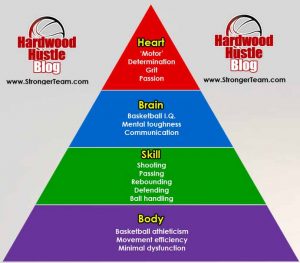
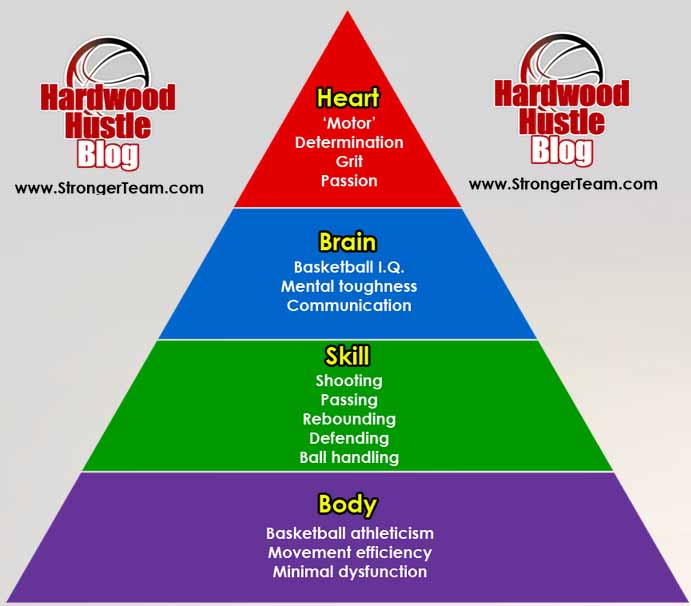
Basketball Coaching Complete Player Pyramid

By Brian Williams on October 23, 2013

Originally posted by Alan Stein of Pure Sweat Basketball

Something to share with your players. and to think about as you plan your season.

I have also included some links to other articles that Alan has written at the end of this post

It doesn’t matter how athletic a player is, if they aren’t skilled, they won’t be very good.

It doesn’t matter how athletic or skilled a player is, if they have a low I.Q., they won’t be very good.

It doesn’t matter how athletic, skilled or smart a player is, if they have no heart, they won’t be very good.

The only way you can build this pyramid successfully, and so it will last, is brick by brick.

Every rep of every set of every workout is another ‘brick.’

How many bricks will you add today?

Get better. FASTER.

Alan Stein
Hardwood Hustle Blog
http://www.About.me/AlanStein

Defensive Change Drill

By Brian Williams on October 22, 2013

This video is of Fran Fraschilla coaching a couple of drills that you probably already use

The video is a You Tube video so make sure that you are on a server that allows You Tube access.

If you are not, I have a link to be able to watch the video on the Championship Productions site.

I have also listed some other defensive conversion drills at the end of the post.

You can also see other basketball defensive drills that are a part of our site at this link: Basketball Defensive Drills Site

I like to use this drill to simulate and practice converting to defense when we commit live ball turnovers, which in my opinion are more difficult to defend than a missed shot.

You can run this defensive change drill either half court or full court.

If you run it as a half court drill, it forces the offense to adjust to defense more quickly. If you run it as one of your full court defensive drills, it is more game-like in terms of the angles and distances that your players will need to use to convert to defense when they turn the ball over.

I like to run the drill with a coach calling “Change!” rather than having the coach blow the whistle. We want our players to play as hard as they possibly can until the whistle blows, so I don’t ever like to use the whistle to do anything in practice other than to stop the action.

Here is the basic setup to run these 2 basketball defensive drills.

If you are running the drill half court: Offense, runs their regular offense and attempts to score. I think it is best to develop a scoring system so that the offense is intense in their execution of screens, cuts, passes, catches, and all other fundamentals. We have a scoring system for all of the drills that we run. If they know that they are not being scored and that the drill is not competitive, their natural human tendency will be to relax.

We keep score for the drill just like we keep score in a game, 3s, 2s, and free throws. We have one of our assistants keep track and make sure that both teams have an equal opportunity to take shots before we yell “Change”

One team is on offense and one team is on defense. When “Change!” is called, the player with the basketball puts the ball down on the spot they are on on the floor. You have to set that rule for both of these basketball defensive drills site or players will roll the ball away from their opponents to gain an advantage. When that happens, we give the other team 2 points. (You could deduct 2 points from the team committing the rules violation of rolling the basketball, but that gets difficult for the scorekeeper to keep track of.)

On the “Change!” command, the defense becomes the offense and the offense becomes the defense. However, the new defensive team must all guard a different player than was guarding them. This rule in the drill forces them to talk to each other to get this accomplished. It creates confusion, just like there is in a game when they turn the ball over. As a matter of fact, when they get frustrated by the confusion, it is a good time to teach them that they can cut down on that in a game by taking care of the basketball and not turning it over. Another important teaching point is that in a scramble situation, the first two things that must happen are that someone needs to take the basketball and someone needs to get to the basket to protect it. After those two items are covered, the final job is to match up with the remaining players.

The full court version of these two basketball defensive drills is run the same as the half court, with the two differences being that the team going from offense to defense is not required to guard a different player than the one guarding them and that the team transitioning from defense to offense goes to the basket at the opposite end of the floor rather than trying to score at the basket that they were just defending.

If you are interested in purchasing this or any other Championship DVD, you can use this link:

Defensive Awareness Drill

Make sure your sound is on.

Below are more links to other basketball defensive drills sites that are posted on the Coaching Toolbox:

Basketball Plays Pistol Side Chest 4

By Brian Williams on October 21, 2013

Coach Vonn Read has submitted several plays from his playbook series The Basketball Encyclopedia of Plays to the Coaching Toolbox. Vonn is currently serving as an assistant in the Women’s at Syracuse.

He has also served as an assistant coach in the WNBA with the Phoenix Mercury, Orlando Miracle, and San Antonio Silver Stars. He was an advanced scout for the Orlando Magic as well as The Charlotte Sting.

Diagrams created with FastDraw


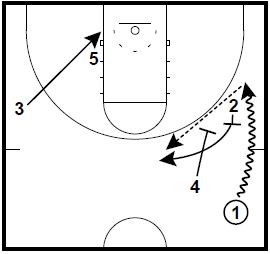
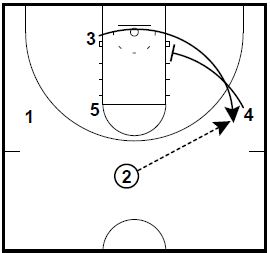
The 2 player will set a step up screen for the 1 player, and then 2 will receive a screen from the 4 player looking for the 3-pointer.

The 3 player will stack on the opposite block with the 5 player.


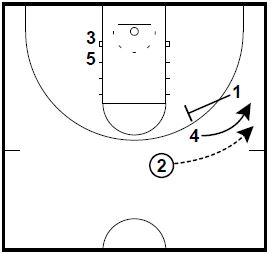
If the 2 player does not have a shot, the 1 player will set a flare screen for the 4 player (Shooter) for a 3-point shot.


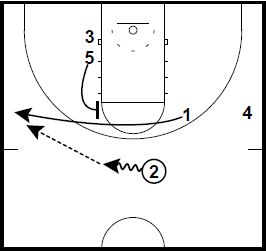
If the pass is not open to the 4 player, the 1 player will cut to the weakside off of a screen set by the 5 player for the 3-pointer.”


If the 1 player is not open, the 3 player will come off of a pindown screen set by the 4 player for the 3-pointer.


Coach Read has also put together The Basketball Encyclopedia of plays. You can check them out here: The Basketball Encyclopedia of Plays or read more about the books:

Any coach looking for the latest and innovative plays from the Professional, College, or High School levels can stop looking. With a compilation of over 7,700 different plays, you will never need to purchase another basketball playbook again. These playbooks can be used as a great reference tool for years to come. This 2 Volume Book includes plays from 19 different play categories, and they are the most extensive playbooks on the market.

The Basketball Encyclopedia of Plays (Platinum Series) contains over 7,700 Plays (Both Volumes combined) from the NBA, WNBA, USBL, and College levels from someone who has worked as an Advanced Scout or Coach on each level!!! This book has been intensely compiled over the last 21 years, with plays taken from a lot of NBA Coaches (past and present), WNBA coaches, and College coaches (Men’s and Women’s) from around the country.

Any coach that is serious about improving their knowledge of the game from an X and O standpoint will benefit tremendously from these books. These Books can be used to discover New Quick hitters, add a New Package to your playbook, or develop an entire Offensive System. There are a lot of new ideas and concepts in these books to study, and the Basketball Encyclopedia of Plays can be a great resource for coaches on all levels!!! This book is definitely for those X and O junkies who are always looking to improve as a Coach.

“THE GAME IS ALWAYS CHANGING? ARE YOU?” Vonn Read

Here is the link: The Basketball Encyclopedia of Plays

  • « Go to Previous Page
  • Page 1
  • Interim pages omitted …
  • Page 212
  • Page 213
  • Page 214
  • Page 215
  • Page 216
  • Interim pages omitted …
  • Page 288
  • Go to Next Page »

Primary Sidebar

  • Twitter
  • Facebook
  • Linkedin
coachestoolbox
personaldevelopmenttoolbox
basketballplayerstoolbox
basketballtrainer
athleticperformancetoolbox
coachingbasketball

© Copyright 2026 Coaching Toolbox

Privacy Policy