• Skip to primary navigation
  • Skip to main content
  • Skip to primary sidebar

  • Basketball Plays
    • Ball Screen Sets
    • Horns Sets
    • Man to Man Post Up
    • Man to Man Isolations
    • Backdoor Plays
    • Man to Man 3 Point Shot Plays
    • 2-3 Zone Attack
    • Baseline Inbound Plays
    • Sideline Inbound Plays
    • Combination Defense Attack
  • Drills
    • Defensive Drills
    • Offensive Drills
    • Competitive Drills
    • Passing Drills
    • Rebounding Drills
    • Shooting and Scoring Drills
    • Toughness Drills
    • Transition & Conversion Drills
    • One on One Drills
  • Blueprint
  • Practice
  • Mental Toughness
  • Skill Development
  • Offense
  • Defense
  • Store

Basketball Drills Wichita State Skill Development

Basketball Drills Wichita State Skill Development

By Brian Williams on November 2, 2013

This is a 4 minute video of Coach Gregg Marshall going through a drill that they use with their perimeter players to attack double teams.

There is a second drill at around the 3:30 mark for working on handling 1 on 1 full court pressure.

The video is a YouTube video.

Make sure your sound is on as you watch.

If you are interested in learning more about the entire DVD that this sample came, click this link.

Anyone who purchases anything from the store receives one of my basketball coaching eBooks as a bonus.

Just email me and let me know which one you would like to receive!

The video is 4 minutes and 24 seconds. Make sure your sound is on.

If you are interested in learning more about the entire DVD that this sample came, click this link. Anyone who purchases anything from the store receives one of my basketball coaching eBooks as a bonus. Just email me and let me know which one you would like to receive!
Del Harris Offensive Spacing

By Brian Williams on November 1, 2013

Del Harris is the former head coach of the Lakers, Bucks, and Rockets. Coach Harris guided the Rockets to the 1981 NBA Finals.

I have had a couple of email correspondences with him and he has graciously provided me with a few articles for the site that I will be posting in the coming weeks.

He went to high school and started coaching in Indiana and I have crossed paths with a few of his former students and players. They all say that even with the success he has enjoyed, he has remained loyal to those who knew him on his way up the coaching ladder.

Specific Areas to Consider Re-Evaluating (Offensive Spacing)

  1. Maintaining Spacing—with better player movement on penetration and post passes.
    1. Points:
      1. Dribble penetration is the most dangerous offensive weapon in the game today.
      2. Ball skills are much better than previous generations.
      3. Problem areas are perimeter movements: Basic post moves on penetration are well known and executed by now.
      4. Whether strong or weak side the posts are good at moving opposite and opening up to a catch/shoot position.
  1. Perimeter player’s movements.
    1. Players in front of penetration should move against (into) the direction of the penetration as opposed to drifting in the same flow as the ballhandler.
      1. Breaks the 3-in-a-row alignment with ball, teammate in front and that man’s defender.
      2. Allows the front player to move into rhythm to catch/shoot or to make a second penetration.
      3. Second penetration will often create something more positive than the first, especially if the passer will go behind his pass.
      4. Defensive balance is key. If the ballhandler shoots or dishes off inside, the front defender is already in a better position for defensive balance than is one who drifts away in the same direction as the penetration.
      5. Corner shooters should both move up when there is penetration from the front, making both perimeter targets and putting them in positions to be back on defense.
      6. Alert: be ready to backcut. In the case where the defender on the man in front does not open or drop to commit to give help to the ball, but maintains visual and /or body contact with the front man, the rule can be broken if the player thinks he can make a good backcut to the goal.
      7. He should continue the cut on through if he does not get the ball.
    2. Players behind the ball on penetration must rotate to follow in the direction of the penetration.
      1. This puts him in position to serve as a safety outlet in the event that the penetrator gets stuck.
      2. In the case of a baseline penetration it is especially vital that the nearest perimeter player follow the penetration since the best defensive teams will attack the ball at the baseline, cutting off clear passing angles in front.
      3. The ballhandler knows he can stop and reverse pivot and get the ball out of the problem when he has a player is in the safety position behind him.
      4. The followup man will be open for a catch and shoot or an easy penetration or reversal because the defender on the player following up the penetration will normally drop down toward the help area.
      5. Create four targets. Making this cut also opens up the floor for the penetrator, as he will have 4 targets—the safety, the post who moves, and the other two perimeter players will be in good positions.
      6. If the play started from the front with both corners filled, they will have moved up a couple steps and there will be the safety and a player at a weak side diagonal angle on the perimeter for him as well as a post man who will have moved opposite the ball. (Note: after stepping up initially, the player in the weak side corner will drift down to the corner if the penetrator goes deeper than the dotted line in both points vi and vii.)
      7. If the play started with no one in the strong side corner, the penetrator will have a safety behind him and a man moving up in the weak side corner area and a man at the weak side diagonal spot, as well as the post man.
  1. Cross-penetration. The same principle for the corner area player applies to a player in the front court who has the ball penetrated toward him by the other front court player or the wing man nearest him.
    1. This one is generally violated by players at all levels as they drift in the direction of the ball, putting the off-ball defender in a great position to help on the penetrator and still stay directly in line with the pass to the drifter.
    2. Again, this puts the second offensive player in a defensive balance position, has him catch in rhythm with a better chance to shoot or make a second penetration.
    3. A turnover is a layup when there is a steal on a pass to a front man who drifts away from the ball.
  1. Do not jam up a player in the low post with poor cutting techniques.
    1. The best cuts when the ball is passed into the low post from the wing are the baseline cut and the drift to the corner.
    2. The worst cut is the middle cut unless you have a specific move set up to pick the weak side low post man (e.g. Laker’s Triangle)
    3. The middle cut jams the lane and lets a defender drag through to hamper the post man’s inside move; and allows for an easy trap.
    4. If you want a middle cut, then at least pick for the next perimeter man on top as in a high split action so that a player is brought over to the strong side.
    5. If the ball is passed into the low post in a three-man wing and corner triangle, the corner man must cut hard baseline as in the Triangle offense. The wing man will drift down (or even up a little) but must stay on the strong side unless he picks away at the top to bring another man to the strong side.
    6. In a two-man game, wing to low post, the wing man should cut hard baseline or drift to corner as noted.
    7. But then the next man on top must move to a position on the strong side that is at least two full steps (more is better) past the vertical line of the ball so that only two or three offensive players are on the weak side of the posted man, depending on whether the feeder cut through or drifted.
    8. Big common error is the high drift—in a two-man game it is not good for the feeder to drift high toward the weak side, loading up the weak side of the floor. Reasons:
      1. This puts 9 players behind the post man and allows the defense to have to defend only half of the front court.
      2. The post man has no easy outlet in front of him, the safest pass he will be able to make if he gets doubled.
      3. Shortens rotations. It’s easier to double the post because the rotations to get back to defenders are so short with the floor compacted.
      4. It’s harder for a slot cutter to be able to get a pass on a cut into a lane that is clogged up with so many players.
      5. Self-inflicted wound. Bottom line is that it creates terrible spacing.

Note: However, if a wing passes to a man in the medium post or if it is a clearout for a 1-1 on the wing or mid-post, the high drift is the right cut to make.

But if he backs all the way down into the low post, then the nearest top man should move out to the strong side wing as the outlet and to open up the weak side, just like when the play starts in the low post.

  1. Players should learn the basics of the passing game. Simplified version is enough.
    1. No need to be a passing game team, just need to know the elements because it is basic basketball and is best learned 3 on 3.
    2. See the accompanying notes regarding some simple passing game techniques a team can use by learning it in 3 on 3 basic training without committing totally to a passing game regime.
    3. I have always been a passing game coach since 1967, but never exclusively.
  1. Things to use more of:
    1. High wing curls, wide turnouts that put the defender in a bind to know whether to go over or under the pick. Best if the picker can pop back a step or two and make shots. Must be a big and a small to prevent switching.
    2. Use multiple pick and rolls in your offense. The first one is usually covered fairly well by the good teams, but they are not ready for the second and third ones as often. But to do this you must have more than one player who can handle the ball on the pick and roll.
    3. The first pick on the pick and roll in the multiple system can be a fraud to set up the second one. Know your personnel.
  1. Things to do less of:
    1. I do not recommend pick and rolls on the late clock. They are too easy to switch and you do not have time on the late clock to take advantage of the mismatches adequately. (Therefore, we have an automatic to switch all pick and rolls the last 5 seconds of a shot clock.)
    2. In addition they can be trapped easily on the late clock and again, the time pressure becomes an issue in beating it.
    3. I do not recommend pick and rolls as game winner plays for the same reasons above.
    4. If you have a good player, getting him 1 on 1 is superior to setting a pick and roll for him and bringing that extra defender.
    5. If your key man is not a 1-1 player, then have some sets where he gets lots of picks off of the ball, as they do for Ray Allen or did for Reggie Miller, etc.

Del Harris, GM Texas Legends
Author, On Point -four steps to better life teams
You can read a free sample by clicking here: On Point Sample

This is what Coach Harris had to say about the book:

“Every coach should have his point guard read my book. It came as a result of my speaking at the Nancy Lieberman
Award in Detroit in 2010. I wanted to say something that would make sense to the hundreds who would be there who were not the women’s NCAA D-1 best point guard in America, getting the award named for Hall of Fame PG and all time greatest woman player. I came up with the idea of noting the qualities in terms of abilities and attitudes that made for great point guard play. Then I showed how we all could mine those elements from within ourselves on the various Life-teams of which we are and would become a part.

The book will not only be good for the PGs to read but will absolutely make the coach a better coach. I wish I had known all that I have written when I was in my 20s , 30s or 40s. I am totally confident that what I have written is truth and it is backed up totally by biblical principles.”

Best regards and blessings to all, Del

For another sample and if you are interested in purchasing the book, you can click this link to see it on Amazon:

On Point: Four Steps To Better Life Teams

Basketball Coaching Championship Killers

By Brian Williams on October 31, 2013

Originally posted by Alan Stein on his Hardwood Hustle Blog (re-posted with permission)

11 Championship Killers

by Alan Stein

The wait is over! Basketball season is officially here. The NBA season kicks off tonight, college programs started practice earlier this month and most high schools will hold try-outs in November.

Man, this is my favorite time of year!

When the season first starts, every team is in the championship hunt. Every team sets their eyes on the final prize – winning a championship and being crowned #1

Legendary Hall of Fame football coach Bill Parcells once said, ‘In order to win, you have to figure out what makes you lose.’

That is a powerful concept.

So before you can win a championship, you need to figure out what will prevent that from happening.

Here are 11 Championship Killers:

  1. Entitlement: Players don’t feel they need to earn a championship. They think it will happen automatically based on tradition or last year’s success.
  2. Arrogance: Similar to entitlement, players don’t think losing is even possible. They lack respect for their opponent and for the game itself.
  3. Selfishness: Players think ‘me’ and not ‘we.’ They are more concerned with individual stats than with winning.
  4. Complacency: Players think ‘good enough’ is good enough. It isn’t.
  5. Lack of Confidence: Too much confidence (see #2) is a major problem. But so is a lack of confidence. You have to believe you can win it all.
  6. Lack of Effort: This one better be obvious.
  7. Lack of Trust: Players need to trust coaches. Coaches need to trust players. Lack of trust on either side will create dysfunction and dissention and cause the entire ball of yarn to unwind.
  8. Lack of Conditioning: It is a long season. If players run out of gas mid-way through, they can’t finish the race!
  9. Lack of Commitment: Winning a championship requires commitment on and off the court. Staying up late on your computer the night before a game or getting in academic trouble shows a severe lack of commitment.
  10. Lack of Leadership: Coaches can’t be the only leaders on the team. Period.
  11. Lack of Role Acceptance: Basketball is a team game. Every player on the team, from the leading scorer to the last player on the bench, has a specific role. To win a championship, every player on the team must know, accept and take pride in their role.

Keep Pushing

It is human nature to seek comfort. It’s in our DNA. We are programmed at birth to do everything we can to avoid discomfort… and to live in the ‘warm and fuzzy.’

But that is the exact opposite of what is required to make progress as a basketball player.

To maximize your potential for success on the court, you not only have to tolerate discomfort…

You have to pursue it.

You have to embrace it.

You have to crave it.

You have to fight against human nature and learn how to be comfortable being uncomfortable.

Intentionally leaving your comfort zone (mentally and physically) is how you make progress.

If you only do what you are currently capable of doing, you will never get better. You have to push beyond your own boundaries.

When you are doing lunges and your legs are on fire… keep pushing.

If you only do what you are currently capable of doing, you will never get better. You have to push beyond your own boundaries.

When you are doing lunges and your legs are on fire… keep pushing.

When you are running through shooting drills and you get winded… keep pushing.

When you have 10 minutes left in your workout and you are absolutely exhausted… keep pushing.

It will pay off, I promise you.

The best players on the planet, the LeBron’s – the KD’s – the CP3’s – all have an extremely high tolerance for discomfort. When most players quit; they are just getting started!

They fight against human nature every workout, every practice and every game.

Do you?

Alan has teamed up with Better Basketball to create a workout program for coaches called CoachFIT. Here is a link to an overview of the program:
http://betterbasketballtribe.com/coachfit/

CoachFIT is our way of helping coaches stay fit during the long, stressful season. Each workout…

  • Can be done in 15 minutes
  • Can be followed in real time on any smartphone, tablet or laptop
  • Can be done right on the court before/after practice
  • Can be done with minimal equipment
  • Can be done with the entire staff

Alan Stein
Hardwood Hustle Blog
http://www.About.me/AlanStein

Basketball Drills Alford Toughness Shooting

By Brian Williams on October 30, 2013

This video is of Steve Alford putting a player through a toughness shooting drill. It is a good way to get some toughness and conditioning at the end of an individual workout or practice. It forces players to make shots when tired. Either time how quickly each player can complete the drill or count the number of shots it takes to get to 21.

I like to end individual development workouts with a toughness drill. I like to have a variety of 3 or 4 of them. I hope you can use this in the toughness drills section of your workouts and practices.

I have also listed some skill development drills that have already been posted on the site below the video.

If you are interested in learning more about the entire DVD that this sample came, click this link. Anyone who purchases anything from the store receives one of my basketball coaching eBooks as a bonus. Just email me and let me know which one you would like to receive!
Make sure your sound is on


Click the play arrow to see the drill

If you are interested in learning more about the entire DVD that this sample came, click this link. Anyone who purchases anything from the store receives one of my basketball coaching eBooks as a bonus. Just email me and let me know which one you would like to receive!
Below are links to other skill development drills that are posted on the Coaching Toolbox:

Basketball Drills Finishing Toughness Drills

By Brian Williams on October 29, 2013

I like to end practice with a segment that works on toughness and game situations. This dril is a good way to work on developing the toughness to finish at the basket.

I believe that when attacking the basket, a player’s mindset should be

1) Expect hard contact. If a player is fouled hard and then loses his or her poise, that is going to have a negative affect on the free throws.
2) I want the player looking to score the basket and not looking to only draw a foul. The official might or might not make the call, but if the ball goes in, we get two points.

These drills were originally posted on FastModel Sports Plays and Drills Library by Greg White.

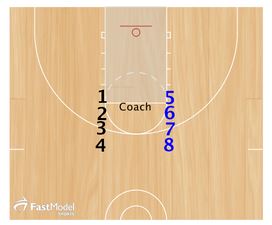
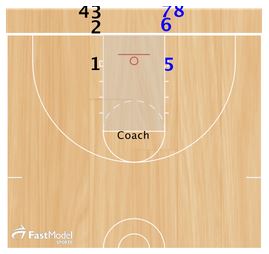
Great drill from Coach Mike Jones and Coach Alan Stein at DeMatha High School. We use this to set the thermostat at practice.

(See Digrams below)

Divide players of equal size.

Coach passes to player who attacks the rim while the other player attempts to block the shot.

The offensive player has to attack strong. Do not allow them to avoid the contact.


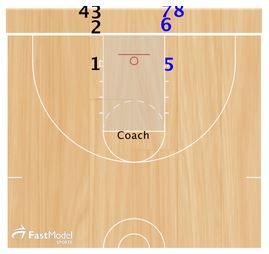
Same set up as Frame 1 but different location.


Same set up as Frame 1 but different location.


Man Offense Sets Boisvert

By Brian Williams on October 28, 2013

Zack Boisvert has put together some short clips of some of his favorite man to man offense from NCAA and NBA games on the You Tube video below.

The point is not a “highlight” tape, but the movements to get shots. Several of the teams miss the shots in the video of the set they are running.

He has posted several videos of some of the better schemes he has seen. His You Tube channel is: Zac Boisvert YouTube Channel

If you are interested in subscribing.

He also is also very active on Twitter:
@ZakBoisvert

He also has an outstanding resource site for coaches. You can access it here: PickandPop.net

Here are 10 different man-to-man sets. Most are shown more than once. Some have sound and some do not. I hope you can find one or two that fit your basketball program.

The videos are hosted on YouTube, so please make sure that the network you are on provides YouTube Access.

Click the play arrow to begin the video


  • « Go to Previous Page
  • Page 1
  • Interim pages omitted …
  • Page 211
  • Page 212
  • Page 213
  • Page 214
  • Page 215
  • Interim pages omitted …
  • Page 288
  • Go to Next Page »

Primary Sidebar

  • Twitter
  • Facebook
  • Linkedin
coachestoolbox
personaldevelopmenttoolbox
basketballplayerstoolbox
basketballtrainer
athleticperformancetoolbox
coachingbasketball

© Copyright 2026 Coaching Toolbox

Privacy Policy