• Skip to primary navigation
  • Skip to main content
  • Skip to primary sidebar

  • Basketball Plays
    • Ball Screen Sets
    • Horns Sets
    • Man to Man Post Up
    • Man to Man Isolations
    • Backdoor Plays
    • Man to Man 3 Point Shot Plays
    • 2-3 Zone Attack
    • Baseline Inbound Plays
    • Sideline Inbound Plays
    • Combination Defense Attack
  • Drills
    • Defensive Drills
    • Offensive Drills
    • Competitive Drills
    • Passing Drills
    • Rebounding Drills
    • Shooting and Scoring Drills
    • Toughness Drills
    • Transition & Conversion Drills
    • One on One Drills
  • Blueprint
  • Practice
  • Mental Toughness
  • Skill Development
  • Offense
  • Defense
  • Store

Basketball Drills Stay Positive Shooting

Basketball Drills Stay Positive Shooting

By Brian Williams on December 11, 2013

This basketball shooting drill came from the University of Washington Women’s Basketball Coaching Newsletter.

If you would like to subscribe, email me and I will forward your interest on to Coach Mike Neighbors.

Use this drill with individual shooters. Break down your offense in this drill. Each spot the shooter must make a game speed move for lay-up/midrange jumper and also make a 3 point shot. If they make both shots they are a +1. If they miss one shot, they are 0. If they miss both shots, they are –1. Keep a running total. The shooter stays on until they get to +5 or end the drill when they get to –5. So the goal is to STAY POSITIVE. (good visual image drill)

As a coach, you must be the judge of the individuals GAME SHOTS, GAME SPOTS, and GAME SPEED. If it
doesn’t meet that players standard, count that particular shot as a “MISS”…

Once the player gets to +5 for that section, they make 5 FT’s. Change the cuts, screens, shots and go again.
Goal is always to STAY POSITIVE.

Will give you a few examples here… keep in mind these are from OUR actions. You MUST adapt them to
YOUR actions. This is just an idea of how to score and keep a drill competitive more than trying to copy the
drill action for action. We have about 25 different ones for variety.

Diagrams created with FastDraw

Stay Positive Shooting Drill
basketball-drills-stay-positive-shooting1

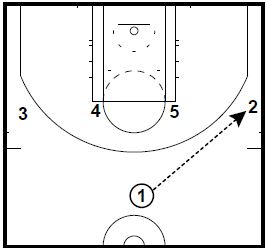
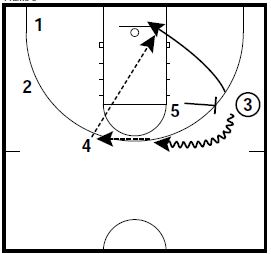
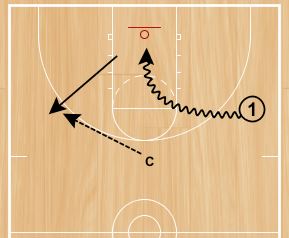
Coach passes to the shooter. Shooter attacks the basket off the rip to score. This can be a lay-up, a floater, or mid-range jumper. After completing that shot, the shooter simulates cutting to corner off a baseline block screen for a 3-pointer.

+5 or –5, then make 5 FTS.
 

basketball-drills-stay-positive-shooting2

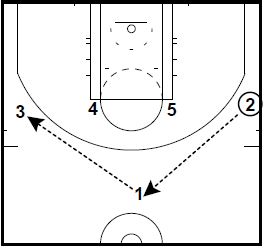
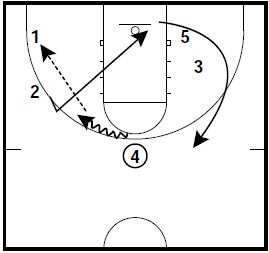
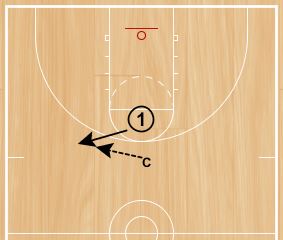
Player starts with ball on wing. Simulates using a ball screen and drives it to score. After the shot, shooter cuts to the wing for a 3 point shot.

+5 or –5, then make 5 FTS.


basketball-drills-stay-positive-shooting3

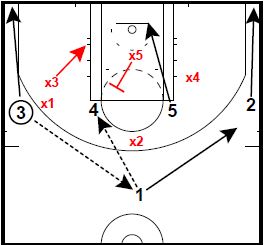
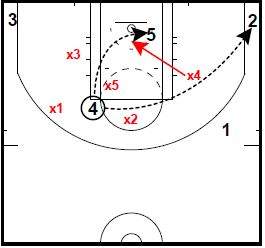
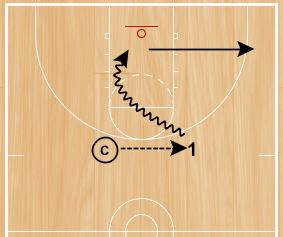
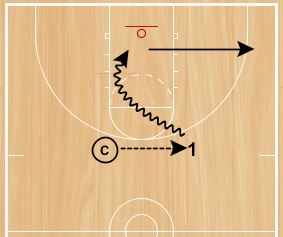
Shooter starts at the nail. Cuts to the arc simulating a flare screen for a 3 point shot. From the spot where shot is taken, shooter receives another pass from coach. Shooter rips it through a drives it to finish. ** Be careful when you do the shorter shot 2nd in the sequence that you don’t allow them to take a NON-game type shot in effort to not be –1 if they have missed the 3 pointer.
 

Basketball Drills Steve Alford Rebounding

By Brian Williams on December 10, 2013

This video is a competitive 2 on 2 rebounding drill used by Steve Alford when he was Head Basketball Coach at New Mexico. He is currently the Head Coach for the men’s team at Nevada.

This is a drill that he likes to use almost daily.

Click the play arrow to see the video and make sure your sound is on as you watch.

The video is a You Tube video.

If you are interested in more information about the DVD that this sample came from. click here: All Access Basketball Practice with Steve Alford


Steve Alford Rebounding Drill

There are links to more basketball drills below this post.

If you are interested in more information about the DVD that this sample came from. click here: All Access Basketball Practice with Steve Alford

Basketball Plays 14 Elbow Dive

By Brian Williams on December 9, 2013

Coach Vonn Read has submitted several plays from his playbook series The Basketball Encyclopedia of Plays to the Coaching Toolbox.

Vonn is currently serving as an assistant in the Women’s at Syracuse.

He has also served as an assistant coach in the WNBA with the Phoenix Mercury, Orlando Miracle, and San Antonio Silver Stars.

He was an advanced scout for the Orlando Magic as well as The Charlotte Sting.

Run this play against a 2-3 zone


Basketball Plays


1 passes to 2 to start the action.


Basketball Plays


The offense will quickly swing the ball to get the Zone moving.

On ball reversal, the defense will have 2 players guarding the 3 player on the bump.


Basketball Plays

The 3 player will quickly pass the ball back to the 1 player who will pass it to the 4 player at the Elbow before X1 can recover.

On the pass to the 4 player, 5 will dive hard to the rim looking for layup.

The 2 player will slide to the corner and the 1 player will space to the wing.

Basketball Plays

X5 will take the high post player (4 player), and X4 will have to take the 5 player diving to the rim to prevent the easy layup.

This will usually leave the 2 player wide open in the corner.


Coach Read has also put together The Basketball Encyclopedia of plays. You can check them out here: The Basketball Encyclopedia of Plays or read more about the books:

Any coach looking for the latest and innovative plays from the Professional, College, or High School levels can stop looking. With a compilation of over 7,700 different plays, you will never need to purchase another basketball playbook again. These playbooks can be used as a great reference tool for years to come. This 2 Volume Book includes plays from 19 different play categories, and they are the most extensive playbooks on the market.

The Basketball Encyclopedia of Plays (Platinum Series) contains over 7,700 Plays (Both Volumes combined) from the NBA, WNBA, USBL, and College levels from someone who has worked as an Advanced Scout or Coach on each level!!! This book has been intensely compiled over the last 21 years, with plays taken from a lot of NBA Coaches (past and present), WNBA coaches, and College coaches (Men’s and Women’s) from around the country.

Any coach that is serious about improving their knowledge of the game from an X and O standpoint will benefit tremendously from these books. These Books can be used to discover New Quick hitters, add a New Package to your playbook, or develop an entire Offensive System. There are a lot of new ideas and concepts in these books to study, and the Basketball Encyclopedia of Plays can be a great resource for coaches on all levels!!! This book is definitely for those X and O junkies who are always looking to improve as a Coach.

“THE GAME IS ALWAYS CHANGING? ARE YOU?” Vonn Read

Here is the link: The Basketball Encyclopedia of Plays

We Over Me

By Brian Williams on December 6, 2013

By Alan Stein of Pure Sweat Basketball.

Two Great Exercises that every coach should do with his or her team…

A basketball coach’s most difficult job is getting 15 individuals to fully acknowledge and embrace this fundamental concept:

We > Me

This is not an easy task.

Human beings are inherently selfish. We are programmed at a very early age to always look out for #1.

Trust me, I have 3 children under the age of 4 years old, and their entire existence is consumed by the concept of ‘me.’

This is cute with toddlers, but not with basketball players.

Why?

Basketball is a team game, not an individual sport.

In order for a team to be as successful as it is capable of, each individual must sacrifice their own ‘wants’ for the betterment of the group.

It’s not about what you want; it’s about what the team needs. Powerful distinction.

Coach Jones recently conducted the following exercise with our varsity team at DeMatha:

In a private team meeting, he asked each of our 16 players to write on an index card the number of minutes they truly believed they deserved to play in each game this season. He then collected the cards and tallied the numbers up.

Like most high schools, we play a 32-minute game (4, 8-minute quarters) and are only allowed 5 players on the court at any given time. Therefore…

32 minutes X 5 players = 160 total game minutes

However, when Coach Jones tallied up the total number of minutes our players truly believed they deserved to play… it came to 276 total minutes.

I wasn’t a statistics major, but even I can spot a colossal discrepancy.

So what does this mean?

It means most of the players on our team will not play as much as they would like.

He then replicated the exact same exercise with shots instead of minutes.

Last year our team averaged taking 52 shots per game.

When he polled our 16 players about how many shots they truly felt they earned the right to take each game… guess what the total was?

109 shots!

Déjà vu.

This simple exercise was a major eye opener. It gave our coaching staff tremendous insight into just how important it is going to be for us to create a ‘We > Me’ culture.

In fact, this concept will define our season.

If we can successfully get all 16 of players to buy in to the fact that it is not about their minutes or the shots they take… we have a chance to be really, really good this year. We have championship caliber talent. But do we have championship caliber unselfishness? Only time will tell.

A vast majority of the time, if a player does not buy into this concept… they start worrying about ‘me’… and feel like they should be playing more…

This mindset is a cancer to your team is absolutely, positively unacceptable.

It is understandable to want more playing time.

It is understandable to want to take more shots.

Just because something is understandable doesn’t mean it is acceptable.

Just because you want it doesn’t mean it’s what’s best for the team.

It takes a very special player to admit…

It’s not about me; it’s about us.

I challenge you to be special.

Alan Stein
Pure Sweat Basketball
http://www.About.me/AlanStein

Defending Pick and Roll Del Harris

By Brian Williams on December 4, 2013

This article was posted with the permission of retired NBA Coach Del Harris

Regarding pick and roll defenses:

  1. Avoid “stringing out” too far on showing/hedging from the picker.

It is fine to jump up hard in a position parallel, or virtually so, to the sideline and go a step or even two with the ballhandler as a defensive option.

Continuing to string out with the ball handler forces the team defense has to rotate to your man on any kind of show.

The stringer is in a position too far out to rotate back safely to any man.

Remedy: After a defender shows, he needs to recover quickly “down the line” toward the free throw lane, not out toward the sideline.

  1. When defending elbow area picks, show hard or at the angle to corner but:

If you show hard, your man will roll to the basket and will have to be picked up by a teammate.

Show high, stay high. The defender on the elbow who shows aggressively must be prepared to cover the pop by the picker or, if he rolls, to cover the next player who comes up high—“show high, stay high!”

If you show at a 45 degree angle, then you cannot string out toward the corner more than a step.

Show “down the line” so as to be able to stay in a position whereby you are able to slow down the ball and still make it hard to pass to the roller by staying in the pass lane with active hands.

Weak side help is vital. As in showing at an angle anywhere (covering the turn) on the pick and rolls, the defender goes down the line but still needs help.

  1. To turn the pick/roll down? If you try to mix your pick and roll defenses by “turning it down” here are some suggestions:

First, do not be afraid to try it. But then do not be like many NBA teams and overdo it. It is a good change up, when done right, and a lot of teams do not do a good job of going against it. (But that is changing in the NBA now as teams overuse it.)

The defender on the picker must call it out loud and clear three times, (whatever signal you decide to use) and the ball defender cannot change positions until he hears it, no matter what the game plan is.

The picker defender must get into a strong, athletic position ready to defend any attacker and stay in it. This is crucial.

The picker defender must get into a line between the ball and the basket but ought not to be any further from the picker than an arm’s length plus a step, certainly no more than two steps.

The biggest concerns are:

  1. The ballhandler splitting between him and the picker, leaving the ball defender behind,
  2. And allowing a quick short bounce pass (“pocket pass”) to the picker whereby he can catch and get to the goal or catch/shoot so quickly no one can get to him.

If the ball is penetrated the picker’s defender will try to defend both players as long as he can, by dropping down the line toward the goal.

The ball defender must try to recover back in front, but the help defender must be ready to commit to the ball if he has to (trap or late switch).

The defender on the ball must quickly jump to the high side of the ballhandler, maintaining at least a touch with his man, and be in a position to force him to go to the sideline/baseline instead of penetrating to the middle.

Do not get too high on the top of the ballhandler. Be only slightly higher than parallel with the sideline, not turned too far toward the baseline because it encourages a split.

Note: if you are a zone team. Turn all the pick and rolls on the wing or corner areas down. Usually players can switch the top and elbow pick and rolls.

Basketball Plays Xavier

By Brian Williams on December 2, 2013

This play is a quick hit to run against a man to man defense..

It is from an old Xavier Men’s Basketball Newsletter. If you are interested in subscribing to their newsletter, you can do so at this link: Xavier Newsletter

You might not be able to run the entire play, but possibly a few of the cuts, screens, and principles can be applied to what you already run.

There are links to other plays at the bottom of this post


Diagrams created with FastDraw

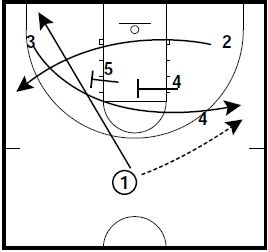
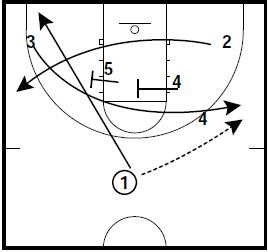
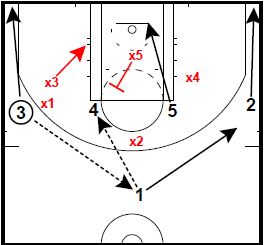
3 Iverson cuts off 4 and 5 to receive ball. 2 clears away from 3’s cut.

1 cuts to opposite side of pass


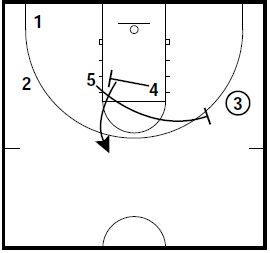
4 screens 5 into an on-ball screen for 3.

After setting the screen, 4 fills the point.


3 comes off the on ball screen and passes to 4.

4 immediately looks to 5 who rolls to the basket afer setting the screen for 3


If 4 is not able to hit 5, 2 cuts through and the pass goes to 1 in the corner.

Another option would be to run a dribble handoff between 4 and 1.


  • « Go to Previous Page
  • Page 1
  • Interim pages omitted …
  • Page 207
  • Page 208
  • Page 209
  • Page 210
  • Page 211
  • Interim pages omitted …
  • Page 288
  • Go to Next Page »

Primary Sidebar

  • Twitter
  • Facebook
  • Linkedin
coachestoolbox
personaldevelopmenttoolbox
basketballplayerstoolbox
basketballtrainer
athleticperformancetoolbox
coachingbasketball

© Copyright 2026 Coaching Toolbox

Privacy Policy