• Skip to primary navigation
  • Skip to main content
  • Skip to primary sidebar

  • Basketball Plays
    • Ball Screen Sets
    • Horns Sets
    • Man to Man Post Up
    • Man to Man Isolations
    • Backdoor Plays
    • Man to Man 3 Point Shot Plays
    • 2-3 Zone Attack
    • Baseline Inbound Plays
    • Sideline Inbound Plays
    • Combination Defense Attack
  • Drills
    • Defensive Drills
    • Offensive Drills
    • Competitive Drills
    • Passing Drills
    • Rebounding Drills
    • Shooting and Scoring Drills
    • Toughness Drills
    • Transition & Conversion Drills
    • One on One Drills
  • Blueprint
  • Practice
  • Mental Toughness
  • Skill Development
  • Offense
  • Defense
  • Store

Basketball Drills Convert to Defense

Basketball Drills Convert to Defense

By Brian Williams on January 21, 2014

Our teams convert to defense after almost every offensive possession-other than dead ball turnovers.

It is also much tougher to score against our set half court defense.

That makes it important that we work at being very good in our conversion defense.

These 3 drills are conversion defense drills from the previous post:

Another aspect of conversion defense that I never practiced enough was converting after we miss (or make) a free throw. It happens a lot in games, but isn’t practiced enough, in my opinion.

“Things Basketball Teams Do a Lot” You Can view that post by clicking here: “Things Basketball Teams Do a Lot”

All of this information came from Coach Mike Neighbors, Arkansas women’s head coach.

Tip Drill
tip-drill

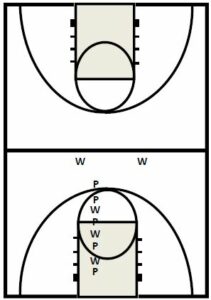
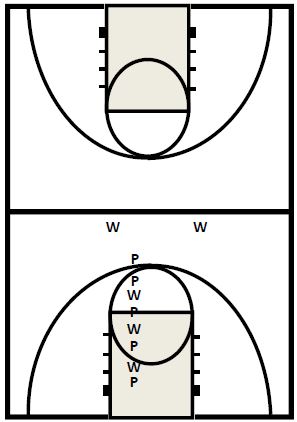
Drill begins with teams divided into two colors… Purple and White for the Huskies.

They are lined up alternating colors in a line stretching toward half court. Allow two players from the defensive team to start near half court to simulate our FULLBACK and HALFBACK transition responsibilities.

On the whistle the ball is tipped onto the glass with tipper going to back of line and next player keeping the tip going. When the ball is in hands of the offense coach blows whistle again (or yells shot). The offense goes in transition as the defense retreats.

We go until we get transition stopped. As the season progresses allow offense to flow into action that you must defend as well. Change what you allow as the season goes to create variation and emphasis.

We make the drill competitive by putting 4:00 on the clock. The clock runs during the time the ball is being tipped off the glass and is in live play. If the defense is successful in their efforts the clock stays on the time when the ball is stopped. For example, after first tipping it might be at 3:38. If the defense however is unsuccessful the clock is re-set to 4:00. This builds toughness.

** Once the team gets the time into the 2:00s you reset to 3:00 rather than 4:00. Once the get into the 1:00s you reset to 2:00 and so on until the clock reads 0:00…

Get Back Drill
basketball-drills-get-back

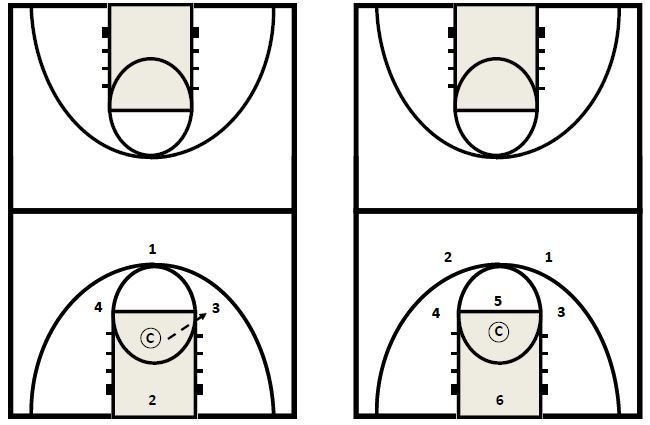
Players 1 and 2 are on defense. Players 3 and 4 are defenders. Coach has the ball. Tosses the ball to 3 or 4. 1 turns and SPRINTS back as the FULLBACK. 2 then must SPRINT back to get AHEAD of the BALL and try to slow the attack.

In diagram 2, we have added player 5 on offense and player 6 on defense to simulate 3-on-3 play.

We will slowly begin to add players and manipulate the number of defenders to get the advantage/disadvantage situations in which we drill.

To add to fun of the drill, after the coach passes the ball to the offense we will turn and using a blocking pad try to impede the progress of the last defender.

Progressive Fast Break
basketball-drills-progressive-fast-break

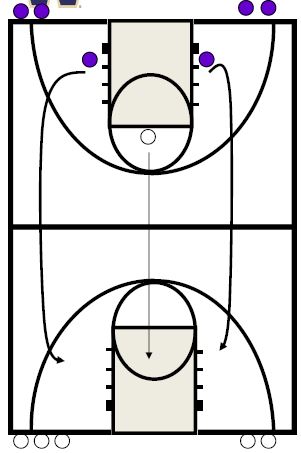
Great drill for teaching transition offense and defense simultaneously. Also stresses importance of making FT’s, taking advantage of “numbers” situations.

Divide team into two colors. Try to get even number of guards and forwards if possible but not critical. We score the drill as a normal game with 1s, 2s, and 3s.

White team player a White team player attempts a FT. Two Blue defenders play the make/miss. The white player converts to defense.
 

basketball-drills-progressive-fast-break2


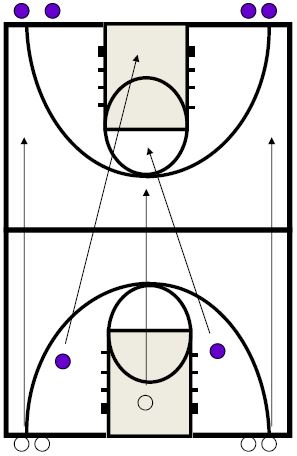
Once the possession is complete without stopping the action, two additional white team players come from the baseline to join the original white team player as they attack the two blue team players who are retreating into a 3‐on‐2 advantage/disadvantage situation. Complete
this possession then without stopping add TWO blue team players and they attack in a 4‐on‐3 situation… this continues until you have built it into a 5‐on‐5 situation. At the completion of the 5‐on‐5, start again with BLUE team player attempting a FT.
 

Basketball Plays Double Stacks Step Up

By Brian Williams on January 20, 2014

Coach Vonn Read has submitted several plays from his playbook series The Basketball Encyclopedia of Plays to the Coaching Toolbox. Vonn is the Associate Head Coach for the Women’s program at Syracuse.

He has also served as an assistant coach in the WNBA with the Phoenix Mercury, Orlando Miracle, and San Antonio Silver Stars. He was an advanced scout for the Orlando Magic as well as The Charlotte Sting.

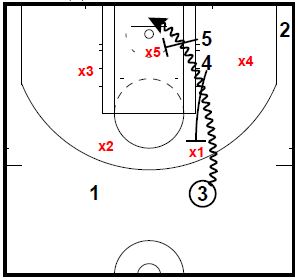
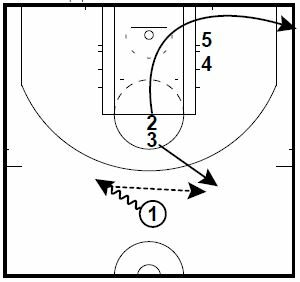
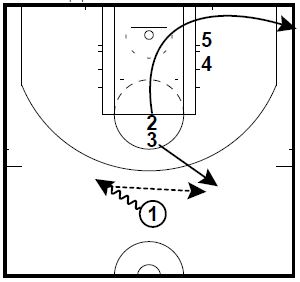
This play is a quick hitter to get a look at an open three point shot against a 2-3 zone.


basketball-plays-step-up1


The 2 and 3 players stack at the FT Line, and the 4 and 5 players stack on the block.

The 1 player will dribble over to the slot to form a 2 Guard Front with the 3 player popping out.

The 2 player (Shooter) will cut to the corner.


basketball-plays-step-up2

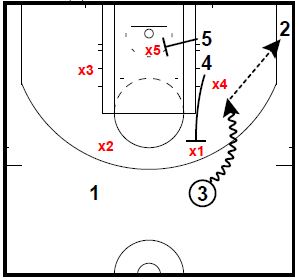
As soon as the 3 player catches the ball, the 5 player will screen the center (X5) in the Zone.

The 4 player will sprint up and set a step up pick and roll. This ball screen forces the defense to help.

If X4 does not help, the 3 player can shoot the pull up jumper or get all the way to the basket.


basketball-plays-step-up3


If X4 does help on the drive by the 3 player, kick it to your shooter (2 player) in the corner.

This play can be tough to stop if the screener sets a good screen.


Coach Read has also put together The Basketball Encyclopedia of plays. You can check them out here: The Basketball Encyclopedia of Plays or read more about the books:

Any coach looking for the latest and innovative plays from the Professional, College, or High School levels can stop looking. With a compilation of over 7,700 different plays, you will never need to purchase another basketball playbook again. These playbooks can be used as a great reference tool for years to come. This 2 Volume Book includes plays from 19 different play categories, and they are the most extensive playbooks on the market.

The Basketball Encyclopedia of Plays (Platinum Series) contains over 7,700 Plays (Both Volumes combined) from the NBA, WNBA, USBL, and College levels from someone who has worked as an Advanced Scout or Coach on each level!!! This book has been intensely compiled over the last 21 years, with plays taken from a lot of NBA Coaches (past and present), WNBA coaches, and College coaches (Men’s and Women’s) from around the country.

Any coach that is serious about improving their knowledge of the game from an X and O standpoint will benefit tremendously from these books. These Books can be used to discover New Quick hitters, add a New Package to your playbook, or develop an entire Offensive System. There are a lot of new ideas and concepts in these books to study, and the Basketball Encyclopedia of Plays can be a great resource for coaches on all levels!!! This book is definitely for those X and O junkies who are always looking to improve as a Coach.

“THE GAME IS ALWAYS CHANGING? ARE YOU?” Vonn Read

Here is the link: The Basketball Encyclopedia of Plays

Crunch Time Safe Inbound Play

By Brian Williams on January 17, 2014

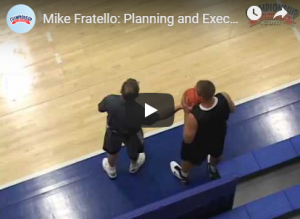
In the video, Mike Fratello walks you through a side out play that is designed to get the ball inbounds at the end of the game when you have a lead and do not need to score.

An example would be 3 seconds left in the game with a 1 point lead, or any scenario where the defense is going to foul as soon as you inbound the ball.

This would also be a scenario where you would want to put your best free throw shooters in the game as well as make sure you have your best available inbounder.

Obviously, it is a coaching decision that you must make, but I believe that even if the best inbounder is one of your best four best free throw shooters, I would still have that player inbound the ball, rather than using our second or third best inbounder.

These are the types of decisions best made in your office before the season starts when you can think clearly and without emotion.

Waiting until the pressure of the end of a tight game is not the time to do your best thinking.

Even if you don’t like this play, it is important to have something to go to in this situation.

Click the play arrow to see the video.

The sample video is from the Mike Fratello: Planning and Executing Special Situations DVD. In the DVD, Coach Fratello discusses:

  • Steal a basket when you need it most
  • Get insight on how to incorporate specials into a team philosophy and team practices
  • Learn how to maximize your time outs
  • Learn to handle a trap and how to trap and recover

Here is a link for more information or to purchase the video Planning and Executing Special Situations

Coaching Basketball: Free Throw Attack

By Brian Williams on January 16, 2014

This post is an edited summary of a series of posts that Coach Brian Anglim made regarding ways of being intentional about getting to the free throw line.

A big movement in the basketball world has been the usage of advanced analytics. Author’s such as John Hollinger and Dean Oliver have offered great insight into how games are won and lost. I first got into statistical analysis when I read the book “Basketball on Paper” by Dean Oliver. A big concept in this book is offensive efficiency, which is measured by calculating the number of points a team would score over a period of 100 possessions. It is a great way to measure how effective a team’s offense is disregarding the pace of the game. For example, watching Georgetown might seem like a great offense but they don’t seem to score much? The reality is they are a very efficient offense but they don’t score a lot of points because they use so much clock they get a limited number of possessions. These types of advanced stats allow a coach to go beyond the scoreboard.

Digging deeper into these numbers we can hope to discover what factors create a great offense. Some interesting insights that I got from Vance Walberg, is the point value of different types of shots. For example:

  • Inside Shots: teams shoot 60 percent on these shots; being worth two points per successful attempt you get 1.2 points per attempt
  • 3 Point Shots: teams shoot 35 percent on these shots, but being worth three points per successful attempt, you get 1.05 points per possession.
  • Free Throws: teams shoot .70 per free throw, when you calculate the value of two attempts you get 1.4 points per 2 shots
  •  

  • Mid-Range Shots: The percentage on these is barely higher than that off three point attempt. Let’s say for this example our team shoots 43 percent from the mid range (which is high number), on a per possession basis they would score .86 points per possession.

Going through this exercise we can develop a hierarchy of the type of shots we are looking for from our offense. Free throws are by far the most efficient shot. So, it would stand to reason that should be the shot you are striving for. What types of shots are you trying to get out of your offense? The standard answer is open shots, but what type of open shots? Layups, threes, mid-range shots, or shots that give you a chance to get to the free throw line? We should be designing our plays, offenses, and teach fundamentals skills that lead to the three most advantageous shots – free throws, shots in the interior (which often lead to free throws), and threes.

Getting fouled is a mistake made by the defense, but there are a number of things that you can do to encourage teams to make this mistake. Not only by its points-per-possession value are free throws efficient but it puts teams in foul trouble, gets them into the bonus sooner, and also gives you a chance to score a three point play.

Here are some considerations when designing your offense to get to the free throw line:

1. Isolation actions
2. Low Post Attack
3. Driving Game
4. Transition Attack
5. Cutters
6. Offensive Rebounding

No single shot statistically has a greater effect on on-court offensive success than the free throw. Offensive efficiency needs to be seen not only in field goal percentage but in fouls drawn from the opponent.

Many coaches see the “foul line game” won with post play. I think this is a limited view as there are multiple ways to get the ball in the post/paint area. An idea I got from Don Meyer was to chart paint touches and how you got those touches. These could be from post touches, penetration, cuts, screens (curl cuts need to be an attacking cut), transition, and offensive rebounding. Big guys own that low box game but to have a balanced attack you need to also work on your penetrating “foul line attack”.

Finishing Skills

The most basic layup is the speed layup. This is the classic inside foot, high jump off of one foot shot that players need to be able to execute full speed. It’s the uncontested layup that we often see on the fast break. However most half court layups are contested and these are the type of layups that lead to three point players. You need your players to hunger for three point plays rather than settle for two.

Below I will list six different types of layups that will improve your player’s ability to make contested finishes.

With all of these attacking finishes, the player needs to “finish strong”. In my mind, “finishing strong” means that we are looking for contact so that we might play off of it. It means that we are going to have a strong grip on the ball, maintain a strong posture to handle the contact, and most importantly to concentrate solely on that finish and not even think about the hit we might take. Our players need to know what it is and practice being that type of player.

1. Reverse Layup – this is where we extend the ball to the other side of the rim, to protect against the shot blocker. We once again encourage the player to get a shoulder or hip into the defender and then extend to the other side of the rim. Players need to be able to make this shot with either the inside or outside hand depending on the defenses position. A big key to this layup is to extend up and outward in your jump. For speed layups we talk about taking off like a rocket, for a reverse layup we want to take off like a jet.

2. European Step – the European game has definitely invaded America. The “Euro Step” has become a staple of any advanced player. The European step is a direct step at a defender followed by a lateral step to avoid that defender. You get the defender thinking you are going right at him and then step laterally to avoid him and finish the play. Despite attempting to avoid contact I am constantly seeing players get fouled on this move, the the defender will often hip check the player.

3. Extended Layups – this is the layup where we extend our layup hand outward away from the defense. This is something we might do if a player is riding us on our hip and we need to move the ball away to make that finish. In this type of finish, we crave contact as it allows us to pin a player to one side of our body and use the extended hand to keep away from the defense. A great term I heard was to “lay the ball up with long limbs”.

4. Power Layup – this is the where we get the shoulder of the offensive player into the middle of the chest of the defensive player. If we can achieve this position, the defender will have to go across the body of the offensive player to get to the ball. This is a great way to get fouled.

5. Inside Hand Layup – the “fundamental” way we teach layups is always with the outside hand, but sometimes we have the defender on our outside shoulder. Going through the fundamentals way would expose the ball. In this instance, an inside hand finish would be most appropriate, you see “Princeton” offense teams master this type of layup as there back cuts often lead to it.

6. Wide Layup – this is another finisher that doesn’t lead to many fouls, but is a necessity to prevent defenders from drawing a charge. In this move we take a driving angle toward the post box instead of at the rim, this angle forces the shooter to extend his layup into a hook like shot. This was a type of finish that I first heard about from Hubie Brown, he referred to it as a running hook. The key to this type of finish is that we drop the shoulder so we can really extend the ball up. Here is a great video of the shot and how to drill it. He has some other interesting finishes as well.

Basketball Drills Closeouts

By Brian Williams on January 15, 2014

These 3 drills to work on keeping the ball out of the lane are a follow up to the article I posted from Coach Mike Neighbors entitled:

“Things Basketball Teams Do a Lot” You Can view that post by clicking here: “Things Basketball Teams Do a Lot”

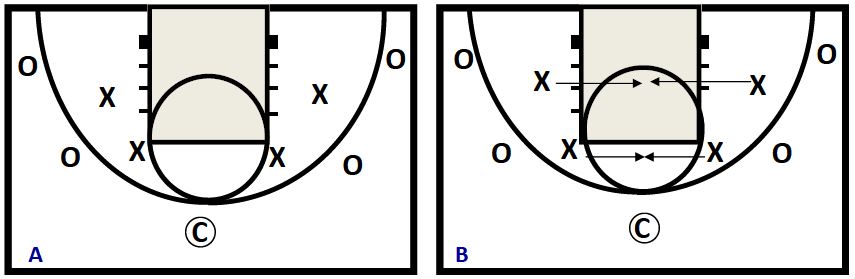
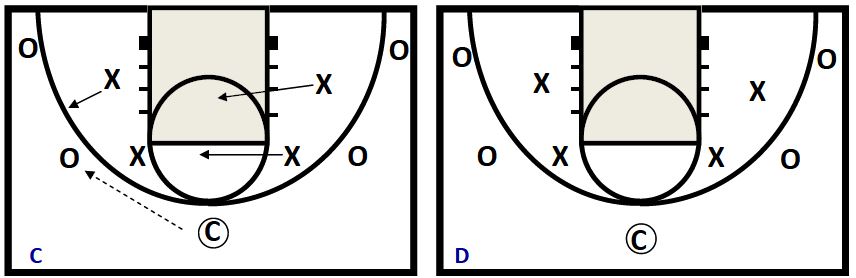
One of those things that the article discusses as something that basketball teams do a lot is closeout.

These three basketball drills are designed to give you some variety as you drill closing out.

All of this information came from Coach Neighbors weekly basketball coaching email newsletter. If you are interested in being added to his list, let me know and I will forward your email address on to Coach Neighbors.

I will post the remainder of the drills next week.

Again, these drills are attributed to University of Washington Women’s Head Coach, Mike Neighbors.

basketball-drills-sideline-closeouts

Sideline Closeouts

Position 3 chairs along each sideline. We place a ball in the seat of each to simulate that chair as a player being a ball handler.

Coach on each side between the chairs.

Three defensive players at “on the ball”, three defensive players start along the mid‐line in “help”

Coach with ball passes across court to other coach.

Defensive players that were in “help” sprint to close‐out to the chairs on the AIR TIME of the pass.

POINTS OF EMPHASIS

Key Elements to a great close out:

1) Move on the Air Time of the ball: a great defender moves from position to position while the ball is in the air.

2) Start with sprint end with a chop: the first two steps are a dead sprint while the ball is in the air and ends with feet chopping as they approach the offense player

3) High Hands/Low Shoulders: as the feet are chopping, the hips/butt go down as the hands go high. The low hips/butt defend against the drive and the high hands take away vision
for pass or shot.

The ability of each offense player effects each defenders close out. If we are closing out to a player who can stroke the 3 but can’t score off the bounce, we will close out a little tighter. If the opposite is true, the hands will still be high to take away a quick post pass but the close out with shorter to take away catch and go drives.

Storm Closeouts

Another good way to work on the all important technique of closing out on defense. Also simulates good transition defense and places premium on talking and communicating.

basketball-drills-storm-closeouts

Another good way to work on the all important technique of closing out on defense. Also simulates good transition defense and places premium on talking and communicating.

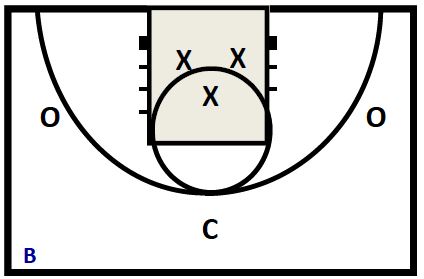
Three X defenders in triangle around basket. Coach initiates action with pass to the wing.

All defensive players close out and we play moving the ball from side to side then coach takes a shot. Defense has three on two advantage so we hope to get every rebound.

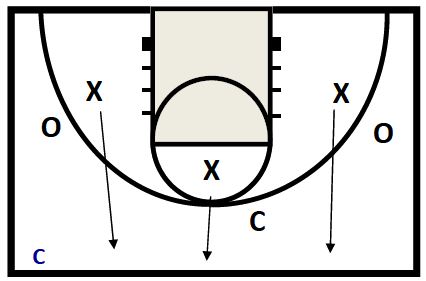
basketball-drills-storm-closeouts2

On the rebound and or a steal before the shot goes up, the three X players become offense and go in transition 3 on 2 against the O players minus the coach.

You can make this competitive by scoring the offense and splitting into two teams. Teach the techniques you teach on closeouts, defending on ball, and rebounding.

Brooklyn Closeouts

basketball-drills-brooklyn-closeouts1

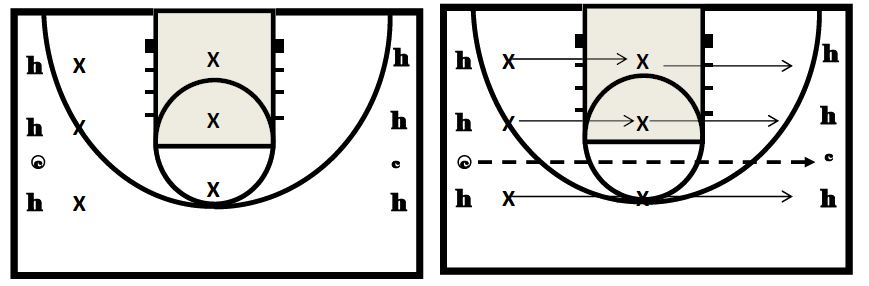
Defensive players begin in GAPS

Coach bounces the ball to initiate drill. On the bounce the defense slides to touch hands then back to their GAP.

basketball-drills-brooklyn-closeouts2

Coach makes a pass. Player closes out and others jump to GAP. Each time the ball returns to the Coach…

Once coach is satisfied with the drill, bounce the ball again…

All 4 defensive players sprint to paint to celebrate Volleyball style (you know how they all come together after a good or bad play!!)

Basketball Drills Team Fire

By Brian Williams on January 14, 2014

This is a short video of a tweak to the 3 on 2 continuous full court transition drill that can be used as a toughness drill.

Make sure your sound is on as you watch.

The drill starts out as “no dribble” and then the players are allowed one dribble at about the 3 minute mark.

My other takeaway from this drill is calling “other way.” I believe it is important to tell players why you are giving possession to the other team, but it is a great way to emphasize your teaching points.

Players don’t pay attention to your fundamental areas of emphasis, so they lose the ball in practice, just like they will in a game when they don’t pay attention to details.

The drill is a sample from the All Access Practice DVD with California State Junior College Championship Coach Ed Madec. Click the link for more information about the DVD. All Access Basketball Practice with Ed Madec

Click the play arrow to see the video.

https://coachingtoolbox.net/wp-content/uploads/2014/01/BD-04246_2.mp4
  • « Go to Previous Page
  • Page 1
  • Interim pages omitted …
  • Page 203
  • Page 204
  • Page 205
  • Page 206
  • Page 207
  • Interim pages omitted …
  • Page 288
  • Go to Next Page »

Primary Sidebar

  • Twitter
  • Facebook
  • Linkedin
coachestoolbox
personaldevelopmenttoolbox
basketballplayerstoolbox
basketballtrainer
athleticperformancetoolbox
coachingbasketball

© Copyright 2026 Coaching Toolbox

Privacy Policy