• Skip to primary navigation
  • Skip to main content
  • Skip to primary sidebar

  • Basketball Plays
    • Ball Screen Sets
    • Horns Sets
    • Man to Man Post Up
    • Man to Man Isolations
    • Backdoor Plays
    • Man to Man 3 Point Shot Plays
    • 2-3 Zone Attack
    • Baseline Inbound Plays
    • Sideline Inbound Plays
    • Combination Defense Attack
  • Drills
    • Defensive Drills
    • Offensive Drills
    • Competitive Drills
    • Passing Drills
    • Rebounding Drills
    • Shooting and Scoring Drills
    • Toughness Drills
    • Transition & Conversion Drills
    • One on One Drills
  • Blueprint
  • Practice
  • Mental Toughness
  • Skill Development
  • Offense
  • Defense
  • Store

Coaching Basketball Penetration Bailout Spacing Rules

Coaching Basketball Penetration Bailout Spacing Rules

By Brian Williams on January 29, 2014

This article was written by Del Harris, retired head coach of the Lakers, Bucks, and Rockets. Coach Harris guided the Rockets to the 1981 NBA Finals. He was also a very successful high school, small college, ABA, International, and NBA assistant coach.

He went to high school and started coaching in Indiana and I have crossed paths with a few of his former players. They all say that even with the success he has enjoyed, he has remained loyal to those who knew him on his way up the coaching ladder.

Spacing is key—Know the Bailout Rules on Penetration

Bailout Dribble Rules-where to go on dribble penetration—creating four pass angles for the ballhandler on penetration at all times

 If you are on the perimeter and the ball is dribbled toward you.

• Drift toward the ballhandler so that if your man drops to help on penetration, you are creating an open pass lane to the ballhandler.
• This is true whether you are in the corner on a wing or front angle penetration toward you, or if you are on top and the ball is penetrated toward the middle. In the latter case, drift up and toward the ballhandler so as to be a safety pass outlet and to avoid getting into his penetration path.
• If you receive a pass on the penetration, you may have walked into a rhythm-up jumper or you may run a second penetration and the man who passed to you will curl up behind your second penetration dribble.

If you are on the perimeter and the ball is dribbled away from you.

• Fill cut in behind the dribbler in order to provide a safety outlet pass in the event he cannot get to the goal, pull up for a jumper or pass to any of the other three players on his team. Again, provide a safe angle outlet pass for him.

If you are in the post and the ball is penetrated.

• If you are on the strong side post, move opposite of the dribble and open up to the ball, ready to catch and shoot.
• That is, if you are on the block and the drive is to the baseline, move up the foul line 2-3 steps and 1 step over toward the sideline to create a pass lane, if the defender on the post helps vs. the driver.
• If the penetration is to the middle, the strong side post will pop out 2-3 steps on the baseline ready to catch and shoot, if his man helps. Obviously, if the defender on the post does not help on the penetration, it makes it open more for the penetrator.
• If the post is on the weak side, his move is the same on penetration.
• If the penetration is baseline, he moves to the front of the rim.
• If the penetration is to the middle, he has the option of moving out to the baseline on the weakside or to cross under to the block on the other side of the basket, which I tend to prefer.

If you are on the weak side wing area and see the penetration going down the side line opposite you, quickly drift to the corner to be an outlet along the baseline. The catch phrase on this is, “baseline drive, baseline drift”.

• However, if you are already in the weak side corner and there is a middle penetration from the wing or a penetration from the top, move up a step or two out of the corner. That way, if your defender moves into the lane area to jam the middle, you will create an easy pass lane from the ballhandler for a catch and shoot or a second penetration.

PROGRAMMING YOUR PENETRATION GAME

PROGRAM THE TEAM MOVEMENT UPON DRIBBLE PENETRATION–TEAM PENETRATION MOVES I REFER TO AS “BAILOUTS”.

• THE PENETRATOR MUST KNOW WHERE HIS 4 TEAMMATES WILL BE MOVING WHEN HE PENETRATES FROM ANY ANGLE.
• THIS REQUIRES DRILLING 2-0, 3-0 AND 5-0 SOME IN THE SHOOTING DRILLS.
• THESE PROVIDE HIS BAILOUT PASSES, IF HE CANNOT GET TO THE RIM OR DOES NOT ULL UP FOR A JUMPER.

• SIDELINE PENETRATION TO BASELINE
• SIDELINE PENETRATION INTO MIDDLE
• FRONT OR TOP ANGLE PENETRATION
• CROSSOVER PENETRATION AT TOP

TEACH THE PRINCIPLES OF PASSING GAME AS WELL AS THE PENETRATION GAME—YOUR 3-3 AND 4-4 COACHING SHOULD DO THAT AS YOU FINISH OFF DRILLS THAT ARE DESIGNED TO TEACH THE BASIC FUNDAMENTALS OF OFFENSIVE AND DEFENSIVE EXECUTION OF THE BASIC BASKETBALL 2-MAN AND 3-MAN EXERCISES SUCH AS:

• BACK PICKS
• CROSS PICKS
• DOWN PICKS
• FLARE PICKS
• PICK AND ROLL AT VARIOUS ANGLES
• PINDOWNS AND TURNOUTS
• STAGGERED DOUBLES

USE PICK AND ROLLS
WORK THE MIDDLE, THE HIGH WING AND THE ELBOWS

DEVELOP YOUR PLAYS INTO OPTIONS
INSTEAD OF 10 PLAYS, HAVE 3 OR 4 WITH DEPTH IN OPTIONS.
Bob Knight Zone Attack

By Brian Williams on January 28, 2014

This post contains two videos with Coach Bob Knight showing some of his ideas for attacking a 1-3-1 and a 1-2-2 zone defense.

Make sure your sound is on as you watch.

The video is a You Tube video.

Make sure that you are on a server that allows You Tube access.


1-3-1 Zone Attack

If you are interested in learning more about the entire DVD that this sample came, click this link Bob Knight: Encyclopedia of Zone Offense. Anyone who purchases anything from the store receives one of my basketball coaching eBooks as a bonus. Just email me and let me know which one you would like to receive!


Make sure your sound is on.

If you are interested in learning more about the entire DVD that this sample came, click this link Bob Knight: Encyclopedia of Zone Offense. Anyone who purchases anything from the store receives one of my basketball coaching eBooks as a bonus. Just email me and let me know which one you would like to receive!

1-2-2 Zone Attack

If you are interested in learning more about the entire DVD that this sample came, click this link Bob Knight: Zone Offense Strategies. Anyone who purchases anything from the store receives one of my basketball coaching eBooks as a bonus. Just email me and let me know which one you would like to receive!

If you are interested in learning more about the entire DVD that this sample came, click this link Bob Knight: Zone Offense Strategies. Anyone who purchases anything from the store receives one of my basketball coaching eBooks as a bonus. Just email me and let me know which one you would like to receive!

Basketball Plays Horns Elbow Bone

By Brian Williams on January 27, 2014

Coach Vonn Read has submitted several plays from his playbook series The Basketball Encyclopedia of Plays to the Coaching Toolbox.

Coach Read is currently the University of Houston Women’s Assistant Coach.

He previously was the Associate Head Coach for the Women’s program at Syracuse since 2011 as was instrumental in their final four run in the spring of 2016.

Coach Read has also served as an assistant coach in the WNBA with the Phoenix Mercury, Orlando Miracle, and San Antonio Silver Stars. He was an advanced scout for the Orlando Magic as well as The Charlotte Sting.

This play is a quick hitter to get an isolation for your 1 player.

The numbers are meant to identify the players.

They are not meant to say that you have to have a traditional #1 to run this play, or that the player has to drive to their right hand. You can adjust the play to the opposite side of the floor, if you would want the player to drive left.

It is meant to stimulate your thinking to come up with ways to put your players in positions where they can use their individual strengths for the good of the team.

basketball-plays-horns1

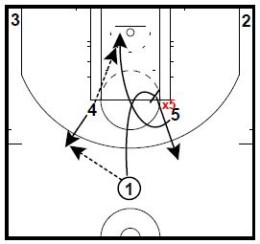
This is a good isolation set for your 1 player.

The 1 player will pass to the 4 player popping out.

After the pass to the 4 player, the 1 player will fake the cut to the basket and stop to set a brush screen for the 5 player.

If we set a good screen, we can get a layup for the 5 player. The 1 player will pop back hard for the ball.

basketball-plays-horns2

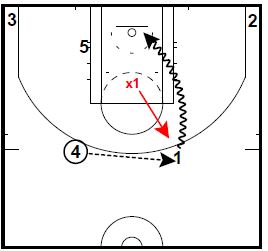
On the pop back, the 1 player can shoot the 3-pointer if the defender is late recovering after helping on the cut to the basket by the 5 player.

The 1 player can drive it all the way to the basket on a bad close-out by X1.

Put a shooter in the corner to take away the help on the drive.

Coach Read has also put together The Basketball Encyclopedia of plays. You can check them out here: The Basketball Encyclopedia of Plays or read more about the books:

Any coach looking for the latest and innovative plays from the Professional, College, or High School levels can stop looking. With a compilation of over 7,700 different plays, you will never need to purchase another basketball playbook again. These playbooks can be used as a great reference tool for years to come. This 2 Volume Book includes plays from 19 different play categories, and they are the most extensive playbooks on the market.

The Basketball Encyclopedia of Plays (Platinum Series) contains over 7,700 Plays (Both Volumes combined) from the NBA, WNBA, USBL, and College levels from someone who has worked as an Advanced Scout or Coach on each level!!! This book has been intensely compiled over the last 21 years, with plays taken from a lot of NBA Coaches (past and present), WNBA coaches, and College coaches (Men’s and Women’s) from around the country.

Any coach that is serious about improving their knowledge of the game from an X and O standpoint will benefit tremendously from these books. These Books can be used to discover New Quick hitters, add a New Package to your playbook, or develop an entire Offensive System. There are a lot of new ideas and concepts in these books to study, and the Basketball Encyclopedia of Plays can be a great resource for coaches on all levels!!! This book is definitely for those X and O junkies who are always looking to improve as a Coach.

“THE GAME IS ALWAYS CHANGING? ARE YOU?” Vonn Read

Here is the link: The Basketball Encyclopedia of Plays


Basketball Drills Hit Ahead Scoring Series

By Brian Williams on January 24, 2014

This is a drill to work on several moves and ways to score.

It was posted in the Fast Model Drills and Plays Library by Fabian McKenzie, Head Women’s Basketball Coach Sydney, Nova Scotia, Canada.

Coach McKenzie has been a head coach at the university level for 15 years, and has been involved as a coach at this level for 20 years.

He has been involved with the Canadian Women’s National team program for the past 6 years.

The Fast Model library has hundreds of plays and drills from coaches all over the world and from various levels of coaching. You can check it out here: Fast Model Plays and Drills Library


You can use this basic structure and incorporate other scoring moves that your players use like floaters or step back shots.

Basketball Drills Hit Ahead Scoring Series

basletball drills

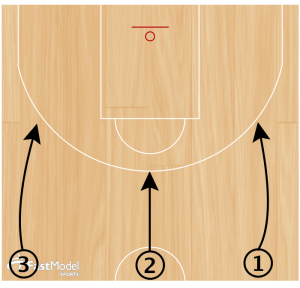
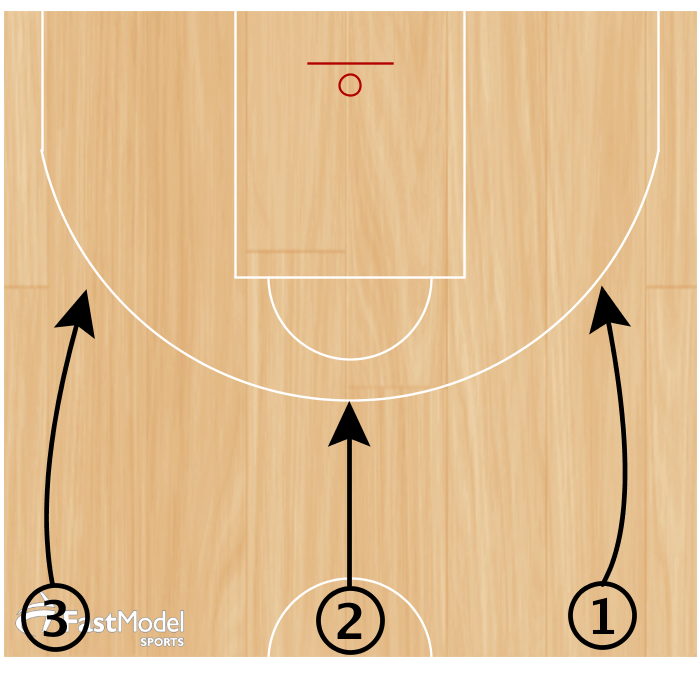
Sprint up court. Toss ball ahead of you simulating a catch at the 3 pt. line.

6 moves at each spot.

Moves are:

1. Spot up – catch and shoot


2. 1 dribble finish with layup – extend and reach to get there.

3. 2 dribble Power Layup -shoulders must be parallel to board on finish.

4. Rip and Go Opposite for layup on opposite side of rim – baby hook

5. One Dribble Pull Up Jumper

6. One Dribble Pull Up Jumper opposite direction

After shooting sprint back to half court and do the next move. You could also do one move at each spot then the next move, then the next, etc.

Coaching Basketball Finding a Way to Win

By Brian Williams on January 23, 2014

Here are some of my coaching takeaways for building a basketball program from Bill Parcells’ book “Finding a Way to Win.”

  • When an organization stays the course and holds fast to their philosophy, through good times and bad, they work from a firm foundation. They gain an identity. They stand for something.
  • Every organization, whether it’s floundering or ruling the roost, needs a calm, clear vision. Only people inside the group can chart its course; outside voices must be kept in their place.
  • Division from within is the most dangerous factor that can ruin any organization.
  • When selfishness is tolerated, the entire organization is in jeopardy.
  • The chances my team takes are calculated – only fools gamble at random. But you can’t play safe and pursue your vision: you can’t shrink from risk and expect others to follow you.
  • Explain what you’re trying to accomplish…when people understand the point of the risk, they’re more likely to give their all, in the effort, and less likely to second-guess afterward.
  • It’s one thing to hate failure; it’s another to fear it.
  • When you fail to give your staff meaningful tasks and input, you wind up with robots and yes-men. You stop getting quality advice and innovative ideas.
  • Every way isn’t my way. The challenge is to find the best way, and then collectively commit to it.
  • Confidence is only born of demonstrated ability.
  • You can’t build an accountable organization without leaders who take full responsibility.
  • Coaches should be judged on three things:
    Do players have a design that allows them to function on game day?
    Are the players prepared to deal with contingencies that may confront them?
    Do the players behave the way the coach wants them to?
  •  A competent coach should be able to field a team that is strategically sound, that plays with discipline, that doesn’t beat itself.
  • Leadership is the most visible thing there is – because if it’s not visible, there is no leadership.
  • No Excuses – excuses and alibis are the main enemies of accountability. On my team we simply don’t accept excuses for failure.
  • Nobody cares what you’re up against. The sooner you put those issues out of your mind, the sooner you can direct your focus toward the real issue: pushing your team toward victory.
  • Establish clear expectations – people can’t become accountable unless they understand exactly what you want.
  • Never blame a game on a player.
  • Be Hard on Yourself–Confident leaders freely admit their own mistakes. And by doing it publicly, they set an example for others to take responsibility.
  • Without new ideas, your organization will stagnate.
  • Coaching is an act of communication – of explaining what you want of people in a way that allows them to do it.
  • I consider preparation the most enjoyable part of my work, and the most challenging. To the extent my teams have succeeded, I’d say that solid preparation – not talent or strategy – was the primary factor.
  • The more you prepare beforehand, the more relaxed and creative and effective you’ll be when it counts.\
  • We don’t want our players to think during a game we want them to react – thinking takes too long. Have the correct moves ingrained in practice so instinct guides them to the right place at the right time.
  • A team’s practices will predict its performance just about every time.
  • Whenever I send my team into a game with some new wrinkle or adjustment they aren’t fully prepared for, it blows up in my face more often than not.
  • Well-prepared leaders plan ahead for all contingencies, including the ones they consider unlikely or distasteful.
  • Good Preparation begins with Organization:Before my staff meets with our players, we have to budget our time for the week, set our priorities. We decide which points we’ll emphasize in depth, what we’ll go through quickly, and what we’ll skip altogether.
  • People perform most reliably when they’re sure they can handle the task at hand-and that sureness comes only with specific preparation.
  • When leading a group toward important achievement, don’t compromise your standards based on people’s complaints or conventional workloads.
  • You’re constantly balancing mental preparation against physical wear and tear. As the old saying goes, you want to work smarter, but not always harder.
  • I emphasize the obvious all the time, especially with a younger team, because it’s the obvious things that beat you if they’re not taken care of.
  • The road to execution is paved by repetition.
  • Be a Teacher, Not a Drill Sergeant
  • To teach you have to listen as well as talk. When we experiment with something new in practice, our players’ feedback is invaluable.
  • Trial and error is part of the process; it’s rarely fatal to try something and fail. The greater danger lies in hiding behind tradition while the world keeps turning. Resourceful managers tinker and adapt until they find the winning formula.
  • There are always problems on a football team, as in any other business. And there are coaches, and managers, who can sit around indefinitely expounding upon those problems. Those people will not help you find a way to win.
  • Resourcefulness is simply resilience – a refusal to quit or give in, even when all seems bleak.
  • You’re not truly successful until you’re challenged at the top level of your ability – and you consistently marshal your best effort.
  • The main threats, the ones that tear you down, are all internal: complacency, distraction, all the petty jealousies that come with the distribution of credit.
  • In a competitive environment, to remain the same is to regress.
  • Measure Excellence by Performance, not Reputation.
    • I wouldn’t ask a player to do something I wouldn’t do with my own kids. I don’t want them to think that I would ever compromise them.
    • The team that makes fewer mistakes will generally get the opportunity to win, even when the opposition has more talent.
    • The disciplined team has to get beat by somebody; it refuses to beat itself.
    • There is always a way to compete, even against superior forces, but it requires strict adherence to a calculated plan.
    • Mental errors reflect poor concentration or inadequate preparation.
    • A Physical error can also result from poor concentration, but physical errors are typically caused by an athletic mismatch, where you’re up against someone whose ability is greater than yours.
    • What sets disciplined people apart?
      The capacity to get past distractions
      Focus on the task at hand.
      The willingness to condition mind and body for the task at hand
      An ill-disciplined body makes for a weak mind.
      The ability to keep your poise when those around you are losing theirs.
    • Organizations can’t improve without setting the highest standards. But they also need to measure achievement against their real potential at a given time.
  • What the quick-fix guys miss is that there’s a process at work here – there are steps you need to take to build a successful organization, and if you try to skip one you’ll trip.
  • The disciplined course isn’t always the daring course or the exciting course. It’s the course that gives your organization the best chance to prevail.

If you are interested in reading some samples from inside the book or purchasing the book on Amazon, you can either click the link below or click the image of the book cover.

Finding A Way

Basketball Drills Wichita State 1 on 1 Defense

By Brian Williams on January 22, 2014

This is a 3 minute and 30 second video of former Wichita State Head Basketball Coach Gregg Marshall going through a one on one defensive drill during a Wichita State practice.

Make sure your sound is on as you watch.

If you are interested in learning more about the entire DVD that this sample came, click this link. Anyone who purchases anything from the store receives one of my basketball coaching eBooks as a bonus. Just email me and let me know which one you would like to receive!


Make sure your sound is on.

If you are interested in learning more about the entire DVD that this sample came, click this link. Anyone who purchases anything from the store receives one of my basketball coaching eBooks as a bonus. Just email me and let me know which one you would like to receive!

  • « Go to Previous Page
  • Page 1
  • Interim pages omitted …
  • Page 202
  • Page 203
  • Page 204
  • Page 205
  • Page 206
  • Interim pages omitted …
  • Page 288
  • Go to Next Page »

Primary Sidebar

  • Twitter
  • Facebook
  • Linkedin
coachestoolbox
personaldevelopmenttoolbox
basketballplayerstoolbox
basketballtrainer
athleticperformancetoolbox
coachingbasketball

© Copyright 2026 Coaching Toolbox

Privacy Policy