• Skip to primary navigation
  • Skip to main content
  • Skip to primary sidebar

  • Basketball Plays
    • Ball Screen Sets
    • Horns Sets
    • Man to Man Post Up
    • Man to Man Isolations
    • Backdoor Plays
    • Man to Man 3 Point Shot Plays
    • 2-3 Zone Attack
    • Baseline Inbound Plays
    • Sideline Inbound Plays
    • Combination Defense Attack
  • Drills
    • Defensive Drills
    • Offensive Drills
    • Competitive Drills
    • Passing Drills
    • Rebounding Drills
    • Shooting and Scoring Drills
    • Toughness Drills
    • Transition & Conversion Drills
    • One on One Drills
  • Blueprint
  • Practice
  • Mental Toughness
  • Skill Development
  • Offense
  • Defense
  • Store

Basketball Drills 5 Lane Passing

Basketball Drills 5 Lane Passing

By Brian Williams on February 18, 2014

I have not used this drill, but it is one that I think is worth experimenting with for 10 or 15 minutes to see if it is worth continuing to use in your program.

I think it is worth experimenting with new ideas each week in practice to see if they will improve your program.

I have posted a similar drill using 3 lanes previously.

Here is the link to the video if you missed it: 3 lane sureness drill

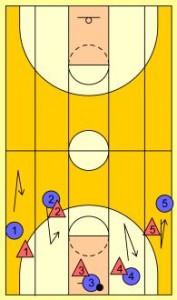
With 5 lanes in the drill, one of the main teaching points is spacing on the passes.

You can vary the drill by making teams compete against each other for the least amount of passes required for completion or by timing each team.
basketball-drills-5-lane-passing1

This drill emphasizes man-to-man defensive coverage, develops the ability to pass and catch under pressure, and develops team communication and court spacing.

It is a great way for players to develop the ability to get open.

The drill is very effective in teaching intensity and internal motivation, resetting without dwelling on the mistake, and working together.


basketball-drills-5-lane-passing2

Assign each pair to play in one of the 5 lanes as designated on the diagram. Neither member of this pair is allowed to go outside of their lane.

You can use floor tape or markers such as cones or spots from PE classes to mark the lanes.

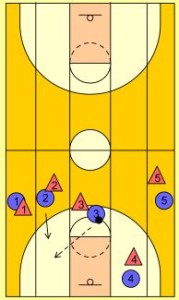
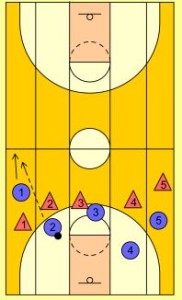
Offense moves the ball up the court; with every offensive player having to receive a minimum of 2 passes. (You can try the drill with and without this rule to see which way works best for your team.)

The offense has completed the drill successfully when one of the offensive players receives a pass while standing on the opposite baseline.
basketball-drills-5-lane-passing3

Once an offensive player receives a pass, they must yell out the number of passes they have received. This will help the offense know when all 5 players have caught 2 passes if you are using that rule.


basketball-drills-5-lane-passing4

RULES FOR THE DRILL;

1. No dribbling. Get your players used to pivoting under pressure.

2. If the defense steals the ball or causes it to go out of bounds, the offense must reset at the baseline. Insist that your players reset without instruction.

3. A loose ball can only be retrieved by the person in the lane it is in.

This drill was submitted by Denita Dyck

Basketball Plays Line 2451 (Tip Layup Play)

By Brian Williams on February 17, 2014

Coach Vonn Read has submitted several plays from his playbook series The Basketball Encyclopedia of Plays to the Coaching Toolbox.

Vonn is the Assistant Coach for the Women’s program at Houston.

He has also served as an assistant coach in the WNBA with the Phoenix Mercury, Orlando Miracle, and San Antonio Silver Stars. He was an advanced scout for the Orlando Magic as well as The Charlotte Sting.

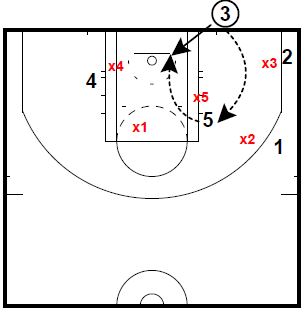
This play is a short seconds inbounds play from underneath the basket.


basketball-plays-line-tip


This is a good short clock UOB play against a 2-3 Zone.

The 2 player will cut hard to the corner.

The 4 player will cut hard to the block.

The 1 player will pop out to the wing.


basketball-plays-line-tip2


The 3 player will pass the ball to the 5 player for the quick shot.

If X5 steps up to guard the 5 player on the pass, the 5 player can jump up to tip the ball to the 3 player stepping inbounds from the baseline for a layup.

The taller the 5 player, the easier the tip pass will be.

Coach Read has also put together The Basketball Encyclopedia of plays. You can check them out here: The Basketball Encyclopedia of Plays or read more about the books:

Any coach looking for the latest and innovative plays from the Professional, College, or High School levels can stop looking. With a compilation of over 7,700 different plays, you will never need to purchase another basketball playbook again. These playbooks can be used as a great reference tool for years to come. This 2 Volume Book includes plays from 19 different play categories, and they are the most extensive playbooks on the market.

The Basketball Encyclopedia of Plays (Platinum Series) contains over 7,700 Plays (Both Volumes combined) from the NBA, WNBA, USBL, and College levels from someone who has worked as an Advanced Scout or Coach on each level!!! This book has been intensely compiled over the last 21 years, with plays taken from a lot of NBA Coaches (past and present), WNBA coaches, and College coaches (Men’s and Women’s) from around the country.

Any coach that is serious about improving their knowledge of the game from an X and O standpoint will benefit tremendously from these books. These Books can be used to discover New Quick hitters, add a New Package to your playbook, or develop an entire Offensive System. There are a lot of new ideas and concepts in these books to study, and the Basketball Encyclopedia of Plays can be a great resource for coaches on all levels!!! This book is definitely for those X and O junkies who are always looking to improve as a Coach.

“THE GAME IS ALWAYS CHANGING? ARE YOU?” Vonn Read

Here is the link: The Basketball Encyclopedia of Plays

Basketball Drills Rebounding Drills

By Brian Williams on February 14, 2014

These basketball rebounding drills are from an old University of Washington women’s Newsletter.

Coach Mike Neighbors has moved on to Arkansas.

8 Minute Rebounding

5-on-5 competitive drill where points are totalled at the end of 8 minutes.

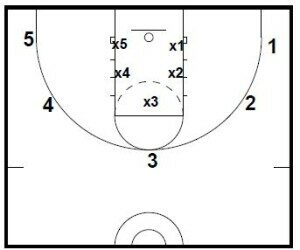
Offense is around the perimeter behind the 3 point line. Defense must start in the key.

Offense will get 1 point for the rebound.

They can also play the rebound and score for more points.

After offense gets the ball, the play is over when offense scores or defense recovers.

basketball-drills-rebounding1

Defense must rebound and transition down the court. Whatever they score at the other end is their points. If the offense recovers the ball, they do not get to transition back.

Point guard always gets back on defense in this drill. The defender of the point should go to double team whoever is the biggest threat.


Circle the Wagons Rebounding Drill

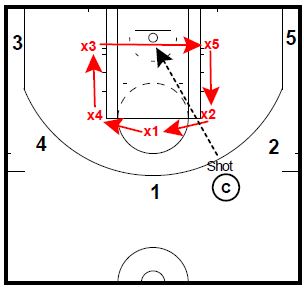
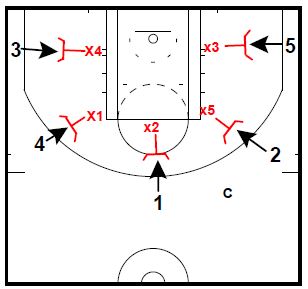
I think this is a good way to work on looking for someone to block out either out of a zone or from a man to man defense that traps and rotates.

basketball-drills-rebounding-drills basketball-drills-rebounding-drills2

Basketball Coaching Fostering Aggression

By Brian Williams on February 13, 2014

I received this article from Creighton Burns.

The article was written by Mike Dunlap, former Head Basketball Coach for the Charlotte Bobcats.  Coach Dunlap has also coached at several levels both internationally and at several colleges in the United States.

I frequently get asked about making players more aggressive.

SOME THOUGHTS:

1) Inch by inch.
Too much aggression from you, another player, assistant, or anyone else will drive him away from the very thing you are asking him to do.

2) 5 Two Minute Drills
a) Short drills that show the player how to be assertive.  Example given: you hold a ball out in front of you, squeezing it very tightly and the player must snap it out of your hands, front pivot and shoot.  This teaches him/her how, what, why, when, where, to be aggressive AND it doesn’t hurt……also when you make him shoot at the end of the action it takes some focus off what you are after and is like a reward.

b) Slowly roll the ball from under basket. The player must dive on the ground, grab the ball, get up, and shoot the ball….put a target of say 3 makes out of 5 tries,all done within 2 minutes.

c) Have the player get into a defensive stance…you or another player does the same as they face each other about 12 inches apart and have them push  or lightly hit one another on the chest or shoulders…yes they alternate doing this, perhaps 3 times.  Then hand each a ball and have them power dribble the ball one time and lay it in. WHY?  This teaches the player how to pop another player without hurting anyone, lets him feel what it is like to take a hit, and shows him that the FEAR he was experiencing  was a ghost with no soul.

*The point here isn’t the actual drill but more about the teaching methodology.

3) Self Evaluation
You can either do this with each drill  or at the end of practice.  Ask the player what he is going to give you today….scale of  1-10…. he says 8  then either hold him to that or ask him as the drills unfold to tell you how he thought he did in the last drill with his aggression level.  You may be amazed one way or the other how the player sees it.

4) Film
a) Get some clips of other players that show him an  “AGGRESSIVE ACT.”

b) Film him doing an aggressive act; this reinforces the very behavior you are after and is quite easy now with IPads.

5) Patience
a) All this takes time but is well worth the wait. One thing is for sure: he won’t become more aggressive because you yell at him or if he does it will be short term.

6) Model
a) Certainly one of your players has a salient predisposition for eating red meat.  It is a good idea to use this player as an example, but only if you do this in a skillful and thoughtful  way.  You don’t just want to throw your “tenderloin” in with the wolf.

7) Peer Support
a) Teach and encourage your players to bring along the less aggressive, while also making sure they don’t coddle them either: a balanced approach.

8) Game Ball-Practice Ball
a) Get a bag of Nerf balls and give them out occasionally as an acknowledgement to the player who demonstrates the very behavior you want. You can do this after practice or games….and it is quite cheap!

*My purpose here isn’t to say everything or write in a way that I am  all knowing.  I just want to stimulate thought and  share some ideas.

Shared by Mike Dunlap

Basketball Drills Triangle Ball Toughness

By Brian Williams on February 12, 2014

This post was created by Kyle Gilreath. He is NBA Client Services Manager for FastModel Sports.

He is the Head Basketball Coach at Astronaut High School in Florida. He served as an undergraduate manager as well as graduate assistant for the Florida Men’s program under Billy Donovan.

I found the drill on FastModel’s plays and drills library.

It contains over 2000 drills and plays in the library. Here is the link. FastModel Drills and Plays Library

You can also find out more about FastModel Play Diagramming software by clicking this link: FastDraw

Kyle also has a very good blog you should check out. Here is the link to it: Words on the Bounce

Here is what Kyle wrote about the drill:

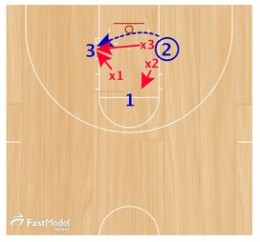
This is a great offensive and defensive peer pressure drill that can help your players improve their toughness.

basketball-drills-triangle-toughness-2


x1 and x2 trap 1.

1 must be strong with the ball trying to pass to 2 or 3.

1 must utilize pass fakes to lead x3 and pass to the open man.


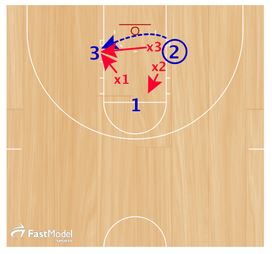
basketball-drills-triangle-toughness


If 1 passes to 2, x2 and x3 become the new trappers.

Drill continues until the defense gets a deflection or causes a turnover.


Basketball Drills Quick Strike Transition Drill

By Brian Williams on February 11, 2014

The name of the drill is Quick Strike and its purpose is to work on both transition offense and conversion defense.

The drill is from Arkansas’ Mike Neighbors.

I heard him speak at a clinic and he said that if he were allowed to use only 2 drills, this would be one of them.

The description below the video is a slightly different version of the drill that he used to run.

Like all of our drills, this one has evolved and improved over time.

The video of this rebounding drill is hosted on You Tube.

You will need to be on a network that allows you to access You Tube.

Click the play arrow to view the video.

There is narration with the video, so please make sure that your sound is on.

Quick strike emphasizes both transition offense and defense. It also reinforces shot selection, decision making. and eliminating turnovers.

The drill is about the scoring and teaching opportunities that it presents as you try to teach transition offense and defense.

You must have a score clock (shot clock is best) or a stop watch that counts down.

Divide players into two-colored teams all on one end of the floor. Begin the drill by tossing the ball to the white team putting them into transition attack mode and blue team into transition defense.

The clock starts at 15 seconds since we are emphasizing transition offense and a quick attack.

If blue scores they are awarded points based on how much time has elapsed from the 15 second clock… For example, if they push the ball up quickly and score with 10 seconds left they get 10 points. The action never stops and White now attacks in transition as Blue defends.

No points are scored if the team does not score. You will need to decide how you score points for fouls. One way would be to award all 15 points to the offense if the defense fouls, regardless of how much time remains on the clock.

Again the clock is re-set as they begin their attack. This continues for a set # of possessions, to a certain score, or a set amount of time…

Quick Strike Basketball Transition Drill

You can imagine the importance this places on communication and decision making.

LOTS of teaching points for your transition.

“Milk the Clock” using the Quick Strike Basketball Transition Drill

You can also use it as a drill to teach and rehearse milking the shot clock if you have a lead. Even if you are a high school coach in a state without a shot clock, you can use this drill to have your players practice running clock at the end of the game without going into an actual stall.

To practice milking the clock, run the same drill, but the team scores for how much time they took off the clock when they score. For example, if you have a 30 second shot clock or want to practice running 30 seconds off before you score without a shot clock.

An example would be: Put 30 seconds on the clock and give one team the basketball. Stop the clock when the ball goes in the basket. If it goes in at 8 seconds left on the clock, they score 22 points. If it goes in at 5 seconds left on the clock, they get 25 points. When there is a change of possession, either on a made basket, a defensive rebound, or a turnover, start the clock again at 30 seconds for the other team.

[thrive_leads id=’17277′]

  • « Go to Previous Page
  • Page 1
  • Interim pages omitted …
  • Page 200
  • Page 201
  • Page 202
  • Page 203
  • Page 204
  • Interim pages omitted …
  • Page 288
  • Go to Next Page »

Primary Sidebar

  • Twitter
  • Facebook
  • Linkedin
coachestoolbox
personaldevelopmenttoolbox
basketballplayerstoolbox
basketballtrainer
athleticperformancetoolbox
coachingbasketball

© Copyright 2026 Coaching Toolbox

Privacy Policy