• Skip to primary navigation
  • Skip to main content
  • Skip to primary sidebar

  • Basketball Plays
    • Ball Screen Sets
    • Horns Sets
    • Man to Man Post Up
    • Man to Man Isolations
    • Backdoor Plays
    • Man to Man 3 Point Shot Plays
    • 2-3 Zone Attack
    • Baseline Inbound Plays
    • Sideline Inbound Plays
    • Combination Defense Attack
  • Drills
    • Defensive Drills
    • Offensive Drills
    • Competitive Drills
    • Passing Drills
    • Rebounding Drills
    • Shooting and Scoring Drills
    • Toughness Drills
    • Transition & Conversion Drills
    • One on One Drills
  • Blueprint
  • Practice
  • Mental Toughness
  • Skill Development
  • Offense
  • Defense
  • Store

Basketball Drills Improvement Season Shooting

Basketball Drills Improvement Season Shooting

By Brian Williams on March 27, 2014

These basketball drills were designed with FastModel. You can find out more about the software and also see several other plays and drills that were contributed by coaches from various levels, locations, and backgrounds at FastModel Drills and Plays Library

Here are 3 shooting and scoring drills that I hope will fit into what you are allowed to do with your players during this spring improvement season. I posted a competitive workout system last week as an idea to use with your players to add some variety to what you do with your skill development.

If you did not see the article last week, here is the link: Competitive Basketball Workout


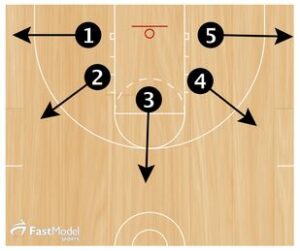
5-Spot Range Shooting
basketball-drills-isss1

In the competitive workout system, this is in the technique drill category.

6 shots at each spot. Make 60% of 30 shots in order to move spots back. Continue moving spots back to determine range.


“On the Clock Attacks”

These next two drills were contributed by Tim Springer he Girls Varsity Basketball Coach at Castle Hills First Baptist School in San Antonio, Texas
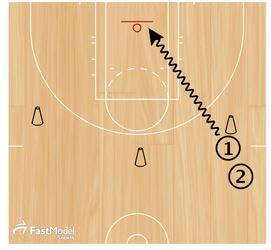
basketball-drills-isss2


Players drive to rim and hit change of direction at 3 point line then finish with layup or jump shot.

Group must make 10 at each cone within 4 minutes.

Repeat drill 3 times with different moves at 3 point arc.

You can adjust time required, number of reps, and specific moves to fit skill level and needs of your players.
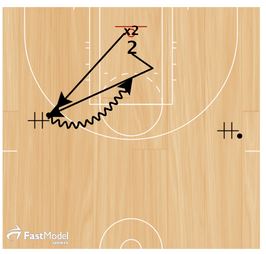
basketball-drills-isss3


Player gives misdirection to defense and sprints to either chair.

Grabs ball from chair and pivots into triple move and attacks defender.

Play 1 on 1 with limit of 2 or 3 dribbles.

Player remains on offense until the defense gets a stop without fouling.

Adjust rules to your program.

Champions Shooting

As a high school coach at Park Tudor in Indianapolis, Ed Schilling used this drill both during the season and during summer workouts. Ed is currently an assistant for Steve Alford at UCLA.
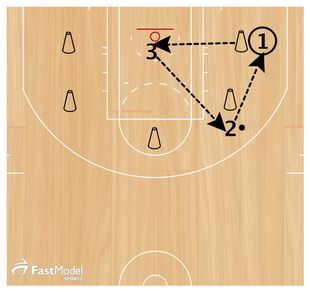
basketball-drills-isss4

Put 15 minutes on the clock.

You can adjust the distance and type of shots (catch and shoot, shot fake 1 dribble, floaters) to suit your needs.

2 basketballs per 3 player group.

3 is rebounder, 2 is passer, 1 is shooter for 1 minute.

Each minute sound horn and players rotate from shooter to rebounder, rebounder to passer, passer to shooter.

Can compete for makes as a group, or as an individual, compete against your personal bests.

Drill works best for long term development if player calls out score for manager or coach to record after each round. Keep record and post progress of each player.
Coaching Basketball Don Meyer Fundamentals

By Brian Williams on March 26, 2014

Passing & Receiving Ideas

from Don Meyer

  • There aren’t many great passers anymore. Most perimeter players are able to dribble, and some can shoot, but not many can pass. It is quickly becoming a lost art.
  • Great passing teams are happy teams.
  • Players must understand who they are passing to and the current situation. It does no good to throw a pass to a great 3-point shooter inside the 3-point arc, and it does no good to pass to a post man that can’t dribble on the break when he will have to put the ball on the floor to get to the rim.
  • The bounce pass is used in tight quarters (penetrating guard using the bounce pass to the post) and can be used on cuts to the rim (example: back cut on the wing). We don’t want any bounce passes on the perimeter, and a general rule of thumb is no bounce passes anytime the player is moving away from the basket.
  • We like to use the chest pass in the open court (transition) or when our guards are spaced on the perimeter (much quicker than the one-handed flick pass). The legs must be used for velocity.
  • We tell our players that if they can’t successfully make solid, catchable passes to the post, they can’t play. We work on post feeds a lot. On the baseline post feed, we want our players to dribble down to get the proper angle, and then we teach our players to step across with the inside foot to shield the pass from their defender (one of the only times we violate our concept of permanent pivot foot)
  • On all bounce passes (including post feeds), we want the ball to hit 2/3 of the distance from the passer to the receiver. We also want the passer to turn the wrist from inwards to outwards so that the ball digs into the floor and spins into the receiver.
  • On all catches, we want the following: “Ball in the Air, Feet in the Air” so that we can catch with two feet and then use our permanent pivot foot.
  • On all catches, we want the receiver to meet the ball (shorten the pass). Most passes are intercepted when the receiver doesn’t shorten the pass, allowing the defense to shoot through the passing lane.
  • “Every pass is a shot” Perimeters must believe that their pass will lead to the success or failure of the shot. A good pass in the shooting pocket will lead to a rhythm shot, whereas a pass too low or too high will get the shooter out of his rhythm, and may take the shot opportunity away (defense has time to react).

Transition Game Ideas

  • In the primary 2v1 break, we teach our ballhandling guard that they must attack the defense with the intent to score. They only make the pass to the receiver when the defense fully commits to their penetration.
  • In the 2v1 break, we want our offensive players to split the floor into 1/3’s, approximately one yard outside of the free throw lane. As they get closer to the hoop, they will progressively get closer to each other. We want the ball in the inside hand of the ball-handler (better angle to make the bounce pass to the finisher).
  • In the 3v2 break, we want our ball-handler to go towards our best shooter and away from our best finisher at the rim (ball-handler must immediately recognize the strength of his teammates). The ball-handler must attack the first line of defense and occupy that defender. At that point in time, the defense must make a decision to guard the hoop or cheat to guard the best shooter. If the bottom defender protects the hoop, the shooter will have an open look, and if the bottom defender cheats to guard the shooter, the finisher will have an open look at the rim. The key is to occupy the top defender and be able to make a quick read on the bottom defender (requires a point guard with a high skill level).
  • We want our point guard to receive the outlet as deep as safely possible. On the catch, we want his body opened up to the middle of the floor, or if he has to catch facing the opposing basket, we want him to pivoand turn to the middle of the floor. We prefer the catch to be wide (near the sidelines) so that the angle is good to make the pitch-ahead pass to the near-side wing, or the point-to-post “lob” pass to a post running the rim. If the guard catches in the middle of the floor, there is typically a lot of traffic and passing angles diminish.
  • We want our wings (2s and 3a) to run the wings as wide as possible. In fact, in practice, we have them run near the sideline or even run out of bounds to emphasize running wide. Once the rebound is secured, they must immediately begin to sprint the lane.
  • Point guards are looking to pitch ahead to the near side wing, go point-to-post to the streaking post man (typically must pass before the ball gets to the half court line), or look for the diagonal pass to the opposite wing (aim the pass to the far corner).
  • Point guards can also “cross main street” by using the 4 man who is trailing as a moving screen. This is a great way to get a quick ball reversal, which forces the defense to rotate.
  • If the point guard has no options to pass the ball ahead to a teammate, we want our point guards to look to penetrate in secondary transition. We tell our point guards to “crack the shell” of the defense. It is crucial that the near side wing is wide & low enough, and that the trailer stays well behind the 3-point line to space the floor and discourage help-side defense. On the penetration, the low-post must drop into an alley near or behind the hoop to give the guard room to get to the rim or passing angles on any post help.
  • If the point guard is a great shooter, we work on the pull-up 3 in transition, especially in a 2v1 or 3v2 setting. This shot is very difficult to make, but it is almost impossible to defend, without giving up an easy lay-up (especially in 2v1).

Basketball Plays from 2013 NCAA Tourney

By Brian Williams on March 25, 2014

A great idea this time of year is to either set your DVR for the men’s and women’s NCAA, NIT, and high school basketball tournament games that are on TV. That way you can go back any time this spring or summer to pick up some great man to man, zone, and inbounds plays. I also like to look for sideline, under out, and on ball screen sets in the upcoming NBA playoffs.

This video is a compilation video with some of the favorite man to man sets, zone sets, and baseline inbound plays from last year’s NCAA Men’s Tournament of Zak Boisvert.

He is an Assistant Men’s Coach at Army.

I have previously posted some of the You Tube videos His You Tube channel is: Zak Boisvert You Tube Channel

If you are interested in subscribing.

He also is also very active on Twitter:
@ZakBoisvert

Box Elbow Split High

By Brian Williams on March 24, 2014

I have posted several plays from Syracuse Associate Womens’ Head Coach Vonn Read has submitted several plays from his playbook series The Basketball Encyclopedia of Plays to the Coaching Toolbox.

Coach Read has also served as an assistant coach in the WNBA with the Phoenix Mercury, Orlando Miracle, and San Antonio Silver Stars. He was an advanced scout for the Orlando Magic as well as The Charlotte Sting.

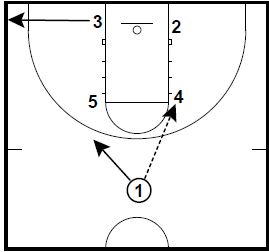
This play is a quick hitter to use against man to man defense.


basketball-plays-besh1


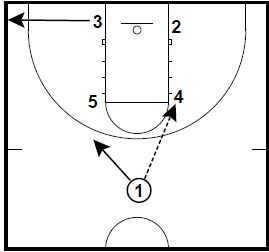
1 passes to 4 at the elbow and takes 2 steps away from the ball.

3 spaces to the corner.


basketball-plays-besh2

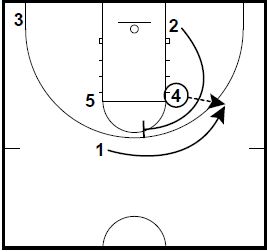
2 curls high to the top and sets a split screen for 1.

1 will come off the split screen and get the handoff pass for the jump shot.


basketball-plays-besh3


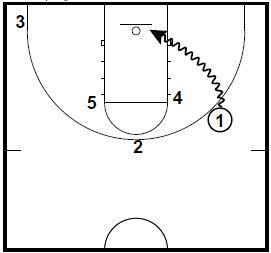
If 1 does not have the jumper, he can drive hard to the basket for the layup!!


Coach Read has also put together The Basketball Encyclopedia of plays. You can check them out here: The Basketball Encyclopedia of Plays or read more about the books:

Any coach looking for the latest and innovative plays from the Professional, College, or High School levels can stop looking. With a compilation of over 7,700 different plays, you will never need to purchase another basketball playbook again. These playbooks can be used as a great reference tool for years to come. This 2 Volume Book includes plays from 19 different play categories, and they are the most extensive playbooks on the market.

The Basketball Encyclopedia of Plays (Platinum Series) contains over 7,700 Plays (Both Volumes combined) from the NBA, WNBA, USBL, and College levels from someone who has worked as an Advanced Scout or Coach on each level!!! This book has been intensely compiled over the last 21 years, with plays taken from a lot of NBA Coaches (past and present), WNBA coaches, and College coaches (Men’s and Women’s) from around the country.

Any coach that is serious about improving their knowledge of the game from an X and O standpoint will benefit tremendously from these books. These Books can be used to discover New Quick hitters, add a New Package to your playbook, or develop an entire Offensive System. There are a lot of new ideas and concepts in these books to study, and the Basketball Encyclopedia of Plays can be a great resource for coaches on all levels!!! This book is definitely for those X and O junkies who are always looking to improve as a Coach.

“THE GAME IS ALWAYS CHANGING? ARE YOU?” Vonn Read

Here is the link: The Basketball Encyclopedia of Plays

Coaching Basketball 4 Levels of Defense

By Brian Williams on March 21, 2014

Today’s post includes a video about Better Basketball’s Dynamic Defensive System. It contains samples from the whole program.

It moves fast and you may have to rewind, pause it, or watch it a second time, but I think there are several ideas to be had from the content. I hope you get some ideas that can be adapted to your program.

You can also see their You Tube channel of several coaching resource videos at: Better Basketball You Tube Channel

My takeaways from the video below

4 levels of defense

0 = Prerequisites Moving Mechanics and Rebounding

3 Types of movements (forward/back, side to side, rotation)

Some ideas for preseason conditioning drills next fall (see exercises on the video)

(Emphasis that rebounding is a prerequisite for playing defense)

Level 1 = on ball defense

Level 2 = guarding away from the ball

Stop the ball from being driven into the lane
Stop the ball from being shot in the lane
Stop the ball from being passed into the lane
Quickly recover to level 1 position on the ball

Level 3 = guarding situations such as baseline drive, ball screens, post feed, failed traps

Level 4 = restore order

Snippets of drills (see the drills in the video)

Terminology

Taking a charge–“no hand bracing” keep hands up when landing to avoid injury to hand/wrist and a drill to work on it.

Skirmish = make the penetrator indecisive by faking help.

The help behind a recovering defender is the most important part of recovery.

If the ball is fed into the post, the post defender has the air time of the pass to recover to guard the ball once it is caught.

To create level 3 defenders, 1) Reduce each principle into specifics that can be measured 2) Turn the principle into repeatable actions that can be drilled

A skill can be acquired if it can be turned into repetitions

3 ways to double team the post 1) Ball is in the air from a pass 2) On the catch 3) On the move by the offense

Having mental toughness does not guarantee a championship, but a lack of mental toughness (not having poise, focus confidence) in the key possessions is guaranteed to cost you a championship.

Championship commitment on defense requires verbal, physical, and emotional commitment.

If you are interested in learning more about this defensive system click the link below.

Better Basketball’s Dynamic Defensive System.

Basketball Drills Shooting with Conditioning

By Brian Williams on March 20, 2014

I always like to complete our improvement season skill development workouts with a “Toughness Drill” that challenges players both mentally and physically.

If you didn’t see the post with my competitive workout structure, here is the link: Competitive Basketball Workout

This is a very good drill to do just that.

It is from Coach Mike Neighbors, Assistant Coach Dallas Wings.

He calls it “3-6-9-12-15 Shooting”

Put balls on the court at the half court line, the opposite three point arc, and the opposite free throw line. These are targets that shooters have to run around based on their shooting performance.

This is a five cycle drill with a FT in between each cycle. Total drill will give shooter 50 attempts.

First cycle is a 3. Shooter starts by first ball at half court line. She comes on the move to top of key to attempt shot #1. Make or miss she sprints to shot #2. Make or miss to shot #3. This completes the 3. She shoots a FT.

basketball-drills-3-6-9-12-15

Second cycle is a 6. Shooter starts at same spot and completes the cycle just as above. If she makes all 3 shots, she goes directly back to spot 1 for shot 4 and finishes the pattern. If she misses all three of her first shots she must sprint around the far ball before attempting shot #4. If she misses two shots, she sprints around the ball at opposite arc. If she misses only 1, she sprints around the closest ball at half court before attempting shot 4, 5 , and 6. Free Throw then back to start the 9.

This is a GAME SHOT/GAME SPOT/GAME SPEED drill that will also challenge your best conditioned shooters.

You can chart scores for individual cycles. 2 out of 3, 5 out of 6, 8 for 9, etc…

Your best shooters will in time have perfect rounds up through 12… never seen a perfect round in 15.

Your best shooters will have a 50 shot score in the 40’s. After a 3-6-9-12-15 with a free throw between rounds.

  • « Go to Previous Page
  • Page 1
  • Interim pages omitted …
  • Page 196
  • Page 197
  • Page 198
  • Page 199
  • Page 200
  • Interim pages omitted …
  • Page 288
  • Go to Next Page »

Primary Sidebar

  • Twitter
  • Facebook
  • Linkedin
coachestoolbox
personaldevelopmenttoolbox
basketballplayerstoolbox
basketballtrainer
athleticperformancetoolbox
coachingbasketball

© Copyright 2026 Coaching Toolbox

Privacy Policy