• Skip to primary navigation
  • Skip to main content
  • Skip to primary sidebar

  • Basketball Plays
    • Ball Screen Sets
    • Horns Sets
    • Man to Man Post Up
    • Man to Man Isolations
    • Backdoor Plays
    • Man to Man 3 Point Shot Plays
    • 2-3 Zone Attack
    • Baseline Inbound Plays
    • Sideline Inbound Plays
    • Combination Defense Attack
  • Drills
    • Defensive Drills
    • Offensive Drills
    • Competitive Drills
    • Passing Drills
    • Rebounding Drills
    • Shooting and Scoring Drills
    • Toughness Drills
    • Transition & Conversion Drills
    • One on One Drills
  • Blueprint
  • Practice
  • Mental Toughness
  • Skill Development
  • Offense
  • Defense
  • Store

Basketball Drills Ball Screen Pocket Passing

Basketball Drills Ball Screen Pocket Passing

By Brian Williams on April 17, 2014

This passing drill for teams that use a lot of on ball screening actions is from the competitive drills file.

If you are interested in being added to his list, please email me and I will pass it along to him.

Coach Mike Neighbors picked this drill up from Todd Schaefer.

Todd is currently serving as an assistant to Coach Neighbors at Arkansas.

Here are links to 3 other passing drills that are posted on The Coaching Toolbox.

This post has a little bit of Coach Beilein’s coaching philosophy–the second part includes several passing drills John Beilein Passing Drills

This series passing drills, involves twp players and coach, and works on the ability to penetrate with their head up and make intelligent scoring or passing. It also emphasizes catching passes while on the move: 2 player passing drills

This passing drill requires 5 offensive and 5 defensive players: 5 Lane Passing Drill

Ball Screen Pocket Passing Drill
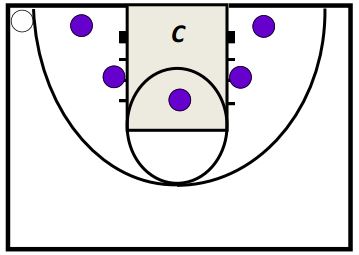
basketball-drills-pocket-passingFeeding a rolling post player is a must have skill for any guard who plays in a ball screen action offense. Without this skill, defenders can simply focus on defending the screen and subsequent potential drive to the basket.

Set up chairs, cones, or balls in an arc. Wide enough that two balls fit in the space between them. Coach stands inside the arc as the receiver and return passer.

Player starts in the corner. Simulate an on-ball screen. Explode from that simulated screen and deliver a pass that bounces in the area between the first and second obstacle. Coach returns the ball and player repeats the action all the way around and back.

You can make this timed competitive or number competitive.

For variety you can change the angles of the passes or decrease the distance between the obstacles.
Basketball Drills Smother Defensive Drill

By Brian Williams on April 15, 2014

Smother Defensive Drill

I received this drill from Creighton Burns

This 5 on 5 defensive drill allows you to work on defending the following actions

1) High Pick and Roll
2) Side Pick and Roll
3) Step up Pick and Roll
4) Dribble Handoff

The purpose of this post is to give you a system for practicing defending on ball screen and hand off movements in the manner that fits your defensive system by having the second unit run this pattern. It is not to tell you how to defend them

As with everything I post, my main objective is that you will find a way to adapt this drill to fit the needs of your team, or to create a similar drill that is even better for you.

In my opinion, it is a very good way to be able to work on defending ball screens 5 on 5 to be able to get help positioning and rotations down.

Diagrams created with FastDraw

basketball-drills-smother1

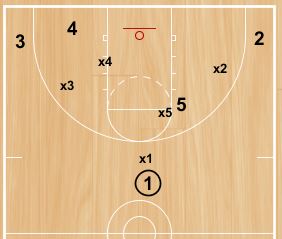
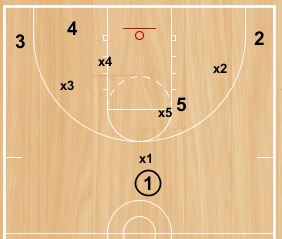
The drill is a 5 on 5 drill with an emphasis on defense.

The offense starts out with the point guard with the ball in the middle of the floor

#5 can start at either elbow.

#2 and #3 are in the corners.

#4 starts in the short corner

basketball-drills-smother2

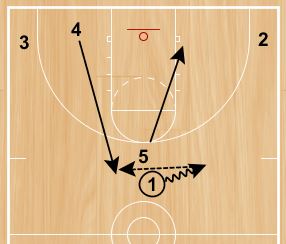
5 sets a middle pick and roll for 1


basketball-drills-smother3

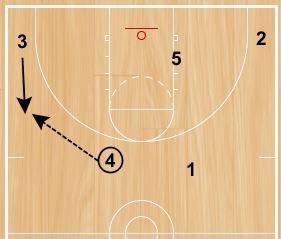
4 cuts to the deep elbow opposite 1 and receives a pass from 1.

5 relocates to the block.


basketball-drills-smother4

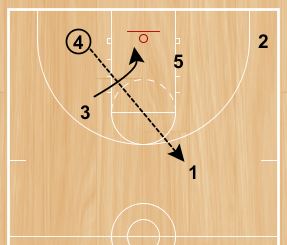
3 cuts to the free throw line extended and receives a pass from 4.


basketball-drills-smother5


4 sets a side pick and roll for 3.

3 dribbles to the middle and passes to 4 as he rolls.


basketball-drills-smother6


4 skips the ball back to 1.


basketball-drills-smother7

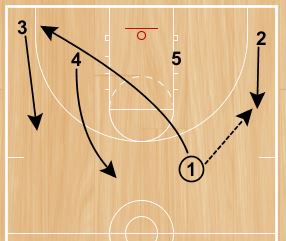
1 reverses the ball to 2 who has cut to the free throw line extended.

4 returns to the top.

After 1 passed the ball he cuts to the corner opposite the ball.


basketball-drills-smother8

5 sprints out to a step up ball screen for 2.

2 drives baseline off the screen.


basketball-drills-smother9

2 passes the ball back to 4 at the ball side deep elbow.


basketball-drills-smother10


4 dribbles back at 2 for the dribble hand off.


Basketball Plays Inside Triangle

By Brian Williams on April 14, 2014

This 3 in 2 out play was diagrammed by retired Division I Coach Randy Brown.

This set isn’t something that you would want to run the whole game.

It is a way to exploit it if you have an inside scoring advantage as a change up to what you normally do.

Randy’s site has been recently received a new look.

You can see it at coachrb.com.

It features his mentoring program for anyone interested in becoming a college coach.


Inside Triangle

This is an inside triangle set that can be run as a quick hitter or continuity offense. 3-4-5 are in a revolving screen and cut mode on the interior. 1 and 2 are available on the wings as receivers and passers into the post. Guards must move up and down sideline to occupy their defenders to allow inside scoring.

basketball-plays-inside-triangle1

1 dribbles to the wing

4 down screens for 3

If 3 is not open for an inside scoring opportunity, he cuts above the arc.

1 passes to 3
basketball-plays-inside-triangle2

3 reverses the ball to 2

4 cross screens for 5

If 2 can feed the ball inside to 5, he makes the pass.


basketball-plays-inside-triangle3

3 down screens for 4

2 passes to 4

3 cross screens for 5

Continue the down screen cross screen with ball reversal.
Randy’s site has been recently received a new look. You can see it at coachrb.com. It features his mentoring program for anyone interested in becoming a college coach.


Basketball Plays Louisville Drag Double

By Brian Williams on April 11, 2014

This ball screen play is from Coach Scott Peterman’s 158 page Louisville Cardinals Playbook.


Louisville Drag Double

basketball-plays-drag-double1


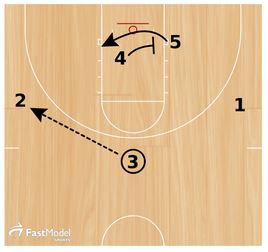
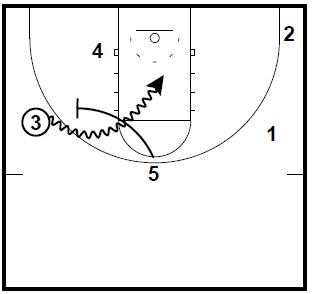
4 and 5 set a staggered ballscreen on 1.

1 attacks the right side. 4 rolls to the basket.

3 slides up to the left wing.


basketball-plays-drag-double2


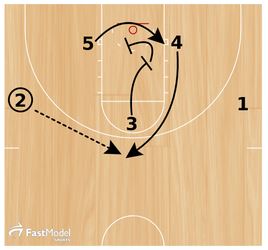
5 pops out to the top of the key.

1 passes to 5.

5 passes to 3.


basketball-plays-drag-double3


5 sets a ballscreen on 3.

3 attacks the middle.


Basketball Drills Finishing

By Brian Williams on April 10, 2014

I found these 2 drills in the Fast Model basketball library.

They are drills that can be used in 2 or 3 player skill development workouts, or in a team practice setting.

If you like these drills, please consider sharing them on Twitter or Facebook through the share buttons on the left side of the page.

Also, click here for a link to all of the basketball drills on The Coaching Toolbox.

This drill was contributed by Taylor Jannsen.

He is the owner and founder of PMax Basketball Training centrally based out of Milwaukee.

The purpose of this drill is to teach players how to beat rotational help with a variety of finishes.

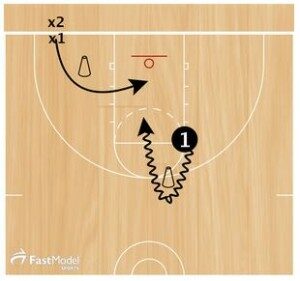
Beat the Helper

basketball-drills-beat-the-helper

On the offensive player’s first move, the defense loops around a cone and simulates a help defender.

Player 1 pushes the dribble out in front and must touch the paint before attempting a shot.

Make the drill competitive by scoring it as a one on one game. You can either play straight scoring or allow the offense to stay until the defense gets a stop.
 

6 Scoring Moves Drill

John Leonzo, student assistant for the men’s basketball team at Cedarville University, contributed this drill

basketball-drills-6-moves

This drill allows for a lot of repetitions on moves for finishing around the basket, one on one moves, and jump shots.

This can also be used by small groups or individuals as a part of their improvement season workouts.

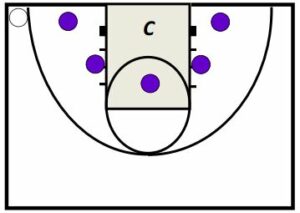
Passers are represented by dots. If there are no passers available, players can simulate a pass by spinning the ball to themselves.

Players sprint to the 3 point arc, and then execute the following series of moves:

1. Rip and go lay-up
2. Change of direction and lay-up
3. Rip and go jump-shot
4. Change of direction jump-shot
5. 1 dribble step-back jumper
6. 3 pointer

This series of moves is to be executed twice at each wing, once going to the open side and another time going to the middle.

To make it competitive, time one player through all 6 moves from one spot with a 2 second penalty for each missed shot.

Coaching Basketball Synergistic Offense and Defense

By Brian Williams on April 9, 2014

This post is a combination of two articles written by Brian Anglim

Synergistic Offensive and Defensive Philosophies

Earlier this week I was reading some clinic notes from Mike Dunlap and I came across an idea that I liked -“does your defense compliment your offense?” I liked this concept and immediately tweeted it (I am trying to be more active on twitter) and further asked the questions “Does your offense compliment your defense”. A coach on twitter (@CoachDWarriors) asked if I would expand on this thought and give some examples. Twitter is great for quick thoughts, but not for big answers so I figured I would blog on the topic. Basketball can not be broken up into two sides of the ball like you can in football, the demands you make on one side of the court effect the execution on the other. We also coaches want to develop our offense and defense to work synergistically. Different combined offensive and defensive systems revolve around three factors – depth, talent, and coaching philosophy.

Depth

If I have a team with a lot of depth, I want my defense and offense to maximize pressure on our opponent so conditioning becomes a factor. For example, VCU has an up tempo offensive and defensive system. Their defense leads the NCAA in turnovers forced with their full court “Swarm” pressure. This defensive system is married with an attacking/up tempo offensive attack. With constant offensive and defensive pressure they wear down an opponent physically and mentally and utilize that depth.

Teams that don’t have great depth cannot play a high energy type of offense and defense. I have heard Dick Bennett (and now his son is emulating his father to some extent) talk about how he ran the Blocker-Mover offense to slow down the tempo a keep their players fresh. With this thought in mind, they play a Pack Line Defense which does to extend beyond the 3 point line, thus conserves the energy of their players.

Coaching Philosophy

Certain coaches are offensive coaches while others are defensive coaches. With this in mind, they will focus their time and energy on one side of the court at the expense of the other. This translates that I might teach a simple offense so that I can focus on my defense or visa versa.

An example of this is Gary William’s Maryland teams, he ran a simplistic offense known as the flex so that he could have the time to perfect his half court man, half court zone, full and ¾ court pressure systems. He was known as a pressure defense coach and he really emphasized the flex as an offense because he believed it got the ball inside that lead to his team getting to the line. Thus he was able to set up on full court pressure defenses. An example of an offensive team would be Notre Dame, I have been watching All Access Notre Dame Practice with Mike Brey and the vast majority of their practice time is spent on their motion and teaching offensive concepts. With this in mind, they run very simple man and zone defenses without much attention to detail. This offensive focused team philosophy works to the skills of the coach and his players.

Personnel

By personnel I mean the type of players that make up a team. Some teams might be smaller in size with a collection of guards, thus they cannot expect to rebound the ball as well as some teams. Their defense might be tilted toward forcing turnovers and their offense might look to take advantage of the driving and shooting ability of these guards. An example of this might be the 4 guard teams that Villanova teams of several years ago. Bigger teams, might look to have a more controlled offense that looks to minimize their bigs touching the ball in high turnover positions so that they can focus on their rebounding advantage, while their defense would looks to challenge shots and own the boards.

Shot selection – A philosophical examination

Before we can plan for the upcoming season, we need to define a vision on how we want our program to perform. We cannot develop a strong plan for the future without having a clear understanding of what that future might look like. A great exercise in defining a vision is to answer the question what are the top five shots you are trying to find within your offense? I think one of the most important and difficult jobs as a coach is to define what is a good shot to our players, the exercise helps us define that for yourself and your players.

Theses top shots are determined by you as a coach through the lens of your coaching beliefs, filtered through the talents of your players. I brainstormed some different types of to helpful spark some inspiration in defining your offensive goals.

• A transition layup – this is key for up tempo teams and particularly pressing teams, that layup lets teams flow easily into their pressing positions. Louisville lives on theses.
• Offensive rebound layup – if you don’t shoot it well, getting multiple attempts is huge. It has been a staple of Bob Huggins.
• Uncontested “3”
• Uncontested jump shot
• Post move in the paint
• Transition paint touch – something you would see with teams that run secondary breaks.
• A late shot clock uncontested shot – for teams that look to burn clock, like the UVA men’s program.
• Corner three – the most efficient field goal attempt in the NBA.
• Free throw – can be achieved by many ways. Team’s like Indiana and Duke take tremendous pride in making for free throw’s than their opponents take
• Transition “3” – for the up tempo team a great shot as I think it is an easily reboundable shot
• Penetrating shot inside of 5 feet which is a cornerstone of the dribble drive offense.
• Backdoor cut – key for teams playing in a league of pressure defense and a must for balance for the classic three point shooting team. Speciality of Princeton teams.
• A good shot for your star player – a good shot for your star might be better than a long 2 for an average player

This question can be posed on the defensive end as well. What are you willing to give up on the defensive end? A uncontested long “2”, a challenge “3”, a driving layup at the rim contested by your bigs? What are the type of shots you don’t want to give up? Offensive rebounds, transition buckets, or the NBA favorite – the corner three? By defining your goals on the offensive and defensive end, you can develop a plan to make your vision a reality. One final thought, don’t keep this vision to yourself. Let your players know your formula for success.

  • « Go to Previous Page
  • Page 1
  • Interim pages omitted …
  • Page 194
  • Page 195
  • Page 196
  • Page 197
  • Page 198
  • Interim pages omitted …
  • Page 288
  • Go to Next Page »

Primary Sidebar

  • Twitter
  • Facebook
  • Linkedin
coachestoolbox
personaldevelopmenttoolbox
basketballplayerstoolbox
basketballtrainer
athleticperformancetoolbox
coachingbasketball

© Copyright 2026 Coaching Toolbox

Privacy Policy