• Skip to primary navigation
  • Skip to main content
  • Skip to primary sidebar

  • Basketball Plays
    • Ball Screen Sets
    • Horns Sets
    • Man to Man Post Up
    • Man to Man Isolations
    • Backdoor Plays
    • Man to Man 3 Point Shot Plays
    • 2-3 Zone Attack
    • Baseline Inbound Plays
    • Sideline Inbound Plays
    • Combination Defense Attack
  • Drills
    • Defensive Drills
    • Offensive Drills
    • Competitive Drills
    • Passing Drills
    • Rebounding Drills
    • Shooting and Scoring Drills
    • Toughness Drills
    • Transition & Conversion Drills
    • One on One Drills
  • Blueprint
  • Practice
  • Mental Toughness
  • Skill Development
  • Offense
  • Defense
  • Store

Coaching Basketball Building Great Teams

Coaching Basketball Building Great Teams

By Brian Williams on May 13, 2014

This article was written and submitted by retired High School Coach Dave Millhollin. Coach Millhollin is known throughout the Sacramento area for his Boys Varsity teams’ fundamental soundness, discipline, unselfishness, team defense and overachievement. Dave Coached for 27 seasons and compiled 391 wins. I have included more information about his coaching career at the end of the article.

If you would like to contact Coach Millhollin, email me and I will put you in touch with him.

I am always looking for good information to share. If you have an article, drill, play, or anything else that you would like to have posted on the Coaching Toolbox, feel free to contact me.

Building Great Teams

By Dave Millhollin; Retired High School Basketball Coach

Editor’s note: This is part One of Two parts for this article. I will be posting Part Two on Tuesday May 19.


Over the last two decades, much attention has been given to the concept of “Team Building” by private, public, and volunteer organizations. In all situations where groups of people are necessary to produce a product, generate revenue, or provide services, the groups that work best together and possess a sense of shared common purpose tend to be the most effective and efficient.

Our program’s approach to “Team Building”

We have established four fundamental reasons for team building:

• First, we want the experience of participating on the team to be the most satisfying and enjoyable experience it can possibly be for every individual member of the team.

• Secondly, we want each individual member of our team to experience as
much personal growth as possible in the context of being a member of our team.

• Thirdly, participating on a team affords the members of that team to form meaningful and lasting relationships. The relationships we develop while participating on teams can be wonderful and life-long.

• The fourth reason for team building is to ensure that our team is as competitive as it can possibly be; that we play the absolute best basketball that we are capable of playing, win as many games as we can, compete for championships and advance as far as we are capable of in post season play.

We promote the concept of “cause over self” and profess that individual achievement will be accomplished through the giving of one’s self to the goals and welfare of the team. Therefore, unselfishness and self sacrifice are two of our program’s core values.

Building the “Team”

Leadership by the coaching staff

As adult leaders we determine what kind of program we want to run. While at Ponderosa, we decided to involve our players in as much of the decision making as possible. We want to achieve the highest degree of “ownership” and commitment as possible and we want our players to be accountable to one another and to their coaches with regard to the standards we set for our program. As coaches we see our primary responsibility as that of helping our players establish realistic goals and expectations, then doing everything in our power to help them achieve those goals and expectations.

Collaboration, “Ownership”, and Commitment

Prior to and at the beginning of the season, we conduct a series of meetings where our players and coaches engage in discussions and come to agreements on almost every aspect of our program. We clarify our values and our behavioral expectations and we discuss and agree on consequences. We agree on the role of the coach and the role of the players. We also discuss and agree on what we want to accomplish during the season. These desired accomplishments are written in two areas; season goals and progressive benchmarks. The progressive benchmarks provide us with a checklist of things we want to accomplish as the season goes along, this helps us progressively evaluate our performance and identify necessary adjustments as the season moves along.

As the season gets underway we also develop an identity statement that epitomizes the kind of team we want to have for that season. One season our team decided on the slogan; “Belief, Trust, Discipline and Unselfishness”.
We want all of our actions to reflect our identity statement.

The overall purpose for the collaboration process is to bring about a sense of ownership and develop a strong sense of responsibility and commitment by the members of our team. We will then be better able to hold one another accountable during the course of the season

Players are accountable to each other, not just to their coach. They live up to a set of standards and attempt to accomplish goals that they help develop, not ones imposed upon them by authority figures.

Individual Roles

Once we have established our goals for the season and discover our team’s identity, our coaches then work with each individual player to establish individual player roles. We base these roles on the specific attributes each player has in relation to the team’s goals. We have each player answer a set of questions designed to help them recognize what they can do to help the team achieve its goals. This part of the team building process is critical. If we can get every player on our team to align his personal goals with the goals of the team and establish his role on the team accordingly, then we will have a much better chance of having a great team. This is where unselfishness and personal self sacrifice for the goals and welfare of the team comes in to play.

For a player who would like to have a different role, we allow him to work on the areas he would like to improve on in practice so he will have a chance to change his role. This comes with the understanding that first and foremost he must be focused on and be committed to his initial role. If his role is to change, he and his coach must agree on that change in order for the change to take place.

Once we establish individual player roles, we have each player write down three to five things they can personally commit to that will help the team achieve its goals. This commitment list is a reflection of each player’s individual role. We require all of our players to become familiar with all their teammates’ commitment lists. We want all our players to “Know and understand your self and your teammates”.

Communication and Reminders

Communication is an area that is essential for the effectiveness of all groups. In the area of team sports, teams that communicate on the field or court are normally the most effective at what they do. We encourage our players to communicate on and off the court. We have them constantly give each other “Reminders”. These reminders can range from players reminding each other to be on time for a meeting to getting their hands up on defense. We demand each other to communicate about every expectation of our program. During practice sessions we run many drills which reinforce communication and during games we have our players on the bench constantly communicating to their teammates on the court, giving them reminders and encouragement. This communication is critical to our team chemistry, accountability, and overall effectiveness. During our goal setting meetings the coaches discuss the importance of communication and guide the members of the team to set communication as one of our team goals. Once our players understand how important communication is, they normally buy in to it and take ownership for being good communicators.

Click here to read part 2 of this post

About the author of this article, Coach Dave Millhollin In fourteen years at Ponderosa High School, Coach Dave’s teams won 260 games (.665). From 2000 through 2009 Ponderosa won 207 games over a ten year stretch which included four SVC Conference Championships and two CIF Section final four appearances. Over his 27 year Boys Varsity Coaching career, Coach Dave posted 391 wins, produced 20 college basketball players and was named SVC Coach of the Year four times. At Ponderosa, Coach Dave’s teams were #1 in California in team defense five times and in 2008 Ponderosa was the top defensive team in the Nation among shot clock states. Over Coach Millhollin’s last five seasons (2005-6 through 2009-2010; 136 games) Ponderosa averaged a composite 50% total field goal percentage, 58% two point field goal percentage and 32% three point field goal percentage. Since retiring from High School coaching in 2010, Coach Dave has been actively involved in coaching Jr High level School and AAU teams as well as and running instructional basketball clinics from the primary grades through the College level.
Basketball Plays Attacking a Down Ball Screen

By Brian Williams on May 12, 2014

These 2 ideas for attacking a defense that downs your side ball screens is from the Arizona Basketball Coaching Newsletter.

It is a monthly newsletter.

If you are interested in being added to their mailing list, email me your:

1) Name
2) email address
3) School or Team
4) Coaching Position

and I will pass it on to the Arizona staff.


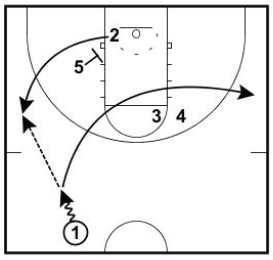
Attacking a Down Ball Screen

basketball-plays-down-ballscreen5

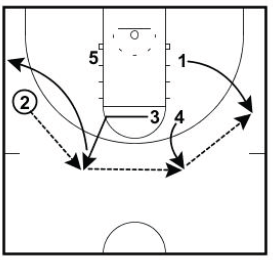
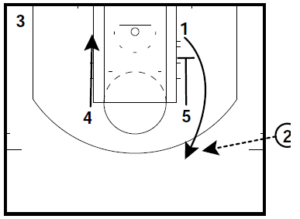
5 screens for 2 who cuts to the free throw line extended.

1 passes to 2 then cuts to the opposite side wing.


basketball-plays-down-ballscreen6

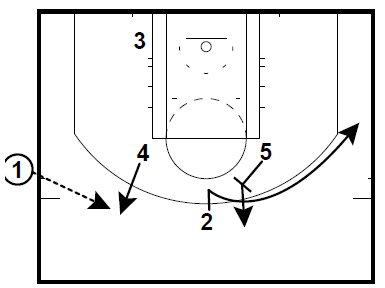
3 and 4 fill the deep elbows.

1 fills the wide wing

The basketball is reversed from the left wing to the right wing to #1.

3 spaces to side after making the pass.


basketball-plays-down-ballscreen7


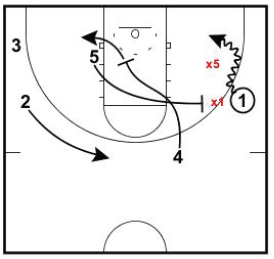
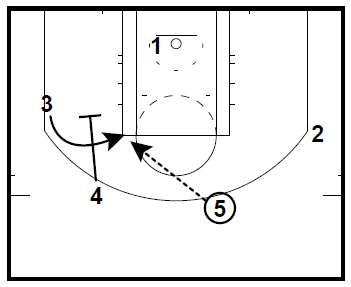
5 cuts to set a ball screen for 1.

X1 takes away the drive off the ball screen.

X5 takes away the straight drive to the basket, forcing the ball down.


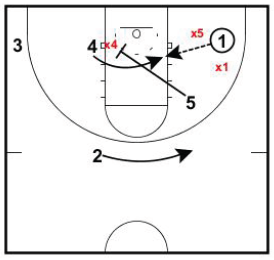
Option 1

basketball-plays-down-ballscreen4


5 releases and sets a screen on X4.

O4 cuts to the ballside block for a possible post feed.


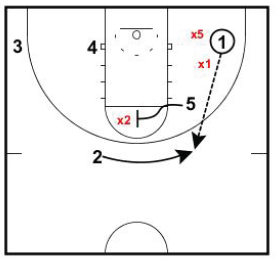
Option 2

basketball-plays-down-ballscreen8


5 releases from on ball screen and screens X2

O2 cuts behind the ball for a 3 point shot.


Basketball Plays NBA Side Out

By Brian Williams on May 9, 2014

These two side out plays can be saved for crunch time or any time you are looking for a quick score off an out of bounds play.

These two samples are from the 256 pages of crunch time plays, under out, half court sets, and transition offense from the Oklahoma City Thunder and Dallas Mavericks Playbooks.

Click the link below for more information about the Playbooks.

Thunder and Mavs Playbooks Information


Dallas Mavericks Dive

basketball-plays-dive1

5 sets a downscreen for 1.

1 cuts to the top right guard spot.

2 passes to 1.

4 drops to the left low block.


basketball-plays-dive2

1 dribbles toward the left wing.

2 sets a cross screen for 4, then breaks to the wing

5 pops up to the right elbow.

4 cuts to the right low block.

1 passes back to 5.

5 passes to 4 on the cut.

Oklahoma City Thunder Crunch Time

basketball-plays-crunch1

4 pops out to the top left guard spot.

5 sets a flare screen for 2.

2 cuts to the right wing.


basketball-plays-crunch2


4 passes to 5.

3 sets a backscreen for 1.

1 cuts over the top to the basket.


basketball-plays-crunch3


4 sets a downscreen for 3.

3 curls to the left elbow.

5 passes to 3.


These two side out plays can be saved for crunch time or any time you are looking for a quick score off an out of bounds play.

These two samples are from the 256 pages of crunch time plays, under out, half court sets, and transition offense from the Oklahoma City Thunder and Dallas Mavericks Playbooks.

Click the link below for more information about the Playbooks.

Thunder and Mavs Playbooks Information

High Volume Shooting Drill

By Brian Williams on May 8, 2014

Current Arkansas State and former Louisville Assistant Coach Mike Balado takes you through a shooting drill that he has used at the end of individual development workouts.

The video is 5 minutes long.

The goal in this drill is for players to make 80% of their shots in workouts when they are unguarded.

In this drill, that equates to making 10 of the 12 shots.

I don’t send out the resources to say that is how you should do it. I

send them out to stimulate thinking to take an idea or two and adapt it to what you do or to motivate you to think about what you are doing and how to do it better.

The video is one of the 1,000’s of basketball training videos for all levels of coaches, players, and parents that is offered by BasketballHQ.

You can access their entire library with a pro membership.

They offer a free 7 day trial for the membership. If you are interested, you can see more at this link: Basketball HQ

Make sure that your sound is on to hear the instruction and click the play arrow to start the video.

This is a YouTube video.

23 Characteristics of Great Players

By Brian Williams on May 7, 2014

This article was a part of Alan Stein’s Coaching Nuggets Collection. The author is Coach Lyndsey Fennelly of lyndseyfennelly.com

23 Characteristics of Great Players

1: Getting Better – the #1 emphasis and purpose behind training. Each athlete’s goal every time you walk into a gym should be to pick up 1-2 new golden nuggets of improvement. Commit to this improvement by starting a basketball journal and writing the concepts you learn each day down on paper for maximum information retention. The way to create big separation in your game is by picking up as many ‘little things’ as you can.

2: Energy – there are 2 things people do when they walk into any room: they either take away energy with frowns, negative body language, and constant complaints or they give energy with genuine smiles, positive body language, and encouraging comments. An energetic gym is more fun to be so, as is living an energetic life. Create the energy in your own gyms, classrooms, and other environments.

3: Focus – most people attribute the success of athletes to the physical game. This is key and important, but you cannot under-estimate the power of a strong and focused mind. Great players focus on what is taking place in every drill, every practice, every game, and every day. The mind is constantly asking oneself : What can I do in this moment to get better?

4: Hustle – great players have an uncommon hustle. You should know that your career window is limited, so make it a habit to maximize every second every time you are in the gym. Set the standard of hustle in your practices, not in games. Great players don’t have an ‘on-off switch’; they simply have it always turned ‘on’!

[thrive_leads id=’26038′]

5: Attitude – one of the few things in life we can control. You have only one September 19, 2010 your entire life. Why not have a great attitude every single day? What’s special is having a terrific attitude every day under every circumstance. Show off your great attitude during the toughest of times – that’s impressive.

6: Commitment – the act of being pledged, loyal, and true to your dreams and visions. Create a goal for this season. Write it down somewhere that you can look at it daily. Remind yourself of the commitment you’ll need to make both on and off the court this year to have a successful season.

7: Passion – do what you love and love what you do. You cannot fake passion. If you truly love the game of basketball, you should have a passion for your improvement and development. You should have passion every time you step into the gym with a willingness to learn and mentality of, ‘what can I do to get better?’

8: Teamwork – in a team sport like basketball, the we is always more important than the me. The better the team, the more noticed the player. Do all you can to foster great teamwork, knowing that will get you the attention most players desire? A program with great teamwork, constantly putting others before themselves, is easily envied by the weak.

9: Body Language – 93% of what we say is non-verbal. You are constantly communicating even if your mouth isn’t moving. Communicate all the time that you’re paying attention, you’re engaged, you’re tough, and you’re eager to learn more. Great body language will make your coaches coach you more, will make your teachers teach you more, and will make an employer want to hire you one day.

10: Hard Work – “If everyone worked as hard as I did, I would be out of a job” is a quote by Steve Nash that is a great reminder that there is truly no substitute for hard work. Hard work is unquestionably one of the best skills you can master to master a successful life both on and off the court. Allow no one to out work you.

11: Control – control of body, control of eyes, control of thoughts, control of emotions, control of the game, control of the tempo, and most importantly, control the controllable. Rather than blame, make excuses, or point fingers, focus on the things you can control : your effort, your attitude, your mind.

12: Practice Makes Pe…Permanent – practice does not make perfect, it instead makes permanent. Great players don’t go half speed at any time, knowing that the opportunity to become permanently great was just missed. Practice habits that will make your game permanently improve and allow you to compete at the highest level.

13: Sportsmanship – the best players have a respect for the game, its rules, officials, and participants, including coaches, players, and fans. Be gracious in defeat and humble in wins without compromising the unrelenting desire to succeed, improve, and most importantly win.

14: Character – you speak louder in action than you do with words with the decisions you make. Live this simple rule : “do the right thing”. If you don’t whether you know it’s right or wrong, it’s most likely the wrong decision. Treat others as you want to be treated, including your teammates. Be ‘bigger’ than negative people and show off your true self all the time, not just when things are going well.

15: Pride – a true champion has the pride of a lion: self-respect and personal worth. You have satisfaction with your achievements, and you allow your pride to fuel your burning passion to always improve. Those with pride have a feeling of ‘dislike’ when they know they’ve fallen below their own standards.

16: Loyalty – you are honest with your family, your coaches, your teammates, your friends, your teachers, but most importantly, yourself. You are loyal in words and actions with those you surround yourself with. Be loyal to these people in life by never violating their trust, turning your back on them, or speaking about them instead f to them.

17: Appreciation – life is TOO short to not appreciate each and every day you are given on this Earth. Two powerful words that we don’t use enough : “thank you” can be said more often than most do. Be verbally appreciative with sincere words and physically appreciative by never wasting an opportunity on court to improve.

18: Respect – most importantly, respect yourself because it’s impossible to respect others if you can’t respect the most important person in your life, you. Treat others as you want to be treated : coaches, parents, teachers, friends, family, teammates, officials, and opponents. Respect the facilities you play in and the environments you are surrounded by.

19: Accountability – you are the driver of your own life and of your own career. Do not fall prey to allow others to dictate your future. Take accountability and responsibility for your actions, your dedication, your work ethic, and ultimately, your decisions. Hold yourself to a higher standard of excellence than anyone else.

20: Finish – the great Michael Jordan once said, “It’s not how hard you push along the way, it’s having something in you to finish”. The great players and people in life finish what they have started. Make it a habit to complete everything you do with the same energy and effort you start with.

21: Intensity – an effort defined by expression of great zeal, energy, determination, and concentration. You ‘attack’ drills with speed, power, and a rage for improvement. Your end of game intensity is paralleled by your in practice intensity. You show off your intensity not only in effort, but in your consistent body language.

22: Poise – having a calmness under every situation and always being yourself. Pressure situations don’t faze you, but instead bring out your greatness. You are always communicating an “I got this” with your teammates and coaches. People turn to you knowing you have an un-faze-ability.

23: Excellence – “the habit of excellence can become enjoyable addictive” (Dick DeVenzio, author of Stuff Good Players Should Know). We have trained all Fall Skills in creating habits of excellence on the court. Make excellence your habit in everything you do. Be an excellent student. Be an excellent friend. Be an excellent daughter, son, sister, brother. Be an excellent athlete. Be an excellent human being.

Techniques to Get the Ball Inside

By Brian Williams on May 6, 2014

The techniques originated with Mike McNeill

In addition to the two that I have posted here, he also has included:

Post Triangle
High Low Down Screen
Down Screen to Post Up
Duck In
and Flex Duck In

The following are three of tactics that can be used to get the ball inside.

Whether they are a part of a play your team runs, or they are part of the concepts you teach players, all teams must have several strategies to get the ball inside.

Diagrams created with FastDraw

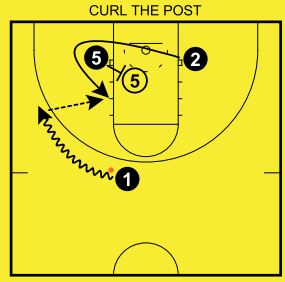
Curl the Post:

curl-the-post

This tactic is extremely effective when the post defender bumps curl cuts by offensive players.

The ball starts at the high elbow above the post. The cutter cuts across the lane below the post and then curls very tight around the post to the middle of the lane.

As the cutter comes across the lane the post defender must momentarily help on the curl, if the post does not help, the pass should go to the cutter. As the defender is helping on the curl the passer brings the ball towards the wing to improve his/her angle and the post steps into the post defender to establish position.

Once the cutter’s defender clears the passing lane is usually open. In many cases the cutter may set an incidental screen. by running into the post defender as he/she completes their cut. If the cutter’s defender attempts to go over top of the screen then the post should step higher and the cutter should fade to the corner.

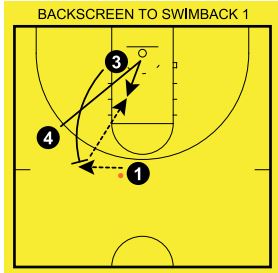
Back Screen to Swim Back:

backscreen-to-swimback1

This tactic serves two purposes:

1) to get the ball inside and
2) serve as a pressure release.

A small to big back screen is a very effective way to relieve denial pressure because, unless the defense switches, the small defender will have to help momentarily as the offensive post player comes off the screen to the basket.

If the small defender does not help they may give up a lay-up.

The screener (the small) steps out of the post and sets a back screen for the post to go to the basket.

backscreen-to-swimback2

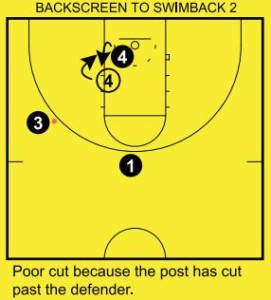
The screener then quickly steps out to the 3 pt. line and receives a pass from the top.


There are three critical points on the post’s cut to the basket:

1) He must come tight off the screener’s shoulder to force the small defender to help momentarily,

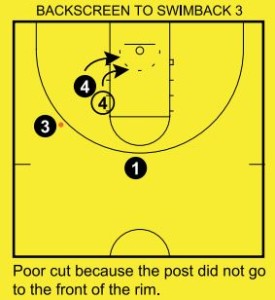
2) He must take the cut towards the front of the rim to force the defender higher (above the line of deployment)

3) He must not cut past the defender and allow the defender to easily get over top and front or side front.

backscreen-to-swimback3

To execute a good post up the post must swim back by taking their baseline arm aggressively over top and in front of the post defender and, with their baseline foot, step across the top foot of the defender.

The passer may be able to pass directly in to the post or may need to take a dribble to the baseline to improve the passing angle.


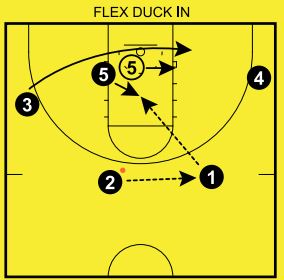
Flex Duck-In

basketball-plays-flex-duck-in

This tactic has the same principle of curling the post: the post defender must defend a cut by another offensive player. The cutter will flex cut low off the post and force the post to help momentarily.

As the post defender helps the offensive player ducks in right in front of the post defender. As in all flex action the ball wil be at the opposite high elbow. The post should not step outside the lane to set a screen for the cutter because it makes the distance too far to get back in and post up. The flex screen should be set with the posfs back to the basket.

Then to execute the duck-in properly the post wil drop step towards the bal with hislher top foot and then slide quickly in front of the defender. The ball may be passed into the post high or low depending on the post defenders recovery. Similar to the regular duck-in, the post should go back in the direction he/she came from to score, because there should not be any back-side defenders to help. This is done by completing a drop step with the foot furthest from the passer. The finish can be either a lay-up or a power move.

Closing Thoughts:

These tactics are team concepts because they will involve more than one player. When concepts are taught to players they must learn to read the defenders because the position of the defenders will determine where the ball should be passed. In the case of getting the ball inside the first step is to teach the players to see the position of the post defender. So begin teaching these tactics with only a post defender and initially instruct the defender on where to play. Then you can allow the defender to be live. The next step is to add defenders on the passers. This will now force the passers to use their skills while also reading the post defender. The final step is use the tactic within the context of a 5 on 5 environment, so the passers must recognize the help defenders.

With all offensive play, spacing is a critical element. It is important to emphasize spacing throughout the teaching of these tactics to ensure the post player is not crowded when he/she receives the pass. Proper spacing will help prevent the quick double-team on the post and will open passing in and out of the post.

The last aspect is timing. The anxious post player will often get into position before the pass is ready to be delivered. The post often ducks-in too early or posts-up before the ball is at the wing; which either results in a 3 second call or allows the defender time to get around the post. It is important for the post player to be patient and allow the play to develop.

All teams need to have an inside threat. Whether you simply teach the tactic or concept, or incorporate them as part of a play, these are steadfast methods which wil usually be effective when executed properly. While there are many ways to get the ball inside these are some of the most effective and popular ways.

  • « Go to Previous Page
  • Page 1
  • Interim pages omitted …
  • Page 191
  • Page 192
  • Page 193
  • Page 194
  • Page 195
  • Interim pages omitted …
  • Page 288
  • Go to Next Page »

Primary Sidebar

  • Twitter
  • Facebook
  • Linkedin
coachestoolbox
personaldevelopmenttoolbox
basketballplayerstoolbox
basketballtrainer
athleticperformancetoolbox
coachingbasketball

© Copyright 2026 Coaching Toolbox

Privacy Policy