• Skip to primary navigation
  • Skip to main content
  • Skip to primary sidebar

  • Basketball Plays
    • Ball Screen Sets
    • Horns Sets
    • Man to Man Post Up
    • Man to Man Isolations
    • Backdoor Plays
    • Man to Man 3 Point Shot Plays
    • 2-3 Zone Attack
    • Baseline Inbound Plays
    • Sideline Inbound Plays
    • Combination Defense Attack
  • Drills
    • Defensive Drills
    • Offensive Drills
    • Competitive Drills
    • Passing Drills
    • Rebounding Drills
    • Shooting and Scoring Drills
    • Toughness Drills
    • Transition & Conversion Drills
    • One on One Drills
  • Blueprint
  • Practice
  • Mental Toughness
  • Skill Development
  • Offense
  • Defense
  • Store

Free Throw Offensive Rebound

Free Throw Offensive Rebound

By Brian Williams on July 2, 2014

These two plays to run to get an offensive rebound on a free throw were posted on Xavier Men’s Basketball Coaching Newsletter Archive.

Click here for their entire archives

Even if you don’t like these two plays, I hope they encourage you to find something that will work for you!

Even the best FT shooting teams miss 3 out of 10 fouls shots in game situations. This creates an outstanding offensive rebounding opportunity for your team. This is one aspect of basketball that does not work every time you execute it perfectly. But I can assure you that if you have FT offense on every time your team attempts a FT next year, there will be numerous Big Boards that could in turn mean extra possessions and extra wins as a result. Its also just another thing your opponents must focus on even if they have you scouted!!

We (Xavier) defend any FT offense by teaching the top foot block out technique. Have your player begin with feet together as close to their opponent as possible, then on release step with their top foot to initiate the contact and get that player under control more quickly. Too many players begin in a bad position on FT defense.

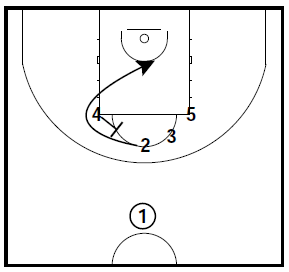
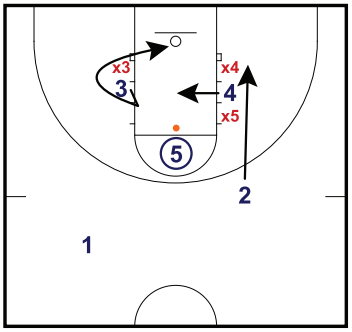
CIRCLE
basketball-plays1

Have your best rebounder step into lane as they have been doing all game, except this time they circle around to weak side block. Best athlete goes to rim line. Your “safety” rebounder waits for the ball to hit the rim then sprints to block area just vacated by your best athlete. Even though they have to wait until ball hits the rim, you’ll be shocked at how many rebounds this player will get.

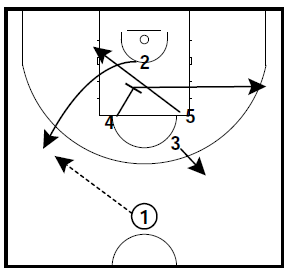
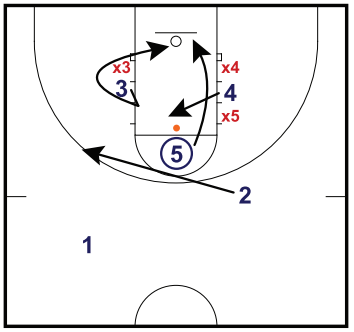
FLOOD
basketball-plays2

This is our Miss FT play as well as 3rd option of FT Offense. Good to teach your worst FT shooters!!! Best rebounder runs circle. Best athlete comes higher than normal and draws the person who “Has the shooter.” The shooter waits for ball to hit then releases and gets running start at rebounder. Again you’ll be surprised how
many times the shooter gets it!
Basketball Plays Thru Jayhawk Special

By Brian Williams on June 30, 2014

This play is a backdoor play to run out of transition.

Coach Vonn Read has submitted several plays from his playbook series The Basketball Encyclopedia of Plays to the Coaching Toolbox.

Coach Read has also served as an assistant coach in the WNBA with the Phoenix Mercury, Orlando Miracle, and San Antonio Silver Stars.

He was an advanced scout for the Orlando Magic as well as The Charlotte Sting.


basketball-plays-thru1

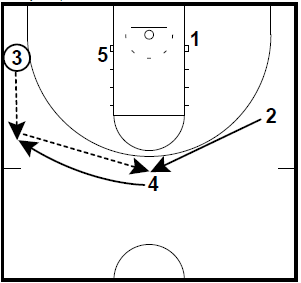
The is a good backdoor set right out of transition.

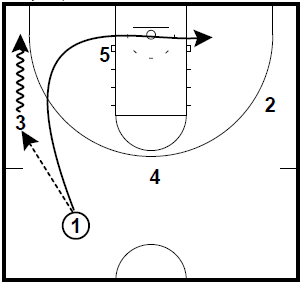
The 1 player will pass the ball to the 3 player on the wing and then cut through to the opposite block.

The 3 player will dribble down to the corner.


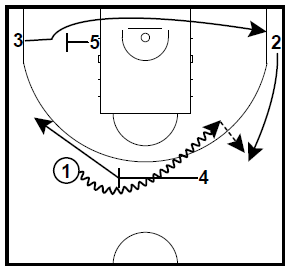
basketball-plays-thru2

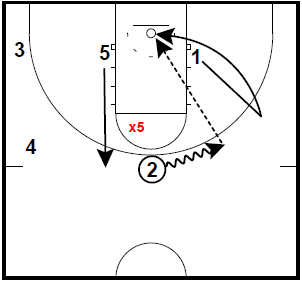
The 3 player will pass to the 4 player who will pass to the 2 player at the top of the key.

The 1 player is getting ready to set their defender up for the backdoor.

If the timing is right, the 1 player can time the cut where they do not have to stop.


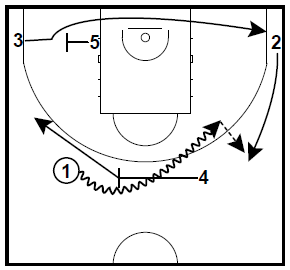
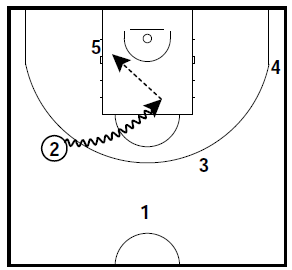
basketball-plays-thru3

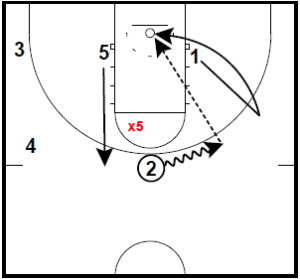
The 2 player will dribble hard at the 1 player who will execute the backdoor cut.

Timing and execution of the backdoor are critical to the success of the play.

The 5 player will flash up the lane to occupy their defender by taking away the closest help defender.


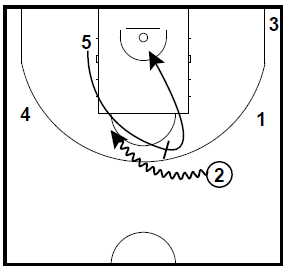
basketball-plays-thru4

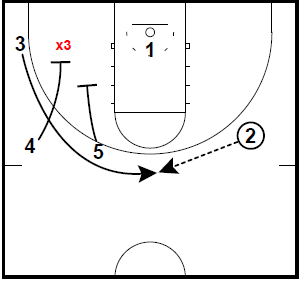
If the backdoor cut is not available, the 4 and 5 players will set a stagger screen for the 3 player.

This is a good option because X3 might try to help on the backdoor cut.


Coach Read has also put together The Basketball Encyclopedia of plays. You can check them out here: The Basketball Encyclopedia of Plays or read more about the books:

Any coach looking for the latest and innovative plays from the Professional, College, or High School levels can stop looking. With a compilation of over 7,700 different plays, you will never need to purchase another basketball playbook again. These playbooks can be used as a great reference tool for years to come. This 2 Volume Book includes plays from 19 different play categories, and they are the most extensive playbooks on the market.

The Basketball Encyclopedia of Plays (Platinum Series) contains over 7,700 Plays (Both Volumes combined) from the NBA, WNBA, USBL, and College levels from someone who has worked as an Advanced Scout or Coach on each level!!! This book has been intensely compiled over the last 21 years, with plays taken from a lot of NBA Coaches (past and present), WNBA coaches, and College coaches (Men’s and Women’s) from around the country.

Any coach that is serious about improving their knowledge of the game from an X and O standpoint will benefit tremendously from these books. These Books can be used to discover New Quick hitters, add a New Package to your playbook, or develop an entire Offensive System. There are a lot of new ideas and concepts in these books to study, and the Basketball Encyclopedia of Plays can be a great resource for coaches on all levels!!! This book is definitely for those X and O junkies who are always looking to improve as a Coach.

“THE GAME IS ALWAYS CHANGING? ARE YOU?” Vonn Read

Here is the link: The Basketball Encyclopedia of Plays

Basketball Plays Duke Down Set

By Brian Williams on June 24, 2014

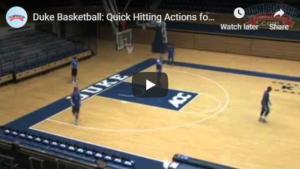
This basketball set play is a quick hitter that you can use to compliment what you already run.

To learn more about the entire DVD that this sample came from, click here: Duke Basketball: Quick Hitting Actions for Motion Offense. Anyone who purchases anything from the store receives one of my basketball coaching eBooks as a bonus. Just email me and let me know which one you would like to receive!

Make sure your sound is on as you click the play arrow for the video.

To learn more about the entire DVD that this sample came from, click here: Duke Basketball: Quick Hitting Actions for Motion Offense. Anyone who purchases anything from the store receives one of my basketball coaching eBooks as a bonus. Just email me and let me know which one you would like to receive!

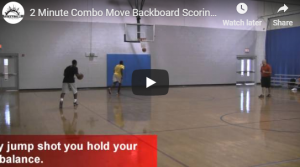
Basketball Drills 2 Minute Combo Move Backboard Scoring

By Brian Williams on June 23, 2014

This basketball drill is a competitive drill that is timed for two minutes.

Players can either compete against each other or if they are working out individually, against a team standard or a personal best.

The video is a one of the 1,000’s of basketball training videos for all levels of coaches, players, and parents that is offered by BasketballHQ.com


Basketball Drills 2 Minute Combo Move Backboard Scoring

The video is a one of the 1,000’s of basketball training videos for all levels of coaches, players, and parents that is offered by BasketballHQ. You can access their entire library with a pro membership. They offer a free 7 day trial for the the membership. If you are interested, you can see more at this link: Basketball HQ

Basketball Plays 2 Euroleague Sets

By Brian Williams on June 20, 2014

The first basketball play on today’s post involves a screen/rescreen into an isolation. Rescreening actions are difficult to get unless you run a set play and in my opinion are very difficult to guard.

The second involves 2 ball screens and a dribble hand off.

These 2 plays are from Scott Peterman’s Euroleague eBook bundle that contains over 170 Euroleague sets including guard post up plays, plays to post a big, motion and pick and roll sets, SLOBs, BLOBs, and many other actions.

Basketball Plays Real Madrid 5 Pick and Roll

basketball-plays-euroleague1

4 sets a ballscreen for 1 and pops out to the left wing.

5 sets a cross screen for 3.

3 cuts baseline side to the right corner.

2 slides up to the right wing.

1 attacks 2 for a dribble hand-off.

basketball-plays-euroleague2


5 sets a ballscreen for 2 and rolls to the basket.

2 attacks the basket.


Basketball Plays FC Barcelona 1 Down

basketball-plays-euroleague3


4 sets a backscreen for 2

2 curls to the basket


basketball-plays-euroleague4

4 sets a downscreen for 2

2 pops out to the left wing.

1 passses to 2

4 pops out to the right wing.

5 cuts to the left low block.

3 pops out to the top right guard spot.

basketball-plays-euroleague5

2 has an isolation.https://coachingtoolbox.net/wp-admin/options-general.php

If 5’s defender comes at him, 2 will pass to 5.

These 2 plays are from Scott Peterman’s Euroleague eBook bundle that contains over 170 Euroleague sets including guard post up plays, plays to post a big, motion and pick and roll sets, SLOBs, BLOBs, and many other actions.


Coaching Basketball Toughness for Coaches Part 2

By Brian Williams on June 19, 2014

This is the second part of an article from University of Arkansas women’s Head Coach Mike Neighbors.

Here is a link to the first part of the article: Are you as tough as you want your players to be?

TOUGH coaches are VISIBLE
TOUGH coaches are accessible. They don’t hide out in their office. They don’t barricade themselves in a locker room.. They are seen.

We have all been witness to coaches who grab the microphone to celebrate with a jubilant crowd following a big win only to see the same coach escape the nearest exit to never be seen again that night following a tough loss.

TOUGH coaches are visible win or lose.
TOUGH coaches lead from the front.


This one works rather counterintuitively. You should actually be MORE visible when your team is struggling. You should be the first one on the court to show your players you are in it with them. You should be LESS visible following that big win, big shot, or winning streak.

Remember Jim Valvano running around the court looking for someone to hug following their National Championship win? Your players don’t need you then. They need you when they miss the big shot. They need you when they throw the ball to the wrong team on the last possession of the title game. I still remember Fred Brown collapsing into John Thompson’s arms.

TOUGH coaches are afraid of no news more than bad News

TOUGH coaches seek out information. They want to be aware. They want to be told first and don’t want to be surprised by someone
outside their program on issues inside their program.

Players must trust their coach to handle bad news. If they trust you to handle bad news, they are more willing to share it. If you blast them the first time they do, you can bet they will be reluctant to do it again.

A tough coach can handle the truth (there is my Few Good Men mandatory reference).

If you handle bad news early in a season with a team or early in the career of a player, you will build trust that lasts forever. Betray that trust and you may never hear the whole truth and nothing but the truth again.

We have experienced situations growing up where we were told it was better to tell the truth than lie only to be harshly punished for actually telling the truth.

It is a fine line, but one you must walk masterfully to be TOUGH.

TOUGH coaches play a schedule that reflects level of their team

After hiring your staff and assembling your team, the next most important responsibility a TOUGH coach has on their plate is to put together an appropriate schedule. TOUGH coaches have a realistic understanding of their team. After all, they should know them better than anyone.

TOUGH coaches know you must challenge your best teams so that they are peaked come tourney time. TOUGH coaches know you must raise the confidence level of an unsure team. TOUGH coaches know you must teach your weakest teams what winning feels like.

If you have a great team that never faces adversity, what happens when you do? If you have a great team that doesn’t know how to win a close game, what do they do in crunch time? One of my favorite scenes from the movie MIRACLE is when the Russian coach doesn’t think about pulling his goalie because he had never been behind late in a game.

Like many of the topics we have already discussed, this is a fine line.

Put together a schedule that is too difficult and your team might never reach it’s full potential. Put together one that is too easy and the exact same result could occur.

TOUGH coaches know their team. They know to schedule teams that will prepare them for the rigors of a season…. A team must face a variety of styles in a variety of environments.

Once you choose the opponents, laying out the calendar comes into question. Do you schedule a tough opponent right before a holiday or a testing period? Do you lay out opponents to avoid a strong of wins/losses? Do you want to open with a home game or a road game?

TOUGH coaches get this right more often than they get it wrong.

TOUGH coaches surround themselves with people smarter than them

TOUGH coaches are not threatened by people smarter than they are. In fact, they seek them out and surround themselves with them. This is one of the easiest TOUGHNESS qualities to spot. If the head coach is the only person that ever talks in a huddle, they probably have not done this. If the head coach is the only person that has a voice in practice, they probably have not done this.

Coaches with TOUGHNESS understand that having smart people surrounding them produces a multiplying effect rather than adding effect. These smarter people provide vital information that then allows the experience of the head coach to take over. These smart people supply the head coach with knowledge they have that the head coach can then turn into actionable tactics.

Smarts can also be substituted for talent or skilled.

TOUGH coaches that have this environment are free of time consuming details that can easily bog down a program. TOUGH coaches can focus on the most important 20% of things and allow the talented people they have surrounded themselves with to focus on the other 80%.

TOUGH coaches adapt to times without compromising core values

TOUGH coaches are facing their greatest challenges in this area. The iY Generation is the first to attend 12 years of schooling in a world that did not require a teacher/coach to provide them with information…they have always had access and the know how to use the internet.

When I was a 7th grader and had a question about who the greatest Point Guard of all-time was, my resources were my coaches, my uncles, an outdated World Almanac from the public library, and a once a week CBS basketball game of the week. A 7th grader today can Youtube millions of video clips, read a 100,000 on line articles that Google finds in 1.1818181 milliseconds, or tune into one of their 700 cable channels and actually watch a game live.

Technology has changed and continues to change at a rapid rate. The second I got proficient at Facebook, here comes Twitter, then Instagram, and SnapChat, and…

The iY Generation is also the most entitled generation of all-time. It’s not their fault we have made the choice to give everyone a ribbon just for showing up. It’s not their fault cuts from teams weren’t allowed until high school (if ever). It’s not their fault that so many rules are in place for them regarding equal playing time and fairness to all who sign up that they no ZERO.ZERO ZERO experience with dealing in adverse conditions. Few of them have ever been given the authority to be a leader. Fewer of them were allowed to fail without a parent or loved one stepping in to fight for equality.

But the fact is, that is who we coach and are starting to hire in the work force.

TOUGH coaches have found a way to adapt without compromising their core values. The stubborn old “my way or the highway” coaches have been replaced by the leaders who can still hold their players accountable to the time proven values that equal success.

Some would argue that some of the TOUGHEST coaches of all-time would have a difficult time coaching in today’s world. While there is plenty of evidence and examples of tough minded coaches who have fallen from grace, I disagree. The TOUGHEST would have adapted. It’s the weak coaches that refused to adapt that ultimately found themselves doing something other than coaching.

TOUGH coaches routinely mentor “over achievers”

TOUGH coaches consistently have players that leave their program much better than they entered it. A TOUGH coach has mastered the skills it takes to push a player beyond the limits that the player has set for themselves. We see this at all levels but is especially on display every March when the Madness starts. Sienna or George Mason or Northern Iowa or Butler make a run in the tournament with a bunch of Burger King All-Americans knocking off a roster full of McDonald’s All-Americans. It’s because they had a TOUGH coach who got them to over achieve individually and as a team.

The TOUGHEST coaches do it year in and year out. And it’s not an accident. And it’s not a coincidence when it happens at the same school repeatedly. (Keeping the coach there becomes the tough part for administration however).

TOUGH coaches can help their players through adverse situations that over achievers must overcome to be successful.

When a TOUGH coach meets a TOUGH player great things are possible.

TOUGH coaches get the most of practice time

Every coach on the face of the earth as 24 hours a day and 365 days per year to coach their team. It is the only commodity that we have equality in. The richest school district or athletic department may have nicer uniforms or a fancier gymnasium, but they can’t buy more time.

TOUGH coaches use this commodity especially well when it comes to their practice time. There is no wasted time. There are no
wasted movements. There is a plan.

Those plans may vary widely. I have seen 1000s of practices and none of them have ever been exactly the same.

The actual time factor can also vary widely. Some coaches may use three hours while others may only use half that. Regardless of the actual time utilized, the results are consistent.

  • « Go to Previous Page
  • Page 1
  • Interim pages omitted …
  • Page 186
  • Page 187
  • Page 188
  • Page 189
  • Page 190
  • Interim pages omitted …
  • Page 288
  • Go to Next Page »

Primary Sidebar

  • Twitter
  • Facebook
  • Linkedin
coachestoolbox
personaldevelopmenttoolbox
basketballplayerstoolbox
basketballtrainer
athleticperformancetoolbox
coachingbasketball

© Copyright 2026 Coaching Toolbox

Privacy Policy