• Skip to primary navigation
  • Skip to main content
  • Skip to primary sidebar

  • Basketball Plays
    • Ball Screen Sets
    • Horns Sets
    • Man to Man Post Up
    • Man to Man Isolations
    • Backdoor Plays
    • Man to Man 3 Point Shot Plays
    • 2-3 Zone Attack
    • Baseline Inbound Plays
    • Sideline Inbound Plays
    • Combination Defense Attack
  • Drills
    • Defensive Drills
    • Offensive Drills
    • Competitive Drills
    • Passing Drills
    • Rebounding Drills
    • Shooting and Scoring Drills
    • Toughness Drills
    • Transition & Conversion Drills
    • One on One Drills
  • Blueprint
  • Practice
  • Mental Toughness
  • Skill Development
  • Offense
  • Defense
  • Store

Rebounding Toughness and Accountability

Rebounding Toughness and Accountability

By Brian Williams on October 10, 2014

This article on rebounding was written by Fred Castro, Associate Women’s Coach at Mississippi State.

Even if this is not the technique that you teach, I think you can use the ideas of individual toughness and grading your players on rebounding accountability.

Rebounding by Coach Fred Castro

In my opinion, the two most important statistics in basketball are rebounding margin and turnovers. I became infatuated with rebounding during my time at Oklahoma. To start the 2003 season we began implementing the “Gonzaga
Rebounding Model”. We had struggled the year before keeping teams off the glass and were exposed in the NCAA tournament. Being undersized we had to find a way to consistently win the rebounding war. To me the two things Gonzaga rebounding addressed immediately were technique and accountability.

TECHNIQUE:

I really believe in one on one rebounding against scout team guys because it exposes our players. Are they weak mentally, physically, or does their technique need improvement? Ultimately it forces players to develop a sense of toughness both mentally and physically. The mentality that needs to be developed in practice to be a good rebounder is the first thing that must happen as part of teaching technique.

If a sense of toughness does not exist individually and cohesively as a team you will never be a great rebounding team. Technique and muscle memory must support the mindset of rebounding. To start practice on Day One, our warm up drill was working on our technique and the verbiage we would use. “Shot, chest, swim”, three consecutive words I am certain I will never forget, and words I probably say in my sleep after games if we lose the rebounding battle. We started with four lines on the baseline and with a teammate free throw line extended facing the baseline.

Pretending the teammate at the free throw line was on offense coach blows the whistle and the first person in line goes at half speed to close out, chest, and swim. I am fairly certain we did that for the first 6-8 weeks of practice coming back to it periodically through out the year depending on how well we executed in games. Needless to say you have to practice it full speed in drills and live action during practice, but the fact that we started practice that season with rebounding as our focus set a foundation for who we would be that year.

Shot: Closing out on a shooter with high hands with intentions of discouraging the shot.

Chest: With your hands holding your jersey chest level and elbows out, you meet (hit) the offensive rebounder and make contact with intentions of stopping their forward progress.

Swim: After “chesting”, forward pivot and swing your elbow over and through in the same direction as the offensive player chooses to go, keeping the player from changing directions and getting the ball. Finishes looking like typical box out with high hands.

ACCOUNTABILITY:

Accountability involves lots of film and post game analytics. Most players do not believe it until they see it. Watching film of practice and letting them see that they are not “checking” their shooter, are not “chesting” rebounders, are not crashing the glass on offense, etc. is all part of the process. One of my favorite parts is once teams became more aware of rebounding and start executing; the one person who does not do their job, their man always gets the ball. So accountability changes from the coaching staff saying rebound, to rebounding because they are letting the other 4 teammates down on that possession. This sense of accountability is the biggest motivator and leads to solid rebounding teams.

Grading rebounding after games became a huge quantifier for the staff and the players. Chad Thrailkill and I would grade each player on every shot attempted including FT’s after every game. The magic number was 70% for our team. If we achieved that number as a team we never lost, the only exception was if we turned the ball over a ridiculous amount of times, which did happen once or twice.

The correlation between our rebounding numbers with wins and losses was amazing! You could pretty much go off the number alone and tell how the game wet and who had a good game. The correlation was also evident in a player’s offensive performance whether it is PPG or FG%. If they were locked in to rebounding, their offensive game followed the majority of the time. If we reached our 70% or higher there were no repercussions the following day in practice. If we were below 70%, the players had to one on one rebound vs. our scout team guys the number of rebounds for which they were graded negatively. So if a player went 9 for 22 they would have to get 13 rebounds the next day.

Sometimes they only had to get S and sometimes they had to get 30 so it became a reminder to rebound while improving their skill. At Albany the team did up downs for the number of negative grades and that too seemed to work.

Ten years later I find myself working at the University of Washington working for Mike Neighbors, a defensive minded coach, who is a number crunching machine and knows all too well the correlation between rebounding and winning. Last year we were undefeated when our starting posts each finished with double digit rebounds. This year that streak was broken, guess why… 20+ turnovers!

I appreciate playing devil’s advocate and in all my stops of coaching there have been some anomalies whether they be players or teams. While coaching on the men’s side at Rogers State we never used the shot, chest, swim technique, instead we used the punch them in the mouth and go get the damn ball technique. To be quite honest we had some athletic hard nosed players that competed and we never really had any problem rebounding. Two other players that were anomalies to the theory were Julie Forester and Courtney Paris.

Courtney Paris I am sure you have heard of but Julie Forester was a 6’l lanky kid who I coached at Albany and was a rebounding machine!! She had an uncanny ability to read the flight of the ball and get to it faster than anyone I have ever seen. I was always happy I did not have to coach against her because she would have drove me mad had she been getting all those rebounds against a team I coached. Courtney was the best rebounder I have ever coached. Her ability to see the ball in flight, get position, and have the best hands I have ever seen allowed her to shatter NCAA rebounding records. That being said, her teammates doing their jobs also left her one on one, which was a battle she would always win.

Most players are not natural rebounders and most players regardless of how talented they may be, do not comprehend the importance of rebounding. This is something that must be taught and emphasized in some form or fashion on a daily basis as far as I am concerned. The beauty of it is, once they see the results they will always believe in it and attempt to recreate it. Much like playing good motion offense, once you know how to play in it you never want to “just go hoop”. From time to time you will be blessed with a player who “just gets the damn ball a lot” and you will have to just let her do what she does knowing that her gift will only be magnified by her teammates doing their jobs.


INTERESTING STATS:

Of the top 75 rebounding teams last year, all but 6 had winning seasons and the majority you saw in post-season play.

In the 2013 Final Four 3 out of the 4 teams were ranked Top S in rebounding margin.

From 2002-20 13, 60% of Sweet 16 teams finished in the Top 50 of rebounding margin.

From 2002-20 13, 25% of Sweet 16 teams finished Top 10 in rebounding margin.

Since 2002, of the 192 teams in the Sweet 16, all but 2 have been in the top 200 in rebounding margin nationally.
Basketball Drills Prairie Fire Shooting

By Brian Williams on October 9, 2014

This basketball shooting drill is from Coach Randi (Peterson) Henderson, Head Women’s Basketball Coach at Coe College.

It is included in The Basketball HoopScoop’s A System of Success: 2011 Conference Champion and National Tournament Playbook–edited by Dan Ninham.

This eBook is bundled with the 2014 NIT Finals Playbook as this week’s feature. Click this link for more information: NIT Finals and System of Success Bundle

This drill encourages communication, responsibility, and attention to detail.

The team is required to keep the ball off the ground for the duration of the drill as well as make consistent two handed passes and catches on the run. Other variations of the drill are 1) to make a certain amount in 1:00 2) have a perfect 1:00 3) Add Coaches for defense in transition or to trap the out1et.

The most demanding way to run the drill is to put 5:00 on the clock with the team goal being to score 150 points (1 point for layups, 2 points for 2 point jump shot, 3 points for 3 point shots).

The rules are NO TRAVELS, NO MISSED LAYUPS, AND THE BALL CANNOT TOUCH THE GROUND. Exception: 1 bounce is allowed on the rebound for two and three point jump shots.

You will need to adjust the standards to fit the level you coach and the changing abilities of your players from year to year and also adjust the types of shots and passes to fit your system of play.

Diagrams created with FastDraw

basketball-drills-prairie-fire-shooting-drill1

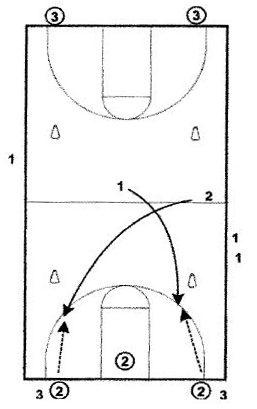
Coach starts the time on the clock with a layup and a pass to 1 who is yelling “Outlet.”

1 cuts to top of the key for the pass.

Right and Left wing take off sprinting.

One is naming and yelling “Long” the other is yelling “Out1et”.

1 distributes the ball without dribbling or traveling to the Outlet wing and follows the pass.

The outlet wing delivers a scoring pass without dribbling or traveling, then follows the pass for a shot.

basketball-drills-prairie-fire-shooting-drill2


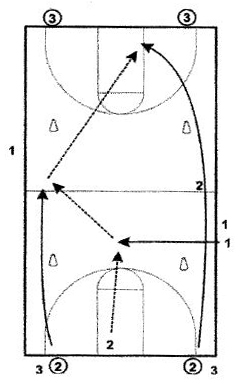
After the layup is made, the player who just shot the layup gets the ball out of the rim keeping it off the ground and outlets to 1 cutting to the top of the key.

The two wings who are on the baseline, deliver 2 handed passes to the shooters and then proceed to take off for the “outlet” or “long” layup.


basketball-drills-prairie-fire-shooting-drill3


Drill is done for 5 minutes:

NO TRAVELS, NO DROPPED PASSES, and NO MISSED LAYUPS

On the Wing Catches, be outside the 3 pt line on the catch:

(You can adjust the types of finishes or shots to fit your needs)
1 minute the finish is 1 Dribble Layup off 1 foot
I minute 1 Dribble Layups off 2 feet w/a Peek
1 minute 1 Dribble Jumpers
1 minute Catch & Shoot in Range
1 minute Choose your shot

This drill is included in The Basketball HoopScoop’s “A System of Success: 2011 Conference Champion and National Tournament Playbook–edited by Dan Ninham. The book has a lot of drills and sets from very successful small college women’s programs.

This eBook is bundled with the 2014 NIT Finals Playbook as this week’s feature. Click this link for more information: NIT Finals and System of Success Bundle

If you are interested in adding to your Coaching Toolbox take look at what I believe is our best offer.

CLICK HERE to select from a list of more than 70 eBooks.


Basketball Coaching Kevin Eastman Offensive Thinking

By Brian Williams on October 8, 2014

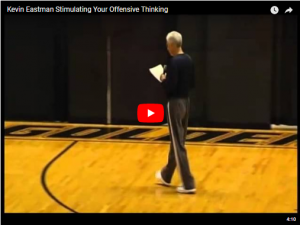
I have been fortunate to partner with Kevin Eastman to provide some sample videos from has basketball coaching DVDs. This video is a segment from his “Stimulating your Offensive Thinking DVD.” It is a part of his 8 DVD set which includes High Intensity Skill Development, NBA Drills for All Levels, Stimulate Your Offensive Thinking, Defensive Strategies and Teaching Points, Strategies and Philosophy for Coaching Success, Stimulate Your Defensive Thinking, Defending the Pick and Roll the NBA Way, A Champion’s DNA.

This link is to a previous video that I posted with: 3 Drills from Kevin Eastman.

You can also see another 5 minute video from Coach Eastman by clicking on this link: Keys to Quality Skill Development.

Click here for detailed information about purchasing the DVDs at a special price If you need any assistance, email me at [email protected] or call or text (317) 721-1527.

Former D1 Head Coach and Long Time Doc Rivers Assistant NBA Coach Kevin Eastman provides some principles to apply to your offensive attack as well as a little about your team culture.

Coaching Basketball Choosing Your Team

By Brian Williams on October 7, 2014

This article was written and submitted by retired High School Basketball Coach Dave Millhollin.

Coach Millhollin is known throughout the Sacramento area for his Boys Varsity teams’ fundamental soundness, discipline, unselfishness, team defense and overachievement. Dave Coached for 27 seasons and compiled 391 wins. I have included more information about his coaching career at the end of the article.

If you would like to contact Coach Millhollin, email me and I will put you in touch with him.

Things to consider when choosing your team

The two most important questions you have to answer:

  1. What do I want our team to accomplish this season?
  2. How is who I keep and how many guys I keep going to affect what our team accomplishes this season?

The next two most important questions are:

  1. What players do I keep?
  2. How many players do I keep?

Questions to consider in deciding who makes the team and how many guys to keep;

What guys can I count on when things get difficult; when we hit a losing skid or when we have to get “tough” with our players? If I do not want them in the “foxhole” with me, I do not want them on my team!

What players will keep “team business” from leaving the locker room?; What players can I trust?

What guys will be best able to “buy in” to the team concept and commit to our team’s goals?

What number of players should I keep that will most likely insure that we have complete player “buy in” to our team’s goals? and; what # is too many?

Would I rather have a player and his parents disappointed at the beginning of the season over not making the team or upset throughout the season because he is (or they are) not happy with his role and playing time? Remember; disappointed players and selfish players are not able to “buy in” to the team concept or the team’s goals and disappointed people always find one another!

What players will be able to accept their roles as “role players”?

What players are going to make the best “practice players”?

How many guys am I going to realistically be able to play each game?

How am I going to feel in late January about who I kept and how many I kept?

Do I want to spend my time this season figuring out how to win games, teaching my team how to win and on player and team improvement…..

Or

Do I want to spend my time trying to figure out how to divide up the playing time in order to satisfy individual desires of players and parents?

Most coaches first select 7 or 8 guys they believe are going to play the most. Then they figure out how many guys they want on their roster (normally 5 or 4 more guys). Then they decide which “depth players” are going to make the team, “Depth players” are critically important!

The parents who drive coaches away or get them fired are almost always parents of “depth players”.

If your “Depth players” and their parents are sincerely supportive, you will probably have a good season!

Team selection will be the single most important decision you make each year.

© Dave Millhollin

Editors note from Brian at the Coaching Toolbox:  I developed a document to use during tryouts to help clarify each prospect’s thinking on what their role will most likely be for the upcoming season.  I check where I have the prospect rated and then ask him to check what he would be happy accepting.  I use it as a tool to select the squad and then as documentation if needed later in the season.  You can download it here: Coaching Toolbox Prospect Sheet

Also, here is a link from Quinn McDowell of Arete Hoops that you might consider sharing with your prospects on being prepared for a basketball tryout: 10 Tips for Your Next Basketball Tryout

About the author of this article, Coach Dave Millhollin In fourteen years at Ponderosa High School, Coach Dave’s teams won 260 games (.665). From 2000 through 2009 Ponderosa won 207 games over a ten year stretch which included four SVC Conference Championships and two CIF Section final four appearances. Over his 27 year Boys Varsity Coaching career, Coach Dave posted 391 wins, produced 20 college basketball players and was named SVC Coach of the Year four times. At Ponderosa, Coach Dave’s teams were #1 in California in team defense five times and in 2008 Ponderosa was the top defensive team in the Nation among shot clock states. Over Coach Millhollin’s last five seasons (2005-6 through 2009-2010; 136 games) Ponderosa averaged a composite 50% total field goal percentage, 58% two point field goal percentage and 32% three point field goal percentage. Since retiring from High School coaching in 2010, Coach Dave has been actively involved in coaching Jr High level School and AAU teams as well as and running instructional basketball clinics from the primary grades through the College level.

Basketball Drills “Baseball”

By Brian Williams on October 6, 2014

This drill was from an old Xavier Men’s Newsletter.

You can see their archives and subscribe at this link.

I thought with the World Series in progress, this would be a good time to post this basketball drill that works on 1 on 1, 2 on 2, and 3 on 3 situations in a competitive way.

If you have to wait on some athletes to start practice and need something to add variety to your practice, or late in the season when you are looking for ways to change things up, here is one idea.


Basketball Drills “Baseball”

Diagrams created with FastDraw

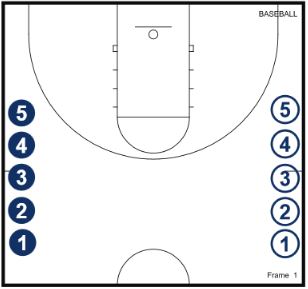
basketball-drills-baseball1


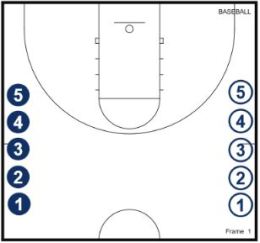
Divide teams into two colors.

Blue team establishes a “batting order” and white matches up accordingly to how they want to defend.


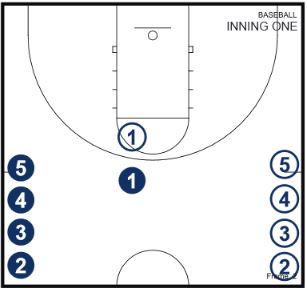
basketball-drills-baseball2

INNING 1: ONE-ON-ONE:

Blue team is on offense, scoring as many RUNS (points) as possible until they get 3 OUTS (defensive stops by white)…

Switch to White team on offense. White plays until they get 3 outs…

End of first inning. (To make a long game you can run through this again and count as an additional inning)

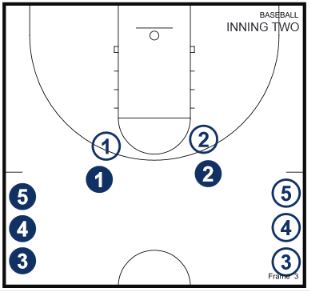
basketball-drills-baseball3

INNING TWO: TWO-ON-TWO:

For each inning, we vary the initial actions (ball screen, down screen, flare screen, etc.)

Use whatever actions are part of your offense or maybe your upcoming opponent’s offensive attack to work on defending them.


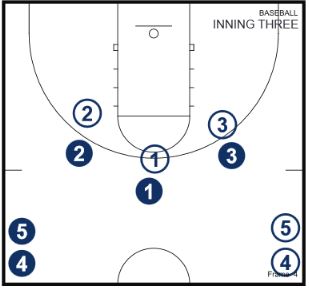
basketball-drills-baseball4

INNING THREE: THREE-ON-THREE:

Again changing the initial actions to actions that you either use or have to defend.

For each of the innings and individual matchups, you will need to decide what to do with fouls. You can make them an automatic run (point) for the offense, or you can have players shoot them to work on free throws with a little pressure. If you shoot them, the offense gets their point if they make the free throw. They get the ball back if they miss. Like any drill that you see from other programs, you need to make the adaptations that fit the objectives that you have for running the drill.

Coaching Basketball Maximizing Your Preseason

By Brian Williams on October 3, 2014

This article was written by Basketball Strength and Conditioning Coach Alan Stein and published on his Stronger Team Blog

Even if you are a college coach, or your high school association has different rules than Alan’s I know there are some points he makes that you can adapt to your program. He also has posted a video of an agility drill that can be done with or without a basketball.

In case you missed these articles, here are a couple of other articles to help you finish up your pre-season.

Preparing for Basketball Preseason
Reducing ACL Issues
Preseason Conditioning Drills

Here is one more article (this one is from Coach Mike Neighbors of the University of Washington Women) with ways to liven up open gym pickup games. You can also file it away and use it late in the season when you need some variety and excitement in your practice scrimmages: Wildcard Drills

Maximizing Your Pre-Season

Written by Alan Stein

Jim Boeheim once said, “You can’t win a championship in the pre-season, but you sure as hell can lose one.”

The 8-week period before official practices start (the pre-season), sets the tone and lays the foundation for your entire season. It should be a time to focus on improving 4 key areas:

  • Athleticism
  • Skill
  • I.Q.
  • Chemistry

At the high school level, it varies tremendously from state to state, as to what you are allowed to do with your players in the pre-season. Therefore, simply do what you can, with what you have, where you are. I don’t believe in making excuses and I don’t believe in cheating the rules.

At DeMatha Catholic High School, we are governed by the rules of the Washington Catholic Athletic Conference (WCAC), which fortunately for us, allows us to work with our players in just about every capacity possible. The only exception is we are not allowed to hold a ‘team practice’ until November 6th. We are allowed to conduct strength & conditioning workouts, skill workouts and monitor play (‘open run’). Yes, we are very thankful to be in such a progressive conference. I sympathize with those that aren’t.

I get numerous inquires via email and social media asking about our pre-season program.

Here is our DeMatha Basketball pre-schedule in September and October:

Monday:

  • 3-4pm: Academic Study Hall
  • 4-5pm: Performance Training
  • 5-6pm: Position-Specific Skill Work
  • 6-7pm: Play 5-on-5

Tuesday:

  • 3-4pm: Academic Study Hall
  • 4-5pm: Position-Specific Skill Work
  • 5-6pm: Play 5-on-5

Wednesday:

  • 3-4pm: Academic Study Hall
  • 4-5pm: Performance Training
  • 5-6pm: Position-Specific Skill Work
  • 6-7pm: Play 5-on-5

Thursday:

  • 3-4pm: Academic Study Hall
  • 4-5pm: Position-Specific Skill Work
  • 5-6pm: Play 5-on-5

Friday:

  • 3-4pm: Bikram Yoga Class

Saturday:

  • 9-10am: Performance Training (Optional)
    10-11am: Position-Specific Skill Work (Optional)

Sunday:

  • OFF

To ensure our players maximize their 5-on-5 play; we implement the following 5 rules:

  1. Every offensive player must be in the front court when a point is scored. If not, the basket does not count and it is a turnover. What happens on a quick steal or a long outlet pass? You better sprint!!
  2. Every defensive player must be in the front court when a point is scored. If not, the basket counts and the offensive team receives another possession. This helps eliminate standing and pouting after a turnover, missed shot or no foul call.
  3. Defense calls fouls. No arguments. No exceptions. However, we strongly encourage our players to limit calling fouls, as we want them to get used to playing with severe contact.
  4. Games are played to 21, with 2’s and 3’s. All 10 players are expected to call out the score on every possession. We choose to play to 21 because it simulates the length of a quarter (8 minutes-ish) and creates a superior platform for conditioning. It also allows for a comeback (if one team jumps out to a 12-2 lead, you still have plenty of time to come back and win).
  5. The player that scores the game winning point must immediately step to the free throw line and make a free throw. If so, the game is over. If not, the game-winning basket is erased and play resumes.

I wish you the best the remainder of this pre-season.

Train hard. Fuel smart. Get better.

Alan Stein
Hardwood Hustle Blog
http://www.About.me/AlanStein

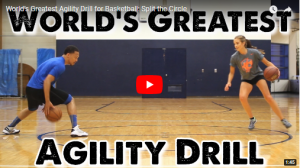
PS: Need a great pre-season drill that works on change of direction, deceleration and ball handling? Here is the World’s Greatest Agility Drill!

  • « Go to Previous Page
  • Page 1
  • Interim pages omitted …
  • Page 176
  • Page 177
  • Page 178
  • Page 179
  • Page 180
  • Interim pages omitted …
  • Page 288
  • Go to Next Page »

Primary Sidebar

  • Twitter
  • Facebook
  • Linkedin
coachestoolbox
personaldevelopmenttoolbox
basketballplayerstoolbox
basketballtrainer
athleticperformancetoolbox
coachingbasketball

© Copyright 2026 Coaching Toolbox

Privacy Policy