• Skip to primary navigation
  • Skip to main content
  • Skip to primary sidebar

  • Basketball Plays
    • Ball Screen Sets
    • Horns Sets
    • Man to Man Post Up
    • Man to Man Isolations
    • Backdoor Plays
    • Man to Man 3 Point Shot Plays
    • 2-3 Zone Attack
    • Baseline Inbound Plays
    • Sideline Inbound Plays
    • Combination Defense Attack
  • Drills
    • Defensive Drills
    • Offensive Drills
    • Competitive Drills
    • Passing Drills
    • Rebounding Drills
    • Shooting and Scoring Drills
    • Toughness Drills
    • Transition & Conversion Drills
    • One on One Drills
  • Blueprint
  • Practice
  • Mental Toughness
  • Skill Development
  • Offense
  • Defense
  • Store

Basketball Plays Iowa State Quick Hits

Basketball Plays Iowa State Quick Hits

By Brian Williams on November 20, 2014

Here are two quick hitters from Fred Hoiberg’s time at Iowa State.

They are both contained in the Basketball HoopScoop’s Fred Hoiberg Iowa State Cyclones Playbook (written by Wes Kosel).

These plays are a part of this week’s featured eBook bundle along with Scott Peterman’s Ultimate Matchup Zone Defense Playbook.

You can see more information about what is included in this bundle by clicking this link: Iowa State Offense and Matchup Zone Defense Bundle

Here is a link to another pair of plays from Iowa State run out of a 2-3 alignment: 2-3 Corner Up


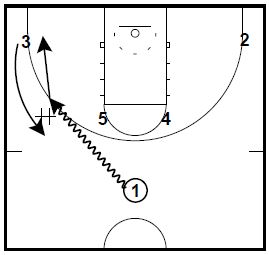
Iowa State Horns – Hand-Off to Back-Cut

Diagrams created with FastDraw
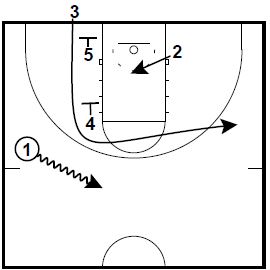
basketball-plays-isu1


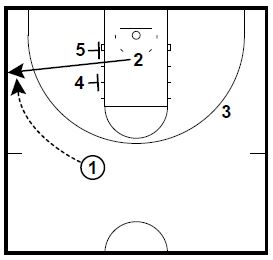
1 dribbles to the left wing and gives the ball to 3 on a dribble hand-off.


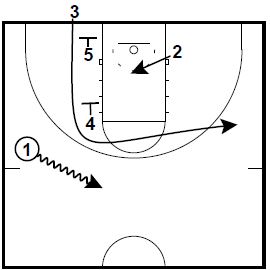
basketball-plays-isu2


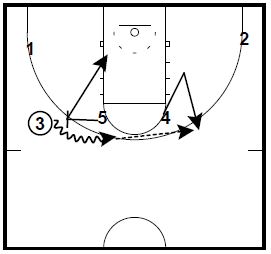
Once 3 has the ball, 5 sets a wing ball-screen for 3.

3 drives middle as 5 rolls to the basket.

4 moves down as if setting a screen for 2, but instead pops out to get the pass from 3.
 

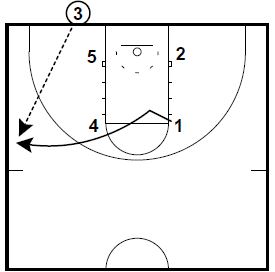
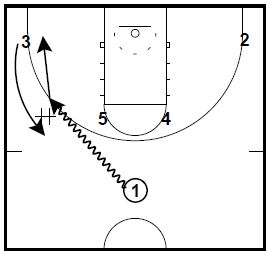
basketball-plays-isu3


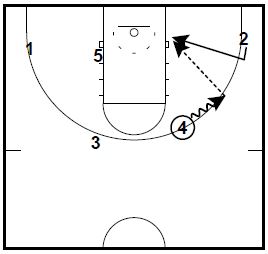
4 dribbles towards 2 as if he is going to execute a dribble hand-off.

2 makes a hard cut to the basket looking for the back-door pass from 4.


Iowa State Horns Stagger

basketball-plays-isu4

1 passes to 4.

1 runs past 5 to set a staggered screen with 5 for 3.

3 cuts up the wing.

4 passes to 3 for a shot.


basketball-plays-isu5

If 3 doesn’t have a shot, 3 runs around 4 and gets the ball on a dribble hand-off.

3 turns the corner and drives to the basket looking to score, pass to 5 diving to the basket, or pass to 2 in the corner for a 3-point shot.

This play is a part of this week’s featured eBook bundle along with Scott Peterman’s Ultimate Matchup Zone Defense Playbook.

You can see more information about what is included in this bundle by clicking this link: Iowa State Offense and Matchup Zone Defense Bundle

If you are interested in adding to your Coaching Toolbox take look at what I believe is our best offer.

CLICK HERE to select from a list of more than 70 eBooks.
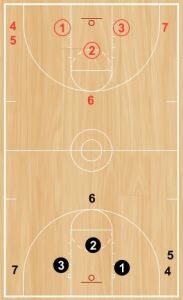
 

Coaching Basketball Defending Pick and Roll

By Brian Williams on November 19, 2014

This video sample from Kevin Eastman’s CoachingU Live came from his clinic entitled ” Defending the Pick and Roll the NBA Way.”

He served as an Assistant Coach for the Celtics from 2004 to 2013.

He finished his career prior to retiring as an assistant coach and VP of Basketball Operations with the Los Angeles Clippers.

At the bottom of this post, there are more links to other short videos with Coach Eastman on various topics.

Make sure your sound is on and you click the play arrow to see the video.

Basketball Drills 3 Basketballs 2 Ends Shooting

By Brian Williams on November 18, 2014

This basketball shooting drill is from Mike Neighbors of the Arkansas Women’s Program.

I think it is good to collect a variety of drills so that you can continually add in new drills for variety as the season unfolds to keep things fresh for your players.

At the bottom of this post are links to other drills as well as other posts from Coach Neighbors.

With a large team we had to tweak some of our shooting drills this season.

This is one we “accidentally” created from our One Minute, One Spot shooting drill.

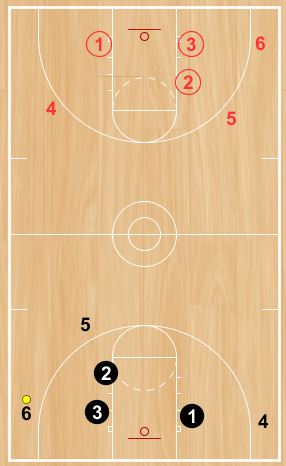
Divide team evenly as possible on both ends. Each end has three balls.

Encircled numbers in the diagram represent the three passers with basketballs at each end.

Passer will pass to shooter then take spot in line. Shooter will shoot and rebound make/miss and pass to next person in line.

basketball-drills-3-balls-2-ends1


We shoot in this spot for 1:00. We can record three things if we have enough counters. Each group score per spot, each end score per spot, and total score for team on both ends.


basketball-drills-3-balls-2-ends2

For second 1:00 period, we move one spot to the left and repeat. We shoot 5:00 and all 5 spots.

(The five spots are both corners, both 45 degree angles, and straight on from the top of the key)

The ends can compete against each other. The team can compete against a “record number”, and individual groups can compete against one another.

I love the variety, the number of shots we can attempt in a short period of time.

We have only done this once so expect scores to improve, but first totals were:

135 high spot for whole team. 90 per end, and 63 per single group

Basketball Plays Double Zipper 3

By Brian Williams on November 17, 2014

Today’s Baseline Out of Bounds Play is from Houston’s Women’s Assistant Coach Vonn Read.

Coach Vonn Read has submitted several plays from his playbook series The Basketball Encyclopedia of Plays to the Coaching Toolbox.

Coach Read has also served as an assistant coach in the WNBA with the Phoenix Mercury, Orlando Miracle, and San Antonio Silver Stars.

He was an advanced scout for the Orlando Magic as well as The Charlotte Sting.

Diagrams created with FastDraw


basketball-plays-box-zipper1


This is a good UOB 3-point set

The 4 player will set a screen for the 1 player popping to the wing.


basketball-plays-box-zipper2


After passing the ball in, the 3 player will cut hard off of the double Zipper screen and curl to the wing.

The 1 player will dribble high, looking for the 3 player. This is a decoy action.


basketball-plays-box-zipper3


After the 3 player makes their cut, the 2 players will sprint to the wing through the elevator screen for the 3-point shot.

Coach Read has also put together The Basketball Encyclopedia of plays. You can check them out here: The Basketball Encyclopedia of Plays or read more about the books:

Any coach looking for the latest and innovative plays from the Professional, College, or High School levels can stop looking. With a compilation of over 7,700 different plays, you will never need to purchase another basketball playbook again. These playbooks can be used as a great reference tool for years to come. This 2 Volume Book includes plays from 19 different play categories, and they are the most extensive playbooks on the market.

The Basketball Encyclopedia of Plays (Platinum Series) contains over 7,700 Plays (Both Volumes combined) from the NBA, WNBA, USBL, and College levels from someone who has worked as an Advanced Scout or Coach on each level!!! This book has been intensely compiled over the last 21 years, with plays taken from a lot of NBA Coaches (past and present), WNBA coaches, and College coaches (Men’s and Women’s) from around the country.

Any coach that is serious about improving their knowledge of the game from an X and O standpoint will benefit tremendously from these books. These Books can be used to discover New Quick hitters, add a New Package to your playbook, or develop an entire Offensive System. There are a lot of new ideas and concepts in these books to study, and the Basketball Encyclopedia of Plays can be a great resource for coaches on all levels!!! This book is definitely for those X and O junkies who are always looking to improve as a Coach.

“THE GAME IS ALWAYS CHANGING? ARE YOU?” Vonn Read

Here is the link: The Basketball Encyclopedia of Plays

Coaching Basketball True Shooting Percentage

By Brian Williams on November 14, 2014

This article on True Shooting Percentage (also known as True Scoring Percentage)  is a follow up to the Effective Field Goal Percentage Post from a few weeks ago.

With it being clear that the most efficient ways to score in order are:
(I would define “efficient” as the highest probability of scoring from each of these opportunities)

  1. Free Throws
  2. At the basket–restricted area in college and pros, same area in high school even if not marked
  3. 3 point shot
  4. Midrange two point shot

Yes, you have to play to your strengths,  But if you can’t find ways to get to the free throw line, score at the basket either in transition, through driving the ball to the basket, cutting to the basket, or via a low post game, and make a competitive percentage of 3 point shots for the level your team plays, you probably won’t win a lot of games.

Effective Field Goal Percentage takes that 2 point 3 point imbalance into account.

However, if in one game:

Player A makes 2 for 2 from the line, and has an Effective Field Goal Percentage of 58%.

Player B makes 2 for 6 from the line, and has an Effective Field Goal Percentage of 58%.

True Shooting Percentage (TS%) is a measure of a player’s individual points per shooting possession, which would distinguish between the two players in the above example. It takes into account scoring efficiency by combining three point shots, two point shots, and free throws. It effectively measures a player’s scoring productiveness based on opportunities to score.

It does not account for times the player turned the ball over. Adding turnovers into the formula gives you a way to look at individual points per possession completed. I have detailed that later in this article.

This is not to say that a player’s overall value at the offensive end can be measured by this formula. Certainly there is value for players who are the primary ball handlers, get other players open through screening and spacing, are offensive rebounders, and hockey assisters.

True Shooting Percentage merely gives you data on which players are the most efficient producers of points for your team when they shoot the basketball either from 3, 2, or the free throw line.

The battle we face is balancing between obtaining stats that are actually significant and at the same time are easy to calculate. Points per shot is easy to calculate, but does not correlate to an efficient offensive performance. True Shooting Percentage is difficult to calculate, but it is the best way to determine who your most efficient scorers are because it accounts for free throw efficiency as well. TS% is actually more of a scoring efficiency ratio rather than a percentage because it measures points produced compared to the number of possessions that player used to score those points.

The formula for True Scoring Percentage is

TS% = (Points/2) / [FGA + (0.44 * FTA)]  Each of these numbers is included in your post game statistical summary and could easily be put into a spreadsheet.

FGA = Total Field Goal Attempts including 2 point shots and 3 point attempts
FTA = Free Throw Attempts

The formula in words is:

Take the points a player scored and divide it by two and get a number.

Multiply the Free Throw Attempts by .44 and add it to the total field goal attempts (2s and 3s) and get second number.

Divide the first number by the second to calculate true shooting percentage.

The rationale in dividing the points by two is that by doing so, it effectively makes each three point shot made worth 1.5 points.  Dividing by two also makes each two free throws made equal to one two point basket made.

One free throw attempted is basically half a field goal attempt, so initially multiplying the Free Throws Attempted by .5 seems to make sense.  The reason that .44 is used instead is that statistical research has taken into account the old fashioned three point play of a basket and a foul where there is a field goal attempt and a free throw attempt in the same scoring possession.

Here is an example:

Player A makes 2 for 5 on 3 point shots, 3 for 7 on two point shots and 7 for 9 on free throws for a total of 19 points on 10 Field Goal Attempts.

To calculate the TS%, take the total number of points scored (19 points in this example) and divide by 2. Which is 9.5 for “the first number.”

Now, for “the second number,” take the Free Throw Attempts times .44 which is 9 * .44 or 3.96. Next add that product to the overall Field Goal Attempts (12 for the example). Your second number is 15.96.

For the Ts% divide 9.5 (The first number) by 15.96 (The second number) which yields: .595. That is an outstanding TS%. You will need to do some crunching to see what is good for your team and level of coaching, but .5 or better is usually very good and near .6 is a great offensive game. As a reference, the NBA/ABA lifetime leader is Cedric “Cornbread” Maxwell with a lifetime TS% mark of .6294 for his 11 season NBA career.

I do realize that the stat will be a little off if the player does not have a 3 point play, but I still feel it is a much more accurate assessment to use to determine how efficiently your scorers are performing that Points per Shot or using Two Point Field Goal Percentage, Three Point Field Goal Percentage, or Overall Field Goal Percentage. Our most valuable scorers both get to the line and make their free throws in addition to shooting a high percentage from the field. TS% corrects that flaw in the other metrics.

Individual Points Per 100 Possessions (aka Scoring Efficiency)

Another way to look at offensive scoring productivity is to consider using individual points per possession.   Most of us look at Offensive and Defensive points per possession as one way to measure team efficiency.  I believe that individual points per possession (or per 100 possessions, however you look at it) is a way to measure a players scoring contribution.

I am not in any way saying that scoring is the only way to measure every player’s offensive contribution.   There is absolute contribution in passing, screening, cutting, spacing, offensive rebounding, and sureness with the basketball.  All of those skills are critical, but only serve to create opportunities to score.

What I do believe is that total points scored is not the best way to measure a player’s scoring contribution.  For every turnover made and every shot and free throw a player misses, that is taking an opportunity away from someone else to score.  While it is true that you can’t score if you don’t shoot, it is also true that you won’t score enough to win unless your best scorers are getting the most opportunities to score.  This is a way to consider as using as one tool when you make that evaluation.

In place of or in addition to the formula above, consider determining the number of possessions that a player ended for your team as:

The number of shots they took, plus the number of trips (not free throw attemps) to the free throw line, plus the number of turnovers to determine the number of possessions that each player finished.

Take the number of points divided by the number of possessions for each player

In my opinion, a player with a lower than 1.0 ratio is hurting the team at the offensive end unless there is absolutely no one else on the team that has scoring skills.  So, for example, in most instances, even a 29 point game would not be a good performance for the team, if it required 30 possessions to attain.  Something such as 19 shots, 7 trips to the line, and 4 turnovers (or any other combination of 30

No one metric or opinion should be the sole deciding factor of how to play.  It takes a staff and as many meaningful pieces of data as you can get.  These ideas are submitted as ideas to consider using as more pieces of information as you work to develop your and evaluate your offensive system.


Basketball Plays Down Ball Screen Counter Options

By Brian Williams on November 13, 2014

These counters are taken from the Basketball HoopScoop’s Comprehensive Ball Screen Playbook (written by Trey Watts).

It is a part of this week’s featured eBook bundle is the Princeton Hybrid Offense eBook along with the Comprehensive Ball Screen Playbook eBook. You can see their descriptions at this Link: Princeton Hybrid Offense and Ball Screen Playbooks

If you have any questions about the Playbooks, please feel free to email me or call/text me at (317) 721-1527.

These are some options to use to counter a defense that forces the dribbler of a ball screen down to the baseline.

I hope you can adapt to your system or take parts from to tweak what you do.

Diagrams created with FastDraw


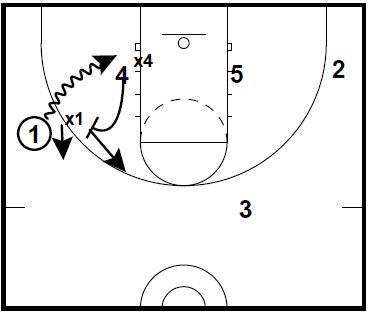
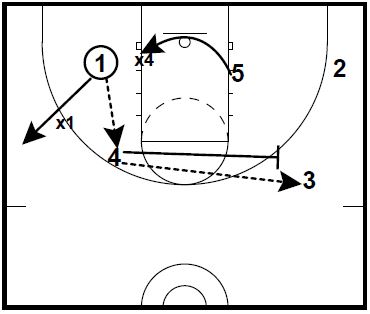
basketball-plays-down-counters1


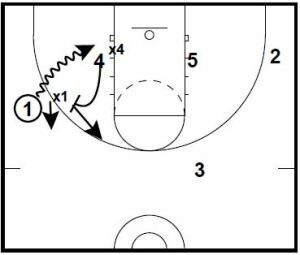
Against teams that force the ball handler away from the ball screen and towards the baseline.

We want the ball handler to attack the big.


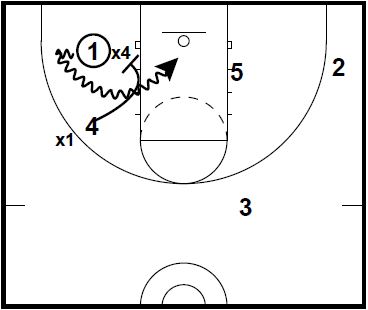
basketball-plays-down-counters2


If we kick to post he reverses the ball and sprints to next Ball Screen before his defender can recover.


basketball-plays-down-counters3


If we don’t hit the post stepping out, we look to score with 4 getting a jumper or 1 beating the X4.

IF no shot is there we will run “TWIST” and set another screen on the ball.


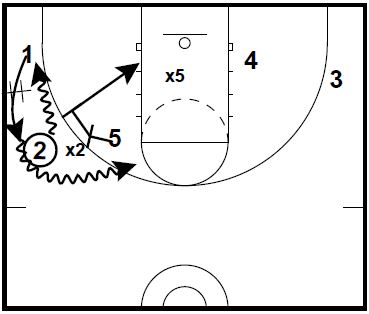
basketball-plays-down-counters4

VS DOWN DEFENSE ON A SHAKE OR LOADED SIDE

We will dribble handoff with the guard in the corner.

there is no hedge because post help is in the paint.

These counters are taken from the Basketball HoopScoop’s Comprehensive Ball Screen Playbook (written by Trey Watts).

It is a part of this week’s featured eBook bundle is the Princeton Hybrid Offense eBook along with the Comprehensive Ball Screen Playbook eBook. You can see their descriptions at this Link: Princeton Hybrid Offense and Ball Screen Playbooks

If you are interested in adding to your Coaching Toolbox take look at what I believe is our best offer.

CLICK HERE to select from a list of more than 70 eBooks.
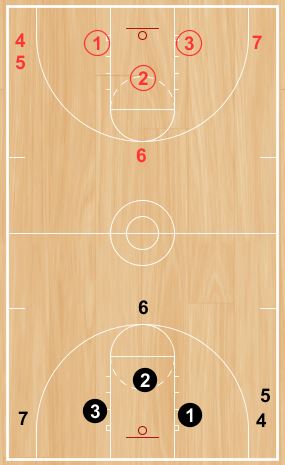
 

If you have any questions about the Playbooks, please feel free to email me or call/text me at (317) 721-1527.

  • « Go to Previous Page
  • Page 1
  • Interim pages omitted …
  • Page 171
  • Page 172
  • Page 173
  • Page 174
  • Page 175
  • Interim pages omitted …
  • Page 288
  • Go to Next Page »

Primary Sidebar

  • Twitter
  • Facebook
  • Linkedin
coachestoolbox
personaldevelopmenttoolbox
basketballplayerstoolbox
basketballtrainer
athleticperformancetoolbox
coachingbasketball

© Copyright 2026 Coaching Toolbox

Privacy Policy