• Skip to primary navigation
  • Skip to main content
  • Skip to primary sidebar

  • Basketball Plays
    • Ball Screen Sets
    • Horns Sets
    • Man to Man Post Up
    • Man to Man Isolations
    • Backdoor Plays
    • Man to Man 3 Point Shot Plays
    • 2-3 Zone Attack
    • Baseline Inbound Plays
    • Sideline Inbound Plays
    • Combination Defense Attack
  • Drills
    • Defensive Drills
    • Offensive Drills
    • Competitive Drills
    • Passing Drills
    • Rebounding Drills
    • Shooting and Scoring Drills
    • Toughness Drills
    • Transition & Conversion Drills
    • One on One Drills
  • Blueprint
  • Practice
  • Mental Toughness
  • Skill Development
  • Offense
  • Defense
  • Store

Basketball Drills: Dawg Passing

Basketball Drills: Dawg Passing

By Brian Williams on December 30, 2014

This is a passing drill that Coach Mike Neighbors used at the University of Washington.

That is why he called it “Dawg” passing.

He is now at Arkansas, so maybe it is “Hawg” passing now.

There are two versions on this post.

The first version is a diagram that includes layups and the second version is a passing and catching only version (You Tube Video).

Coach Neighbors has a newsletter that is the longest running one that I know of.

If you would like to be added to it, please let me know and I will pass along your email address to him.

This is a drill that is fast moving and requires communication.

Dawg Passing Drill

Diagrams created with FastDraw
basketball-drills-dawg-passing1

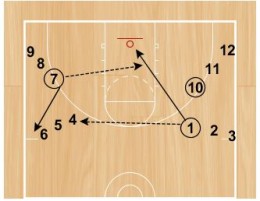
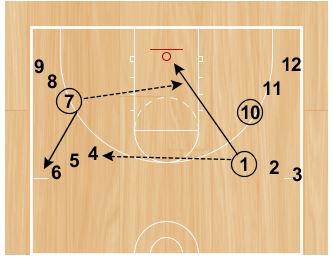
Players 1, 7, and 10 start with basketballs.

1 passes to the line directly across from her to player 4.

1 then cuts on diagonal to receive pass from front of bottom opposite line (player 7) which she takes in for a layup.

After 7 passes to 1, 7 goes to the end of the line behind where 6 is.
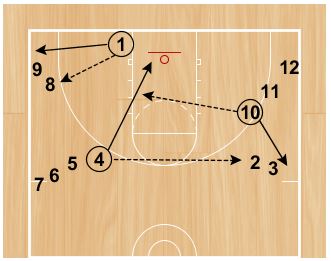
basketball-drills-dawg-passing3

1 gets her own rebound, passes the ball to 8 (the same line that passed to her for the layup) and goes to back of line where pass came from–behind player 9.

The top basketball is now on the opposite side with player 4.


4 passes to 2, cuts to the basket, and receives a pass for a layup from 10

The drill now repeats itself from this side with the passes and cuts being the same.

You can make it competitive by timing to see how long you can go without bad passes, drops, or missed layups.

Or, you can split into two ends and set a time counting completed passes and made layups.

Dawg Passing Drill

This is a You Tube video (without sound) of the above drill without shooting layups.

Click the play arrow to see the video.
Basketball Plays Pop 54 Hammer Flare

By Brian Williams on December 29, 2014

Today’s Play was contributed by Houston Women’s Assistant Coach Vonn Read.

Coach Vonn Read has submitted several plays from his playbook series The Basketball Encyclopedia of Plays to the Coaching Toolbox.

Coach Read has also served as an assistant coach in the WNBA with the Phoenix Mercury, Orlando Miracle, and San Antonio Silver Stars.

He was an advanced scout for the Orlando Magic as well as The Charlotte Sting.

This is a good set for a 3 pointer.


Pop 54 Hammer Flare

Diagrams created with FastDraw

basketball-plays1

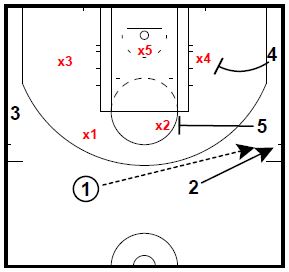
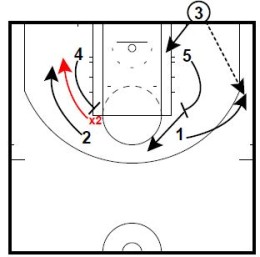
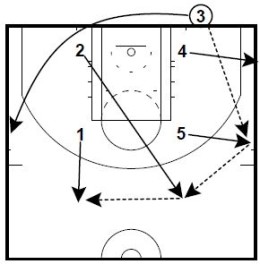
This is a good play for a quick 3-point shot against a Zone.

The 4 and 5 player will pop out to get the pass.

The 2 player (Shooter) will pop high for the pass and then reverse the ball to the 1 player.

The 3 player will cut to the opposite wing.


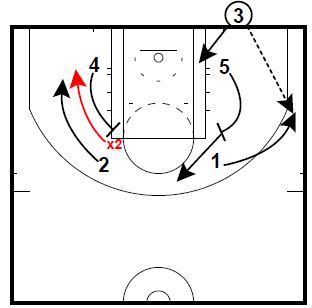
basketball-plays2


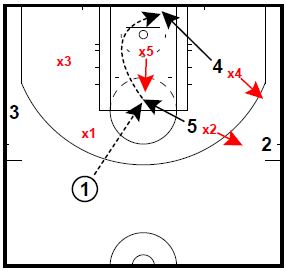
The 4 and 5 player will screen the outside defenders in the Zone to set up the flare screen for the 2 player.


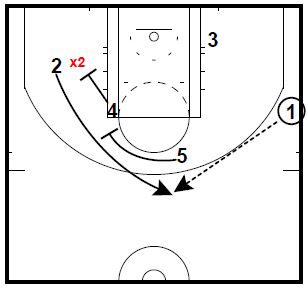
basketball-plays3

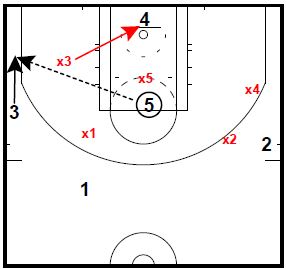
If X4 and X2 cheat over the flare screens to deny the shot to the 2 player, both the 4 and 5 player will slip the screens.

The 5 player will slip and shoot the jumper at the nail. If X5 steps up to challenge the shot by the 5 player, the 5 player can go high low for the layup to the 4 player.


basketball-plays4


If X3 sinks to stop the layup by the 4 player, the 5 player can pass it to the 3 player for a 3-point shot.


Coach Read has also put together The Basketball Encyclopedia of plays. You can check them out here: The Basketball Encyclopedia of Plays or read more about the books:

Any coach looking for the latest and innovative plays from the Professional, College, or High School levels can stop looking. With a compilation of over 7,700 different plays, you will never need to purchase another basketball playbook again. These playbooks can be used as a great reference tool for years to come. This 2 Volume Book includes plays from 19 different play categories, and they are the most extensive playbooks on the market.

The Basketball Encyclopedia of Plays (Platinum Series) contains over 7,700 Plays (Both Volumes combined) from the NBA, WNBA, USBL, and College levels from someone who has worked as an Advanced Scout or Coach on each level!!! This book has been intensely compiled over the last 21 years, with plays taken from a lot of NBA Coaches (past and present), WNBA coaches, and College coaches (Men’s and Women’s) from around the country.

Any coach that is serious about improving their knowledge of the game from an X and O standpoint will benefit tremendously from these books. These Books can be used to discover New Quick hitters, add a New Package to your playbook, or develop an entire Offensive System. There are a lot of new ideas and concepts in these books to study, and the Basketball Encyclopedia of Plays can be a great resource for coaches on all levels!!! This book is definitely for those X and O junkies who are always looking to improve as a Coach.

“THE GAME IS ALWAYS CHANGING? ARE YOU?” Vonn Read

Here is the link: The Basketball Encyclopedia of Plays

Coaching Basketball Matchup Zone Notes

By Brian Williams on December 26, 2014

These notes on matchup zone defense are from Scott Peterman’s Ultimate Matchup Zone eBook. I hope they give you some ideas to apply to your zone defense. If you don’t play zone in games, then hopefully you can use them as you practice your zone attack against your second team in practice.

The Ultimate Matchup Zone eBook is paired with the Full Court Pressing Playbook as this week’s eBook Bundle.

Click here to find out more about the pair: Ultimate Matchup Zone and Full Court Pressing Defenses Playbooks

If you do have any questions about the Playbooks, please feel free to email me or call/text me at (317) 721-1527.

Here are some favorable zone defense situations:

  • * Man to Man Matchup problems
  • * 2 non-shooters who are both small.
  • * You are playing against a high volume of post-up teams and penetration teams.
  • * You are playing your second night of a back to back.
  • * When you are coming out of a time-out. You can take the opposing coach out of the set play by changing to a zone defense.
  • * Low clock situations with a sideline out of bounds play, baseline out of bounds play, or an end of the quarter play.
  • * Limited preparation time
  • * Foul Trouble

Zone Defense Issues that cause problems:

These are areas that you must have a plan to counter and practice.

  • No one is in your “home” area.
  • When your opponent spreads the floor with multiple shooters.
  • When the zone offense screens the middle man.
  • Back Screens on the weak side of a zone defense.
  • When rotating two players to one. If in doubt then the smaller person stays.
  • If two players try to defend one offensive player. You must talk on zone defense.
  • If you have two offensive players in one “Home” area.

Zone Defense Tips:

  • The quality of the shooter will dictate your ball pressure level on the offense.
  • The Ball can’t rest in a “Bump” area. The “Bump” areas require reading and talking among teammates.
    If the ball is in the High Post area then it’s the 5 man’s responsibility.
  • Watch out when you are switching on/off the ball in a bump area.
  • The Player that is further from the ball must communicate more.
  • If you don’t have someone in your “home”area then look at the next area and pick someone up.
  • You must go “HOME” on all Skip Passes.
  • When the ball gets below the free-throw line then all five defensive players must be below the free throw line.
  • If you are more than one pass away then you should be thinking of protecting the basket first.
  • If you are one pass away then you should be defending the ball first.
  • All five players must Rebound.
  • If you don’t know what to do, then go “Home”. Someone will come in your “Home” area.
  • If no one is in your “Home” area, then build your help from the basket out.
  • If we get caught sending two players to the same rotation then we want the strong side defender to stay with the ball, and the weak side defender to re-rotate to another man.
  • Never leave the ball during a scramble situation.

Zone Defense Checklist | Think about how you want to handle these situations

  • Ball Screens: Middle, Side, Step-up, and Elbow Pick and Rolls.
  • Off Ball Screens: Stagger Screens, Double Screens, Flare Screens
  • Passes: One pass away, Two passes away, and Skip Passes
  • Areas where the offense will attack: Short Corner, Dribbling between areas, Low post flash, Low post
    flash into corner, High post flash, High post flash into perimeter step-out, Dives to the rim, Drives to the rim.
  • Concepts: Baseline Runner, Overload, Underload, Defending two people in one space, 5 out on the
    perimeter, 4 out and 1 post player.
  • Zone Offensive Sets and Alignments: 1-4, 1-2-2, 2-1-2, 1-3-1, 2-3, 3-2, Running “X” in the paint.
  • Situations: Baseline out of bounds, Sideline out of bounds, Low Clock, End of the Game, After a free
    throw, After a press, After a missed shot, and Low clock resets.

These notes on matchup zone defense are from Scott Peterman’s Ultimate Matchup Zone eBook. I hope they give you some ideas to apply to your zone defense. If you don’t play zone in games, then hopefully you can use them as you practice your zone attack against your second team in practice.

The Ultimate Matchup Zone eBook is paired with the Full Court Pressing Playbook as this week’s eBook Bundle.

Click here to find out more about the pair: Ultimate Matchup Zone and Full Court Pressing Defenses Playbooks

If you do have any questions about the Playbooks, please feel free to email me or call/text me at (317) 721-1527.

Basketball Plays Box 54 Up Double

By Brian Williams on December 21, 2014

Houston Women’s Assistant Coach Vonn Read has submitted several plays from his playbook series The Basketball Encyclopedia of Plays to the Coaching Toolbox.

Coach Read has also served as an assistant coach in the WNBA with the Phoenix Mercury, Orlando Miracle, and San Antonio Silver Stars.

He was an advanced scout for the Orlando Magic as well as The Charlotte Sting.

This is a good set for a 3 pointer.


Box 54 Up Double

Diagrams created with FastDraw

basketball-plays-box54up1

The 4 and 5 players will up screen for the 1 and 2 players.

The 1 player will pop out to the wing for the pass.

The 3 player will step in and post up on the block.


basketball-plays-box54up2

After the 2 player comes off the screen, he will receive a quick counter double screen by the 4 and 5 player for a 3-point opportunity at the top of the key.

After X2 gets through the up screen by the 4 player, he will have to fight through a quick stagger screen.


basketball-plays-box54up3

If the 2 player does not have a shot, the 3 player will receive a double low stagger on the baseline for a 3-point shot.

The 1 player will screen down on X4 to free up the 4 player popping out for a 3-point shot.

X4 will get hit with a mis-direction screen while he is helping on the stagger screen for the 3 player.


Coach Read has also put together The Basketball Encyclopedia of plays. You can check them out here: The Basketball Encyclopedia of Plays or read more about the books:

Any coach looking for the latest and innovative plays from the Professional, College, or High School levels can stop looking. With a compilation of over 7,700 different plays, you will never need to purchase another basketball playbook again. These playbooks can be used as a great reference tool for years to come. This 2 Volume Book includes plays from 19 different play categories, and they are the most extensive playbooks on the market.

The Basketball Encyclopedia of Plays (Platinum Series) contains over 7,700 Plays (Both Volumes combined) from the NBA, WNBA, USBL, and College levels from someone who has worked as an Advanced Scout or Coach on each level!!! This book has been intensely compiled over the last 21 years, with plays taken from a lot of NBA Coaches (past and present), WNBA coaches, and College coaches (Men’s and Women’s) from around the country.

Any coach that is serious about improving their knowledge of the game from an X and O standpoint will benefit tremendously from these books. These Books can be used to discover New Quick hitters, add a New Package to your playbook, or develop an entire Offensive System. There are a lot of new ideas and concepts in these books to study, and the Basketball Encyclopedia of Plays can be a great resource for coaches on all levels!!! This book is definitely for those X and O junkies who are always looking to improve as a Coach.

“THE GAME IS ALWAYS CHANGING? ARE YOU?” Vonn Read

Here is the link: The Basketball Encyclopedia of Plays

Basketball Coaching Mistakes

By Brian Williams on December 19, 2014

If you have been on the Coaching Toolbox for any length of time, you know that Mike Neighbors from the University of Arkansas is one of my absolute favorite coaches to learn from. This post is a portion of an article he is working on to detail his move from assistant coach to head coach. The article is entitled “418 Mistakes Later” and is still a work in progress. My guess is that he is much harder on himself than he should be, but I do think that as always, he brings up some really good lessons for us to consider whether we are a head coach or an assistant.

On day 366 of the job, I spent the entire day with the list. By the end of the day, I was able to categorize them into a dozen areas of similar reasons that I felt I had made them. I will list those 12 areas below and then once every now and then, update this document and go more in depth on each area.

1. I assumed being an assistant coach would prepare you to be a head coach
2. I told people the TRUTH before I had earned their TRUST
3. I got out of shape
4. I got out of alignment between Process and Results
5. I tried to do too many “things”
6. I was afraid to do “what I thought best”
7. I exhausted my daily decision energy on stuff that didn’t effect winning
8. I stopped confronting things that needed to be confronted
9. I let the Urgent overcome the Important
10. I forgot to keep myself “charged”
11. I didn’t realize how tight my friend circle would become
12. I had no idea how to manage a staff or how to “manage up”

I ASSUMED BEING AN ASSISTANT COACH WOULD PREPARE YOU TO BE A HEAD COACH

We all know the saying about assuming (ASS-U-ME)… if you haven’t, asked one of your kids to explain. Well, it was never more true than in the case of me assuming that my 14 years of being an assistant coach would have me fully prepared to be a head coach. While those years certainly helped and probably kept me from making 936 mistakes, it just isn’t that simple.

The job description of a Head Coach is completely different from being as assistant.

So many of my actual mistakes fell in this category and some will overlap with later topics we discuss. I believe simply knowing that would have saved me from the first mistake I made that fall under this header. Over the course of 14 years I had accumulated resources that allowed me to be productive in my day. I had forms for this and that. I had a routine that led to an efficient day. So on Day 1 as a head coach, I expected that to be the same. But it wasn’t. Not even close.

I didn’t have a form for keeping up with people contacting me for jobs.
I didn’t have a form for what to do when a recruit didn’t want to come to Washington.
I didn’t have a plan for delegating assignments to my staff.
I didn’t have a plan for what do to when one of my “recommendations” didn’t work.

For my entire professional career, I had been making suggestions. Some were used. Some weren’t. Some that were used worked. Some didn’t. None of them however ever came back across my desk to explain to the media or administration. Now my decisions had consequences. We will cover Decision Making much more in detail in a later piece.

For the last 14 years my decisions pretty much just directly effected me and maybe my immediate family. Now my decisions affected the lives of every player, coach, aide, manager, strength coach, athletic trainer, etc.

My biggest mistake was just ASS-u-ming again that “things would slow down” or “you’ll get adjusted to the new demands”… I wish I would have gone in knowing that it was okay to be overwhelmed. That is wasn’t going to slow down. That it wasn’t going to just adjust. I needed a better plan. I needed support. I needed help. I wasted valuable time waiting for things to slow down or adjust.

What would I do differently: I would have spent “free” time as an assistant reading up on the area. I would have paid more attention to the job my head coach was doing. I would have picked their brains about how they manage their time. I would have asked to sit in on meetings with marketing, facilities, administration. I would have not kept expecting what I knew in the past to be good enough.

I TOLD PEOPLE THE TRUTH BEFORE I HAD EARNED THEIR TRUST

Again ‘assuming’ got the best of me. I had assumed the trust I had earned with the players as their assistant coach would directly carry over to the new office and the new title. Not true.

So, when I began from Day 1 with TRUST as one of our three core values, I told players the truth. The truth about their situation at UW. The truth about how I saw them fitting in with the change of staff. The truth about my expectations for them moving forward in their career.

Mistake category #2 was born!!!

Have you ever noticed in your life you don’t listen to people you don’t trust? Think about it for a second. Friends. People you are in relationships with. Strangers. Enemies. You listen to people you trust. As always this comes back to a Papa Neighbors quote:

“Don’t listen to anyone who doesn’t have a dog in the fight.”

I am betting after you thought about it, you realized your life long learning advice came from someone who had earned your trust.

Look at it from another perspective. Do you tell people the 100%, truth and nothing but the truth, nothing held back TRUTH to people you don’t TRUST? Betting that’s a no again.

Read in a book that if you want to find out if someone trusts/likes/respects/gives a crap about you, simply ask them for feedback on something. If you get ALL positives…they don’t!!! So true. We have all given a presentation or a talk in which everyone tells you what a great job you did. But you know you fumbled some words. Or you had a ton of “verbal graffiti” like, you know, um, um, um, um. Only people that love you will tell you your fly was open. Only people that care about you will tell you that you have something in your teeth.

Not saying you don’t listen to others. Not saying you don’t consider their input. Saying that when it comes down to it, you only tell the truth to people you trust and you only listen to truth from people you trust.

As my first year was unfolding, my desire to be transparent, to be an open book, to be 100% honest was well intended, but not so well executed.

Will share will you the best example…

My team was struggling with shot selection early in the year. We had a strong returning group of players who had been our leading scorers for two years with an incoming McDonald’s All-American who could also really score. I wanted it to be very clear what we viewed was an acceptable shot and what wasn’t. We showed film. We pointed in out in practice. We charted every shot take in our pre-season and posted for everyone to see.

My intention: That our team driven, high basketball IQ kids could see the results and realize who needed the most shots and why.

Result: Through first 30 practices, a scrimmage game, an exhibition game, and our first two regular season games, we still didn’t know.

My solution: Get everyone in the film room in front of a whiteboard. Break down for them that we get on average 70 FG attempts per game. Some games a few more. Some games a few less. But 70 on average. With that in mind, Player A needed between 12-17 of those. Player B needed 10-15 of those. Player C need 8-12 of those. The remaining shots would be available to those other players based on each game and need in each game.

All based on evidence from shooting in practice, in games, and extra shooting each of them put in. Evidence mind you. It was crystal clear to me that our team would want our best shooters taking the most shots therefore we would have a chance to win more games.

It was pretty much straight from the Don Meyer clinic on shot selection. How could it fail.

Well it failed. And it failed miserably. It completely backfired. It separated the team more. The players I said needed the shots even hated it. They felt extra pressure. They felt their teammates were counting their shots. For the next month, we were in recovery mode from my brilliant idea.

But you know what happened about ten games? My exact shot distribution began to happen. And everyone was completely fine with it. In fact, they could be heard during timeouts saying Player A needs a couple touches. Or Player A saying to player B, you’re hot tonight I am looking for you!!

Conclusion: Once I had earned their trust and had earned each other’s trust, it was easier to accept. They believe in before they buyin (as Kevin Eastman told me at a recent clinic.) That could be restated… The Believe in after they Trust In…

I TRIED TO DO TOO MANY THINGS

This mistake shares a lot of crossover with the previous one we just talked about. It stemmed from years of observing and collecting ideas. I wanted to start this. And implement that. Wanted to have this and that. Wanted to promote our program in this way and that. I wanted us to travel this way and that. I wanted our locker room to have this and that. You get the picture.

What I quickly found was that even if you implement them all, you can’t keep track of them all.

A few examples… At Xavier, Sean Miller gave a special colored practice jersey to the practice player of the week. Those guys fought like warriors to earn that jersey. It was amazing to watch them compete for it. Tried it. Complete and utter failure. Our girls didn’t want to be different. They would actively avoid it. What worked for Sean Miller didn’t work for me.

At Tulsa we had great success sitting our team down and explaining our shot selection process. We had adopted the Don Meyer method of evaluating our shot efficiency. It led us to unprecedented success with the program. Complete and utter failure with my first team. It, in fact, hurt us. It caused more problems than it did good.

We had team goals, game goals, position goals, four minute war goals, etc… The result was that no one knew what to really focus on. Didn’t know what was important and what wasn’t.

It carried over to our X’s and O’s too. We had too many actions. Too many defensive thoughts. Too many “what ifs”… again creating confusion with our team.

It was the same with my staff and support staff. We had so many things we were trying to do that we weren’t very good at any one thing. It was difficult to even keep up with the projects we constantly had on-going. I lost track of who was doing what, when I had expected them to be done, and ultimately even what the purpose of the project was.

The solution was to SIMPLIFY…Once we started to strip away and get to what WAS important, we improved. Our theme of ONE was born and from that point on, we all focused on ONE thing at a time… and now the second that we begin to look ahead, someone in our basketball family is quick to point out that we are getting ahead of ourselves.

You have to try things for sure. You have to make mistakes to learn from them. But don’t be stubborn and don’t be afraid to change or be different…

Click here to read Part II of the Article

Basketball Defensive Drills Kevin Eastman

By Brian Williams on December 17, 2014

These four drills for all levels are from Coach Kevin Eastman. Kevin was a long time college assistant and head coach. He served as an Assistant Coach for the Celtics from 2004 to 2013. He made the move to Los Angeles with Doc Rivers and was on the coaching staff last year. He then was promoted to the Vice President of Basketball Operations for the Clippers before retiring.

One of his beliefs that he presents in the sample video is that “Good offense is multiple actions, good defense requires multiple efforts.”

The drills in this video are:

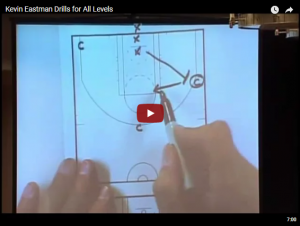
Pinball: A drill to work with one player on fighting through screens.

Close, Direct, Charge: One player works on each of those defensive skills to complete the drill successfully.

Force to Tape: A one-on-one defensive drill to work on controlling penetrating straight line drives and forcing the dribble to specific, pre-determined spots on the floor.

Shell with post and corner drive: Run the traditional 4 on 4 with an additional 4 unguarded offensive players–two in the dead corners and 2 on or above the blocks. Those additional 4 unguarded players can be managers as well. When the ball goes to any of those 4 spots, you are able to work on your defensive rotations.

Watch the video to get the specific details.

Make sure your sound is on and that you click the play arrow. Also, please make sure that you are able to access YouTube videos on the server that you are using.

  • « Go to Previous Page
  • Page 1
  • Interim pages omitted …
  • Page 168
  • Page 169
  • Page 170
  • Page 171
  • Page 172
  • Interim pages omitted …
  • Page 288
  • Go to Next Page »

Primary Sidebar

  • Twitter
  • Facebook
  • Linkedin
coachestoolbox
personaldevelopmenttoolbox
basketballplayerstoolbox
basketballtrainer
athleticperformancetoolbox
coachingbasketball

© Copyright 2026 Coaching Toolbox

Privacy Policy