• Skip to primary navigation
  • Skip to main content
  • Skip to primary sidebar

  • Basketball Plays
    • Ball Screen Sets
    • Horns Sets
    • Man to Man Post Up
    • Man to Man Isolations
    • Backdoor Plays
    • Man to Man 3 Point Shot Plays
    • 2-3 Zone Attack
    • Baseline Inbound Plays
    • Sideline Inbound Plays
    • Combination Defense Attack
  • Drills
    • Defensive Drills
    • Offensive Drills
    • Competitive Drills
    • Passing Drills
    • Rebounding Drills
    • Shooting and Scoring Drills
    • Toughness Drills
    • Transition & Conversion Drills
    • One on One Drills
  • Blueprint
  • Practice
  • Mental Toughness
  • Skill Development
  • Offense
  • Defense
  • Store

Basketball Plays: Sean Miller Horns Handoff

Basketball Plays: Sean Miller Horns Handoff

By Brian Williams on March 2, 2015

This week’s X and O post is a man to man play from Sean Miller previously at the University of Arizona and in the FastModel Sports Basketball Plays and Drills Library The site has thousands of drills and plays that have been submitted by basketball coaches from around the world.

You can also find out more about FastModel Play Diagramming software by clicking this link: FastDraw

This play was posted by Randy Sherman, owner and founder of Radius Athletics–a basketball coaching consulting firm.


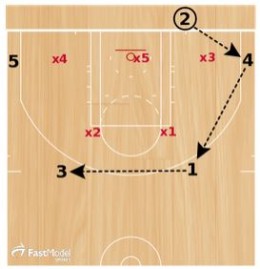
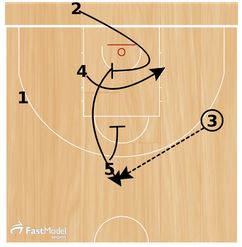
Sean Miller Horns Hand Off
basketball-plays-arizon-horns-dho1

Horns set with 1 using a ball screen from 5

After the ball screen 5 pops

1 passes to 5 on the pick-and-pop then spaces to the wing


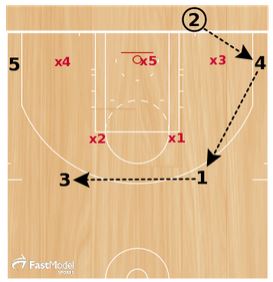
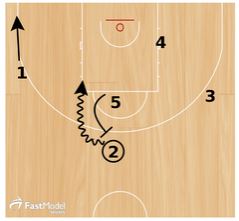
basketball-plays-arizon-horns-dho2

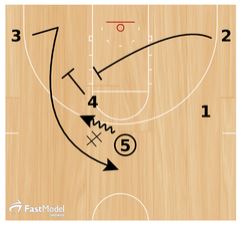
3 sets up cut and 4 sets down screen for 3

5 dribbles at the down screen action and hands off to 3

2 moves to the lane to set cross screen for 4 (STS)


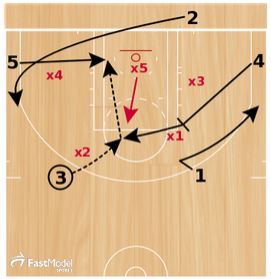
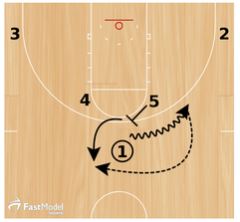
basketball-plays-arizon-horns-dho3

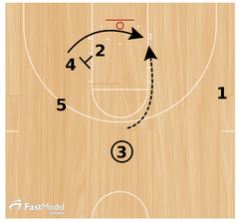
3 has option to enter to 4


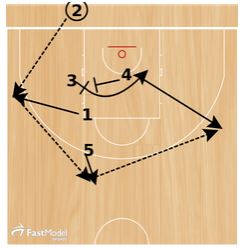
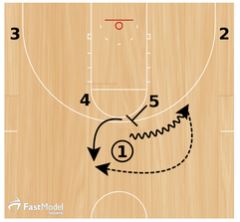
basketball-plays-arizon-horns-dho4

5 pin screens for 2 to bring him/her to perimeter (STS)

3 has has option to pass to 2


Leadership in Your Basketball Program

By Brian Williams on February 27, 2015

Clinic Notes from:

These are some of the notes that I took at a PGC/Glazier Basketball Coaching Clinic.

The topic of this post is leadership ideas for your program.

Bob Starkey-Asst. Women’s Coach LSU

    • There are many different ways to coach, but it boils down to teaching and relationships
    • It doesn’t matter where you coach and who you coach, it matters why
    • Coaching today is more about influencing and mentoring
    • Have the rule in your program that no one comes to the head coach with a problem if they don’t also have a suggestion for a solution
    • Constantly ask yourself, what are we doing with our team to bond this week


    • One good way to build solid relationships with your players is by coaching the pre-practice skill work every day of your season–October through March
    • Establish an identity that makes your program significant to your players that is above and beyond basketball. Don’t let somebody else dictate the culture of your program.
    • With everything that happens in your program, you’re either teaching it, or you’re tolerating it.
    • Value and teach that focusing on each process is more important than worrying about what the product will be
    • Do you want the roots or the fruits? Let your players set team goals.
    • Those goals should include process goals that can be measured daily


  • The best daily practice team he ever coached was a group that set their own goal being the best practice team in the country every day and requested that the coaches hold them accountable ever day. Teammates worked to hold each other accountable and it also reduced the friction when the coaches held the players to that standard. (Maybe there is something our staff can do to encourage those types of goals from the players!)
  • As a coach, you can additionally impact the goals set by the players by having an emphasis of the day ever day.
  • Leadership involves daily maintenance of and attention to culture, goals, and all relationships within your program.
  • Taking the time to develop a player’s notebook is a game changer for the culture of your program.  It gives players a resource and improves their retention of what you are teaching.

These next few leadership ideas were presented by Tyler Coston, a full-time course director and clinician with PGC

  • There is a difference between what isn’t now and what isn’t yet.  Our job as coaches in all areas of our program is to move our players to the latter.
  • Players want to know 1) Can you help me? 2) Do you care about me? 3) Can I trust you?
  • Step 1 when mentoring team leaders: I do, you watch, we talk
  • Step 2: You do, I watch, we talk
  • Step 3  You do, we talk
  • Your job as a team leader–energy and noise in practice, repeat my coaching points, hustle in and out of practice.
  • Give attention and praise to the things your players do that you want to see repeated.
  • Leadership resource books, The Go Giver (Bob Burg), Captain’s Leadership Manual (Jeff Janssen), Runnin’ the Show (Dick Devenzio)

Also since it will soon be time to get your players “Improvement Season” going, here are some notes on individual workouts to implement in your planning

    • Use different drills during your April through September improvement season than you use during in-season practices so that players don’t see it as boring. (Tom Richardson–Vanderbilt men’s assitant)
    • Incorporate agility, balance, conditioning, quickness, and speed work in addition to the skill work.  1/3 of basketball is played with lateral movments (Richardson)
    • Use resistance in ball handling drills with a defender pushing on the dribbler’s shoulders (Richardson)
    • Great shooters develop through PRACTICE (Preparation, Repetition, Attitude, Technique, Intensity, Conditioning, and Expectations (Rick Torbett–Better Basketball)
    • When teaching shooting, have players hold their finishing pose so that you can correct bad habits after the shot has been taken.  Have them correct their finishing post before the next shot is taken.


  • On the finishing pose, shooter should be able to see the rim between their wrists. Their fingers should be above the square (in their sight) and the guide hand frames the goal. (Torbett)
  • Work on shooting at all 7 eyelets. (Torbett)
  • Finish workouts with a toughness drill–one of our favorites is 4 minutes to make 100 shots (Tom Kelsey–LSU men’s assistant)
  • Want to make out of season open gyms more competitive?  Experiment with a layup counting five points (no cherry picking–no intentional/hard fouls to stop a layup).  It forces the offense to take good shots, take care of the basketball, and hustle back to defense.  It also encourages the offense to run as well as attack the basket in the half court.

Practice on Intense Defensive Situations Every Day

By Brian Williams on February 24, 2015

P-O-I-S-E

This article on defensive situations is a follow up to the article that I posted last week on offensive situations.

“Practice On Intense Situations Everyday”

by Coach John Kimble

CoachJohnKimble.com

Retired high school and college coach


Defensive Situations

This article was originally written for Winning Hoops

The winner of many basketball games can many times be determined by just a matter of one or two isolated plays. A wide margin of talent-levels can dictate the winner and loser of games, but what helps define the winner of a game that has comparable talent and skill level?   The answer may very well be just one or two key possessions of the basketball. Sometimes a basketball team can have a wide variety of offensive performance levels.

Offenses can be fleeting, but defenses should be a “constant,” because defenses require effort, energy, heart, enthusiasm and a sound defensive plan of action. Does a team have a marked advantage because of outstanding defensive preparation of unique scenarios that can easily happen during the game? Can a basketball team that has inferior talent and is possibly out-played by the other team, still come out the victor of the game? This can sometimes take place if this team can achieve an edge in scenarios or situations that could happen during the course of the game.

If the many different defensive scenarios have not been carefully evaluated, analyzed and then practiced with detailed repetitions, a basketball team could only win this type of close game by relying solely on the execution of the defensive strategies that were practiced in close detail in practice sessions and then instructed to execute during the game’s timeout.

If winning a game is important, should a coach go with a defensive strategy that was drawn up during the excitement of a last second timeout—a defensive plan that the coaching staff and players are not necessarily familiar with or is a coaching staff going to elect a course of action that has been carefully thought out, discussed, taught, and practiced repeatedly during the season?

Instead of a coach devising a defensive plan of action that his team might not have ever experienced or practiced, why not have these plans already introduced and understood by his/her team and also specifically practiced. This would give that defensive team an opportunity to be as prepared for these last second situations as they are for everything else that takes place in the games’ normal segments.

There are many different defensive schemes, methods and philosophies that can be very effective for a basketball team. Since there is not necessarily a “right or a wrong” method, the plan of action must be carefully planned, devised and then agreed upon (by the coaching staff). The defensive schemes must thoroughly be devised, then taught and convinced to the players of its effectiveness. The purpose of this article, as well as the previous and the following articles, is to dare each coach and coaching staff to be prepared and to have his/her teams prepared for those all important situations.

DEFENSE—B.O.B/S.O.B. PHILOSOPHY

Does your team always use a particular type of defense when defending Baseline Out-of-Bounds (B.O.B) plays, even if it is not your regular half-court defense? Do you zone or play man defense? If playing man, do you switch all off-the-ball screens when playing man-to-man on out-of-bounds plays? Does your philosophy dictate that the opposition’s “B.O.B. Trigger” be defended or not be defended? If you play a zone, do you trap the in-bounded pass in the deep corner? Do you deny the reversal pass out of the corner?

Does your team use a specific type of defense when defending the opposition’s Sideline Out-of-Bounds (S.O.B.) plays? Does your philosophy dictate that the opposition’s “S.O.B. Trigger” be defended or not be defended? If he/she is not defended, where do you place their “Trigger’s” defender, in the lane or as a center fielder? Are in-bounds receivers defended with full face-guarding or not? Do you switch all screens in the S.O.B. scenarios? Why or why not?

TIMEOUT SELECTIONS

Does the coaching staff have a philosophy on whether they want players early in the game to call a timeout to protect the possession of a loose ball? Or does the coaching staff want to save those timeouts for late game situations? If the coaching staff does not have a set philosophy and has not taught their players, those decisions will then be left up to the players. Does the coaching staff want to leave that decision up to the players?

DEFENDING THE DELAY GAME AT THE END OF PERIOD

Is it your staff’s philosophy to change its defense late in the time period when the opposition is holding the ball for the last shot in the period?   Defensively, does your team have a half-court trap defense or does it have a half-court trapping man-to-man defense? Which defense do you prefer to use? Why? Does your defensive attitude become more passive, more aggressive or stay the same? Do you change switching on screens or trapping on ball screens, when playing man-to-man defense?

DEFENSE—END OF PERIOD DEFENSE AFTER A SCORE

When your offensive team is going for the last shot of the time period, does your team have a predetermined defense that your team should use (even if it is a defensive change) when the opposition gains possession of the ball (after your score or turnover in the last few seconds of the time period)? For example, do you have your team change to a token full court pressure defense (to burn time off of the clock), whether it is a zone press or a man-to-man press? At the half-court level, do you then utilize a man-to-man defense to prevent an uncontested three-point shots at the buzzer? Do you change your defensive screening rules during this particular scenario of the game?

DEFENSE–TRANSITION AFTER YOUR TEAM SCORES (Tied or Still Behind)

Conversely, another one of the most important decisions a coaching staff should decide on and then convey to all players is what they should do in the last seconds of a game after they score to tie the game or when the opposition remains with the lead. The amount of the opponent’s current lead should also affect the coaching staff’s philosophy. If still behind, are there specific full court press defenses that should be utilized? If there are several choices, how is the desired defense called out to the team?

What kind of defense (full court and half court) is used after your team has scored to tie the game or put your team into the lead in the final seconds of a game.

Do your players know how to defend the opposition from either the full court and half court levels with the various time and score situations?

DEFENSE–TRANSITION AFTER YOUR TEAM SCORES (Tied or Now Ahead)

Does your team know your philosophy if you are the team that just scored to either tie the score or put your team up (by one or two or three points)? Does every player know what defense you expect them to be in? Do they know whether they are supposed to be in a full court press and what specific half court defense they are to be in to protect the lead and ultimately the game? Do you have a set philosophy to teach your players so that they will be successful?

The next situation a team must recognize defensively is the actual score and what type of shot do they want to deny and what kind of shots (if any) are they willing to concede. Don’t expect your players to read the your mind and know exactly what you want. If the score is tied or ahead by one or two, most likely the staff wants their defensive team to be in their most efficient defense.

If your team is ahead by three, there must already be a decision as to whether to foul the opposition to burn time. Knowing your team is under the limit of team fouls can give the defensive team a huge advantage, if the philosophy has already been established AND the players know ‘how to properly foul’ in those circumstances. A definite philosophy should be agreed upon by the coaching staff in the preseason and then thoroughly taught to all players in the program, so that there is no doubt or hesitation in anyone’s mind as to what to do during the intense situation.

DEFENSE–“LATE GAME 3-POINT LEAD”

Does the coaching staff have a philosophy and have they taught their team a type of man-to-man defense that could be used in late game situations where the primary objective is to defend the opposition from shooting “three’s” and sacrifice giving up an inside shot for “2?” If that has been taught that to players, do players know when to use that defense and when not to use it?

Or does the coaching staff have a philosophy for late game situations of deliberately fouling an opponent to prevent them for shooting (and making a “3” to ultimately tie the score)? If so, has the staff thoroughly taught the players the proper techniques of fouling that opponent? Do the players know when and when not to use that technique? If not, what changes in philosophy and technique are there to defend the opposition in this scenario?

DEFENSE–“QUICK” SIDELINE & BASELINE OUT-OF-BOUNDS SITUATIONS

Do you have a philosophy and a defensive plan to guard against the opposition’s shots when they are in the same type of situation?   One defensive philosophy is not to guard the offensive “Trigger” while another theory is to substitute and put in the tallest defender you have on their “Trigger” to help deny the in-bounded pass. Another philosophy is to trap the first pass that is made to the receiver in the deep corner, while another defensive thought is to remove the defender on the “Trigger” and place that defender either in the lane, as a centerfielder or to double-team and deny the most likely in-bounds receiver?. Defensively, do you advocate any of these theories? If so, have you practiced those situations?

DEFENSE–“ICING” THE OPPOSITION’S FREE THROW SHOOTER

Do you have an organized plan of action when the opposition is the team that is shooting the free throws? Do you believe in “icing” the opposition’s free throw shooter late in a close game? If so, how do you do so?   Do your players understand your method? Have they rehearsed and practiced the situation enough? Do you have a specific fast break or play after obtaining the ball after the opposition shoots the free throw?

Do you have a philosophy and a value for how important “last shots” at the end of a time period are? If your team succeeds before the buzzer, do you have a “Buzzer Prevent Defense?”

DEFENSE–WHEN AND HOW TO FOUL THE OPPOSITION

Do you have a defensive philosophy dependent upon the time and score when to start fouling the opposition to make the last possessions a “free throw shooting contest?” Does the coaching staff have a system of determining whom to foul? Do the players know how to foul the opposition? Late in a game that you are behind, when the stopping of the clock and defensive pressure is extremely valuable, is it important to you to substitute your defensive specialists and/or “foulers” into the game for offensively-skilled players only when the opposition has possession of the ball?

If so, how do you get your offensive scorers back into the game when you obtain possession of the ball? If it is important to have specific players in the game for specific situations, what techniques do you use to achieve that and have you practiced those techniques with your team? Should you have a plan? Does the coaching staff then have a pre-set plan on what players on their team fit those three categories?

CONCLUSION

Devising a philosophy and specific defensive plan for the many scenarios requires a great deal of time, effort, imagination and creativity by a coaching staff. Its creation and development can be much more fruitful and valuable when it is done in the off-season versus trying to manufacture a hasty plan in the middle of an actual game. Winning and losing the game sometimes is just the difference of one decision or of one (correctly or incorrectly executed technique). Winning just two games that could have been losses can drastically turn the outcome of an entire season around. A team that ends up with a 16-10 record seemingly has a totally different season when they could have had a 18-08 record.

If the coaching staff develops a sound philosophy on the different scenarios that can (and will) take place in games during the course of the season, the next step is to thoroughly teach every player that philosophy. Utilizing the last ten to fifteen minutes of practice of most practices for these many different game situations can be a very invaluable asset for a defensive basketball team. This investment of time and energy provides players with the required repetitions for a team to understand and improve the skills needed to be successful.

During the season’s practices, the appropriate techniques can then be fully explained, taught, and practiced with the players and the entire coaching staff. This makes everyone involved more prepared and confident in the defensive plan of action. Remember the cliché, “Luck is when preparation meets opportunity.” Succeed in those important scenarios with POISE.

About the Author

Coach Kimble was the Head Basketball Coaching position at Deland-Weldon (IL) High School for five years (91-43) that included 2 Regional Championships, 2 Regional Runner-Ups and 1 Sectional Tournament Runner-up. He then moved to Dunlap (IL) High School (90-45) with 2 Regional Runners-up, 1 Regional, 1 Sectional and 1 Super-Sectional Championship and a final 2nd Place Finish in the Illinois Class A State Tournament. He was an Assistant Basketball Coach at Central Florida Community College in Ocala, FL for 1 year before becoming Offensive Coordinator and then Associate Head Coach for 3 additional years He then was the Head Basketball Coach at Crestview (FL) High School for 10 years, averaging over 16 wins per season.

He has had articles published in the following publications such as: The Basketball Bulletin of the National Association of Basketball Coaches, the Scholastic Coach and Athletic Journal, Winning Hoops, Basketball Sense, and American Basketball Quarterly. He has also written and has had five books published along with over 25 different DVDs by Coaches Choice and Fever River Sports Production.

See him on Twitter @CoachJohnKimble and his Web Page “www.CoachJohnKimble.com”

Basketball Plays: 1 Zone & 1 M-M BLOB

By Brian Williams on February 23, 2015

This week’s X and O post is from the FastModel Sports Basketball Plays and Drills Library The site has thousands of drills and plays that have been submitted by basketball coaches from around the world.

The first play is a Baseline Out of Bounds Play to run against a 2-3 zone and the second is a man to man BLOB.

You can also find out more about FastModel Play Diagramming software by clicking this link: FastDraw


Iowa State 2-3 Zone BLOB

basketball-plays-isu-blob

2 inbounds the ball to 4

4 swings the ball to 3 through 1


basketball-plays-isu-blob2

4 sets a flare screen for 1 on x1, then flashes to the high post.

3 passes to 4.

2 runs the baseline and fills the corner.

5 cuts to the basket.


Argentina Man to Man BLOB

This play was contributed by Fabian McKenzie who has been a head coach at the university level for 16 years. He has been involved with the Canadian Women’s National team program for the past 8 years.

basketball-plays-argentina1

3 sets a screen for 1 to pop to the wing.

4 sets a back screen for 3 to go to rim.

2 looks at 1 on wing, 3 or 4 at the rim

If 1 catches it, immediately pass to 5 who swings the ball to 3 who has popped to the opposite wing
 

basketball-plays-argentina2

2 sprints toward ball and then turns to set a cross screen for 4 to come to rim.

5 sets a down screen for 2.

3 looks at 4 at the rim of 2 coming up off of 5’s screen.


basketball-plays-argentina3

As 2 catches it, 1 slides to corner and 5 turns to set a ball screen.


Basketball Coaching Mistakes Part 2

By Brian Williams on February 20, 2015

This post is the second part of an article that Arkansas women’s coach working on to detail his move from assistant coach to head coach. The article is entitled “418 Mistakes Later” and he is still adding to it.

I know that he is much harder on himself than he should be, but the points he makes are lessons to consider for all coaches, not just head coaches.

Here is a link to the first part of the article:

Coaching Mistakes We All Make Part 1

I WAS AFRAID TO DO WHAT I THOUGHT BEST

For 14 years as an assistant coach, I never had a bad idea exposed. Although many of my suggestions were unsuccessful, there was never one time I was asked to comment on it by a reporter. My name was never attached on a message board when one of my scouts wasn’t spot on or when my breakdowns didn’t actually prepare us for the big game. But the second you move into that new chair in the new office, that all changes.

Now all eyes are on you. It’s your call. And that’s scary.

I allowed that fear to keep me from trying some things. I think we all have our mentors that we bounce ideas off of. Problem with that practice is that those people usually care deeply for us but have no actual knowledge of our situation. They offer great advice based on similar experiences they might have encountered. They are there to talk us out of bad ideas and into better ones. But at some point, to be successful, you have to trust YOU!!

I spent my first three or four months on the job too worried that what we were doing around our program was the “way it should look.” I’d seen Gary Blair lead teams to the Final Four. I’d seen Kathy McConnell-Miller resurrect a once dormant program into a tournament team. Witness Coach Gardner battle in the nation’s toughest conference with less than most had. And then sit next to Kevin McGuff lead a small, mid-major to within a lay-up of the Final 4 before moving to Washington to start our rebuild. I knew what IT looked like. But it wasn’t my plan. I was just a part of it. Those first 120 days were a continually situation of me asking myself, “What would (insert one of their names) do in this situation?” And each and every time it was usually a combination of what I thought I should do and what I thought they would do. None of the decisions led to disaster and many of them were successful to some extent.

It really had more to do with having the guts to do something that I thought one of them would do differently.

I was worried that I would try something that would so drastically fail that one of them would call me up in disbelief and disappointment that I had not learned better from them. I didn’t want to let them down. I didn’t want to be that “rookie’ coach that was in over his head. I didn’t want to be that first-year coach that people were making fun of around the profession.

It finally came to a head for me on a plane ride home from Christmas break with my family. Our team was off to an okay start. 8-4 overall but the problem was, we weren’t getting better.

We had a depleted roster due to some injuries and for the first two months of the season our practices were disjointed. Three of our players had injuries that allowed them to practice for 20-30 minutes and still be available for games. Another couple needed extra days off all together. While we were able to field a team come game time, we weren’t improving as a team and my healthy players were actually digressing…

For the first time as a head coach, I made a decision without consulting anyone. I came up with a plan and implemented it.

Since we were entering PAC12 play, our calendar was set. Our routine could be defined for the remainder of the season.

I mapped out this weekly plan:

Monday: OFF day. Take care of studies and ‘life’. If you have no training room stipulations you can workout out voluntarily, but if you have modifications you spend any extra time in re-hab not on the court

Tuesday: SKILL DAY. Players with no injuries worked with position coaches on Skill. Players with injuries again spent the day in the training room receiving treatment.

Wednesday: PRACTICE. If you couldn’t practice full this day (after two off days) then you would be unavailable for the games that weekend.

Thursday: PREP DAY 1… we prepared for our Friday opponent. Scouting, film, walk thru, shooting, offensive breakdowns.
Friday: GAME 1

Saturday: PREP DAY 2… same as Thursday but possibly lighter and maybe in sweats

Sunday: GAME 2

We would follow this plan the rest of the season. Once I implemented it with my team, I finally shared it with some of my confidants. They told me I was crazy, it was a bad message to send, I might get fired if word got out, and some that I can’t share in PG format!!

Now I was more scared than before. It was like the scene from Moneyball when Brad Pitt tells the Jonah Hill character, “This had better work!!!”

From the implementation, we saw improvement. The uninjured players said they felt better than all year because we had focused on their skills, we had maximized our time together as a team, and they felt fresh.

A couple of weeks in, we went on the road and won for the first time in PAC 12 history at USC and at UCLA. We came home and lost a close game to #12 Cal before upsetting #3 Stanford. Needless to say the ‘believe in’ and turned to ‘buy-in’.

We saw reduced injuries and need for re-hab.

We saw more energy in games than our opponents.

We saw more concentration and execution of the scout than when had spent more court time covering.

We saw a spike in our team GPA with extra time available for study.

We saw a surge of team togetherness.

Needless to say, it helped salvage our season that ended with 20 wins and a trip to Final 8 of the WNIT.

More importantly it taught me a lesson to trust my instincts. What I learned was that all those experiences of watching other coaches do their things what was the most important was they did what THEY believed in. It was them knowing their team better than any-one. It was them listening to the input, looking at all the information, and trusting themselves to do what is best.

That BIG decision made it much easier to pull the string on less high profile, but equally as important decisions.

It’s your team. You will be held accountable for the actions of your team. So, you better do what YOU think is best and that YOU can put your head on the pillow at night feeling good about.

I EXHAUSTED DAILY DECISION ENERGY ON STUFF THAT DIDN’T AFFECT WINNING

Ever wonder why the POTUS (President of the United States) doesn’t choose his daily suit and tie? It’s not because we are wasting tax payer dollars on needless things. It’s not because he is fashion challenged. It IS because it has been proven that we only have so much ability and energy to make decisions. That energy can be diminished and ultimately exhausted on a daily, weekly, monthly, yearly basis. When you consider the sheer number of important decisions a day the POTUS makes, then you see why simply taking away the task of deciding which tie matches which suit and goes better with the back ground of the set and won’t offend someone watching and, and, and… you quickly see why taking this decision away can pay big dividends as the President is deciding whether to give the “GO” order to attack Bin Laden!! Okay, maybe I have watched Zero Dark Thirty one too many times.

When making the move from assistant coach to head coach you will quickly realize you also go from making suggestions to making decisions. I am sure making suggestions would eventually become exhaustive, but I never reached that number as an assistant!!! I could suggest this and that and another and another and so on and so on and… never got tired of it.

When you are on the other end of those suggestions, people are looking to you for decisions. Correctly making them can mean the difference in the success of your first year and ultimately your success going forward. YOU ARE BEING PAID TO BE RIGHT… Great advice I got from Vic Schaefer at the Final 4 when he spoke about the transition. When you need to be RIGHT, you will find yourself agonizing over every detail and every decision you must make.
So, what do you do about it?

First… Let go of some of the “what tie am I wearing decisions”… in other words delegate decisions to don’t affect winning to other people on your staff you TRUST. You hired em, so let ‘em work. Does what travel suit you order from Nike really affect winning? Does where/when you eat a meal on off days affect winning? Does where you put recruiting files in the office really affect winning? Does the background color of your business card really affect winning? Even if you think some of those do affect winning, then educate someone on your staff what you want and let them make the decisions. This allows you to have a clear head when you get that call from across campus that a player is in academic distress or if you have to choose a tournament to play in over Christmas break.

Second… Understand you need to make decisions that DO affecting winning are made at your energy peak. We can all look back on bad decisions we’ve made. I would bet the vast majority of them were made when you weren’t at your best in one way or another… sad, depressed, discouraged, angry… On the flip side, the best decisions probably were made when you were in a “good place.”

Third… Learn what affects winning and what doesn’t. This is the hard part because experience is a great teacher. But it’s a must do. You have to understand that because YOU think it is important, your players and your staff may not. And in the grand scheme that makes a difference. Your pulse on your program will be your greatest guide. This is where this mistake overlaps with some we have previously discussed about listening to advice and being afraid to do your own thing. Use your energy determining this more than choosing your tie or your pre-game meal locale.

Papa Neighbors always told me to makes decisions about myself with my head and decisions about others with my heart. That advice is always part of my checklist when dealing with discipline issues that arise.

There is also a great book by the popular author, Malcom Gladwell, title BLINK. Highly recommend it to anyone in a decision making position. It will teach you how to ‘thin slice’ and ‘chunk’ which in turn helps you BE RIGHT more often than you are wrong without the exhausting agonizing that we put ourselves through during the process.

This is not to say there aren’t days you’re going to finally crawl into bed exhausted. We all know that is part of being a coach. What I am trying to say is that you won’t crawl in there exhausted from making decisions.

In the first 100 days on the job, everyone will naturally be looking to you to make decisions. As the new Head of the program everyone will be aiming to please you and do things in a manner you approve of. The quicker you delegate duties and responsibilities to others, the quicker you can point everyone in the proper direction.

I made various people HEAD COACHES in area’s of responsibility. I then made a table which I distributed to everyone connected to our program with a COMMUNICATION CARD. For example, I put Adia Barnes in charge of community service. From that point on, every time someone reached out to our campus for a player to read to an elementary school, Adia was contacted. She reached out to our players. She arranged for them to participate. It didn’t take more than a month of people reaching out to me and me referring them to their table of duties to know who to contact.

The little extra work on the front end is worth it.

If I had to do it all over again, that table and card would have been in effect from Day 1 instead of day 201!!

I obviously continued making some bad decisions throughout the year, but it wasn’t because I had exhausted my energy.

I STOPPED CONFRONTING THINGS THAT NEEDED TO BE CONFRONTED

This one occurred as a result of combining other mistakes… getting out of shape, exhausting my daily decision making energy on meaningless stuff, trying to do too much stuff. Those mistakes left me exhausted when issues that needed to be confronted arose. I had wasted my energy on things that didn’t matter that I simply ignored areas that needed the most attention.

Some examples to help explain… poor body language during practice, staff missing “deadlines” on things that needed to be done, off the court actions that threatened our standards, cliques forming on team as result of long season together, sleeping/eating habits, studying hall and class absences… etc.

I would be have exhausted my natural body allotment of energy on things that didn’t matter by noon and a matter come up after lunch that I didn’t confront but should have.

It takes A LOT of energy to consistently CONFRONT. It is emotionally draining to talk to players about roles and role acceptance. It is excruciating to talk about and explain playing time. Many coaches simply refuse to do it as a result. And I believe that is a huge mistake too for coaches to make and could write up another full piece on that, but it’s NOT one of the mistakes I made last year. I learned that one back as a high school head coach. You HAVE to talk to players (and their parent’s) about playing time.

Back to topic…

When you stop confronting, you start allowing—Papa Neighbors.

Heard it said many times at clinics by many great coaches… you are either coaching it, or tolerating it!!

And if your players think you are tolerating the wrong things, you will lose them. You will lose your GOOD ONES. They see you allowing a player to exhibit poor habits, you lose their respect and run the danger of them doing it as well.

Feed your Eagles, starve your turkeys… another Papa Neighbors illustration right there. If you feed your “turkeys” you lose your EAGLES and none of us as coaches can afford to lose our few EAGLES.

So, you better keep your energy up. You do this by conserving your energy in wasteful areas and having the experience to know what to confront and what to tolerate.

You have to know what you will tolerate and what you won’t… Know Your No’s… That was a great topic that Kevin Eastman once covered. You need to make your list out. You need to KNOW your NO’s… How can you expect your players to know if you don’t even know yourself!!

You can’t take Pat Summits Daily Dozen, or Coach K’s Gold Standards, or Bob Knight’s this, or Geno’s that. It HAS to be yours.

You are the person that knows you best. And you should also be the person that knows your team better than anyone.
Get the list… Confront any of your NO’s

Keep your energy up by staying in shape, eating/sleeping the best you can as a coach, use your decision making energy wisely, and delegate things that don’t pertain directly to winning and losing.

This mistake probably cost us a couple of games and without a doubt led to me not having our team peaked at the right time. I won’t go into a ton of detail in this written piece, but grab me at a Clinic or the Final 4 and we can talk about it in more depth.

Of all the mistakes we have covered so far, this is the one that I HAVE NOT MADE in YEAR 2!!

I still don’t eat like I should all the time. I am in better shape but not great shape. I still am afraid to try some things. I still don’t always delegate well.

BUT… I DO CONFRONT!!!

A book that really helped me was CRUCIAL CONVERSATIONS by Paterson-Grenny-McMillian-Switzer.

To read part 3, click here

10 Ways to Improve Using Stats

By Brian Williams on February 18, 2015

Brian Williams, The Coaching Toolbox

Statistical data and advanced analytics are tools that help coaches to make better decisions on how to bring out the best in their individual players and to develop offensive and defensive systems that give your players the best chance to succeed.

They are certainly not the only tool coaches should use. It will always be true that some things that make a difference in winning and losing are difficult, if not impossible, to measure. However, I do believe that improvement as a coach involves finding more sound coaching tools. I also believe that the use of simple data as well as advanced metrics, and more importantly analyzing what they tell us, will play increasing important roles in the next few years at all levels of basketball.

I am a firm believer that what gets measured (with the results being consistently communicated to our players) will improve because it will become an area of concentration. I also believe that by setting goals or targets, measuring progress, and giving specific concrete feedback to your players that they will find ways to self correct and work towards those goals in addition to the coaching that your staff provides.

Here are 10 ideas for ways to improve your program through the use of some simple statistics and also some more advanced analytics. I am not suggesting that you can use all of these, but to pick a few that will have the biggest impact in your program.

  1. Use possessions to set and measure your team’s statistical performance goals. In my opinion, the best way to define a possession is when the ball changes hands from one team to the other. So, by my definition, an offensive rebound is not a new “possession,” but rather an extension of the same possession that resulted in the initial shot. Use points per possession to evaluate your offensive and defensive efficiency rather than points per game. That removes the tempo aspect and is a more true statistical evaluation of your effectiveness.
  1. Keep as much data as you can in your off-season workouts on how many shots your players shoot, where they shoot from, how many they shoot from game spots at game pace, and how many they make. Establish benchmarks to hold them accountable for both quantity and quality. The benchmarks don’t have to be the same for all players. A returning starter should have higher goals than an incoming freshman in order to keep both of them motivated.
  1. Develop your own four factors to winning and plan your in season practices and improvement season workouts around them. Dean Oliver’s statistical research and analysis is that the following four factors have the biggest influence on the outcome of a basketball game (The number in parentheses is the weight each one yields) Effective Field Goal Percentage (40%), Turnovers Per Possession (25%), Rebounding Percentage (20%), Getting to the Free Throw Line (15%) The measurement he uses is FTA/FGA. They apply to both your offensive play and defensive play, so really 8 factors.

    Regardless of whether you agree or disagree with those factors and the weights given to each, develop your own beliefs as to what is most important for your team to win games.Spend the majority of all of your activities both during your games season and in the spring, summer, and fall improvement seasons working in the ratio of what you need to be able to do well to win.For example, If you do agree that effective shooting percentage has a 40% impact on winning, then 40% of your practice and workout time should involve working on getting and making shots that you your offense and players’ skills will be able to get and make in games under game pressures. And, your defensive work should have the objective of keeping the opponent from getting easy shots and the shots that they want to take and can make. This data will help to hold your players accountable.

  1. Find a way to quantify two or three things that are important to your team’s performance. Have an assistant or capable manager chart the one or two statistics that are critical to your team’s success that aren’t a part of a normal box score. Things like first to the floor on a loose ball, shot selection, post touches, post feeds, number of passes/reverals, block out percentage, challenged shots, deflections, going to your offensive rebound positions, time from offense to half court for transition defense to measure who is loafing and who is sprinting can be tracked in game and using video. You can’t do all of them, but you can do what you need to do to hold your players accountable. In addition to holding players accountable, it also gives you a way to reward your role and glue players by recognizing their contributions.Some defensive factors you can measure are defensive transition, easy baskets, help and recover, and charges taken.
  1. Strongly Consider using effective field goal percentage or true scoring percentage in place of traditional field goal percentages. The links are to more information about both in previous articles that I have posted.  They provide more accurate measurements of your team’s scoring efficiency per shot and per scoring opportunity.
  1. Determine your offensive and defensive efficiency (Points per possession) for various sets that you run, against various defenses that you face, when you get the ball into the lane and when you don’t before shooting, and what you allow for varying types of defenses that you play.
  1. Measure your player’s effective field goal percentages from specific distances. Measure catch and shoot vs. shooting off the dribble. This link to the bulls page shows how they shoot as a team from various distances and with various types of shots. http://stats.nba.com/team/#!/1610612741/stats/shooting/ Being able to give specific details about what shots your individual players shoot best helps you determine what shots to work at getting and what are and are not good shots for your players.  For post players, determine their field goal percentages on each scoring move they use and on both sides of the basket.
  1. Just as you develop plans for your players to improve themselves in their improvement season workouts, develop a plan for yourself to learn more about the use of analytics in the NBA and major college levels. There is more information published online Do some research online by visiting sites like kenpom.com, statsheet.com, basketballanalyticsbook.com, and the stats.nba.com for ideas that you can apply to your team.As a part of your plan, take some time in the spring and summer to go back and look at this past season’s game videos and stat sheets through the lens of the new analytics that you are focusing on.
  1. Time your possessions to determine your Points Per Possession for Transition (Less than 5 seconds), and varying lengths of possession in the half court. At times, I have been able to use that data with our teams to stress the importance of ball movement, reversals, and breaking the defense down to create scoring opportunities.
  1. As much as your resources allow you to, keep the same stats in practices that you use in games.  If you use statistical goals to measure performance in games, placing an emphasis on metrics in practice that you use in games is another way to make your practices more like your games.
  • « Go to Previous Page
  • Page 1
  • Interim pages omitted …
  • Page 162
  • Page 163
  • Page 164
  • Page 165
  • Page 166
  • Interim pages omitted …
  • Page 288
  • Go to Next Page »

Primary Sidebar

  • Twitter
  • Facebook
  • Linkedin
coachestoolbox
personaldevelopmenttoolbox
basketballplayerstoolbox
basketballtrainer
athleticperformancetoolbox
coachingbasketball

© Copyright 2026 Coaching Toolbox

Privacy Policy