• Skip to primary navigation
  • Skip to main content
  • Skip to primary sidebar

  • Basketball Plays
    • Ball Screen Sets
    • Horns Sets
    • Man to Man Post Up
    • Man to Man Isolations
    • Backdoor Plays
    • Man to Man 3 Point Shot Plays
    • 2-3 Zone Attack
    • Baseline Inbound Plays
    • Sideline Inbound Plays
    • Combination Defense Attack
  • Drills
    • Defensive Drills
    • Offensive Drills
    • Competitive Drills
    • Passing Drills
    • Rebounding Drills
    • Shooting and Scoring Drills
    • Toughness Drills
    • Transition & Conversion Drills
    • One on One Drills
  • Blueprint
  • Practice
  • Mental Toughness
  • Skill Development
  • Offense
  • Defense
  • Store

Basketball Drills 1 vs 2 Post Double Pass Out

Basketball Drills 1 vs 2 Post Double Pass Out

By Brian Williams on April 29, 2015

This drill was contributed toFast Model Sports Basketball Drills and Plays Library by Drew Hanlen, an NBA Strategic Skills Coach & Consultant that has helped over 25 NBA and NBA pre-draft players.

Drew is an NBA Strategic Skills Coach & Consultant that has helped over 25 NBA and NBA pre-draft players including David Lee (Warriors) and Bradley Beal (Wizards). Drew is the Head Skills Coach for Pure Sweat Basketball. He has run his internationally renowned Elite Skills Clinics in over 30 states and 4 countries over the past four years. He is also the Head Skills Coach for the Reebok Breakout Challenge and has worked various events for Nike Basketball.

This drill is great for post players because it works on the following:

-Establishing position
-Scoring if you get a deep catch
-Reading the nail defender
-Escaping double teams
-Passing out of traps
-Flashing from weak-to-strong side
-Scoring in a 1v1 situation

Diagrams created with FastDraw
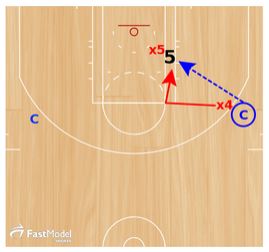
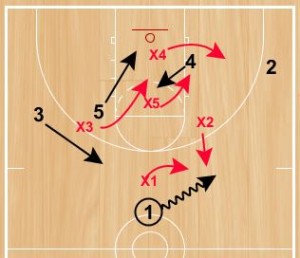
basketball-drills-post-double-pass-out1

Coach will make a post entry to the offensive player. As soon as the coach makes the post entry, the defender that is guarding the coach will sprint and touch the elbow, then sprint to double the offensive player.

On the catch, the offensive post player can attack right away before the double comes. If the offensive player is unable to score quickly before the double comes, they must retreat dribble out of the double team and complete a skip pass to the coach located on the weak-side wing.
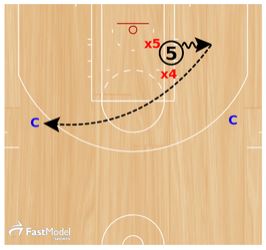
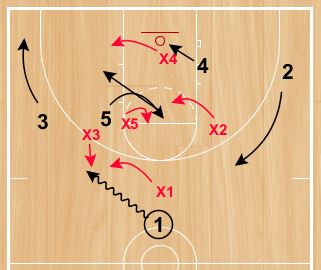
basketball-drills-post-double-pass-out2

After skipping the ball, the doubling defender will step off, while the offensive post will fight across the lane to re-establish position on the opposite block.

The coach with the ball will pass the ball to the offensive player whenever they call for it. On the catch, players will play live 1v1.
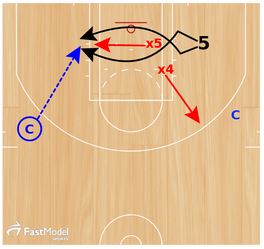
 

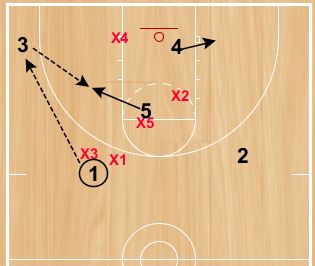
basketball-drills-post-double-pass-out3

If the offensive player scores, they will stay on offense and the doubling defender will become the defender, while the defender that just got scored on will become the doubling defender. If the defender gets a stop, they will move to offense and the offensive player will become the doubling defender, while the doubling defender will become the defender.
Coaching Basketball: 37 Tips for Assistant Coaches

By Brian Williams on April 28, 2015

Coach Bob Starkey is an assistant Women’s Coach at Texas A & M. He has an outstanding coaching blog that you should definitely add to your regular reading list: Hoop Thoughts. This post was originally posted on that blog.

High School coaches won’t be able to apply all of the points, but will still have some takeaways.

Tips for Assistant Coaches

by Bob Starkey

Two of my favorite people in the world of coaching (and two of the people in my coaching circle of influence) are Felicia Hall Allen and Greg Brown. Felicia has been a game changer for our profession with the development of A Step Up Assistant Coaching Symposium for men and women’s basketball coaches. She also is an amazing motivational speaker and excellent team builder. We utilized her at LSU and she made such an impact in our program that we annually voted her a recipient of our Final Four rings. Greg Brown is someone I have know for years in large part because of my relationship with Don Meyer who Greg worked for. In fact, I often tell people that Greg worked for Coach Meyer and Pat Summitt when they were the winningest coaches in all of college basketball. Greg is an excellent teacher and continual learner.

The two of them combined for this post this morning. Greg had sent this list from an article he read to Felicia and she then emailed out to her contact list. It is an outstanding list and I wanted to share it on our blog:

TIPS FOR ASSISTANT COACHES

1. Ultimately, your job is to make your head coach look good. Being a head coach is much more about being a CEO than an Xs and Os strategist. Yes, the head coach will get most of the credit, but they will also get all of the blame. Their job is to win, have a detailed vision and to be the leader. Your job is to help them execute their vision. It’s not your show, it’s the head coach’s show.

2. Understand and teach the game inside and out. Know how to attack opponent weaknesses, win with the players you’ve got, teach fundamentals and research and teach the best drills to prepare your position group.

3. Traits head coaches are looking for in assistant coaches: loyal, hard-working, reliable and trust-worthy. Being a great recruiter can help you get and keep a job.

4. Not everyone on the staff will get along—there will always be jealousy, personal differences, age differences but in order to win you must be able to put that aside to work with each other!

5. Coaching is a family—build your network. Outside of your head-to-head competitions, consider other coaches as your co-workers, not enemies. Build a strong network. You will rely on them heavily throughout career.

6. Best way to move up from where you are today into a new position? Be the best at your current position! Treat your role and current school as your dream job, and work like it’s where you’ve always dreamed to be.

7. Assistant coaches on your staff (or your opponents) can be in the position to hire you one day—you are building a track record with not just your head coach, but assistant coaches and opponents. Keep it professional and courteous.

8. Always bring a great attitude to work, even if you are having down days. Keep your personal issues to yourself, the team would never accomplish anything if every coach and player brought their personal issues to the facility or complained about all of their problems. Manage your personal life, address problems, get counseling if you need to!

9. Your players will mirror you. You want them to do it right and pay attention to detail—you must take the lead and see that you take the little details serious, too. Do what you say you will do. Follow through!

10. It’s never “I,” “me” or “mine,” instead use “we,” “us,” and “our.”

11. No detail is too minor for the head coach. If they want to be kept up-to-date on an issue, keep them in constant communication with a quick text, call or email.

12. Your position group, recruiting efforts and off-field responsibilities need to be your top priority. Do not get distracted by the fluff that goes along with the job. Focus on what you are being paid to do: develop players, graduate players, win games, represent the university and sign new players. If you feel like you can handle it, ask to take on additional responsibilities or create a new job responsibility that falls into one of those categories that will ultimately help your team win.

13. Become a great evaluator of talent—you need to learn how to find the hidden gems who aren’t gracing every recruiting Top 100 list. You need to be able to “find” great players before every other coach. Find the players who fit your needs, who have raw talent, who can be developed reasonably quickly, and who have great attitudes and toughness.

14. Remember—you are ALWAYS representing your boss and university.

15. Understand and value that EVERYONE in program has a role. Everyone has different strengths, everyone can contribute something different and critical: coaches, players, trainers, doctors, academic counselors, marketing staff, interns, students, boosters, maintenance staff, housing.

16. Think ahead, anticipate what’s next. What will your head coach need today/this week?

17. Self-evaluate and scout your team and position group. What weaknesses are returning? Evaluate top teams at those skills—how and why are they successful? What do they do exceptionally better? What drills can you use to help your players improve?

18. When evaluating players it’s critical you rule out players who will be a waste of time in terms of leading you on a wild goose hunt. Don’t spend all of your time recruiting players who will never get enrolled into your university, who won’t finish, who won’t be happy too far away from home, etc. If you know problems will arise down the road, it’s best to find other players who have less off-field issues. The risk isn’t often worth the reward.

19. Nothing is beneath you—all hands on deck. Be wise with your time and put most urgent priorities first! Develop players, graduate players, win games, sign new players.

20. Appearance is important—never know who you will run into. Your days will be long, the stress will be high—being in shape will help you fight the mental and physical battles. Be well groomed, well dressed and energetic.

21. How can you separate yourself—what value can you add to a staff? What can you become indispensable at? Scouting, recruiting, relationships with prep coaches, developing players, leadership?

22. Scout opponents as if your job depends on it—at some point, it will! The smallest of details can make the biggest of difference when it comes to game planning and having your players prepared.

23. Keep a daily to-do list with the same key areas that need your daily attention: situations to monitor (class attendance/study hall/grades of your players), things to do, people to call. Repeat, repeat, repeat with the attention that you expect of your players with their fundamentals.

24. Be organized—organization brings direction to chaos! A prepared player never flinches, nor do prepared coaches!

25. If needed, help communicate for your head coach. You may have to return calls for them, take on delegated responsibilities. Remember—your job is to make their job easier and to make them look good.

26. With recruiting—it’s not about what YOU want in a player, it’s about what your boss wants in a player. Can the recruit play for and be successful under this head coach? Will they clash or flourish? Recruit players who will fit your head coach’s personality and style.

27. If you lack experience or talent, you can overcome your weaknesses by being hardest worker who brings relentless energy—in the same way that you teach your players that “Hard work beats talent when talent doesn’t work hard.”

28. Be who you are and believe in who you work for.

29. Never doubt the head coach in front of players or other members of the staff. When the negative talk begins internally everyone’s job is in trouble. If there is an issue with the head coach, approach them directly.

30. Most head coaches are excellent in three areas—on-field teaching, off-field preparations and recruiting. Most assistant coaches are only good at one or two of these areas, sometimes just masters of one. You must develop strong skills in all three areas to become a successful head coach.

31. Help your players do something that’s never been done before, even if it’s a small accomplishment. Bigger accomplishments will come after you begin achieving smaller, more manageable goals.

32. Develop a good relationship with your player’s parents—communicate! They need to be your allies, not your enemies! Deal with issues before they become unmanageable.

33. Have a ‘no gossip’ policy with your spouse—they shouldn’t be the town gossip about team issues. Like you tell your players, ‘What happens in the locker room stays in the locker room.’ If they can’t keep issues quiet, limit what you share with them.

34. No money talk amongst other coaches—your salary is what you have agreed to and signed for. It is a cancer to constantly discuss money with other coaches on staff.

35. What would a scouting report on your own team/unit look like? Be brutally honest with yourself on which weaknesses your players need to improve on. Build on what they are really good at, show them how to get better!

36. Get to know your Athletic Director and Associate/Assistant Athletic Directors, they could be in position to hire you one day or give you a key recommendation.

37. Get to know athletic department staff—at some point you will need their help, they are ambassadors for your program! Their jobs are important, get to know everyone and let them know you appreciate them.

Basketball Plays 1-3-1 Zone Attack

By Brian Williams on April 27, 2015

Consider using this action as an entry into what you use to attack a 1-3-1 zone.

Submitted by Coach John Kimble
CoachJohnKimble.com

Retired high school and college coach

Follow him on Twitter @CoachJohnKimble

This Play is taken from the DVD “The Ultimate Library of Zone Offenses—Vol. 1: The LINES SET and the CORNERS Continuity Offense” and the book “The Basketball Coaches Complete Guide to Zone Offenses” published by COACHES CHOICE

Diagrams created with FastDraw

“BIG” (Thumbs Down) ENTRY (To the Right)

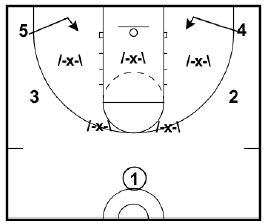
basketball-plays-big-entry1

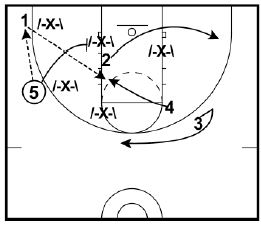
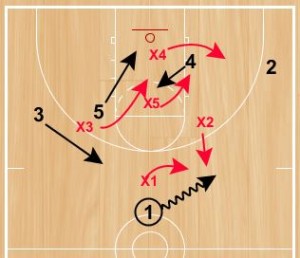
01 could dribble to either side with that side’s post player (04) posting up and the weakside’ post player (05) ‘diving’ to the rim. The ballside ‘corner’ (02) spots up in the deep corner & the weakside perimeter player (03) steps up to the high ‘elbow area.’

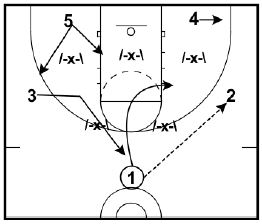
01 ‘freeze dribbles’ at X2’s outside shoulder, pulling X1 with him. To defend the “BIG” entry, X4 must decide on helping out on 04’s ‘duck-in’ cut or to cover 02 in the ‘deep corner.’ X5 must decide on whether to cover 04 down low or 05 diving to the rim. X3 must decide on cutting with 05 on his dive or stepping with 03 to the 3 pt. line. 01 reads either X3 or X4 & passes to the open teammate. All 4 other offensive players are possible options for the pass, depending on how the defense plays.

basketball-plays-big-entry2


Another option if the ball goes to O2 in the corner, he can look to O4 on the second cut.


“BIG” (Thumbs Down) ENTRY (To the Left)

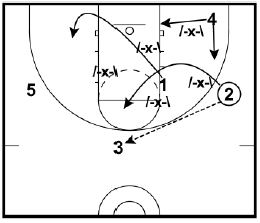
basketball-plays-big-entry3

This third diagram illustrates the same “BIG” play, but with 01 instead dribbling to the left side (or the high stack side) of the court. “BIG” dictates the new weakside ‘Big’ (04) is the player that makes the ‘lob cut’ to the rim, while the ‘SMALL’ player (02) is the player that now steps out to the high elbow area behind the arc for a possible 3 pt. shot. On the ballside, 05 ducks in while 03 flare-cuts to the ballside deep corner. 01 must read the defense & pass the ball accordingly. X2 must diagonally drop down to cover 04. 04 should have great ‘position’ advantages as well as height & strength advantages as a ‘Big’ over more than likely a perimeter defender in X2. If X2 somehow prevents 04 from getting the ball, 01 still could pass the ball to 02 out on top for a 3 pt. shot. 01 reads either X3 or X4 & passes to the open teammate. All 4 other offensive players are possible options for the pass, depending on how the defense plays.

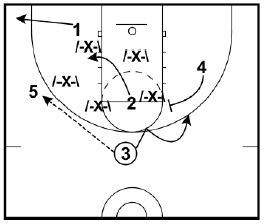
basketball-plays-big-entry4


Another option if the ball goes to O3 in the corner, he can look to O5 on the second cut.


About the Author

Coach Kimble was the Head Basketball Coaching position at Deland-Weldon (IL) High School for five years (91-43) that included 2 Regional Championships, 2 Regional Runner-Ups and 1 Sectional Tournament Runner-up. He then moved to Dunlap (IL) High School (90-45) with 2 Regional Runners-up, 1 Regional, 1 Sectional and 1 Super-Sectional Championship and a final 2nd Place Finish in the Illinois Class A State Tournament. He was an Assistant Basketball Coach at Central Florida Community College in Ocala, FL for 1 year before becoming Offensive Coordinator and then Associate Head Coach for 3 additional years He then was the Head Basketball Coach at Crestview (FL) High School for 10 years, averaging over 16 wins per season.

He has had articles published in the following publications such as: The Basketball Bulletin of the National Association of Basketball Coaches, the Scholastic Coach and Athletic Journal, Winning Hoops, Basketball Sense, and American Basketball Quarterly. He has also written and has had five books published along with over 25 different DVDs by Coaches Choice and Fever River Sports Production.

Evaluating Individual Defensive Players

By Brian Williams on April 24, 2015

Clinic Notes from:

I hope you might get a couple ideas to help teach and evaluate your individual defensive players. These ideas can be used whether you’re a man-to-man coach or a zone coach.

Rick Torbett from Better Basketball speaking on Better Basketball’s Dynamic Defense

Level 0 footwork

  • For example, rebounding footwork
    Rebounding near the basket is power base on power base.
    DNA “Dadgum Nasty Attitude”
    Rebounding away from the basket defensive rebounder’s shoulders perpendicular to offensive players shoulders. Check the player, arc them, pursue the basketball.
    Rebound like a quarterback with the ball and shoulder. Three points of contact, two hands and shoulder, it to protect the basketball

Level 1 Defender can guard the basketball and keep it out of the middle third of the floor.
Level 2 Defender can guard away from the ball and if a teammate gets beat on the dribble level two defender can help keep the ball out of the middle third of the floor.
Level 3 Defender can guard situations which might include ball screens, switching, rotating, among others
Level 4 defender can help everyone recover back to their original assignments

The middle third of the floor is called the highway.
The outside third of the floor is called the arc alley.
Guarding the ball is a handshake distance-conversation distance.
Close talker is in my space and making the ball uncomfortable. They play inside the offensive player’s bubble.
Teach players to cut off the middle third of the floor with their hips not their head and recover back to the offensive player’s bubble.

Terminology
Forces twilight = player with the ball can half see and half not see.
Noon = player with the ball can see clearly.
Midnight = player with the basketball can’t see the floor at all.

Great Level 1 Defender

  • Is a close talker, takes away the wrist shot drive and pass.
  • Forces midnight=the offense can see the floor.
  • Takes away triple threat position.
  • The offense can’t open at the defensive player’s hips

Good Level 1 Defender

  • Plays at a conversation distance away from the player with the basketball.
  • Bothers shots, but does not take them away.
  • Deflects passes.
  • Stops drives after one dribble.
  • Can arc the ball to the half line and doesn’t need help.

OK Level 1 Defender

  • High talker (needs to play further off the ball than a close talker or a conversation distance
  • Can’t force anything.
  • Put and OK level 1 defender on a catch and shoot only player.

Still completions for level one defenders

  • Arc the ball outside
  • No baseline drives
  • On a dead dribble, eat space
  • Interrupt rhythm dribble pull up shots
  • Dominate 1 on 1 in the highway
  • Draw charges, 4 inch fall in the direction of the drive

Level 2 Defender Responsibilities

  • Level 2 defender plays in space.
  • Intercept passes and recover
  • Establish a position to:
    • Help outside the highway
    • Stop the ball from being shot
    • Meet and greet cutters in the lane
    • Quickly recover to level 1 position when the player you are guarding receive a pass
    • Adjust positions on every pass
  • Goal is to guard 2/3 of the court, keeping the ball from going back into the highway (middle 1/3 of the court), while offensive actions are taking place, without having to switch.
  • Fulfill all responsibilities deep into a long possession
  • Cause skirmishes that create doubt in the ball handler’s mind

Every time there is one closeout, there should be 4 others.
The help behind the closeout is critical

On correcting mismatches or rotations—defense must find and cover the open player before the offense does.

Click here if you are interested in learning more about Coach Torbett’s Dynamic Defense System

5 D’s of Zone Offense

By Brian Williams on April 23, 2015

These 5 Zone Attack Principles are taken from Coach Brian Rea’s Ultimate Motion Offense eBook. I hope there are some ideas that you can use to help clarify or teach your

THE 5 D’S OF ZONE OFFENSE

1) DICTATE 2) DETOUR 3) DIAGONAL 4) DRIBBLE 5) DON’T STAND

Three Zone Defenses we work to prepare for are the 2-3, 1-2-2 and 1-3-1. We change very little between our
Man Offense and our Zone Offense, and by doing this we maximize our practice time offensively while
minimizing what our players have to remember…So instead of “Paralysis by Analysis”, we try to build
“Incredible Prep through Infinite Reps”! Here are the adjustments / keys that we work on to turn our Man
Offense into a Deadly and unscoutable Zone Attack:

1) Dictate

We always want to “Dictate” where the defense has to defend us…not the other way around. If we can get the rotations that we want by the movement we use, we can “Dictate” where the defense will go and in turn get the shots we want and have practiced and planned for.

2) Detour

On our “1” cuts (Basket Cuts), we now look to take a “Detour” from our path to the basket and find a gap to sit in for a 2-Count. We want to play behind the backs of the defense, sit low, show hands, and attack from the inside. Once our 2-Count “Detour” is over, we look to get back on path of our “1” cut and fill open spaces. (on the perimeter)

3) Diagonal

We are always looking “Diagonal” against any zone defense. Once the ball is caught, our eyes should go directly to the rim to see “detours” and search for open “Diagonals”. By using this method, we move the defense more and create confusion that leads to breakdowns during the possession.

4) Dribble

Within our Man Offense, we prefer to keep dribbles to a minimum…but, within our Zone Offense we want to attack gaps
with the dribble and draw two defenders. If we can draw two defenders, we put the defense at a disadvantage and use
“Diagonals” and the extra pass to get easy shots.

5) Don’t Stand

That’s it…”Don’t Stand”…We don’t want a stagnant offense that is easy and predictable to guard. We want to make the defense work, chase, rotate and defend in a way that they have not practiced nor are prepared for. We try to use this theory…”When in doubt and you find yourself standing…FLASH”!

Diagrams created with FastDraw

basic-zone1


These five diagrams are basic sample movements of the five principles


basic-zone2


Find gaps to “Dictate” and counter defensive positioning, use “Detour” cuts to sit in the heart of the defense, Look
for open “Diagonals”, Attack gaps with the “Dribble” to draw multiple defenders, and “Don’t Stand”!


basic-zone3JPG

It doesn’t matter what formation / alignment you are in when it comes to our Zone Motion.

The key is that players are drilled to recognize the defensive formation and counter it!

The important part of Zone Offense is not what you do to start, but how you get to the finish…and easy / open shot.

basic-zone4


By teaching the 5 D’s and drilling them along with the Man Offensive actions, we create confident and intelligent players who continue to search for quality scoring opportunities regardless of the defensive strategy.

That is the beauty of this system…There are limitless possibilities, very few mistakes that can be made, transferrable skills from Man to Zone, numbered cuts and specific terminology, and a freedom to make plays within the scope and guidelines of the offense.

basic-zone5

It’s not an Offense… IT IS OFFENSE!

These 5 Zone Attack Principles are taken from Coach Brian Rea’s Ultimate Motion Offense eBook. I hope there are some ideas that you can use to help clarify or teach your  zone attack.

Post Player Skill Development Drills

By Brian Williams on April 22, 2015

Today’s post includes five ideas for drills to use in the spring and summer with any of your players that you count on to score in the low post area.

Or, you can file them and save them to use in your skill breakdown drills during practice next season.

I found the drills on an old Xavier University newsletter.

You can see the archives of all of their old basketball coaching newsletters at this link: Xavier Newsletter Archives

If you can’t use the exact drills, hopefully you can modify them to fit your needs.

There are some other links to other skill development drills in the Related Links at the end of the post.

Diagrams created with FastDraw

Perfect Form Jump Hook

basketball-drills-xavier-post1

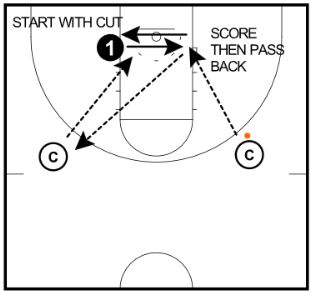
Post Player 1 cuts from the wing and receives a pass from a coach at SPOT 1.

The post player must shoot a perfect jump shot, rebound. and pass back to the coach.

Repeat at SPOTS 2, 3 and 4.


Post Move Rundown

basketball-drills-xavier-post2
Post Player 1 begins on the weak side block and flashes hard across the key to the ball side block.

Post player calls for the ball and gets a pass from the coach

Post Player then must execute one of the following moves, then pass back out to the coach and cut again to the opposite side.
 
1) Jump Hook 2) Drop Step 3) Turn around J 4) Up and Under. After 4 shots rotate to another player.

Bump and Roll Shooting

basketball-drills-xavier-post3

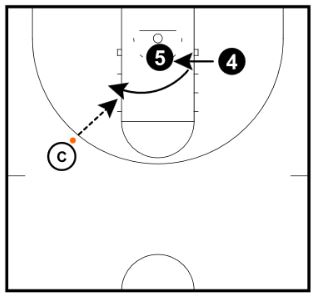
Post Player 4 cuts across the lane and bumps into Post Player 5.

4 must roll or pivot off of the contact to an open area.

At that point he must catch a pass from the coach, make a move or take a jumper.

Rotate players after each shot.

Continuous Sealing

basketball-drills-xavier-post4

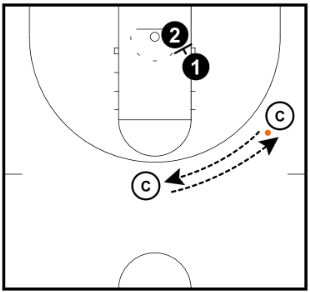
Once Post Player I has a seal on Post Player 2, the ball is passed from one coach to the other.

Post Player 1 must reseal, and hold the seal the entire time. After 5 passes. the coach can feed the post.


Post Sealing Dril

basketball-drills-xavier-post5

Have two coaches on either foul line extended, and two post players on both blocks.

The ball side post player will go after the off side post, attempting to seal him by putting his lead leg between the legs of the defender.


When he has sealed player 2, player 1 must call for the ball.

When the ball is reversed, player 2 goes after Player 1 trying to seal.

When sealed, he calls for the ball.

The coach enters the ball to player 2 who catches and makes a scoring move.

  • « Go to Previous Page
  • Page 1
  • Interim pages omitted …
  • Page 156
  • Page 157
  • Page 158
  • Page 159
  • Page 160
  • Interim pages omitted …
  • Page 288
  • Go to Next Page »

Primary Sidebar

  • Twitter
  • Facebook
  • Linkedin
coachestoolbox
personaldevelopmenttoolbox
basketballplayerstoolbox
basketballtrainer
athleticperformancetoolbox
coachingbasketball

© Copyright 2026 Coaching Toolbox

Privacy Policy