• Skip to primary navigation
  • Skip to main content
  • Skip to primary sidebar

  • Basketball Plays
    • Ball Screen Sets
    • Horns Sets
    • Man to Man Post Up
    • Man to Man Isolations
    • Backdoor Plays
    • Man to Man 3 Point Shot Plays
    • 2-3 Zone Attack
    • Baseline Inbound Plays
    • Sideline Inbound Plays
    • Combination Defense Attack
  • Drills
    • Defensive Drills
    • Offensive Drills
    • Competitive Drills
    • Passing Drills
    • Rebounding Drills
    • Shooting and Scoring Drills
    • Toughness Drills
    • Transition & Conversion Drills
    • One on One Drills
  • Blueprint
  • Practice
  • Mental Toughness
  • Skill Development
  • Offense
  • Defense
  • Store

Coaching Basketball: Defending the 3 Point Shot

Coaching Basketball: Defending the 3 Point Shot

By Brian Williams on July 22, 2015

This post is a compilation of some analytics information that supports the belief that the best three point defenses limit the number of three point shots that their opponents shoot and essentially are not consistently effective at forcing low three point percentages by their opponents.

These ideas are from Army Men’s Assistant Zak Boisvert’s blog PickandPop.net. I have included a link to the specific article at the bottom of this post.

Whether you agree or disagree with that assertion, it is worth taking a look at some of your team’s stats over the past few years as well as doing some research online. Then, examining how that equates to your defensive philosophy, what practice drills you do to emphasize that philosophy, and your defensive rules.

Ken Pomeroy (www.kenpom.com) studied the correlation in Men’s Division I basketball from the 2010-11 season to the 2011-12 season for the four following categories:

The correlation is based on where each school ranked among all other schools in each category for the two years studied.

(The closer the correlation is .000 there is no relationship–high ranking one year, low the next. If the correlation is 1.00 that means that team would be ranked #1 in that category two years in a row.)

Opponent 3 Point Shooting Made Percentage. .204
Opponent Free Throw Percentage .266
Opponent Two Point Shooting Percentage .558
Opponent Three Point Attempts (Of all Field Goals Attempted) Percentage .575

The Free Throw Percentage “Allowed” had a higher correlation from year to year than did the 3 Point Field Goal Percentage Allowed, indicating that a team’s ability to force low three point percentages varies greatly from season to season and game to game. It also provides evidence that teams can affect their opponent’s two point shooting percentage as well as their percentage of three point attempts to overall field goal attempts more effectively.

Source “The Badgers Defensive Secret” espn.com (Ken Pomeroy)

Pomeroy did another analytical study of three point defense between 2009 and 2012 in men’s NCAA Division I Basketball. He looked at the averages of the worst 20 and best 20 teams in terms of 3 point percentage allowed for games played after December 4 each season.

Again, this is only games after December 4, so the early season non conference games are not included.

Best 20 Worst 20
2012-13 34.8% 32.9%
2011-12 34.6% 33.3%
2010-11 35.4% 34.0%
2009-10 34.3% 34.2%
Avg 34.8% 33.6%

Pomeroy has made the following observations from the data he collected:
Source (http://kenpom.com/blog/index.php/weblog/entry/3_point_defense_should_not_be_defined_by_opponents_3p)

1) Three point percentage allowed is “significantly more noise than skill.” However, it is not accurate to say that the defense has no impact on an opponent’s three point percentage. It is just that the impact is very limited.

2) “When someone discusses three-point defense in terms of three-point percentage, they might as well make the leap to discuss free-throw defense in similar terms. Teams have much more control over how many three’s their opponents shoot than how many they make.”

3) “Both free-throw defense and three-point defense exist, but it’s much better measured in the amount of shots taken and not in the noisy world of the percentage of shots an opponent makes.”

Some of the thoughts I have collected that have influenced my thinking on defending three point shots are:

1) Dick Bennett’s belief that over the course of a game, you can only do two of these three things consistently well– 1) Deny 2) Help 3) Recover. His belief was that if you deny and help, it is difficult to recover to three point shooters. If you want to be able to recover to shooters, you can’t start out in a total denial, but rather in gaps ready to help, then recover.

2) Statistical research has also shown that shooting percentage on challenged shots is lower than shots that are not challenged. Most teams work to get open three point attempts that are not able to be challenged. If we can be in position to recover to shooters (makers) to be able to make an impactful challenge, then we are likely to discourage an attempt in most cases.

3) Like anything else, to do it consistently well in games, it has to be a repeated emphasis in practice. Here is a link to a drill to work on taking away three point shots: 4 on 3 No Threes

4) Teams have the best effective field-goal percentage on shots in the restricted area and on three point shots. If it is difficult to affect three point percentage, we should work on taking away three point shots and forcing two point jump shots.
3 Competitive Shooting Drills

By Brian Williams on July 21, 2015

Some competitive shooting drills with some conditioning that hopefully you might be able to use in your pre-season program.

These drills are from Coach Justin Remington’s Moreno Valley High School Summer Shooting Program.

He is also a basket instructor for PGC Basketball.

His Twitter feed is @Coach_JRem


Diagrams created with FastDraw


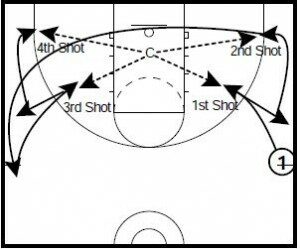
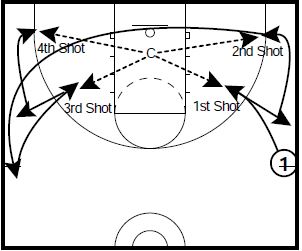
16 Shot Shooting

basketball-drills-16-shot-shooting

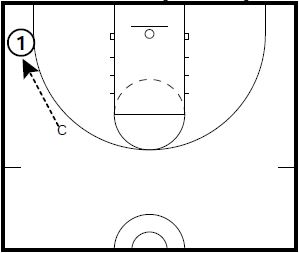
1 starts at coaches box/sideline and sprints into a wing 18 foot jump shot …

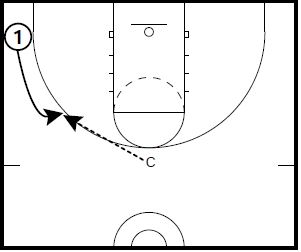
1 back pedals 3 times and sprints into a corner three pointer.

1 sprints through the key to opposite corner back up to the coaches box/sideline and turns and sprints for an 18 footer from the wing

1 backpedals three times and then sprints for a corner 3

*Repeat this pattern until player has shot 16 shots.

***To make it competitive put a time limit on it and a number of makes that they should have…

Ladder Drill

basketball-drills-ladder-shooting1

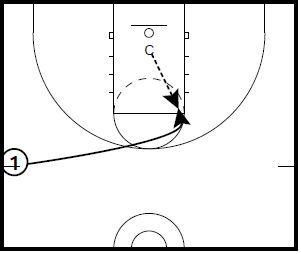
Player sprints from sideline to opposite elbow and catches a pass from the coach for a shot.


basketball-drills-ladder-shooting2

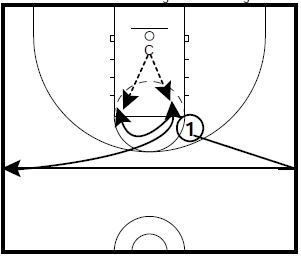
After the first catch and shoot:

Player touches near sideline and then MUST sprint across the floor to opposite sidelines and then come back for elbow jumper again (from same spot as first frame)

After that jumper (since she has touched 2 sidelines she gets two elbow shots in a row). She must arc to the pposite elbow for a second shot

basketball-drills-ladder-shooting3

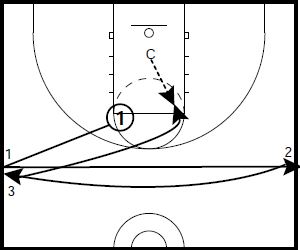
After the second shot:

The player sprints t o near side sideline then to the opposite sideline, then back to the other sideline, then she can sprint to the elbow for a shot…

Since the player touched the sideline 3 times now she must shoot three alternating elbow jumpers before going on to the next stage of the ladder

basketball-drills-ladder-shooting4

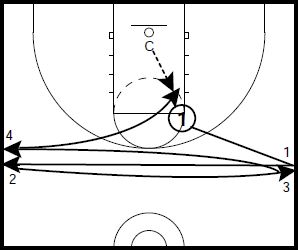
Now the player goes sideline to sideline 4 times.

Then she goes to the elbow for elbow to elbow shots. She gets four elbow shots…

Continue this drill to 5 sideline touches and 5 elbow to elbow shots.

***Once they get in shape work your way back DOWN the LADDER… 5, 4, 3, 2, 1…

***Players w i l l get extremely fatigue during t h i s drill. Stress consistency in footwork and in follow through as well as not allowing them to drift on their shots…

Round of Threes

basketball-drills-rounds-threes1

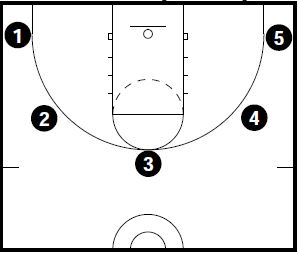
5 shooting spots around the perimeter for this drill

The player will have to make two threes each spot first time around before moving on to the next spot

After completing all five spots the player will make their way back around the perimeter only having to make one this time to move on.

Look at the other frames to see where the coach is passing from. (it is wise to have a rebounder or manager getting rebounds in all of these shooting drills)

basketball-drills-rounds-threes2

Teaching Points from the Corner:

1. I stress Open Hips to the passer (to step into your shot), so in the left corner the player would have their left foot facing the basket (five toes to the basket) and their right foot open so that the shooter HIPS face
the passer. Coach will pass the ball to 1. One brings right foot forward, square up, and shoot.

basketball-drills-rounds-threes3

After making two shots at the first spot the player will run into the next shot at the wing. Here she must make two as well.

Teaching Points:

1. Footwork on the move from corner to wing is left foot (inside foot) first to square you right foot comes around

2. When they are stationary footwork is the same as in the corner

basketball-drills-rounds-threes4


1 runs from wing to TOK

For the OPPOSITE SIDE coach should mirror what where they passed the ball from

***Remember AFTER the complete two makes from each spot they MUST come back around the perimeter and make one shot
each spot before moving on

End of Game/Qtr Need 3

By Brian Williams on July 20, 2015

These two inbounds plays came from the FastModel Sports Basketball Plays and Drills Library.

The site has thousands of drills and plays that have been submitted by basketball coaches from around the world.

The first play is an under the basket inbounds play, the second is a side out play.

You can also find out more about FastModel Play Diagramming software by clicking this link: FastDraw

Contributed by Brandon Mullis, Ragsdale High School in Jamestown, NC

This is a last second play that can also be used at the end of quarters in high school.

One of our opponents ran this BLOB to perfection against us a couple seasons ago.

We did not defend the action very well and gave up the open shot in the corner to lose by one point.

BLOB

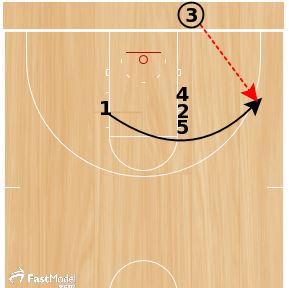
basketball-plays-eog2


1 comes off the triple stack to receive the inbounds pass at the low wing/corner from 3.


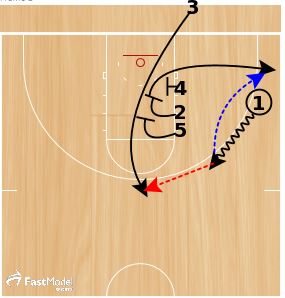
basketball-plays-eog3

1 dribbles toward the top of the key while 2 and 5 move to middle of the lane to set staggered screen 3.

As soon as 3 clears 2, 2 curls around 4’s screen to the corner.

1st Option: 1 passes to 3 for the shot near the top of the key, coming off the double staggered screens from 2 and 5.

2nd Option: 1 reverse pivots and passes to 2 in the corner for the shot, coming off the screen from 4.

Wizzards Curl Hammer SLOB

Submitted to FastModel by Kyle Gilreath,

This play that the Washington Wizards ran at the end of Game 4 in the 2015 Playoffs against the Hawks for Paul Pierce is one of my new favorites. It is very simple yet extremely effective as a misdirection.

basketball-plays-eog1

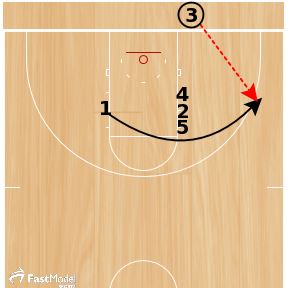
2 (Beal) curled off a stagger from 3 (Pierce) and 1 (Wall).

After receiving the inbounds pass, 2 dribbled to the baseline as 5 set a hammer screen for 3.


Attacking a 1-3-1 Defense

By Brian Williams on July 15, 2015

Here are some thoughts on attacking a 1-3-1 defense.

My hope is that you can get an idea or two to add to what you currently use to attack a 1-3-1.

Or, that it at least gets you to put some sustained thought to what you are doing now and how you could do it better.

The video was put together by high school hall of fame coach and current college assistant coach, Doug Schakel.

The video is a You Tube video, so please make sure that the server you are using allows You Tube access.

The video is about 22 minutes long. You will need to click the play arrow to start it.

Leadership Notes for Basketball Programs

By Brian Williams on July 14, 2015

These are a few of my takeaways from my latest reading on Bob Starkey’s HoopThoughts. If it is not on your regular reading list, I recommend to add it. There are great articles on all aspects of coaching basketball.

From his articles on Kevin Eastman

Special players hold themselves accountable…

…don’t blame others first; instead, they look first for what they contributed (or did not contribute) to the situation.

…don’t complain; instead they look for ways to correct things that aren’t working.

…don’t procrastinate; get things done now.

…always give more than they ask of others.

…always look to take on as much as they can handle, rather than look to pass things on to others all the time.

…are constantly trying to improve their game as they can bring more to the team and constantly fulfill their role.

…are self starters and study the game (and themselves) enough to know what needs to be done; then do about doing it.

…do the un-required work, knowing that it simply needs to be done — extra shots, extra weights, extra film watching, etc. without constantly needing to be told by a coach.

…hold others accountable for their jobs and roles because they know the importance of accountability as it relates to winning; this creates a collective responsibility.

…always be among the most trusted players on the team — by coaches and players.

Characteristics a coach needs. One or more are characteristics that I think may be overlooked.

1. Respect -­‐ I believe that the greater respect the coach commands, the easier it is to ensure buy-­‐in from his or her players. And the more often you can get your team to buy in, the more you’re going to see them do what you want them to do. I’ve always tried to gain respect by outworking others in the business and trying to learn as much as I can at the place and position I’m in. Work ethic and this continuing search for knowledge have been keys to my ability to gain respect.

2. Relationships -­‐ I believe relationships are the foundation for success in any field. As a coach, you need to get to know your team, get to know about your team, talk to your players in good times and bad, let your players know you care about them, and develop a trust with your players.

3. Curiosity -­‐ It seems to me that the most successful people in any business have an insatiable intellectual curiosity about their field. They talk to the best in the business, they read about others, they listen to CDs and DVDs, they want to know what the best are doing and how it can relate to them and their programs, and they are curious to know what you know and how it can fit in to enhance their program or business.

4. Ability to motivate -­‐ Motivation is an aspect of coaching that requires coaches to constantly “read” what’s needed for their team and any given player on a daily basis. It also requires a great deal of thought and study in order to find new ways to accomplish these tasks. Find out what makes a player tick and then create ways to motivate him to get the most out of him each day. And be able to recognize when it’s a new day that needs a new motivator -­‐-­‐ even for the same player who responded yesterday!

“No matter how much we know on any subject, there’s always more to learn. Make the time to read, to study, and to think; each of these is important to your development. We all need to keep up with what’s going on in our field, too. I’ve found that news and magazine articles can be as helpful as books in this regard. The key is to keep searching so that you stay gain knowledge, improve, and stay relevant!”

Coaches expect and demand things of our players — especially those things they can control like attitude, effort and intensity. And then he talked about how we must demand it of ourselves first:

1. Coaches must maintain their intensity everyday.
2. A coach can never get bored.
3. The intensity that a coach brings to the floor helps the player have a more intense workout.
4. Coaches have body language too. Be careful of your body language, and how it could be interpreted by your players.

From Jack Clark, Cal Rugby Coach
(From an article written by Jen Sinkler)

“You and I could go to the sports page today and open it up and see some sports team calling themselves a family. It’s what everyone does nowadays — they call themselves a family. In reality, it grates on me a little bit because my concept of family is unconditional. There’s my screw-up brother down in Huntington Beach. I love him, but you don’t want him on your team, I promise you. Family means unconditional, whereas high-performance teams are highly, highly conditional organizations.”

“I think what matters most — outside of talent — would probably be the culture of the team: developing a really resilient, embedded team culture around performance. It’s like anything else: You’ve got to rep it. You’ve got to talk about it on day one and day five and in the middle of the season and at the end of the season.”

I think this is an underrated and overlook part of culture. I once heard Doc Rivers say, “You have to protect your team culture. This battle is waged daily.”

In other words, culture, to be successful must be intentionally thought out, planned and executed by all those involved

“We believe in constant performance improvement. We say it’s not just enough to win. That’s kind of an old thing. If you go back to legendary basketball coach John Wooden’s Pyramid of Success, you can get some performance over results. It’s there. We believe that and we believe that we should be getting better. We think that we should accept that burden. If we’re going to work at this as hard as we’re working at it, then we should be getting better from week to week, month to month, match to match. There should be improvement.”

Basketball Plays 12 Hook Flash C Screen In Blocker Wing

By Brian Williams on July 13, 2015

A quick hitting set to run against a 2-3 zone defense to get a 3 point shot.

Houston Women’s Assistant Coach Vonn Read has submitted several plays from his playbook series The Basketball Encyclopedia of Plays to the Coaching Toolbox.

You can also see more of his plays in the Related Posts links at the bottom of this post.

Vonn has also served as an assistant coach in the WNBA with the Phoenix Mercury, Orlando Miracle, and San Antonio Silver Stars. He was an advanced scout for the Orlando Magic as well as The Charlotte Sting.

Diagrams created with FastDraw

12 Hook Flash C Screen In Blocker Wing

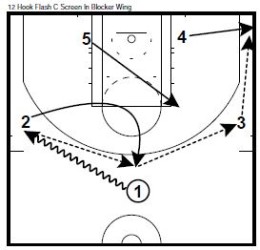
basketball-plays-12-hook-flash1

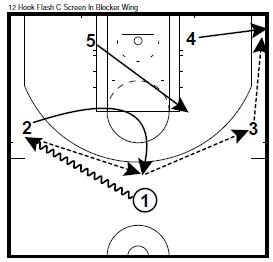
This is a good Zone set for a 3-Pointer.

The 1 player will dribble entry to the wing, with the 2 player (Shooter) making a shallow cut to the top.

The 1 player will pass the ball to the 2 player, then to the 3 player, and then to the 4 player in the corner.

The 5 player will flash to the elbow when the ball is passed to the 3 player.

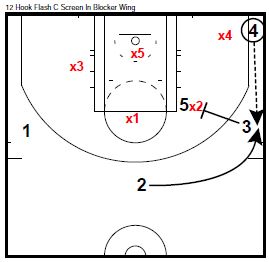
basketball-plays-12-hook-flash2

After making the pass to the 4 player, the 3 player will screen in X2 at the elbow area.

The 2 player will cut behind the screen to the wing for the 3-point shot.


Coach Read has also put together The Basketball Encyclopedia of plays. You can check them out here: The Basketball Encyclopedia of Plays or read more about the books:

Any coach looking for the latest and innovative plays from the Professional, College, or High School levels can stop looking. With a compilation of over 7,700 different plays, you will never need to purchase another basketball playbook again. These playbooks can be used as a great reference tool for years to come. This 2 Volume Book includes plays from 19 different play categories, and they are the most extensive playbooks on the market.

The Basketball Encyclopedia of Plays (Platinum Series) contains over 7,700 Plays (Both Volumes combined) from the NBA, WNBA, USBL, and College levels from someone who has worked as an Advanced Scout or Coach on each level!!! This book has been intensely compiled over the last 21 years, with plays taken from a lot of NBA Coaches (past and present), WNBA coaches, and College coaches (Men’s and Women’s) from around the country.

Any coach that is serious about improving their knowledge of the game from an X and O standpoint will benefit tremendously from these books. These Books can be used to discover New Quick hitters, add a New Package to your playbook, or develop an entire Offensive System. There are a lot of new ideas and concepts in these books to study, and the Basketball Encyclopedia of Plays can be a great resource for coaches on all levels!!! This book is definitely for those X and O junkies who are always looking to improve as a Coach.

“THE GAME IS ALWAYS CHANGING? ARE YOU?” Vonn Read

Here is the link: The Basketball Encyclopedia of Plays

  • « Go to Previous Page
  • Page 1
  • Interim pages omitted …
  • Page 148
  • Page 149
  • Page 150
  • Page 151
  • Page 152
  • Interim pages omitted …
  • Page 288
  • Go to Next Page »

Primary Sidebar

  • Twitter
  • Facebook
  • Linkedin
coachestoolbox
personaldevelopmenttoolbox
basketballplayerstoolbox
basketballtrainer
athleticperformancetoolbox
coachingbasketball

© Copyright 2026 Coaching Toolbox

Privacy Policy