• Skip to primary navigation
  • Skip to main content
  • Skip to primary sidebar

  • Basketball Plays
    • Ball Screen Sets
    • Horns Sets
    • Man to Man Post Up
    • Man to Man Isolations
    • Backdoor Plays
    • Man to Man 3 Point Shot Plays
    • 2-3 Zone Attack
    • Baseline Inbound Plays
    • Sideline Inbound Plays
    • Combination Defense Attack
  • Drills
    • Defensive Drills
    • Offensive Drills
    • Competitive Drills
    • Passing Drills
    • Rebounding Drills
    • Shooting and Scoring Drills
    • Toughness Drills
    • Transition & Conversion Drills
    • One on One Drills
  • Blueprint
  • Practice
  • Mental Toughness
  • Skill Development
  • Offense
  • Defense
  • Store

Basketball Plays: Bo Ryan Corner Pass Ball Screen

Basketball Plays: Bo Ryan Corner Pass Ball Screen

By Brian Williams on July 30, 2015

This man to man play comes from the Wisconsin/Maryland Scouting Report assembled by Bo Ryan.

This week’s featured eBook bundle is Trey Watts’ Versatile Swing Offense combined with Scott Peterman’s Zone Offense and Defense notes eBook.

Click for more info:  Swing and Zone Offense and Defense

If you have any questions about the Playbooks, please feel free to email me or call/text me at (317) 721-1527.

Diagrams created with FastDraw


Bo Ryan Corner Pass & Ball Screen
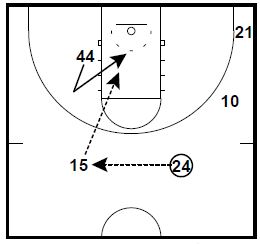
bsketball-plays-ryan1

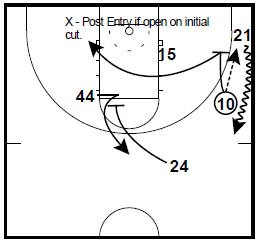
24 passes to 15.

44 cuts high and then back cuts to the rim.

15 can pass to 44 if he is open.
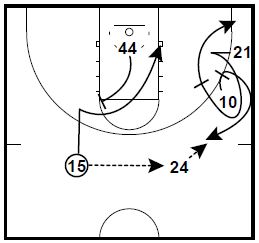


bsketball-plays-ryan2

15 passes to 24.

10 sets a down screen for 21. 21 sets a down screen on 10’s defender. 10 curls off the down screen.

24 passes to 10.

44 sets an elbow screen for 15. 15 cuts to the right low block.

10 passes to 15 if he is open.
bsketball-plays-ryan3

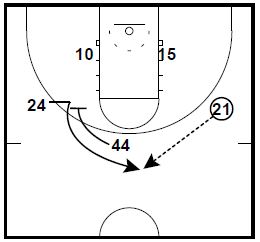
10 passes to 21 and sets a ball screen for 21.

10 will roll to the opposite block.

21 can pass to 10 on the X-Post cut if he is open.

24 sets a down screen for 44.

44 pops to the top of the key.
bsketball-plays-ryan4

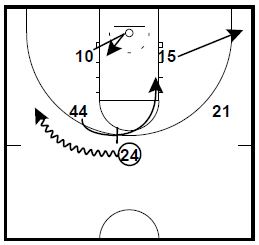
44 turns and rescreens for 24.

24 pops to the top of the key.

21 passes to 24.


bsketball-plays-ryan5

44 sets a ball screen on 24.

24 attacks the left wing.

10 dives into the post.

15 slides to the right corner.

44 rolls to the right low block.

This week’s featured eBook bundle is Trey Watts’ Versatile Swing Offense combined with Scott Peterman’s Zone Offense and Defense notes eBook.

Click for more info:  Swing and Zone Offense and Defense

If you have any questions about the Playbooks, please feel free to email me or call/text me at (317) 721-1527.
Attacking a 1-2-2 Defense

By Brian Williams on July 29, 2015

This video with some ideas for attacking a 1-2-2 or 3-2 zone defense is a follow up to a similar post from a couple of weeks ago on attacking a 1-3-1 zone defense.

My hope is that you can get an idea or two to add to what you currently use to attack a 1-2-2 defense.

Or, that it at least gets you to put some sustained thought to what you are doing now and how you could do it better.

The video was put together by high school hall of fame coach and current college assistant coach, Doug Schakel.

The video is a You Tube video, so please make sure that the server you are using allows You Tube access.

The video is about 22 minutes long. You will need to click the play arrow to start it.

Coaching Basketball: Get Beyond the Culture Cliche

By Brian Williams on July 28, 2015

Building a substantive, lasting culture in your program begins with team leaders and creating common experiences.

Author Quin McDowell, founder of AreteHoops.com

Players naturally gravitate into smaller groups within your program — your job is to make them want to spend time as one unit.

“Culture” is a buzzword in basketball circles today. As coaches, we need to go beyond buzzwords though and dig deeper at how to forge a winning identity.

Put simply, your team lives and dies by the culture it creates. The benefits of culture are obvious: togetherness, selflessness, chemistry and continuity are the intangibles you want to foster.

It’s not easy at the high-school level due to yearly turnover and players spread across three teams (freshman, junior varsity, and varsity), but you can do it by following these three steps.

1 Create Collective ‘Buy-In’

When embarking on a team-culture mission, begin with a list of core-identity values, which remain consistent from year to year (i.e. hard work, toughness, excellence). Then, you need 100 percent “buy-in” from your team leaders so they take an ownership of these values and pass them along to their teammates.

To create “buy-in,” sit down with your leaders before or early in the season and have them develop a list of standards reflecting the core values. An example is if a value is “toughness,” then a corresponding standard is “do not allow offensive rebounds.” Encourage the team leaders to come up with a visual reminder of the standards, such as a poster to hang in the locker room — and have all team members sign it so they take some ownership as well.

At this point, the leaders enforce this standard. If a player at practice misses a boxout and allows an offensive board, the player completes 10 pushups. While you are the team’s rule maker, it’s the team leaders who are most effective in upholding standards.

2 Create Mentor Relationships

Culture only grows when the team comes together as one. Sure, it’s natural for players to segment into their own groups (age, ability) but work hard to encourage cross-pollination among all team members.

Start with the older players. Assign your more experienced players a “little buddy” within the program. While mentoring is important, make this relationship competitive as well as the younger player attempts to earn respect. Have a shooting competition pitting veterans against their little buddies.

Have older players show they care about the next generation by forming a tunnel and banging fists with JV players as they exit the locker room just before a game.

3 Create Memories

Shared experiences bring teams closer and begin to build a tradition in your program as stories are passed from one
generation to the next.

Take a camping trip. Plan an “amazing race” around campus. Go bowling. Have a pie-eating contest after practice. Study your team’s personality and go with experiences not seen as corny or forced.

Creating memories (particularly ones off the court) allow for nuanced relationships to develop, which makes for a stronger team and more dynamic culture.

Basketball Plays Flat 54 Slip 54

By Brian Williams on July 27, 2015

This is a good layup slip play from a Flat UOB Set…

Houston Women’s Assistant Coach Vonn Read has submitted several plays from his playbook series The Basketball Encyclopedia of Plays to the Coaching Toolbox.

You can also see more of his plays in the Related Posts links at the bottom of this post.

Vonn has also served as an assistant coach in the WNBA with the Phoenix Mercury, Orlando Miracle, and San Antonio Silver Stars. He was an advanced scout for the Orlando Magic as well as The Charlotte Sting.

Diagrams created with FastDraw


Flat 54 Slip 54

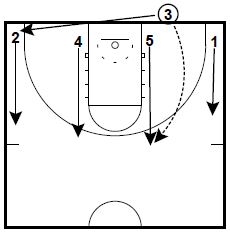
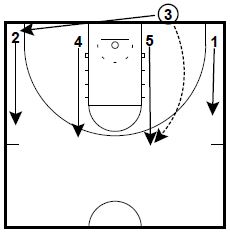
basketball-plays-flat-54

The 5 player will pop back for the pass from the 3 player.

All the other players will pop back high to set up the action.

3 Player will cut to the corner after inbounding to 5.


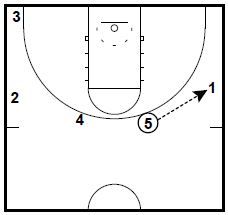
basketball-plays-flat-542

The 5 player will quickly pass the ball to the 1 player on the wing.


basketball-plays-flat-543

After making the pass to the 1 player, the 5 player sprint to the wing to set the screen but instead slips to the basket for a layup.

Good vs. Hedge Defense!!


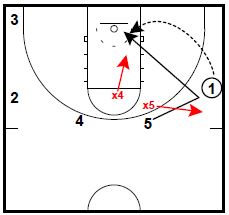
basketball-plays-flat-544

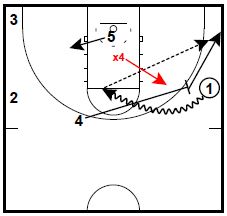
If the slip is not available, the 4 player will follow right behind the 5 player to set the ball screen.

Good pick and pop action or easy jump shot for the 1 player if X4 helps on the slip action.

(Could also create some movement between 2 and 3 to keep their defenders occupied.

Coach Read has also put together The Basketball Encyclopedia of plays. You can check them out here: The Basketball Encyclopedia of Plays or read more about the books:

Any coach looking for the latest and innovative plays from the Professional, College, or High School levels can stop looking. With a compilation of over 7,700 different plays, you will never need to purchase another basketball playbook again. These playbooks can be used as a great reference tool for years to come. This 2 Volume Book includes plays from 19 different play categories, and they are the most extensive playbooks on the market.

The Basketball Encyclopedia of Plays (Platinum Series) contains over 7,700 Plays (Both Volumes combined) from the NBA, WNBA, USBL, and College levels from someone who has worked as an Advanced Scout or Coach on each level!!! This book has been intensely compiled over the last 21 years, with plays taken from a lot of NBA Coaches (past and present), WNBA coaches, and College coaches (Men’s and Women’s) from around the country.

Any coach that is serious about improving their knowledge of the game from an X and O standpoint will benefit tremendously from these books. These Books can be used to discover New Quick hitters, add a New Package to your playbook, or develop an entire Offensive System. There are a lot of new ideas and concepts in these books to study, and the Basketball Encyclopedia of Plays can be a great resource for coaches on all levels!!! This book is definitely for those X and O junkies who are always looking to improve as a Coach.

“THE GAME IS ALWAYS CHANGING? ARE YOU?” Vonn Read

Here is the link: The Basketball Encyclopedia of Plays

Philosophy of Transition Drills

By Brian Williams on July 24, 2015

Submitted by Coach John Kimble
CoachJohnKimble.com

Retired high school and college coach

Follow him on Twitter @CoachJohnKimble

This article was originally written for Winning Hoops

INTRODUCTION

An excellent way to gain an advantage over an opponent is to gain an advantage of having (and cashing in on) more opportunities for easy (uncontested and/or close) shots.

To gain an advantage over another team that could possibly be:   1) more athletic and talented, 2) quicker, 3) faster, 4) taller, 5) stronger, 6) has a deeper bench, or 7) a combination of any or all of the above; a team must maximize its number of easy shots while minimizing its opponents of the number of the same kind of shots.

While half court offenses and defenses greatly affect the frequency of a team’s easy shots, and full court press defenses and offenses contribute to the number of shots also; a large portion of those shots can and will be determined by the facet of the part of the game that takes place between the actual time that a team is on defense and when that same is on offense. That gap between the offense and the defense is the transition between those two parts. The purpose of this transition time between your defense and your offense is to create as many “easy shots” as possible, while the purpose of our transition time between your offense and your defense is to minimize the number of easy shots that your opponents can get.

We define “easy shots” for a team as shots that are uncontested to some degree, a shot that is relatively close to the basket, and that when the shot is taken, the shooting team has a varying numerical and/or position advantage of their personnel over the opposing teams’ individual personnel.

OFFENSIVE TRANSITION

We define “offensive transition” as converting originally from defense to our offensive game. This type of transition leads US to our easy shots by our offense. Refer back to our definition of “easy shots” in the Introduction. This transition from defense to offense could actually initiate from various situations, such as: 1) capitalizing on a ‘live’ turnover by the opponents such as our interception of a bad pass, a recovery of an opponents’ fumble, a deflection or a loose ball on the floor, or their blocked shot, 2) causing and/or capitalizing a turnover violation with us having to take the ball out of bounds to initiate our ‘offensive transition’, or 3) our securing of a defensive rebound after an opponents’ missed shot, (obviously our defense helps determine how many missed shots our opponents have in a game) and 4) last, but not least (but sometimes forgotten), our immediate reaction and securing possession of the ball after our opponents have scored via field goals or free throws.

We believe in an immediate and quick-reacting four-pronged attack. The first phase is actually our that is attempting to create a change of the basketball. The second phase is what we called the Primary Fastbreak. If the opposing team successfully defends the Primary Break, we smoothly and instantly flow into our third phase — the Secondary Break. If the opposing defense is fortunate enough to prevent our scoring from the third phase, our half-court continuity offense fluidly transcends from the Secondary Break. If run properly, our Primary Break into our Secondary Break into our Continuity Half-Court Offense seems to be an old inclusive organized system of continual motion (but orchestrated with specific goals and objectives).

Still, regardless of how good your team’s defenses are and how fundamentally and structurally sound your Primary and Secondary Breaks are, and how solid your half court offensive continuities are, there is a distinct ‘gap’ between your defense and your offense. The smaller the ‘gap time’ is, the more successful your team will be in its “Offensive Transition Game.” The quicker that all five defenders respond and react to the change of possession, and become a “5 part offensive machine,” the more successful your “Offensive Transition Game” is. What a tremendous way for any team to gain an advantage over its opponent.

DEFENSIVE TRANSITION

Conversely to “Offensive Transition,” we define “Defensive Transition” as converting from our offensive game to our defense. The main objective of our Defensive Transition is to minimize the amount of time that our defensive system is susceptible to failure, because of a lack of the number of personnel and their proper positioning. Just as we want to maximize the numbers of easy shots that our Offensive Transition can produce, we want our Defensive Transition to minimize the number of ‘easy shots’ that our opponents can get.

To put it simply, the more (easy shots) we get, and the less (easy shots) that   opponents get, the greater the chance we have to win.

OFFENSIVE TRANSITION DRILLS

By continually using Offensive Transition to initiate all or the majority of your offensive team work in practice, you create the good habit of quickly converting from defense to offense.

One good routine to incorporate in full court scrimmages is to do the following. Often times, do not stop portions of your scrimmages to instruct or correct. This takes away from the number of transition opportunities that present itself.

In a full court scrimmage, if there is a dead ball situation (after a rules violation) allow both teams to take the ball out of bounds as quickly as possible without having pseudo-officials administering the ball (and therefore slow down the ‘gap’ time. Have players use scrimmages to get into the habit of greatly stepping up the pace of both offensive as well as defensive transition.

Make sure this is worked on in more than just full court scrimmages. If you want to concentrate on working mainly on half court offense, start the work on the opposite end of the court in a semi-controlled defensive scenario, where the ‘2nd team’ starts on offense and voluntarily (on the coach’s command) surrenders possession of the ball by shooting, throwing the ball away (both inbounds or out-of-bounds). If you want to concentrate your work on the 4th and final phase–half court continuity offense, instruct your groups to run the Primary and Secondary Breaks, looking for the good shot opportunities. But have them only see them, recognize them, and pass them up; so that the team can concentrate on the selected phase to improve on–half court offense continuity.

Obviously, if the coaching staff decides to work on the Primary or the Secondary Break, that wish is simply passed on to the squads; and the main squad still starts out in the 1st phase–Defense.

Keep in mind that the first phase should be practiced in many variations. Examples of these variations that should be practiced, developed, and improved upon are: 1) Every full court defense you plan on using, 2) Every half court defense that will be utilized, 3) Different Defensive Baseline Out-of-Bounds Situations, 4) Different Defensive Sideline Out-of-Bounds Situations, 5) Opponents’ FT Shooting Situations, and 6) after your opponents have scored a FG or FT.

DEFENSIVE TRANSITION   DRILLS

The philosophies and concepts behind the Defensive Transition Drills are identical to the Offensive Transition Drills, but in an converse manner.

With that statement in mind, we have gone a step further to become somewhat unique in our way of thinking.

Most everyone has a Primary Fastbreak with particular concepts and ideas about running designated fastbreak lanes, located on the court. Since everyone (including all opponents) share that traditional and standard offensive philosophy, we have developed similar concepts and theories on defensive to attempt to counter opponents offensive fastbreaks. We call this scheme our Defensive Fastbreak. This idea is to simply have our perimeter defenders “get out and run the wide lanes” with the opponents’ offensive perimeter personnel. We expect our post defenders to sprint back to defend our interior after they have realized we have surrendered possession of the ball. Running the lanes congests them and also challenges all advancements of the ball down the court, either by means of outlet passes or dribbling. Slowing down our opponents progress while hustling back to defend our goal AND close proximity to the goal helps reduce opponents’ “easy shots;” which is our ultimate goal.

About the Author

Coach Kimble was the Head Basketball Coaching position at Deland-Weldon (IL) High School for five years (91-43) that included 2 Regional Championships, 2 Regional Runner-Ups and 1 Sectional Tournament Runner-up. He then moved to Dunlap (IL) High School (90-45) with 2 Regional Runners-up, 1 Regional, 1 Sectional and 1 Super-Sectional Championship and a final 2nd Place Finish in the Illinois Class A State Tournament. He was an Assistant Basketball Coach at Central Florida Community College in Ocala, FL for 1 year before becoming Offensive Coordinator and then Associate Head Coach for 3 additional years He then was the Head Basketball Coach at Crestview (FL) High School for 10 years, averaging over 16 wins per season.

He has had articles published in the following publications such as: The Basketball Bulletin of the National Association of Basketball Coaches, the Scholastic Coach and Athletic Journal, Winning Hoops, Basketball Sense, and American Basketball Quarterly. He has also written and has had five books published along with over 25 different DVDs by Coaches Choice and Fever River Sports Production.

See him on Twitter @CoachJohnKimble and his Web Page “www.CoachJohnKimble.com”

Basketball Plays: Golden State Warriors DHO and Post Flash

By Brian Williams on July 23, 2015

These 2 man to man set plays below are from the Golden State Warriors Playbook that was compiled by Wes Kosel

If these sets do not fit your players, I hope you can at least get an idea from them that you might be able to incorporate into what you currently do.

Diagrams created with FastDraw

Or, you can purchases any four of our digital playbooks for $35 (62 titles in all–Virginia, Texas Tech, Duke, Kentucky, Brad Stevens, and many others included!) 20 new titles on July 11!

Click this link for all choices! 4 digital playbooks for $35


Warriors Post Flash

basketball-plays-post-flash1

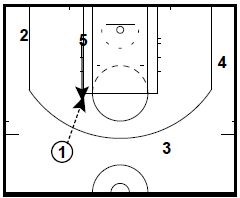
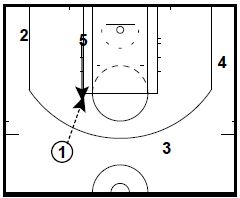
1 passes to 5 flashing to the high post.


basketball-plays-post-flash2

1 screens for 3 who cuts around the screen and then around 5 for a hand-off.


basketball-plays-post-flash3

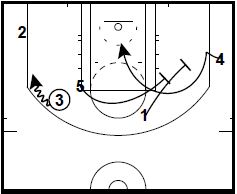
Once 3 has the ball, 5 and 1 set a staggered-screen for 4.


Warriors DHO Wing Stagger

basketball-plays-dho-wing-stagger1

1 dribbles towards the corner and gives the ball to 2 on a dribble hand-off.

5 follows 1 to set a ball-screen for 2.


basketball-plays-dho-wing-stagger2

5 rolls to the basket as 2 drives middle.

3 sets a flare-screen for 4.


basketball-plays-dho-wing-stagger3

If 4 gets the ball without a shot, 3 turns around to set a ball-screen for 4.

4 drives middle as 3 rolls or pops.


  • « Go to Previous Page
  • Page 1
  • Interim pages omitted …
  • Page 147
  • Page 148
  • Page 149
  • Page 150
  • Page 151
  • Interim pages omitted …
  • Page 288
  • Go to Next Page »

Primary Sidebar

  • Twitter
  • Facebook
  • Linkedin
coachestoolbox
personaldevelopmenttoolbox
basketballplayerstoolbox
basketballtrainer
athleticperformancetoolbox
coachingbasketball

© Copyright 2026 Coaching Toolbox

Privacy Policy