• Skip to primary navigation
  • Skip to main content
  • Skip to primary sidebar

  • Basketball Plays
    • Ball Screen Sets
    • Horns Sets
    • Man to Man Post Up
    • Man to Man Isolations
    • Backdoor Plays
    • Man to Man 3 Point Shot Plays
    • 2-3 Zone Attack
    • Baseline Inbound Plays
    • Sideline Inbound Plays
    • Combination Defense Attack
  • Drills
    • Defensive Drills
    • Offensive Drills
    • Competitive Drills
    • Passing Drills
    • Rebounding Drills
    • Shooting and Scoring Drills
    • Toughness Drills
    • Transition & Conversion Drills
    • One on One Drills
  • Blueprint
  • Practice
  • Mental Toughness
  • Skill Development
  • Offense
  • Defense
  • Store

Basketball Plays: 3 Point Sets

Basketball Plays: 3 Point Sets

By Brian Williams on September 28, 2015

These two plays to set up your three point shooters came from the FastModel Sports Basketball Plays and Drills Library.

You can also find out more about FastModel Play Diagramming software by clicking this link: FastDraw

These plays were submitted to FastModel by St. John’s Men’s Assistant, Greg Youncofski

The first play is used by the Hawks and the Celtics.

The second set is used by the Trail Blazers.


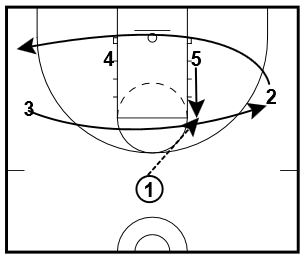
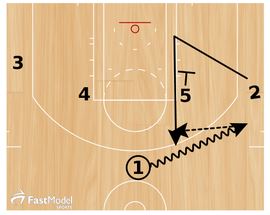
Zipper Pin Back
basketball-plays-nba1

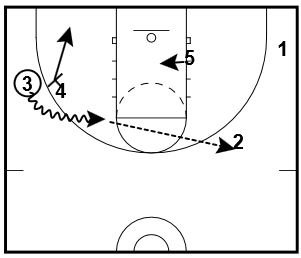
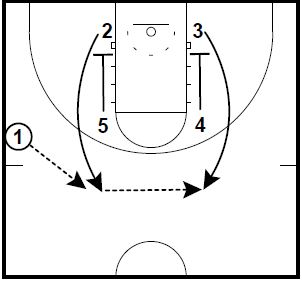
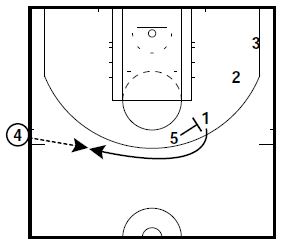
1 dribbles to the right wing.

2 cuts to the block, then back up the lane of the screen from 5 to the NBA slot.

1 passes to 2.
 

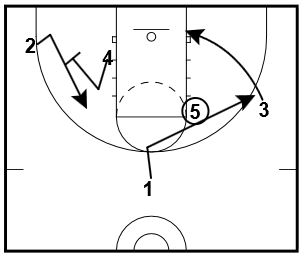
basketball-plays-nba2

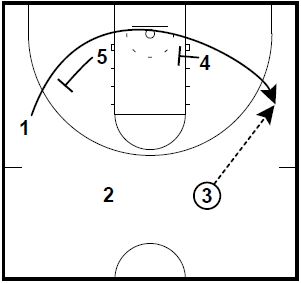
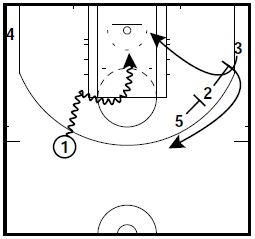
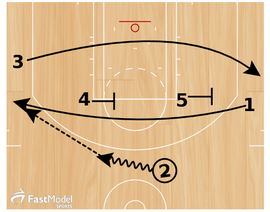
1 makes an Iverson cut off screens from 4 and 5.

3 clears to the opposite side.

2 passes to 1.


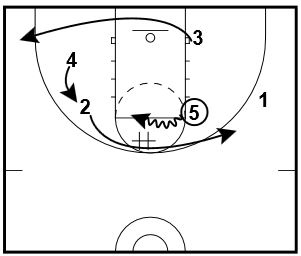
basketball-plays-nba3

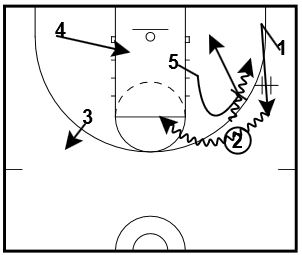
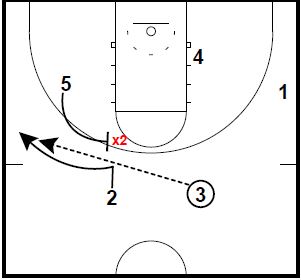
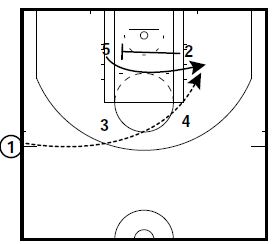
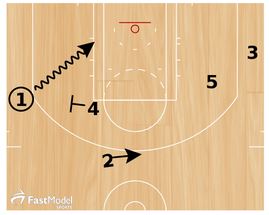
4 turns and sets a side ball screen for 1.

1 rejects the ball screen and drives.


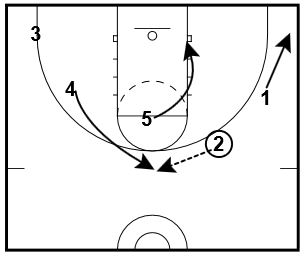
basketball-plays-nba4

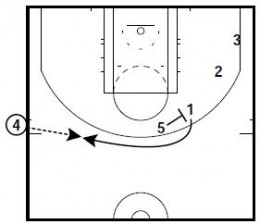
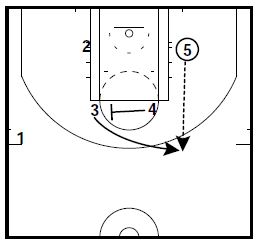
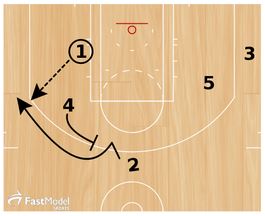
4 then sets a third screen for 2.

1 throws back to 2 for the 3 point shot.


Pistol Hammer
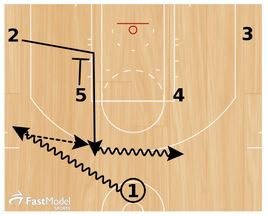
basketball-plays-nba5

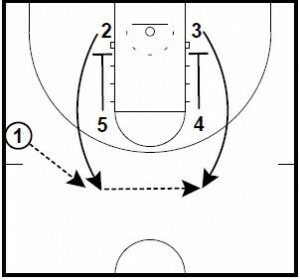
2 comes off of 5’s zipper screen.

1 passes to 2.
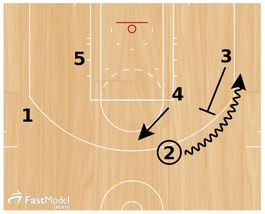


basketball-plays-nba6

3 sets a step up screen for 2 while 4 steps to the top of the key.
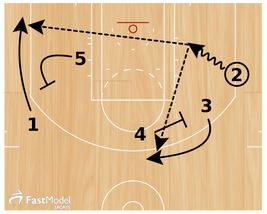


basketball-plays-nba7

2 drives to basket.

4 sets a screen for 3.

5 sets hammer screen for 1.

2 has two options for a pass for a three point shot.
Ball Screen Plays: Baseline Flash

By Brian Williams on September 24, 2015

Today’s post is a ball screen set with multiple ball screens and dribble hand offs called Baseline Flash

This play is included in the Basketball HoopScoop’s Comprehensive Ball Screen Playbook (written by Trey Watts).

It is a part of this week’s featured eBook bundle along with  the Encyclopedia of Pack Line Defense Playbook.

You can learn more about the bundle by clicking this link: Ball Screen Offense and Pack Line Defense Bundle

Diagrams created with FastDraw


Baseline Flash

basketball-plays-ball-screen1

2 will go under the two posts on the baseline.

3 will go over the top.

When 3 goes over, 5 will flash to the elbow.

1 hits 5 at the elbow.


basketball-plays-ball-screen2

3 will plant and go backdoor. 5 looks at 3 on the backdoor cut.

1 cuts away to allow time for 3 to clear.

1 will come around for a HANDOFF from 5.

4 will set a corner screen for 2 coming up.

 
basketball-plays-ball-screen3

5 fakes the handoff and takes a bounce towards the NAIL.

2 continues off the screen and get a DRIBBLE HANDOFF from 5.

4 will follow 2 after setting the screen.

3 has finished his backdoor cut to the corner.

basketball-plays-ball-screen4

We are now into our high low set.

2 will look for 5 on the roll.

2 reverses the ball to 4.


basketball-plays-ball-screen5


4 reverses the ball to 3 and sprints for a ballscreen


basketball-plays-ball-screen6

4 flares to the short corner after ball screening.

5 tries to pin inside by the rim.

3 kicks the ball out to 2.

2 looks inside to 5 on the pin.


basketball-plays-ball-screen7

5 was not open on the pin.

2 runs a DRIBBLE HAND OFF with 1 in the corner.

5 elevates behind the DRIBBLE HANDOFF and set a BALL SCREEN FOR 1.

1 attacks off the ball screen.

5 rolls to the short corner and 4 pins inside.


This play is included in the Basketball HoopScoop’s Comprehensive Ball Screen Playbook (written by Trey Watts).

It is a part of this week’s featured eBook bundle along with the Encyclopedia of Pack Line Defense Playbook.

You can learn more about the bundle by clicking this link: Ball Screen Offense and Pack Line Defense Bundle

If you are interested in adding to your Coaching Toolbox take look at what I believe is our best offer.

CLICK HERE to select from a list of more than 70 eBooks.


Coaching Basketball: Improving Your Pre-Season

By Brian Williams on September 23, 2015

These ideas for improving your pre-season came from Alan Stein.

In Episode #179 of the Hardwood Hustle Basketball Podcast, Alan Stein (Stronger Team) and Adam Bradley (Lead ‘Em Up) get you ready for the upcoming season with the 8 things you need to do to get your team ready!

Editor’s note from Brian: I realize that in the pandemic world we are living in, some of these ideas might not be executable, but I hope there are one or two things that you can get some ideas from.

8 Things You Need To Do This Pre-Season

1. Establish your culture

Alan: Part of establishing culture is to effectively communicate your rules, your policies, your standards and your expectations to the entire team. That stuff needs to be crystal clear.

Adam: If it is not communicated in advance, it looks like you are making it up on the fly.

Alan: It should be a healthy reminder for the players coming back in to your program and it should basically set the tone for any body that’s new in to your program. But clearly communicating these things is the most important part.

Alan: At the college and NBA level, your culture is everything. Culture is a culmination of all these different things that we talk about.

2. Communicate roles

Alan: Now you need to clearly communicate with each individual player, and at the high school level with the player’s parents, primarily about their role. What you foresee that player’s role being this upcoming season and if they want to expand their role, what types of things they should do in the pre-season to earn that expansion.

Alan: At DeMatha we want to treat our players like young men so the meeting is actually with the player but he invites the parents and wants the parents there merely to be a fly on the wall. Although the conversation is directly with the kid, he doesn’t want anything lost in translation and when you’re communicating with teenagers this can happen very easily. So he wants the parents there to hear everything first hand and certainly if the parents have questions or concerns they’re allowed to voice those in that meetings, but he wants to make sure he looks that player in the eye and says, “Here’s exactly what I think of your game, here’s exactly what I expect of you and if you’d like any discussion about it now would be a great time to have it.”

Alan: There are certain things that are best to talk to the entire team as a group, obviously basketball is a team sport, but there also are certain things that it’s most important to discuss individually. Now what I will say is, once he’s come to you and you guys have basically agreed on expectations and role, now your role will be shared with the rest of the team, but he doesn’t share that until he knows you and I are on the same page. It’s important for everyone on the team to know what your role is and it’s important for you to know what each other’s teammates role is so that we’re all on the same page moving forward.

3. Assess and/or recover from the summer

Alan: Because the landscape of youth and high school basketball has now become a year-round sport, most players have had a very busy spring and summer playing usually AAU basketball or going to summer camps or what have you, maybe even working with a trainer, you need to assess and/or recover from the summer. We’re talking physical, we’re talking mental, we’re talking potential nagging injuries, anything that needs to be addressed, now is the time to do it.

Alan: We have to gauge their level of mental and physical fatigue when they show up around Labor Day. We have to see, “Where are they right now?”

Alan: Instead of taking the old coaching ideology of taking a round peg and forcing it into a square hole, I can’t make too many decisions as DeMatha’s performance coach until I see what hand I’ve been dealt.

4. Discuss Goals

Alan: Whether or not you do this as a team at first or you do it individually, but you start to manage taking a step further than the expectations as far as roles are concerned, what’s our identity as a team, who are we going to be as a unit and what is it we are collectively trying to accomplish? What are some of the goals that we want to put in place?

Alan: This is when we want to start coming up with the list of standards, these process goals are going to help us be successful.

Alan: If we’re going to say that we’re going to be a running team, than we may say our goal is to score 20 points every quarter. We want to score 80 points a game in high school basketball.

5. Implement a consistent pre-season schedule

Alan: This isn’t about what you can or can’t do, its about being consistent and maximizing what you’re allowed to
do.

Alan: We have five things at DeMatha that we want to pay attention to. First is performance, which is what I do, strength and conditioning. Second is skill work, which our coaching staff is allowed to do with our players. Third is organized pickup, so the guys are actually playing and learning how to play and starting to build that unity. Next is what you’re an expert in, which is actual leadership and character development. Then lastly is mental training, is teaching our guys what it truly means to be mentally tough, which as we’ve said before is their ability to play
present.

Alan: My sincere condolences to some of the coaches out there who cannot address these because of the rules, but just do the best you can with where you are.

6. Staff Development

Alan: You always need to have some sort of staff development, or like a retreat. Something where you’re going to unify the staff. This is away from the players.

Alan: You should enjoy the company of the people you’re going to spend the most time with over the winter. It needs to be more than just talking about X’s and O’s, it should be a bonding experience with your fellow coaches. You’re all just getting on the same page and the same wave-length because you know it’s going to be a long
season.

7. Build chemistry and unity

Alan: I love what we do at DeMatha because Coach Jones finds fun ways to work in some stuff that our group can do. We have sometimes decided to cancel a pre-season workout and we take the whole team to the movies if there’s an appropriate movie to watch. Sometimes we’ll just play whiffle ball for an afternoon instead of doing any strength and conditioning. We’ve taken the bowling before. We’re not doing this every time, because we’re not trying to win a bowling championship and we’re not movie critics, we’re doing this because every once in awhile we feel that our players have earned the right to do something fun and special and we want to get them away from basketball every now and then so they can solidify their friendships and build their team unity and chemistry.

Adam: I’m always intrigued by this idea of taking the team bowling, of going out to eat and stuff like that. I think that’s a very positive thing to do, don’t get me wrong, but I think it needs to be taken to the next level and I think even beyond that coaches need to be intentional to make sure that it’s accomplishing what they want it to accomplish.

8. Allow adequate rest and recovery and make things fun

Alan: I can stress enough at the high school level how important it is to have fun in everything you do.

Alan: I’ve said on several previous episodes, every single year I’ve been in this, going in to my 13th year now, I’ve done less and less from a volume standpoint to get a better result because the rest and recovery becomes so important. It’s not so much how much you do, it’s how well you do it that’s important.

Basketball Plays: Zipper Pin Down Runner 1

By Brian Williams on September 21, 2015

Today’s post is a set with a couple of 3 point shot options.

Houston Women’s Assistant Coach Vonn Read has submitted several plays from his playbook series The Basketball Encyclopedia of Plays to the Coaching Toolbox.

You can also see more of his plays in the Related Posts links at the bottom of this post.

Vonn has also served as an assistant coach in the WNBA with the Phoenix Mercury, Orlando Miracle, and San Antonio Silver Stars. He was an advanced scout for the Orlando Magic as well as The Charlotte Sting.

Diagrams created with FastDraw

Even if you don’t run the play exactly as it is drawn up, I hope you can find a way to modify it to fit your needs.

Zipper Pin Down Runner 1

basketball-plays-zipper-pindown-runner

This is a good 3-point set for a shooter.

The 2 player (Shooter) will cut hard to the top off the Zipper Screen by the 5 player.

The 3 player will come up hard off the down screen to get the pass from the 2 player.


basketball-plays-zipper-pindown-runner2

The 1 player will cut hard off the double low stagger screens as an option for this play.


basketball-plays-zipper-pindown-runner3

The 5 player will set the flare screen for the 2 player, which results in a 3 point shot.



basketball-plays-zipper-pindown-runner4


If the flare is not open, you can continue the play with a high ball screen.

If X5 helps on the flare, they will be late to hedge on the ball screen, which opens up a roll and replace action.


Coach Read has also put together The Basketball Encyclopedia of plays. You can check them out here: The Basketball Encyclopedia of Plays or read more about the books:

Any coach looking for the latest and innovative plays from the Professional, College, or High School levels can stop looking. With a compilation of over 7,700 different plays, you will never need to purchase another basketball playbook again. These playbooks can be used as a great reference tool for years to come. This 2 Volume Book includes plays from 19 different play categories, and they are the most extensive playbooks on the market.

The Basketball Encyclopedia of Plays (Platinum Series) contains over 7,700 Plays (Both Volumes combined) from the NBA, WNBA, USBL, and College levels from someone who has worked as an Advanced Scout or Coach on each level!!! This book has been intensely compiled over the last 21 years, with plays taken from a lot of NBA Coaches (past and present), WNBA coaches, and College coaches (Men’s and Women’s) from around the country.

Any coach that is serious about improving their knowledge of the game from an X and O standpoint will benefit tremendously from these books. These Books can be used to discover New Quick hitters, add a New Package to your playbook, or develop an entire Offensive System. There are a lot of new ideas and concepts in these books to study, and the Basketball Encyclopedia of Plays can be a great resource for coaches on all levels!!! This book is definitely for those X and O junkies who are always looking to improve as a Coach.

“THE GAME IS ALWAYS CHANGING? ARE YOU?” Vonn Read

Here is the link: The Basketball Encyclopedia of Plays

Basketball Plays: Brad Stevens SLOBs

By Brian Williams on September 17, 2015

Living in Indianapolis, I have always had a lot of respect for Brad Stevens, dating back to the start of his career when he was an Assistant at Butler.

The first 2 Sideline Out of Bounds Plays taken from the Basketball HoopScoop’s Brad Stevens Boston Celtics Playbook (Compiled by John Zall).

You can find out more about the eBook at this link: Brad Stevens’ Boston Celtics Playbook

The third SLOB is a very short video at the bottom of the page from Zak Boisvert (www.pickandpop.net)

Diagrams created with FastDraw


Boston Celtics Weakside Stagger SLOB

basketball-plays-weakside-stagger1

5 sets a screen to free 1.

4 inbounds the ball to 1.


basketball-plays-weakside-stagger2

2 sets a down screen for 3 who curls to the rim

5 sets a down screen for 2 who comes off to the perimeter

1 drives middle and can hit 3, 2, 4, or make a finishing move.


Boston Celtics Misdirection SLOB

basketball-plays-misdirection-quick-hitter1

2 sets a cross back screen for 5

1 passes it over the top to 5


basketball-plays-misdirection-quick-hitter2


4 sets a cross screen for 3

5 passes to 3 for the shot


Boston Celtics Spread SLOB

You might have to watch the video a couple of times to see the play develop.

It is a simple play, but effective if you have a player who is hard to keep from getting the basketball with a running start.

It is a YouTube video, so you will need to click the play arrow to see it.

If you are interested in adding to your Coaching Toolbox take look at what I believe is our best offer.

CLICK HERE to select from a list of more than 70 eBooks.


An In-Depth Analysis of Old and New Statistics

By Brian Williams on September 15, 2015

Submitted by Coach John Kimble
CoachJohnKimble.com

Retired high school and college coach

See him on Twitter @CoachJohnKimble

This article was originally written for Winning Hoops

An In-Depth Analysis of Old and New Statistics

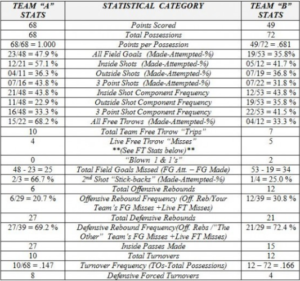
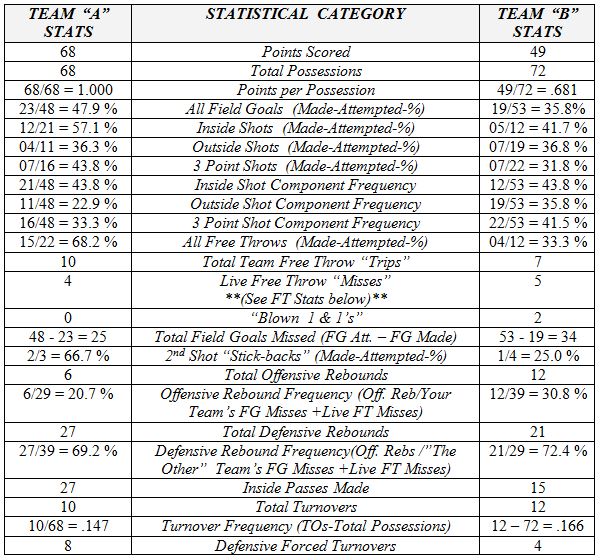
Let’s suppose the following partial list of statistics are taken from the last game that your basketball team played. Team A won the game 68 – 49. What factors contributed to Team A’s win, but what other stats could be conceived somewhat of a negative to Team A—stats that tell you some phases of the game need to be corrected? What stats tell you that and what phases need to be worked on? Let’s analyze the stats and come up with some conclusions from the eyes of coaching staffs of both teams.

My first overall observance would be the “Points per Possession” (PPP) of both teams. This vital statistic evaluates the overall offensive and defensive performance of both teams. Team A scored on an average .681 points on every possession (which totaled 72). That calls for closer scrutiny of Team A’s offensive statistics. Offensively, I would look first for reasons for a low “PPP.” Most likely, the reasons are either because of poor shooting percentage(s) in field goals and/or free throws. I would not only look also at the number of turnovers but the “Turnover Frequency.” This statistic compares overall offensive turnovers with the total possessions an offensive team has in the entire game. Total Turnovers is a stat that can be misleading in that it doesn’t take into account the style and tempo that the offensive team employs. An offensive team that pushes the ball quickly in an up-tempo style of play will have more possessions in a game. The more possessions in a game, the more likely that more points will be scored as well as more turnovers may be committed. “Turnover Frequency” measures teams’ ballhandling skills and abilities on a level playing ground, regardless of whether that offensive team plays an up-tempo style or more of a slow-down tempo style.

Team A out-shot Team B in overall field goal percentage convincingly, so that should be a concern for Team B and therefore studied more closely. Team B’s poor field goal shooting percentage could be attributed to the numbers of types of shots taken and the “Component Frequencies.” 43.8 % of all shots for Team B were “Inside Shots” (shots that were taken inside the free throw lane) and that specific shooting percentage was not extremely high (41.7 %) Team B’s “3-Point Shot Component Frequency” was almost the most frequently taken shot and that actual shooting percentage was the lowest of all three types of shots (31.8 %). The “Outside Shot Component Frequency” was 35.8 % while the accuracy was only 36.8%. (Outside Shots are defined as any shots outside of the free throw lane but inside the three point line.) The overall analysis for Team B would be to work on all three types of shooting in practice and also maybe discuss better shot selection. Compared to losing team’s “Shot Analysis,” the winning team shot the ball much better “in the paint” as well as “behind the arc.” The winning team’s worst type of shot was also the shot that was used the least (22. % of all shots were “Outside Shots”) In my opinion, Team A won the game because of better shot selection and better overall shooting accuracy. Team A played to their shooting strength(s) and tried to avoid their shooting weakness (the mid-range shot). As far as turnovers, the discrepancy between “A’s” 10 turnovers and “B’s” 12 turnovers could at least be attributed to a possible more up-beat tempo (by studying and comparing both teams’ overall possessions for the game—68 and 72 possessions respectively. Team A’s “TO Frequency of .147 compared to Team B’s .166 is not a drastic advantage for Team A, but still an advantage for Team A. Team A should have had (slightly) fewer turnovers than Team B because of (slightly) fewer team possessions so neither team really gained an advantage because of “Turnover Frequency.”

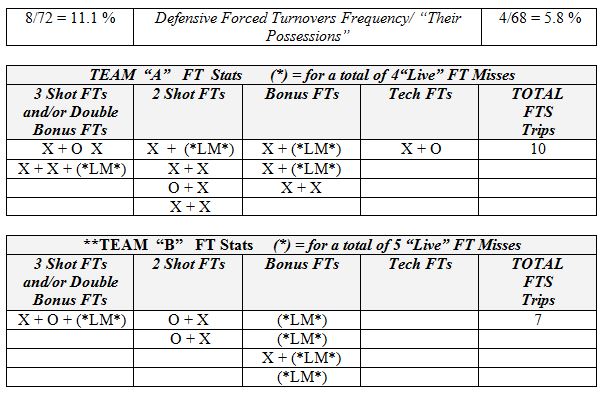
The “Free Throw” phase of the game for Team B suffered greatly and also made a difference in the outcome of the game. Team B’s 33.3% was terrible and by missing the front end of the two “1 & 1’s”, they not only lost those 2 points but also the chance for two other free throws. Team A’s 68.2 % FT Percentage compared to Team B’s 33.3 % not only was more than twice as good, but allowed Team A to outscore Team B from the FT line 15 points to 4. If Team B doesn’t address the poor Free Throw shooting problem and instead complains about the “12 to 22 FT Attempt” discrepancy, they should examine the number of “FT Trips” for each team—not the number of Free Throws taken by each team. Again, when a team misses the front end of a “1 & 1,” they are surrendering the opportunity to shoot a second free throw. 10 to 7 in “Free Throw Trips” is not a huge discrepancy for Team B to complain about. This statistic may also indicate that Team A is more aggressive offensively by attacking the defense via of the dribble or by going inside more than Team B. This is proven by the discrepancy that Team A enjoys in overall “Inside Passes” (27-15) and overall “Inside Shots” (21-12). This may also indicate that Team B is a poorer “on the ball” and/or “post defensive team” than Team A is. The small discrepancy in the number of free throw trips could also have taken place with Team A having a lead late in the game that forced Team B to foul late in the game.

A team loses possession of the ball by missed shots and turnovers while it can gain possession of the ball by “defensive rebounds,” “defensive forced turnovers,” or after “made” baskets. Therefore, these factors should be measured. “Defensive Forced Turnovers” is a defensive stat that tells how many times a defensive team has forced the opposition into a turnover. It is somewhat subjective because each opponent’s turnover must be evaluated as to whether the offense made a mistake or the defensive team caused the offensive team to make a mistake. “Defensive Forced Turnover Frequency” equally measures how much pressure each defensive team places on the opponent compared with total possessions during that game. This combination prevents the skewing of the “Forced Turnover” statistic. In this case, Team A had 8 “Defensive Forced Turnovers” compared to Team B’s 4 “Defensive Forced Turnovers.” But because of the number of possessions that both teams had (Team A had 68 and Team B had 72), the actual frequencies indicate that Team A did not quite maintain the “2 to 1” advantage it had over Team B. Team A had 72 opportunities to obtain the 8 actual “Defensive Forced Turnovers” it created versus the 68 opportunities that Team B had to grab the actual 4 defensive turnovers. Team B may want to also work offensively on taking care of the ball while also working on more of a defensive pressure effort.

Under the same line of thinking, as important as certain stats are; the frequency of that particular statistic is more revealing than the base statistic. Another two examples are defensive and offensive rebounding in correlation to the number of opportunities each team has for those rebounds. “Defensive Rebounding Frequencies” and “Offensive Rebounding Frequencies” give a coaching staff a truer picture and a better measuring tool to evaluate this important phase of the game. In this game, Team A had an advantage in “Defensive Rebounds” because Team B had more missed field goals and free throws that have a chance to be (defensively) rebounded. Team A had 39 chances to obtain its 27 defensive rebounds. Team B had 29 chances to obtain the 21 defensive rebounds it obtained. Team B’s “Defensive Rebound Frequency” is actually higher at 72.4 % than Team A’s frequency. The “Offensive Rebound Frequency” statistic gives a coaching staff a much more reliable evaluation tool than the “Offensive Rebound” statistic (for the same reasons as the “Defensive Rebound Frequency” statistic).

table1

table2

INDIVIDUAL STATISTICS

Total Minutes Played
Offensive Margin per Minute
Defensive Margin per Minute
Contribution Margin per Minute
Offensive Margin per Full Game
Defensive Margin per Full Game
Contribution Margin per Full Game

Sometimes a player does not appear to have obvious or outstanding contributions for his performance by using the standard game stats, but it just seems that every time that player is in the game; good things happen for his team. Trying to make this somewhat subjective evaluation an objective evaluation can be done by simply keeping track of when players enter and/or exit the games by monitoring the score and the actual time on the clock.  For instance, Duane Wade of Team A could come in the second quarter of the game with 6:12 on the clock and with Team A leading 20 to 19. When he went to the bench with 3:42 in the same quarter, his team was then leading 29 to 21. This small amount of data gives the player an example of his three various “margins per minute” now discussed.

His “Offensive Margin per Minute” for just this part of the game would be the nine points his team scored in the 2 ½ minutes of his specific playing time. This means that Duane’s team averaged 3.6 points per minute (9 pts divided by 2.5 minutes) in this specific part of the game.

In that same time span, Team A gave up only 2 points in the same 2 ½ minutes of this game. This makes the “Defensive Margin per Minute” for Duane a rating of .8 points allowed per minute played (2 divided by 2.5 minutes).

When Duane started his 2 ½ minute segment of the game, his team was ahead by just one point. When he came out of the game, his team was now ahead of the game by a total of eight points. This increase in the lead was a total of seven points over the course of this specific 2 ½ minutes. This equates to a + 2.8 points per minute (7 points divided by 2.5 minutes) of this segment of the game.

This is then calculated for the overall contribution per minute played. This number is then multiplied by 32 (32 minutes per game) to give a hypothetical number that would state what Duane’s team would have done if Duane would have played every second of this particular game.   Every segment of every player would have these three “margins per minute” accumulated to have three final statistics that can help tell how every player had contributed as a team member. Hypothetically on paper, Team A would have scored 115.2 points in the game, while allowing only 25.6 points to win by a huge margin of 89.6 points. Regardless of what the old fashioned statistics say of Duane’s performance, he was a part of that overall team contribution. As detailed as stats can be, some things cannot be measured on players’ individual performances.   These unique stats can help a coaching staff evaluate individual and overall team performances.

Taking the time to keep these unique statistics and then spending time and energy in evaluating them can not only give a coaching staff a clearer measuring stick for each player’s individual and overall team performance for each game. This might help players understand their value and their actual playing time which could help improve team chemistry and therefore the overall team’s performance. These statistics are worth the effort.

About the Author

Coach Kimble was the Head Basketball Coaching position at Deland-Weldon (IL) High School for five years (91-43) that included 2 Regional Championships, 2 Regional Runner-Ups and 1 Sectional Tournament Runner-up. He then moved to Dunlap (IL) High School (90-45) with 2 Regional Runners-up, 1 Regional, 1 Sectional and 1 Super-Sectional Championship and a final 2nd Place Finish in the Illinois Class A State Tournament. He was an Assistant Basketball Coach at Central Florida Community College in Ocala, FL for 1 year before becoming Offensive Coordinator and then Associate Head Coach for 3 additional years He then was the Head Basketball Coach at Crestview (FL) High School for 10 years, averaging over 16 wins per season.

He has had articles published in the following publications such as: The Basketball Bulletin of the National Association of Basketball Coaches, the Scholastic Coach and Athletic Journal, Winning Hoops, Basketball Sense, and American Basketball Quarterly. He has also written and has had five books published along with over 25 different DVDs by Coaches Choice and Fever River Sports Production.

See him on Twitter @CoachJohnKimble and his Web Page “www.CoachJohnKimble.com”

  • « Go to Previous Page
  • Page 1
  • Interim pages omitted …
  • Page 142
  • Page 143
  • Page 144
  • Page 145
  • Page 146
  • Interim pages omitted …
  • Page 288
  • Go to Next Page »

Primary Sidebar

  • Twitter
  • Facebook
  • Linkedin
coachestoolbox
personaldevelopmenttoolbox
basketballplayerstoolbox
basketballtrainer
athleticperformancetoolbox
coachingbasketball

© Copyright 2026 Coaching Toolbox

Privacy Policy