• Skip to primary navigation
  • Skip to main content
  • Skip to primary sidebar

  • Basketball Plays
    • Ball Screen Sets
    • Horns Sets
    • Man to Man Post Up
    • Man to Man Isolations
    • Backdoor Plays
    • Man to Man 3 Point Shot Plays
    • 2-3 Zone Attack
    • Baseline Inbound Plays
    • Sideline Inbound Plays
    • Combination Defense Attack
  • Drills
    • Defensive Drills
    • Offensive Drills
    • Competitive Drills
    • Passing Drills
    • Rebounding Drills
    • Shooting and Scoring Drills
    • Toughness Drills
    • Transition & Conversion Drills
    • One on One Drills
  • Blueprint
  • Practice
  • Mental Toughness
  • Skill Development
  • Offense
  • Defense
  • Store

Basketball Drills: Tiger Passing

Basketball Drills: Tiger Passing

By on October 6, 2015

This competitive scoring drill came from the FastModel Sports Basketball Plays and Drills Library.

You can also find out more about FastModel Play Diagramming software by clicking this link: FastDraw

This drill was contributed by Coach Lason Perkins. He has worked at the high school, college, and semi-pro level for over 20 years.

He has also created over 20 instructional DVDs and 5 books on basketball offenses.

He has built a reputation for being an expert on international offenses and styles of play.

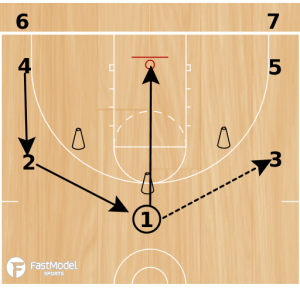
Tiger Passing is a drill that can be used to work on passing, cutting, and being strong with the basketball.

For teams that like to run Open Post offense, it also works on the offensive concepts.

If the setup for the drill does not fit your needs, tweak the version you run so that it does.

FastTradePreview1


Line in each corner, cones are coaches/managers with blocking pads. to pressure receivers: Pass and cut, catch and face, cut to the rim.


FastTradePreview2


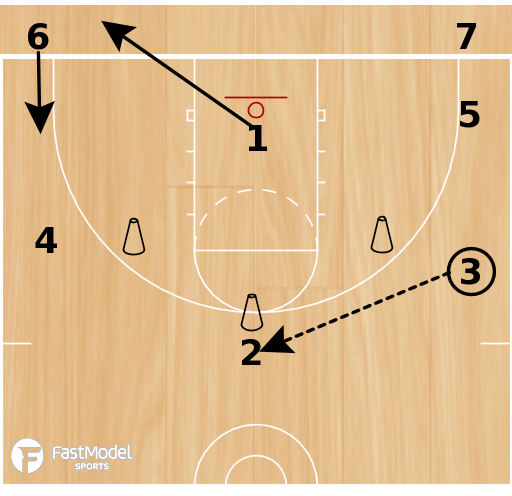
Cutter must sprint to fill the 5 spots (corner, wing, top). Basket cut must be made all the way to the rim.


FastTradePreview3


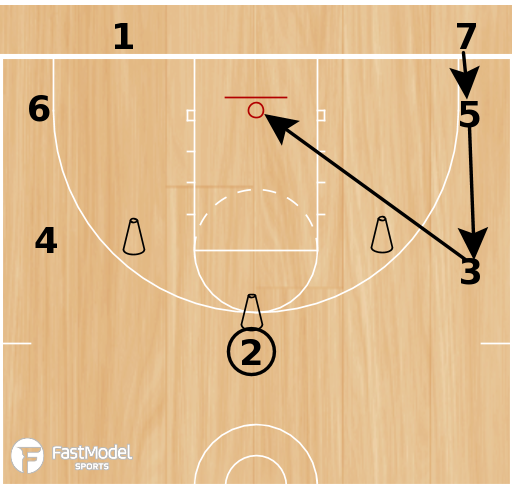
First player in line steps onto the court when the corner spot opens.


FastTradePreview4


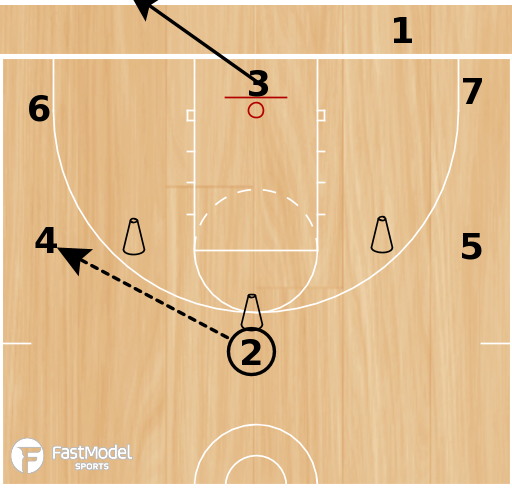
Can run for designated number of passes or for time. Also works as a conditioner.


Basketball Plays: Flash Screen Down Zone Set

By Brian Williams on October 5, 2015

Today’s post is a set to run against a 2-3 zone to get the ball into a post player in the lane.

Coach Vonn Read has submitted several plays from his playbook series The Basketball Encyclopedia of Plays to the Coaching Toolbox.

You can also see more of his plays in the Related Posts links at the bottom of this post.

Vonn has also served as an assistant coach in the WNBA with the Phoenix Mercury, Orlando Miracle, and San Antonio Silver Stars. He was an advanced scout for the Orlando Magic as well as The Charlotte Sting.

If you are looking for other resources you can click here to see our products that relate to attacking zone defenses. There are some sample videos included in these as well: Zone Offense Resources

Diagrams created with FastDraw

Even if you don’t run the play exactly as it is drawn up, I hope it sparks your thinking and discussion to improve what you currently run against a zone.

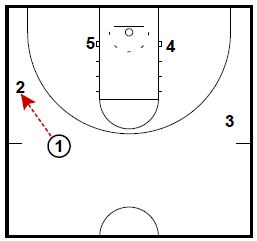
12 Flash Screen Down Middle X5 Trojan

basketball-plays-flash-screen

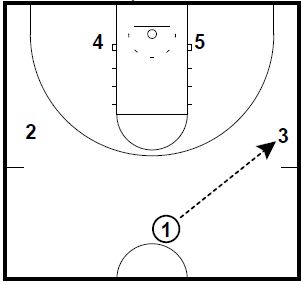
This is a good quick hitter for a post shooter against the Zone.

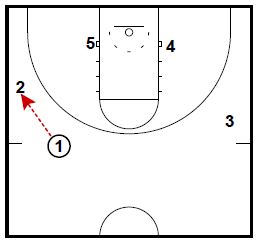
The 1 player will pass to the wing.


basketball-plays-flash-screen2

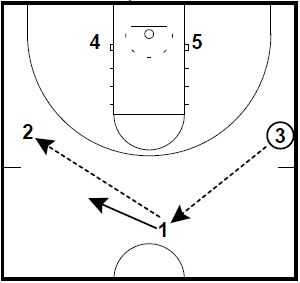
The offense will fully reverse the ball to get the zone moving.


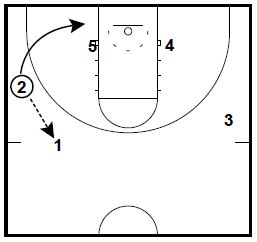
basketball-plays-flash-screen3

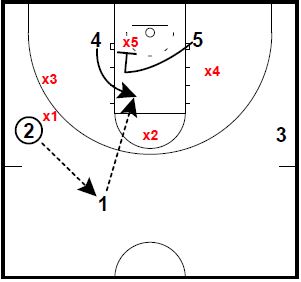
On ball reversal, the defense will have 2 players on the ball (bumping).

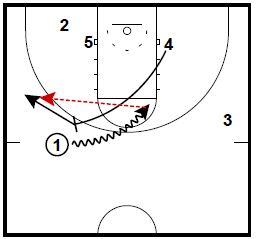
Once the 2 player catches the ball, the 5 player will fake flash to the ball and then downscreen on X5.

The 2 player will pass to the 1 player, who will pass to the 4 player flashing up the lane for the quick jump shot in the paint.

If X5 gets through the screen, go high low to the 5 player for the layup.

Coach Read has also put together The Basketball Encyclopedia of plays. You can check them out here: The Basketball Encyclopedia of Plays or read more about the books:

Any coach looking for the latest and innovative plays from the Professional, College, or High School levels can stop looking. With a compilation of over 7,700 different plays, you will never need to purchase another basketball playbook again. These playbooks can be used as a great reference tool for years to come. This 2 Volume Book includes plays from 19 different play categories, and they are the most extensive playbooks on the market.

The Basketball Encyclopedia of Plays (Platinum Series) contains over 7,700 Plays (Both Volumes combined) from the NBA, WNBA, USBL, and College levels from someone who has worked as an Advanced Scout or Coach on each level!!! This book has been intensely compiled over the last 21 years, with plays taken from a lot of NBA Coaches (past and present), WNBA coaches, and College coaches (Men’s and Women’s) from around the country.

Any coach that is serious about improving their knowledge of the game from an X and O standpoint will benefit tremendously from these books. These Books can be used to discover New Quick hitters, add a New Package to your playbook, or develop an entire Offensive System. There are a lot of new ideas and concepts in these books to study, and the Basketball Encyclopedia of Plays can be a great resource for coaches on all levels!!! This book is definitely for those X and O junkies who are always looking to improve as a Coach.

“THE GAME IS ALWAYS CHANGING? ARE YOU?” Vonn Read

Here is the link: The Basketball Encyclopedia of Plays

Coaching Basketball: Individual Skill Development

By Brian Williams on October 2, 2015

These four videos are with Coach Rich Walton and from his Skill Development Coach program. The program breaks down skills into a table that is patterned after the Periodic Table of Elements.

If you are interested in the program for coaches, you can find out more at this link: Coaches

There is also a program for Skills Trainers: Basketball Skill Trainers

Please make sure that your sound is on

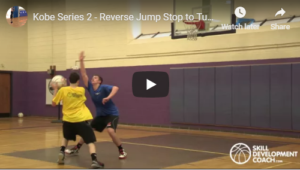
Reverse Jump Stop to Turnaround

These are You Tube videos, so please make sure that you are on a server that allows you to have You Tube access.

Click the play arrow to see the video.

The reverse jump stops allows the player to use either foot as a pivot foot.

Opposite Foot Crossover

This move allows players to create space either for a shot, or to set up another dribble move.

Fake Baseline Pullout Reverse

A second move to beat a defender who has shut off a baseline drive.

Inside Pivot One on One Moves

This video has several variations of moves using an inside pivot.

You can get a free two week trial for Skill Development Coach. Text Coaching Toolbox to the number 31996 for a 2 week free trial.

If you are interested in the program for coaches, you can find out more at this link: Coaches

Basketball Plays: Hand Zone Attack

By Brian Williams on October 1, 2015

This 2-3 zone attack set is from Scott Peterman’s University of Michigan Playbook.

You can purchases any four of our digital playbooks for $35 (62 titles in all–Virginia, Texas Tech, Duke, Kentucky, Brad Stevens, and many others included!) 20 new titles recently added!

Click this link for all choices! 4 digital playbooks for $35

Diagrams created with FastDraw


“Hand” 2-3 Zone Attack

basketball-plays-beilein1


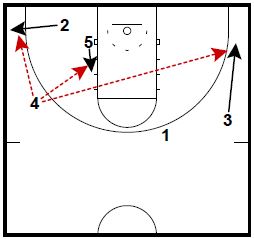
Play begins with 1 passing to 2.


basketball-plays-beilein2


2 will pass the ball back to 1.

2 will then cut to the short corner


basketball-plays-beilein3

4 will come up and set a ball screen for 1

4 will pop

1 will hit 4


basketball-plays-beilein4

IF the bottom/outside defender comes out to cover 4, 4 will hit 2 for a shot

IF the top/outside defender takes 4 and the bottom/outsidedefender covers 2, 4 will look to hit 5 posting up the middle man of the zone

4 can throw a skip pass to 3 for a shot

You can purchases any four of our digital playbooks for $35 (62 titles in all–Virginia, Texas Tech, Duke, Kentucky, Brad Stevens, and many others included!) 20 new titles recently added!

Click this link for all choices! 4 digital playbooks for $35

Coaching Basketball: Administration of the Locker Room

By Brian Williams on September 30, 2015

Submitted  by Coach John Kimble
CoachJohnKimble.com

Retired high school and college coach

Follow him on Twitter @CoachJohnKimble

This article was originally written for Winning Hoops

Game Days are the MOST important days of the entire basketball season both for players as well as coaches. For the players, all of the preseason conditioning, the off-season weight-lifting, the summer league games, the team camps and their games, the practices are all utilized to prepare themselves for THE GAMES. All of the orchestrating and organizing of these events in addition to   the numerous activities that must be planned and performed by the coaches again serve to prepare everyone involved for THE GAMES.

During the all-important “game-night,” there are primarily three instances where teams must     be present in the locker room. These three occurrences can and should be utilized for maximum efficiency, before, during, and after each and every game.

These incidents take place immediately before the game (during the preliminary game); at half-time of THE game, and immediately after THE game. All three instances allow themselves to be invaluable assets for the team, the coaches, the program; if they are organized, and utilized properly.

For many years, we have used the following procedure for our pre-game routine. As soon as the team using our locker room for their game leaves the locker room for their 2nd half (whether it is our JV team, or another team if we are in a tournament), our Varsity players immediately leave the gym to go to the locker room. The majority of our opponents and other teams that I have witnessed typically go to their locker room to prepare and dress for their game after the 3rd Quarter of the prelim game. Dressing for a game seems to take the majority of an 8 minute quarter of a high school basketball game. By coming in to dress immediately after half-time, we give the players the 3rd quarter for their individual time to prepare– to dress and be taped, and to do whatever else they (as individual players) need to do to mentally and emotionally get ready to compete. This time is their time. The 4th quarter is devoted for the overall team to prepare to play. This is team time-not their own to do as they wish.

Scouting reports on our immediate opponent are again reviewed, our game plan is again discussed and diagramed.   Special plays, statistics, specific techniques are discussed, reviewed, taught, or re-taught. This can be done in a rather relaxed manner, because we have allowed the extra time to attempt to gain an extra edge on the opponent. We preach that to our players that we have and continue to out-prepare and out-work our opponent up to that moment. We tell our players that we have an advantageous position over our opponents, that will benefit us in the future. The diagram boards have already been drawn as soon as the locker room is available. For instance, if it is in our gym, the plays, stats, scouting reports have been drawn out even before the prelim game. If it is an away game, we attempt to have our Varsity players put on their game shoes and informally shoot around in the gym as our JV players are getting dressed in the locker room. This gives them even more time to check out and evaluate the rims (are they tight?– which will produce more misses and long rebounds; or are the rims loose?–which will allow for short rebounds) Are there dead spots anywhere on the court? Will the ball bounce more lively or less lively? We want our players to have the answers and be informally experimenting before the game versus finding out the answers to those questions at the expense of the team during the game. We want our players to start each game, believing they have a psychological edge on each and every opponent.

After the first half of our game, our team hustles to the locker room. We attempt to have the locker room prepared with the Gatorade and/or water, the towels available, the diagram boards ready to be utilized by the coaching staff. We want to be as time-efficient as we possibly can. Our routine is to have the players use the first few minutes to towel down, cool off, get their breath, use the restroom, etc. Again, we tell them that these first available minutes are their time. While the players are using their time, the coaching staff uses this small amount of time to privately confer and quickly analyze our performances, our strategies, as well as the opponents= game plan. We decide what adjustments or improvements we need to implement for the second half. This is done partially by summarizing a few of the first half statistics so that we may evaluate our most productive offenses and defenses, our better performing players; as well as what the opponents are attempting to do and how well they are doing it.

The number of points we scored (or allowed) while using a specific offense (or defense) is divided by the number of possessions that offense (or defense) was used. This figure then establishes   a measuring instrument that describes the offensive (or defensive) efficiency. This is called the APoints per Possession Offensive (or Defensive) Efficiency Rating. This statistic is a quick and precise indicator to the staff as well as the players as to the effectiveness of any play, any offense, or any defense which we have utilized in the first half. This helps us determine how much or how little we should employ the designated offenses and defenses in the second half.

We attempt to not   be overly critical or negative about our first half performance and execution, but we firmly believe in being honest. Thus any poor play must be acknowledged in order for it to improve. We verbally express positive comments, followed by any deficiencies. We try not to implement a significant number of adjustments in our second half preparations, so as to not mentally overload the players.

We believe that it is extremely detrimental for us to take so much of our half-time in the locker room, that our players do not have any time to warm up on the court before the second half. We insure ourselves of this by using a wind up timer that the staff sets as we enter the locker room for the half-time. We set it at a designated time so that we will always have a specific amount of time left over for a physical warm-up. An assistant coach periodically informs the head coach in a subtle manner of how much time he has left before he concludes his routine talk. We attempt to end each half-time with a positive comment and a brief summary of our adjustments, before hustling back onto the court.

After the game, we give our players a few minutes to physically and emotionally readjust. During that brief time, the coaching staff quickly convenes to plan a positive and brief speech to the team. This could and should include a plan of how and what to say to the media.

This can be used as a short yet invaluable opportunity to utilize the players= heightened concentration period to teach or reinforce an appropriate facet of the game when it is immediate in their minds.

Negative aspects and criticisms should be very briefly addressed and concentration should be placed on the positives as the head coach gives his final address to the team is made.

We have attempted to always have the locker room available for team members to have a place to wind down and congregate by having sandwiches, pizza, and drinks available; while the coaching staff meets to discuss the game, make future plans and evaluate the game tape.

These three opportunities of meeting in the locker room can be invaluable instruments to prepare, to correct, to reinforce, to teach, to motivate, to praise, and to coach your players at a time when your players are at a heightened level of concentration and reception. These times should be valued and utilized to their fullest potential.

About the Author

Coach Kimble was the Head Basketball Coaching position at Deland-Weldon (IL) High School for five years (91-43) that included 2 Regional Championships, 2 Regional Runner-Ups and 1 Sectional Tournament Runner-up. He then moved to Dunlap (IL) High School (90-45) with 2 Regional Runners-up, 1 Regional, 1 Sectional and 1 Super-Sectional Championship and a final 2nd Place Finish in the Illinois Class A State Tournament. He was an Assistant Basketball Coach at Central Florida Community College in Ocala, FL for 1 year before becoming Offensive Coordinator and then Associate Head Coach for 3 additional years He then was the Head Basketball Coach at Crestview (FL) High School for 10 years, averaging over 16 wins per season.

He has had articles published in the following publications such as: The Basketball Bulletin of the National Association of Basketball Coaches, the Scholastic Coach and Athletic Journal, Winning Hoops, Basketball Sense, and American Basketball Quarterly. He has also written and has had five books published along with over 25 different DVDs by Coaches Choice and Fever River Sports Production.

See him on Twitter @CoachJohnKimble and his Web Page “www.CoachJohnKimble.com”

10 Strategies to Help Coaches And Athletes Defeat Adversity

By Brian Williams on September 29, 2015

10 strategies to help coaches and athletes defeat adversity

By Juan Pablo Favero, Mental Performance Coach.

Originally published on the Coach and Athletic Director site and republished with permission of both parties.

It’s frustrating for athletes when they’re running on fumes, feeling like they have nothing more to give and that no matter what they do there is nothing left to push past a seemingly insurmountable wall. They can feel hopelessness, discouragement and defeat knocking at their door.

Whether the exhaustion is physical, emotional, mental or a combination of the three, we have all experienced what it’s like to “hit the wall.” While the wall is definitely not a good state to be in, there are two important facts we must remember for our own sake as well as that of the groups or teams we lead or coach.

First, athletes must understand that these moments can be overcome. They do have more in the tank if they grind it out. Second, when we don’t quit and we overcome these walls, they serve as a catalyst for growth and potentiate future success in a way that we, and our teams, would otherwise never experience.

In overcoming personal and professional walls, as well as helping athletes and teams overcome their walls, I have developed a very practical list of strategies over the years that I trust can assist both you and your teams to overcome obstacles.

Here are 10 ideas you can use with your own programs.

1 One step at a time. A popular sports cliché is “one game at a time.” This mentality is imperative for individuals and teams to succeed. When we hit walls, the finish line can seem very distant and the goal, which started out as a motivating force, can instantly become overwhelming and even demotivating.

We must remember that the emotional and physical tank is already running low when the wall comes into the forefront, so the time to focus on the big picture is not now. For this reason, it is imperative to just take the next small step, whichever it may be.

One more action stripped down to the most simple of levels allows us to regain momentum toward the direction we set out when we began. Once you complete that next step, the focus can move to the following step and so forth. Before you know it, you have overcome the wall by taking several small steps forward.

2 Positive self talk. The power of our internal dialogue is well researched and documented. There is no other moment as important as this to use this cognitive skill.

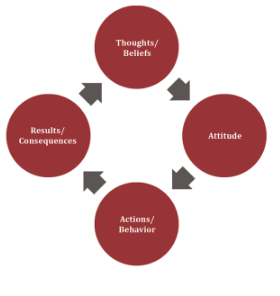
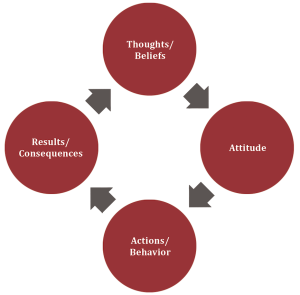
When you or your team struggles, the battle has to be waged and won inside the mind. The cognitive-behavioral cycle above helps explain how our thoughts give birth to every result we experience.

Every thought is a seed that grows into an attitude or mindset. Our attitudes in turn guide our actions or behaviors, which then yield consequences or results. Our results reaffirm and strengthen our thoughts and the cycle goes on.

If we want to have a different outcome, we must first change our “mental playlist” from negative, defeatist thoughts to positive, conquering ones. The use of cue words and affirmations both silently (internally) and out loud (externally) does indeed begin to energize us towards overcoming the wall and allow us to push past it, thus creating a different result.

The key is to remain positive, even in the midst of difficulties and challenges. This is the choice we, and our teams, must make.

3 Help one another. The beauty of being part of a team is critically important during the difficult moments. The accountability, encouragement and synergy that come from others pushing you forward should never be underestimated.

A relevant metaphor is “iron sharpening iron.” The positive voice of someone with whom you have a good relationship can be an energizing force to propel you past the wall. We must teach and encourage our teams to do this for each other. When you combine the use of positive self-talk and encouraging, uplifting communication, you create a contagious force that builds positive momentum.

cognitive-behavioral-cycle-300x295-300x2954 Visualization. This is another very effective technique. At its most foundational level, visualizing simply means seeing yourself in the place you want to be. It is taking our positive thoughts and using our imagination to paint powerful pictures in our mind’s eye. By imagining ourselves successfully overcoming the challenge and believing that we can do it, we unleash the inner power inside our minds to fill our bodies with the belief necessary to continue our climb.

A quote I heard in grad school is, “Belief is the mother of all reality.” I would add that belief followed by action leads to the new reality we are seeking. Visualizing oneself and our teams being successful sets the stage for the materialization of success. Unfortunately, the opposite is also true.

5 Mental strength. There is no substitute to sheer will power, desire and the determination to see things through to their completion. Whether this is innate doesn’t really matter as much as the fact that any person can indeed develop and strengthen this kind of grit.

As leaders, we must assist our teams in the development of this skill by setting up challenging tasks for them to overcome. Mental strength, like a muscle, must be exercised and built little by little. It is forged only when we come face to face with walls — maybe small ones at first — and successfully overcome them.

The more we and our teams will ourselves to not give up and quit, the more mental strength we develop, allowing us to take on steeper challenges.

6 Past achievements. Whenever doubt kicks in and thoughts of quitting start to circle our heads, one quick way to evict these is to recall and focus on instances where we have successfully overcome past challenges. It may be the same or a similar experience, but focusing on previous successes and the positive feelings and emotions associated with them gives an instant boost of confidence, energy and motivation to keep going. Because the wall is a place of doubt, we must help our teams remember triumphs of the past in order to regain the confidence needed to experience success in the present.

7 Minor victories. This goes hand-in-hand with the first strategy of taking one step at a time, but the emphasis here is on the importance of celebrating a successful step in the right direction or an approximation to the desired outcome.

There is much research on the power of positive reinforcement and rewards, but the most practical concept I have seen and used on the matter is “catch them being good,” as explained in the book with the same title by Dr. Colleen Hacker and Tony DiCicco.

Simple yet very specific and genuine reinforcement related to an athlete’s effort and achievements goes a long way and helps build momentum.

8 Push past the pain. When we reach that point of wanting to give up or surrendering to the obstacle, we must push ourselves past our discomfort and pain. Much like a runner’s high produces instant gratification and a release of endorphins, pushing past the pain barrier creates the same kind of euphoric high, which serves as fuel. This mindset also propels our teams from bad to better, from good to great, and most of all, into their personal and collective best.

9 Focus on the why.
The “what” is the goal, the “how” is the process, but the “why” is where the secrets lie. It’s important to distinguish that the “why” is not the goal itself but the reasons why we pursue a goal to begin with.

We must help our teams find and define their “why” long before the moment when the wall stops our forward momentum. The “why” gives purpose, and it’s the reasons behind the mission and the vision. Therefore, our job as leaders is to help define the team’s joint “why.” If the “why” is not clear, people won’t fight, won’t push and won’t persevere.

When the “why” is clearly communicated and defined, it serves as a force that pulls our teams toward the goal and past the walls they face.

10 Reward yourself and the team. The final step is to simply stop and smell the roses when the goal is achieved. I discovered that when this is done in a tangible and meaningful way, it serves to recharge both emotional and physical energy needed for the next challenge.

One suggestion here is to find ways to commemorate and symbolize big achievements. Whether it’s an autographed ball, a photograph or something more intricate, memorializing a triumph has a way of both acknowledging past victories and motivating for success over future walls.

A final thought to leave with you has to do with attitude. We, and our teams, must not allow for an outlook of fear and trepidation toward facing walls and obstacles. We must instead develop a mindset and culture where walls are looked at as not only opportunities but embraced as a blessing, as something meant to be overcome, and to bring out the best in us.

In the short film “The Butterfly Circus,” featuring Nick Vujicic, a quote that resonated deeply within me envelops what our mindset ought to be toward any wall we may face: “The greater the struggle, the more glorious the triumph.”

I wish you and your teams the struggles necessary to bring forth the memorable triumphs.

  • « Go to Previous Page
  • Page 1
  • Interim pages omitted …
  • Page 141
  • Page 142
  • Page 143
  • Page 144
  • Page 145
  • Interim pages omitted …
  • Page 288
  • Go to Next Page »

Primary Sidebar

  • Twitter
  • Facebook
  • Linkedin
coachestoolbox
personaldevelopmenttoolbox
basketballplayerstoolbox
basketballtrainer
athleticperformancetoolbox
coachingbasketball

© Copyright 2026 Coaching Toolbox

Privacy Policy