• Skip to primary navigation
  • Skip to main content
  • Skip to primary sidebar

  • Basketball Plays
    • Ball Screen Sets
    • Horns Sets
    • Man to Man Post Up
    • Man to Man Isolations
    • Backdoor Plays
    • Man to Man 3 Point Shot Plays
    • 2-3 Zone Attack
    • Baseline Inbound Plays
    • Sideline Inbound Plays
    • Combination Defense Attack
  • Drills
    • Defensive Drills
    • Offensive Drills
    • Competitive Drills
    • Passing Drills
    • Rebounding Drills
    • Shooting and Scoring Drills
    • Toughness Drills
    • Transition & Conversion Drills
    • One on One Drills
  • Blueprint
  • Practice
  • Mental Toughness
  • Skill Development
  • Offense
  • Defense
  • Store

Basketball Plays: Eurobasket Tournament Sets

Basketball Plays: Eurobasket Tournament Sets

By Brian Williams on October 15, 2015

These 2 plays from the Eurobasket Tournament eBook Playbook (assembled by Kyle Pertuset)

My hope in presenting plays is that you can take them and change them to fit your own needs or to use to brainstorm ways to get your scorers into positions where they can be effective.

For example, you might be able to find ways to screen for your ball screeners in some of your sets to help them get to their ball screen without their defender.

These plays are a part of this week’s eBook bundle.

You can create your own bundle by selecting any 4 of the eBooks that we have featured over the past few years for $35.00. Click here for the choices.

Diagrams created with FastDraw


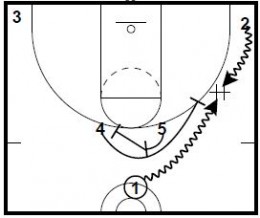
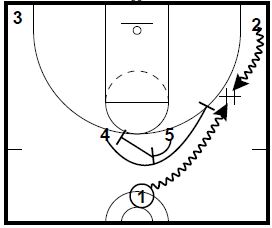
Estonia Horns Stagger
basketball-plays1

1 dribbles to the right wing.

5 screens for 4

1 runs a dribble hand off with 2

4 sets a ball screen for 2 after the dribble hand off.
 
basketball-plays2

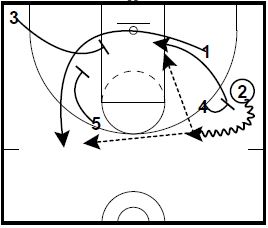
1 continues to the other side to come off a stagger from 3 and 5

2 comes off the ball screen and can hit the roller or 1 coming of the screens.

You could include 3 spacing with 5 flashing to the lane if that fits your needs.

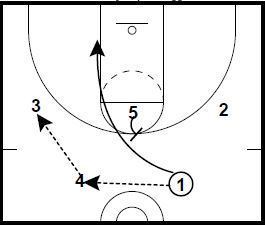
Czech Republic Post Entry Triple Stagger

You could also use this as a way to isolate your 1 in the post if that is to your advantage.
basketball-plays3

1 passes to 3 and cuts to the block off a screen from 5

4 passes to 3.
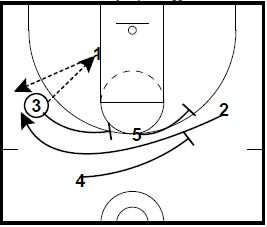


basketball-plays4

3 enters the ball to 1 in the low post.

3, 4, and 5 set a triple stagger for 2 to cut behind the ball for a possible 3 point shot.


These plays are a part of this week’s eBook bundle.

You can create your own bundle by selecting any 4 of the eBooks that we have featured over the past few years for $35.00. Click here for the choices.
Coaching Basketball: Helping Players to Value Practice

By Brian Williams on October 14, 2015

This post contains quotes from two Texas A&M Women’s Assistant Bob Starkey on practice. His Hoop Thoughts Blog should be on your regular for basketball coaches.

Some maxims to use throughout the coming season to help players see the value in well planned and purposefully
conducted basketball practices. I have also added a few of my favorites at the end of the post.

I hope you find some useful ideas to inspire your players and coaching staff to make the most of your practice time.

from Coach Bob Starkey

Because it’s that time of the year, here are some great quotes on the value of practice:

“An ounce of practice is worth more than tons of preaching.” -Mahatma Gandhi

“When you are not practicing, remember, someone somewhere is practicing, and when you meet him he will win” – Ed Macauley

“It’s not necessarily the amount of time you spend at practice that counts: it’s what you put into the practice.” -Eric Lindros

“Practice is the best of all instructors.” -Publilius Syrus

“We learn by practice. Whether it means to learn to dance by practicing dancing or to learn to live by practicing living, the principles are the same.” -Martha Graham

“Winning means you’re willing to go longer, work harder, and give more than anyone else.”-Vince Lombardi

“Don’t practice until you get it right. Practice until you can’t get it wrong.” -Unknown

“Take chances, make mistakes. That’s how you grow. Pain nourishes your courage. You have to fail in order to practice being brave.” -Mary Tyler Moore

“We have all the light we need, we just need to put it in practice.” -Albert Pike

“I play to win, whether during practice or a real game. And I will not let anything get in the way of me and my competitive enthusiasm to win.” -Michael Jordan

“Don’t only practice your art, but force your way into its secrets; art deserves that, for it and knowledge can raise man to the Divine.” -Beethoven

“I’ve always considered myself to be just average talent and what I have is a ridiculous insane obsessiveness for practice and preparation.” -Will Smith

“My father taught me that the only way you can make good at anything is to practice, and then practice some more.” -Pete Rose

“Practice is everything. This is often misquoted as practice makes perfect.” -Periander

“Everything is practice.” -Pele

“I’m a strong believer that you practice like you play, little things make big things happen.” -Tony Dorsett

“Knowledge is of no value unless you put it into practice.” -Anton Chekhov

“I am playing the violin, that’s all I know, nothing else, no education, no nothing. You just practice every day.” -Itzhak Perlman

“Before we can talk about a championship, we have to practice like a championship team.” -Mike Singletary

“Practice puts brains in your muscles.” -Sam Snead

And a few of my favorites…

EVERY TIME WE TAKE THE FLOOR, WE PRACTICE AND PLAY WITH THE TECHNIQUE, INTENSITY, TOUGHNESS, AND TOGETHERNESS OF A STATE (OR NATIONAL) CHAMPION.

“The quality of practice greatly influences the outcome of games, and of great significance is that practice is something that your team can control.”

“I just love the game of basketball so much. The game! I don’t need the 18,000 people screaming and all the peripheral things. To me, the most enjoyable part is the practice and preparation.” Bob Knight

“Practice without improvement is meaningless.” Chuck Knox
[adinserter name=”Block 3″]
“In practice, don’t just run basketball drills, teach the players how to play basketball.” Don Meyer

“Practice does not make the athlete. It is the quality and intensity of practice that makes the athlete, not just repeated practicing.” Ray Meyer

“To give yourself the best possible chance of playing to your potential, you must prepare for every eventuality. That means practice.” Unknown

“Habits are cobwebs at first; cables at last.”

“In theory there is no difference between theory and practice. In practice there is.” Yogi Berra

Daily improvement is directly proportional to your attention to detail in practice.

No coach ever won a game by what s/he knows; it’s what their players can execute.

The greatest mistake is to continue practicing a mistake.

“That which we persist in doing becomes easier for us to do; not that the nature of the thing itself has changed but our ability to do it has increased.” Ralph Waldo Emerson

You are making progress if each mistake is a new one.

“I will get ready and then perhaps my chance will come.” Abraham Lincoln

The only thing that really counts is “are we getting better each day?”

“Good players can take coaching. Great players can take coaching and learn.” John Wooden

Before you can be great, first you must be good. Before you can be good, you must be bad. Before you can be bad, first you must try.

If there is no struggle, there is no progress.

When you see a successful individual, a champion, you can be very sure that you are looking at an individual who pays great attention to the perfection of minor details.

Click here for information on the basketball practice e-book “130 Great Ideas to Get a Lot More Accomplished in Practice”

“The Talent Code” is another outstanding resource on improving through practice. You can click the cover of the book to read a portion of the contents.

Basketball Drills: 3 on 3 Defensive Drills

By Brian Williams on October 13, 2015

These 3 defensive drills are from Matt Monroe’s Hoops Roundtable site.

Modify these drills to fit what you need to use to teach and reinforce and your defensive rules, concepts, and principles.

Diagrams created with FastDraw


3 on 3 Random Movement Drill

Scott Miller, Head Boys Basketball Coach, Glenbard East High School (IL):

3-on-3-random-movement-drill

• Coach sets the ball down anywhere on the floor
• Offensive players position themselves anywhere on the floor
• Defensive players get set in proper defensive position
• On “play!” by coach, offense runs motion offense while the defense adjusts accordingly
• On “freeze!” by the coach, offense stops and coaches check for proper defensive positioning

Notes:
• Can go 3 on 3 or 4 on 4
• Have coaches in practice coach a particular player on defense

3 on 3 Baseline Charge Drill

Matt Monroe

3-on-3-charge-drill-001

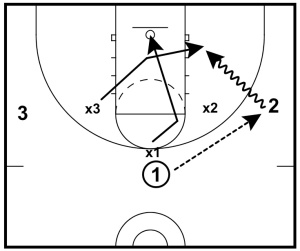
• #1 passes the ball to #2

• All three defenders jump to the ball

• #2 drives

• x3 helps on the baseline drive and takes a charge

• x1 covers down

3-on-3-baseline-charge-drill-002

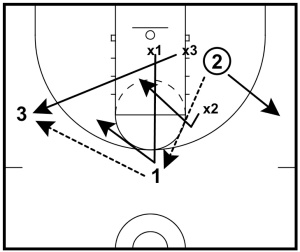
• #2 kicks the ball out to #1

• #1 passes to #3

• The defenders rotate on the passes


3-on-3-charge-drill-003

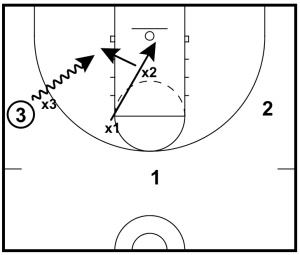
• #3 drives to the baseline

• x2 helps on the drive and takes the charge

• x1 covers down


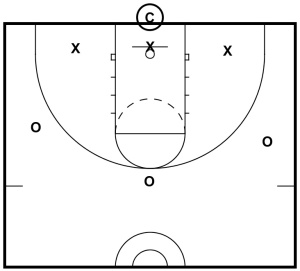
3 on 3 Closeout Drives

3-on-3-closeout-drive

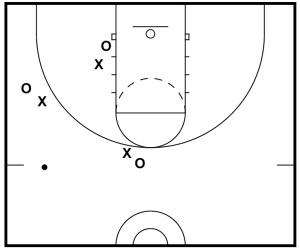
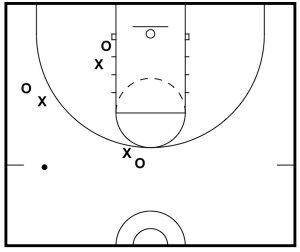
• Coach passes to one of the offensive players (O’s), who catches and drives.

• The defenders (X’s) all close out with proper technique to correct position.

• Play live to a score or a stop

Note: Add back cut if defense over plays when they closeout to a player who does not have the basketball or add a jump shot if the defender closing on the ball is late.


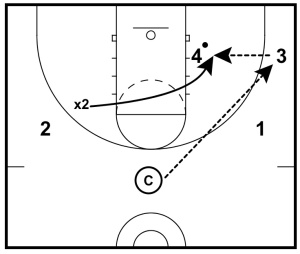
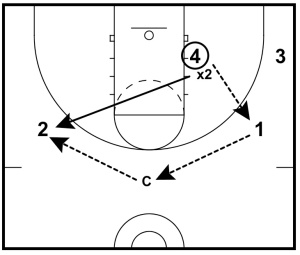
This final drill is obviously not a 3 on 3 drill, but one to think about adapting to how you defend the low post.

Scratch and Closeout Drill

scratch-and-closeout-001

• Players align as shown

• Coach passes the ball to #3 on the baseline

• #3 makes a pass to the player in the post as the defender (x2) slides down and knocks the ball out of bounds


scratch-and-closeout-002

• #4 immediately picks up a second ball and passes to #1

• #1 passes to the coach, who reverses the ball to #2

• x2 closes out to #2 and they play 1 on 1


Basketball Plays: Thru C Out Counter

By Brian Williams on October 12, 2015

Coach Vonn Read has submitted several plays from his playbook series The Basketball Encyclopedia of Plays to the Coaching Toolbox.

Vonn is currently serving as an assistant Women’s Coach at Houston.

He has also served as an assistant coach in the WNBA with the Phoenix Mercury, Orlando Miracle, and San Antonio Silver Stars.

He was an advanced scout for the Orlando Magic as well as The Charlotte Sting.


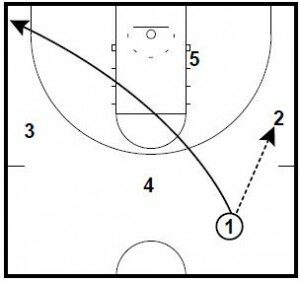
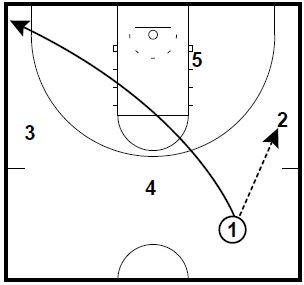
basketball-plays-1

This is a good 3-point set right out of transition for your 4 player (Shooter) at the end of the game.

The 1 player will pass the ball to the 2 player and then cut to the opposite corner.


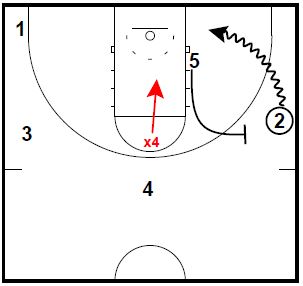
basketball-plays-2

The 5 player will step up to set the fake ball screen, which sets up the 3-point shot.

The 2 player will drive the ball hard to the baseline, looking to force help by X1 or X4.

If you only need 2 points, a lot of times this action will result in a layup.


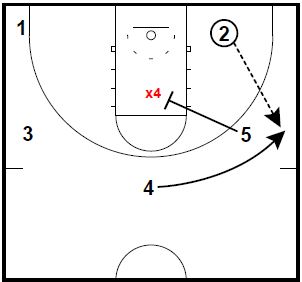
basketball-plays-3

After faking the ball screen, the 5 player will screen in on X4 in the paint.

X4 will usually help on the penetration by the 2 player, which opens up the 3-pointer by the 4 player.

The 4 player will sprint to the wing off the screen by the 5 player for the 3-point shot.

Coach Read has also put together The Basketball Encyclopedia of plays. You can check them out here: The Basketball Encyclopedia of Plays or read more about the books:

Any coach looking for the latest and innovative plays from the Professional, College, or High School levels can stop looking. With a compilation of over 7,700 different plays, you will never need to purchase another basketball playbook again. These playbooks can be used as a great reference tool for years to come. This 2 Volume Book includes plays from 19 different play categories, and they are the most extensive playbooks on the market.

The Basketball Encyclopedia of Plays (Platinum Series) contains over 7,700 Plays (Both Volumes combined) from the NBA, WNBA, USBL, and College levels from someone who has worked as an Advanced Scout or Coach on each level!!! This book has been intensely compiled over the last 21 years, with plays taken from a lot of NBA Coaches (past and present), WNBA coaches, and College coaches (Men’s and Women’s) from around the country.

Any coach that is serious about improving their knowledge of the game from an X and O standpoint will benefit tremendously from these books. These Books can be used to discover New Quick hitters, add a New Package to your playbook, or develop an entire Offensive System. There are a lot of new ideas and concepts in these books to study, and the Basketball Encyclopedia of Plays can be a great resource for coaches on all levels!!! This book is definitely for those X and O junkies who are always looking to improve as a Coach.

“THE GAME IS ALWAYS CHANGING? ARE YOU?” Vonn Read

Here is the link: The Basketball Encyclopedia of Plays

Lane One on One

By Brian Williams on October 9, 2015

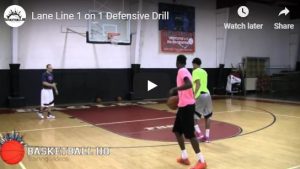
This drill called “Lane Line Ball Pressure Drill” and is among the thousands of resources for both coaches and player available from basketballhq. They have several more videos as well as basketball coaching resource articles.

Please make sure your sound is on to see the video.

Click the play arrow so see the drill. The drill is a YouTube video, so you will need to be able to access YouTube to see the drill.

The Coach in the video is Brian Baudinet, currently the Head Men’s Coach at Chatham University.

The drill can be modified to fit your needs so that it becomes your own and used during your fall skill development workouts (where those are available) or can be used in practices this coming season as well. You could change the restricted area, change the scoring, change the length that the dribbler must attain, change the number of seconds the dribbler has, or make any other changes to fit your players and your philosophy.

Like every other drill, the teaching points in the video, or that you use when you run the drill, for both the offense and the defense are what determine the effectiveness of the drills in helping your players improve.

If you have 3 or 4 players in the drill, you can have the winner of each rep stay and the loser goes to the back of the line. You can also make it a ball toughness drill by having a coach or manager be the defender and allowed to use their hands (within reason) or a blocking pad to overload the dribbler.

To score a point in the drill, the defensive player must keep the offensive player from getting to the free throw line, staying with the lane lines, in 4 seconds.

Lane Line Ball Pressure Drill

Coaching Basketball: Intentionally Creating Your Culture

By Brian Williams on October 7, 2015

Intentionally Create Your Culture

Scott Rosberg – 2015

Have you ever been part of a great team? What made it that way? Was there a special bond among teammates? Was it a place of high energy and strong trust?  Did you win a lot? For most of us who have been on some great teams in our lives, the answer to those questions is usually a resounding “Yes!” Often the next question is, “Why don’t all teams end up being great?” It can’t be only about winning because not all great teams win all the time.  Of all the questions listed above, the concept of winning a lot is not necessarily at the top of the list when it comes to memories of being on a great team. Many people will look back on some of the teams they considered as being great and realize that they didn’t win a championship or even win a lot of games.  Some of the greatest teams in the true concept of a “great team” were teams that did not win a lot of games.

So, if winning a lot of contests is not the only pre-requisite for a team being great, why don’t “great teams” happen more often? I believe everything starts with the leadership.  In sports, that person is the coach. That may seem like a lot of pressure to put on one person, especially given the fact that when we are talking about youth/school teams, we are talking about the skill levels, mental capacities, behaviors, mood swings, etc. of children and teenagers. How can we put all the blame/praise on the coach when there are so many variables in any given team situation?

It all starts with the coach because if the coach is intentional about trying to create a great team culture and experience for the kids, the chances are much greater that it will end up that way. Coaches who are intentional about what they want to see happen have more success at seeing their goals come true. That does not mean that it is a guarantee, but they certainly create a situation that is much more apt to come true if they are intentional about it.

Unfortunately, most teams in the world happen by accident. The culture and the experience is left to chance.  There is no vision, no plan, no roadmap for getting to wherever they are seeking to get.  They wander through the season hoping that it will be a good experience. They let the ups and downs and the ebb and flow of the season dictate whether or not the experience is a positive one. Oh sure, many coaches (and team leaders and team members) will talk about wanting to win whatever championship is the ultimate for their team and set that as their goal. However, goals like that create a focus on a result – a result that has many variables that could create that result or keep it from happening. Focusing only on results creates a lot more pressure. While it is at least giving them a direction to go, focusing on a result means that there is only one way to succeed – achieve that one result.

The better method is to focus on creating the culture that you would like to have in your program. Focus on your team’s standards, your guiding principles. Bruce Brown of Proactive Coaching calls these a team’s “Core Covenants.” In his booklet and presentation, “First Steps to Successful Teams” – www.proactivecoaching.info – Coach Brown says a covenant is “a binding agreement where action is physically visible. This takes the agreement beyond words to an actual vision of performance. It says, ‘This is what we believe, so therefore, this is what you will see.’”  The best covenants are focused on behavioral characteristics. When a team sets up covenants for behavior within the program, they are creating the culture that they seek. By focusing on behavioral characteristics, these teams are zeroing in on things they have control over – not results and outcomes that have all kinds of variables that influence them. For example, if a team establishes “Team-First Attitude” as a covenant, everyone on that team can make the choice to be committed to being a great teammate.  There is no pre-requisite skill, training, education, physical attribute, etc. necessary to be able to display a team-first attitude. Every single person in the program can have a team-first attitude. The same goes for work ethic, teachable spirit, discipline, mental toughness, integrity, and any other behavioral characteristic one can think of. Every player in a program can commit and live every single one of those kinds of characteristics with nothing more than acting and behaving in the proper way.

If a coach is intentional about establishing covenants, s/he creates a much more favorable chance of having them be lived in her or his program. But it takes work. Developing covenants with the leadership of the team, explaining them to the entire team, taking time to discuss them and work on them throughout the year, and doing all that they can to live the covenants must be intentionally and purposefully developed by the coach. It is a process, and the process takes time and effort. But if a great team is the goal, there is no clearer, better, more consistent and predictable way to achieve it than to work through this process with determination and purpose.  Coaches who do this in an intentional fashion create a team environment of success and excellence.

One major by-product of intentionally focusing on creating this type of culture is that these teams also have a much better chance of creating scoreboard success, too. And they are on their way to intentionally creating the “great team” experience that everyone wants to be a part of. For an in-depth look at creating an outstanding team culture, check out Proactive Coaching’s DVD Captains & Coaches’ Workshop, or better yet, have one of us out to do a Captains & Coaches’ Workshop for your teams. For more information go to www.proactivecoaching.info.

Do you intentionally create a culture in your program? If so, I would love to hear the kinds of things you do?  You can contact me through my website – www.coachwithcharacter.com or by email at [email protected]. Scott is also on Twitter @scottrosberg

About the Author of this Article

Scott Rosberg has been a coach (basketball, soccer, & football) at the high school level for 30 years, an English teacher for 18 years, and an athletic director for 12 years. He has published seven booklets on coaching and youth/school athletics, two books of inspirational messages and quotes for graduates, and a newsletter for athletic directors and coaches. He also speaks to schools, teams, and businesses on a variety of team-building, leadership, and coaching topics. Scott has a blog and a variety of other materials about coaching and athletic topics on his website – www.coachwithcharacter.com. He can be reached by email at [email protected].

Scott is also a member of the Proactive Coaching speaking team. Proactive Coaching is dedicated to helping organizations create character and education-based team cultures, while providing a blueprint for team leadership. They help develop confident, tough-minded, fearless competitors and train coaches and leaders for excellence and significance. Proactive Coaching can be found on the web at www.proactivecoaching.info. Also, you can join the 200,000+ people who have “Liked” Proactive Coaching’s Facebook page at www.facebook.com/proactivecoach. Scott can also be reached through Proactive Coaching at [email protected].

  • « Go to Previous Page
  • Page 1
  • Interim pages omitted …
  • Page 140
  • Page 141
  • Page 142
  • Page 143
  • Page 144
  • Interim pages omitted …
  • Page 288
  • Go to Next Page »

Primary Sidebar

  • Twitter
  • Facebook
  • Linkedin
coachestoolbox
personaldevelopmenttoolbox
basketballplayerstoolbox
basketballtrainer
athleticperformancetoolbox
coachingbasketball

© Copyright 2026 Coaching Toolbox

Privacy Policy