• Skip to primary navigation
  • Skip to main content
  • Skip to primary sidebar

  • Basketball Plays
    • Ball Screen Sets
    • Horns Sets
    • Man to Man Post Up
    • Man to Man Isolations
    • Backdoor Plays
    • Man to Man 3 Point Shot Plays
    • 2-3 Zone Attack
    • Baseline Inbound Plays
    • Sideline Inbound Plays
    • Combination Defense Attack
  • Drills
    • Defensive Drills
    • Offensive Drills
    • Competitive Drills
    • Passing Drills
    • Rebounding Drills
    • Shooting and Scoring Drills
    • Toughness Drills
    • Transition & Conversion Drills
    • One on One Drills
  • Blueprint
  • Practice
  • Mental Toughness
  • Skill Development
  • Offense
  • Defense
  • Store

Bigs Post Defensive Drill

Bigs Post Defensive Drill

By Brian Williams on January 3, 2016

This post player defensive dill was posted in the FastModel Sports Basketball Plays and Drills Library.

You can also find out more about FastModel Play Diagramming software by clicking this link: FastDraw

The drill was posted by Randy Sherman is the owner and founder of Radius Athletics.

As with any drill that you see someone else use, you will want to adapt it to your defensive rules and not just use it as is.

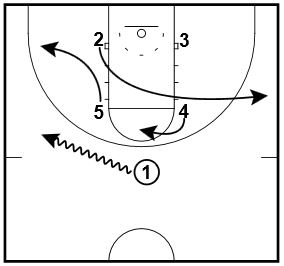
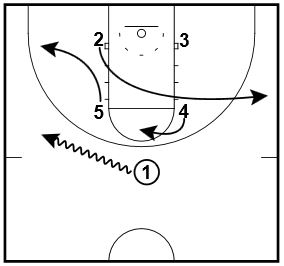
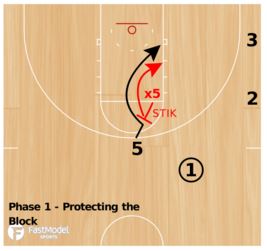
Post defense drill to teach, deny, fronting and x-step footwork as well as wing deny and 1-on-1 from the wing.
 

defensive-drills-bigs1

X5 STIKS (bumps) and disrupts 5’s move from the high post area into a low post position.

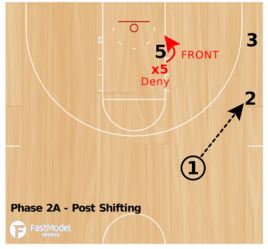
X5 assumes a topside deny position until 1 passes to 2.


defensive-drills-bigs2

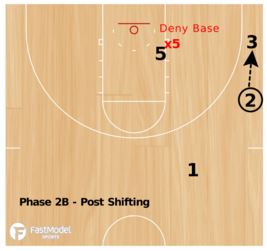
X5 assumes a pass deny position against 5.

When 1 passes to 2, X5 goes arm over and x-step and fronts 5.

X5 must move quickly as soon as the ball leaves the passer’s hands.
 

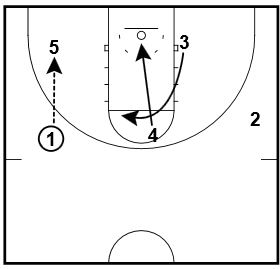
defensive-drills-bigs3

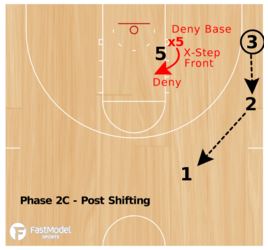
If when 2 passes to 3 in the corner, X5 assumes a baseline pass deny position against 5.

X5 must step over quickly as soon as ball leaves passers hands.


defensive-drills-bigs4

When 3 passes to 2, X5 steps over to front.

When 2 passes to 1, X5 x-steps over to deny.

REPEAT: Ball is passed from point to corner 2-3 times.


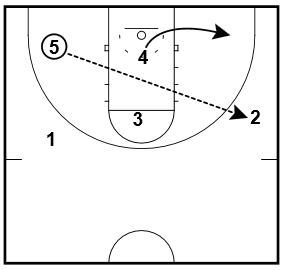
defensive-drills-bigs5

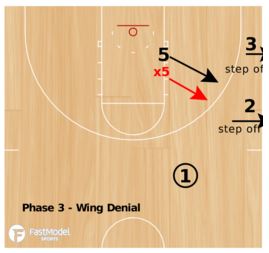
2 and 3 steps off the court as 5 breaks out to the wing.

X5 maintains a pass deny position against 5.

5 cuts and back cuts to uncover.


defensive-drills-bigs6

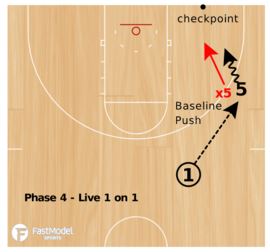
When 1 is able to complete pass to 5, X5 assumes an on ball position against 5 pushing 5 to the baseline checkpoint.

X5 and 5 go live one on one with a two dribble max for 5.

Finish with a contest and blockout.
D1 Defensive Notes

By Brian Williams on December 30, 2015

The Tom Izzo and Bo Ryan Notes below are from Coach Scott Peterman’s eBook Inventory.

This week’s eBook bundle is the Boston Celtics Space, Pace, and Pick and Pop Offense paired with the Michigan State Defense Playbook.
Click here for details on Boston & Michigan State

and, as always email or call/text me at (317) 721-1527 with any questions.

I hope you can at least get some ideas that might fit your needs.

Tom Izzo

These notes are from John Zall’s Michigan State Defensive Playbook

“Hit, Find and Fetch” – this is Michigan State’s rebounding mantra. Tom Izzo preaches stepping towards the player YOU are boxing out and making contact to force them away from the rim. Instead of holding your seal and letting the ball hitthe floor; Michigan State players are taught to go find the basketball and rebound it out of the air.

• Use 2 hands to go after the basketball
• Rebound ball above head = good rebound
• Low man wins when making initial contact
• Sends 4 to the offensive glass (Point Guard gets back). This forces the other team to adjust.
• Must be able to get back behind post player on shot attempt

It is important to contain the basketball. Multiple help rotations lead to players being out of position to rebound.

Defensive teaching point–more turnovers are forced by pressure on the basketball rather than the other 4 defenders.

Must have elbow help and block help.

Mick Cronin, Cincinnati

This first group of notes from Coach Cronin were listed by Zac Boisvert on his site www.pickandpop.net

Offense/Defense Synergy

A major key to your defense is your offense (live ball turnovers will kill your defense)

Control the game with your offense so that teams are forced to 5 on 5 versus your defense

Personnel is everything (Why is this only talked about offensively? Does your defensive scheme fit with your personnel?)

Practice

Majority of team work in practice involves some kind of disadvantage work.
Create drills where you can’t possibly rest.
Playing hard isn’t enough. You need to play smart too.

Stance

Chest in front
Butt to the rim
Make him score over you
Fingers to the sky
Hands in front (forces you to have your head back)
As he picks up his dribble, inch up to his body to take away vision

Difference Between Winning and Losing

Willingness to play team ball
Willingness to be held accountable
Willingness to cover for each other

Just because a player is talented, doesn’t mean you can win with him

Sell your team on why we win and other teams don’t (Make sure they understand it’s often not about talent)

Bo Ryan

These notes are a part of Scott Peterman’s World’s Greatest Coaching Notes Volume 12

Philosophy:

I. Give up fewer shots
– turnovers
– eliminate 2nd & 3rd shots

II. Poorer shots
– shots out of range
– low % shots
– off balance

Whole Method:
– keep ball out of middle
– keep ball out of post
– force catch outside the 3 pt line
– one pass away deny/gap

*shell drill/lane line
-hand up hand down/ mirror ball
-maintain committed side
-one pass away deny (thumbs down) hand in passing lane
-2 passes away weak side- one foot in paint
-in post 1 step cushion

*shell drill/ wing
-ball close out, hand up and down (post pass)
-one pass away in post/DEAD FRONT
-one pass away, jump slightly to ball/hand in passing lane
-two passes away-drop to middle of lane (back to basketball, until ball is put on floor)
-opposite wing-middle of lane (see ball and man).

*shell drill/to other lane line
ball close out
1 pass away/hand in passing lane
2 pass away/1 foot in paint

*shell drill perimeter
-ball close out
-one pass away deny/hand in passing lane
weak side help/middle of floor
post/dead front

*shell drill/post feed
-if post “D” gets caught behind, stay between man and basket
-1 pass away, help and dig up
-RAID the post/be ready for skip pass/close out recover

STANCE
-base wider than shoulder
-sitting position
-back straight
-hands out
-play bigger than you are
-if dribble/dig up

DRILLS
1. shadow drill
2.zig zag
*dead-mirror ball, pass to coach, jump to ball
*charge, and get up quick
3. wipe the floor
* 2 slides open up/square back up/dribble swipe up/shot, yell hot block out, square back
up,/drop, dive,/dead, mirror ball

Wing denial drill
-show in gap
-open in post

Close out drill
-get high hand pressure
-contest pass into post
-quick short steps
-guard against triple threat
-move when ball is in air

Driving line drill
-force offense to baseline
-after ball is dead, make pass to coach go again
Jump to ball drill
-jump to ball/front cutter
-pass to coach, jump to ball, slide, open, secure ball (CHIN UP)
– go 15- 30 sec.

Post “D” drill
-don’t lean or hug post/1 step cushion
-wing pass is made to wing “D” drive leg up and over to dead front
-“O” trying to pin
*Med. To high post
-deny
-go behind
-3/4 front
-IF post dives low-FRONT

Post “D” 1 on 1
-all players work on post “D”
-“D” has to beat post player to spots
-go low to high
*30 sec. to 1 min.

Help and recover wing pent. Drill

*Dribble pent. From wing
-help, stop pent. When dribble is dead/recover
-kick for shot/recover high hand pressure
-block out, rebound, chin, outlet

*Post drop rotation drill
-“D” start in paint
-meet dribble pent. Before paint(help with chest up, hand back, don’t reach)
-rotate recover on shooter
-block out/ chin/outlet

MUST HAVE SYNERGY

NOTES:
1. Defense is hard work
2. guard players like you hate to be guarded
3. 5 on 5
4. Heart and Desire
5. Defense can always hold you in a game
6. Conditioning is a MUST!

This week’s eBook bundle is the Boston Celtics Space, Pace, and Pick and Pop Offense paired with the Michigan State Defense Playbook.
Click here for details on Boston & Michigan State

and, as always email or call/text me at (317) 721-1527 with any questions.

Painfully Ill Advised Shots

By Brian Williams on December 29, 2015

This article was written by By Stephen Shea, Ph.D and published on his blog:  Basketball Analytics.  You can find out more about Dr. Shea and his work in the field of Basketball Anayltics at the end of this article.

Editor’s Note #1 from Brian Williams, The Coaching Toolbox: The acronym that Dr. Shea uses for Painfully ill-advised Shot Selection “PISS” is to make the point as to how he views those shots. You might want to find a new way to abbreviate this stat if you do want to use it with your players, and the intent is not to offend any coaches who are reading.

Editor’s Note #2 from Brian Williams, The Coaching Toolbox I realize that not everyone who reads this plays with a shot clock, but I do think that there are some very good points to think about–especially the point that by taking contested dribble pull up jump shots, you score at the same rate as a player that teams foul on purpose to force him to shoot free throws.

By Stephen Shea (@SteveShea33) and Christopher Baker (@ChrisBakerAM)

NBA possessions are a valuable and limited resource. Each shot is a gamble of that resource. The goal of an NBA offense is to try and create the best bets—shots with the highest expected winnings.

Of course, defenses have the opposite agenda. They are trying to force the worst bets.

Analytics have taught us that certain shots have better odds than others. For example, catch-and-shoot jumpers are better than pull-ups, players will shoot better when open than when contested, and mid-range FGA produce far fewer points per possession than shots from 3 or at the hoop.

The analytics are clear on which shots are the most desired, but offenses can’t always get what they want. As the shot clock counts down, the likelihood of finding a good shot dwindles. A mid-range catch-and-shoot jumper from a capable shooter or a contested 3 might become a reasonable wager.

Thus, we cannot always say that a contested 3 is bad simply because an open 3 would be better. We can’t simply suggest that every open mid-range jumper should have been an attempt at the rim. Determining the quality of a particular shot just isn’t that simple.

However, there is a class of shots that is so foolish that it can be universally condemned.

Pull-up and contested 2-pointers from at least 10 ft. from the hoop and with at least 5 seconds on the shot clock are the antithesis of analytics. Pull-up, contested, and mid-range are an efficiency-decreasing super team. These shots are particularly asinine when they are taken with enough time on the shot clock for a kickout.

To avoid repeating the phrase, “pull-up, contested, 2-pointers from at least 10 ft. from the hoop and with at least 5 seconds on the shot clock” and because we have an unhealthy interest in concocted titles for the sake of acronyms, let’s call these choices “painfully ill-advised shots” or PIS.

Last season, players generated 0.767 points per shot on PIS. (All stats are courtesy of NBA.com.) That’s the equivalent of a 25.6% 3-point shot or 2 free throws from 38.4% free throw shooter. DeAndre Jordan had a FT% of 39.7 and teams intentionally sent him to the line.

At first glance it may appear as though certain players are efficient PIS takers. Tony Parker shot 50.8% on 118 PIS in 2014-15. Beno Udrih shot 49.6% on PIS in 2014-15. However, neither of these players had previous seasons that suggested their efficiency is sustainable. Parker shot 43.1% and Udrih had a PIS% of 39.3 (albeit on a small sample set) in 2013-14.

With only two seasons of the appropriate data to calculate PIS, we can’t say for certain that no players can consistently be efficient enough to make PIS a reasonable choice for the offense. However, preliminary results suggest not.

Not every player gets the same opportunity to take PIS. PIS is best understood as a percentage of a player’s shot selection. Let PIS selection or PISS be the percentage of a player’s FGA with at least 5 seconds on the shot clock that were PIS.

Most good players don’t often choose to take PIS. James Harden had a PISS of 10%, Steph Curry had a PISS of 8.5%, LeBron James had a PISS of 8.2%, Manu Ginobili had a PISS of 5.4%, and Demarre Carroll had a PISS of 2.7%.

Of course, there are the other players, players that have never seen a bad shot, or players with a seemingly uncontrollable urge to PISS.

If it were a contest, DeMar DeRozan would be the PISS champ.

DeRozan had a PISS of 31.6%. Nearly a third of his 850 shots with at least 5 seconds on the shot clock were PIS.

DeRozan shot an atrocious 33.5% on PIS. That equates to 0.67 points per shot. In all of his 2014-15 FGA, DeRozan scored 0.85 points per shot. If he simply removed those 269 PIS (kicked out instead of forcing a bad shot), he would have raised his efficiency to 0.92 points per shot on the season.

DeRozan’s team would have appreciated the kick outs. His team produced 1.02 points per shot. If his team kept that efficiency on kick outs that replaced DeRozan’s 269 PIS, the team would have scored another 93 points in DeRozan’s 60 games.

DeRozan’s PISS of 31.6% in 2014-15 was up from 26.2% the previous season. As the influence of analytics in the NBA grows, we might expect players’ PISS to decrease. In time, it probably will. In fact, DeRozan might be one of the last of a dying breed. Players that depend on PIS as significant portions of their offense were the norm in the 80s and 90s. In 5-10 years, they will likely be extinct.

However, suggesting that analytics are only pushing PISS down would be ignoring half the game. Analytically savvy teams are studying their opponents’ offensive weaknesses. They are recognizing when players like DeRozan will too easily take a PIS. Then, they are forcing that player to take a PIS. If you don’t believe me, listen to Shane Battier talk specifically about his defensive strategy to force Kobe to take a PIS. Click here to listen to Shane Battier on how analytics made him better (three and a half minutes).

In an interview, Battier revealed, “after studying and going through the school of analytics, I knew exactly to a tee who Kobe Bryant was. And I knew as a defender trying to stop him, Kobe’s worst-case scenario and my best-case scenario was to make him shoot a pull up jumper going to his left hand…”

So, DeRozan’s increase in PISS might be a result of both him not realizing the inefficiency of PIS and opposing defenses exploiting his lack of that understanding.

DeRozan is the PISS champ, but he’s not the only player taking too high of a percentage of these shots.

PISS appears to be more an intrinsic quality of the individual than a product of a team’s offensive system. Jarrett Jack, Shaun Livingston and Mo Williams have all changed teams over the last two seasons and seen their PISS follow them.

This doesn’t mean that teams can’t employ strategies to decrease PISS. Of course, teams can try to avoid acquiring players with a high PISS. Beyond that, teams can stress the importance of avoiding these shots.

Teams can support players by providing alternatives to a PIS. For example, the team can regularly station quality shooters on the perimeter and in the corners. This provides good options for a kick out on penetration. Good shooters on the perimeter will also keep help defenders out of the lane and increase the likelihood that the penetrating player will have a path all the way to the hoop.

Houston, Philadelphia and Atlanta had the lowest team PISS in 2014-15. That’s not surprising given that these teams are all recognized as being analytically savvy. Philadelphia’s position shows that teams do not need a tremendous amount of talent to have a low PISS. It’s an organizational decision based on an awareness of analytics.

For teams, the applications of this analysis are direct.

  1. Teams should be reluctant to acquire players with high PISS. This is especially true when that individual is weak in other areas (such as defense).
  2. Teams should look to make defensive adjustments that force players to take a PIS. This would mean running a player like Kobe Bryant off of the 3-point line while having the help defense under the hoop that will persuade Bryant to pull up in mid-range.
  3. Finally, teams should implement offensive systems that reduce PISS. This means stressing the team’s disinterest in this shot, but also playing the personnel and designing plays that regularly provide better opportunities.

NBA possessions are a valuable and limited resource. Players taking contested, mid-range, pull-up 2-pointers with at least 5 seconds on the shot clock are pissing it away.

About the Author, Stephen Shea

Stephen Shea is an associate professor of mathematics at Saint Anselm College in Manchester, NH. He earned a Ph.D. in mathematics from Wesleyan University in Middletown, CT, and a B.A. in mathematics from The College of the Holy Cross in Worcester, MA. His mathematical expertise and publication record is in the areas of probability, statistics, dynamical systems, and combinatorics. For years, he has been applying his abilities in these areas to study professional and amateur sports. Stephen is a managing partner of Advanced Metrics, LLC, a consulting company that provides analytics solutions to basketball and hockey organizations. At Saint Anselm College, he runs a course on sports analytics. His sport writing has been featured in the Journal of Quantitative Analysis in Sports, Psych Journal, the Expert Series at WinthropIntelligence.com, and the Stat Geek Idol Competition for TeamRankings.com. In 2013, Stephen coauthored the book, Basketball Analytics: Objective and Efficient Strategies for Understanding How Teams Win, and co-created the accompanying blog BasketballAnalyticsBook.com. In 2014, he authored Basketball Analytics: Spatial Tracking.

The Spurs 8 Keys to Ball Movement

By Brian Williams on December 22, 2015

This article was written by Kyle Ohman and originally posted on his site, BasketballHQ.

I hope you can take some points from this article to help with your offensive play.

1. Ball Reversals

  • Make the Defense Move
    • The more times the ball goes from side to side, the more the defense must rotate and closeout.
    • Be down ready on the back side as the ball is swung to you.
    • Attack closeouts that are too close, and shoot the ball when the defense closes out short with hands down.
  • Don’t Catch and Hold the Ball
    • Be thinking one play ahead and be decisive with your moves.
    • Don’t waste your dribbles. Either drive the closeout, shoot, or move the ball.

2. Player Movement

  • Don’t Stand
    • Players that stand are easy to guard and force one on one offense.
    • Sometimes you may need to space, but most of the time you should always be moving.
  • Hard Cuts
    • Read your defender and make the appropriate cut.
      • Back cut
      • Face cut
    • Make decisive cuts.
    • Set up your defender before cutting.
    • Slow to fast.
    • Look to score on every cut.
    • Your cut may open up a scoring chance for a teammate.

3. Screens

  • Set GREAT Legal Screens
    • Use screens to help get other teammates open.
    • Must head hunt on screens.
    • Never screen and stand.
    • Read the defense and offensive player using the screen to determine whether you should roll or space after you set the screen.
    • Slip the screen if you are being overplayed.
  • Use Screens to Get Open
    • Set up your defender before using a screen. EVERY TIME.
    • Read your defender when using the screen and then make the appropriate cut.
      • Curl cut
      • Straight cut
      • Fade cut
      • Pro cut
  • On the Same Page
    • The player using the screen and the player(s) setting the screen must work together.
    • Must have great timing and spacing when executing a screen.
  • Hand Offs
    • Use hand offs similar to ball screens to help teammates get open.
    • If your defender is cheating the hand off, fake it and then make a move.

Resources: Game Situation Hand Off Shooting Drill, Game Situation Pick & Pop Shooting Drill

4. Penetration

  • Drive and Kick
    • Great penetration forces the defense to suck in and help, which opens up the kick out pass.
    • Get your shoulders to the basket before making the kick out pass.
      • This sells that you are attacking the basket and makes the defense sink in.
    • Receiver needs to be down ready to either shoot, drive, or swing the ball. Don’t catch and hold!
      • If you catch and hold, the defense can recover and the ball movement is dead.
  • Stay Under Control
    • Don’t leave your feet and open yourself up to charges and wild passes.
    • Don’t over penetrate into trouble.
      • If you get too deep into the defense, there are too many hands to deflect your pass.

Resources: Two Ball Drive and Kick Shooting Drill

5. Passing Angles

  • Receiver Needs to Create Passing Lanes
    • Don’t stand and watch on penetration.
    • Either slide up or down to create a great passing lane.
    • A great time to move is once your defender turns their head to watch the ball.
    • Find the passers eyes, especially when the ball goes into the post.
  • Down Ready
    • Don’t catch the ball standing straight up and down.
    • Anticipate what you are going to do with the ball by how the defender is guarding you; shoot, drive, or swing pass.

Resources: Game Situation Post Skip Pass Shooting Drill

6. Inside Out

  • Post Play
    • Get the ball into the post and then look for kick outs when the defense helps.
    • Find the post players eyes and create passing lanes by moving up or down.
    • Hard cuts on the weak side will be open with a great post passer.
  • Pass Fakes
    • Being unselfish opens up opportunities for pass fakes and keeps.
    • Works great for hand offs in the high post area.
    • Must sell the pass.
    • Use your body to shield the ball from the view of the defender.

Resources: Game Situation Post Entry Relocate Shooting Drill

7. Designed Plays

  • Executing Offense
    • Use set plays to help establish ball movement and player movement.
    • It can be a set play or a motion offense.
  • Read the Defense
    • Don’t be a robot to the play.
    • If the defense is cheating the play than make them pay.

8. Unselfish Plays

  • Extra Pass
    • Turn down an okay shot for a great shot.
    • This type of play will be contagious and lead to better shots for everyone.
  • Set Up Teammates
    • Make a move with the specific desire to set up another teammate for an easy shot.
    • Not just the point guards responsibility.
  • Celebrate Winning Plays
    • Get excited when a teammate makes an unselfish play.
    • It must be all about the team.

Leadership Notes for Basketball Coaches

By Brian Williams on December 21, 2015

Sharing some notes that I have taken recently from some of my favorite leadership sources. Some of them, I hope you can use for yourself and your staff, others for your players, and most of them for both groups!

As with all of my posts, I am sure that you won’t agree with everything that is listed here and will probably find some that you either can use as is or that you can modify to meet your needs.

Kevin Eastman

Twitter: @KevinEastman

The mind & the attitude can have a major impact on how far one can go. The mind has to be “clutter free” and the attitude has to be “all in”!

Understand that trust has eyes & ears. It evaluates the consistency & authenticity of what it sees & hears. It takes its time to evaluate you!

Make sure the “give-get” percentages favor the “give”. Giving should be part of our make up. We all truly do have things to give & share!

As much as we like to tell people what we think it’s even more important to put thought to what we say. Hard to take words back!

Just as you work out physically, you must also get your repetitions in mentally. Challenge yourself with heavier mental reps as well. Stretch yourself!

Every so often a great exercise is to get away & just think about or remind yourself what you TRULY BELIEVE in; things that are non negotiable!!

Give yourself a chance to succeed. Success is about investment; adjustment; & commitment. Determine which, if any, you need to improve on!

To be a true teammate: must hold yourself accountable to everything you hold others accountable to. The one thing a true team is not: self centered!

Everyone says communication is so important-then why are we not as good at listening? It’s critical to success. We ALL need work on this SKILL!

To be a great teammate your pride will take a hit at times and your pride can never take precedent over the success of the team!

Being a good teammate is still doing your part when things are going bad for you. Being a good team is helping that player get out of it!

Consistency is a direct result of doing the right things the right way–now. Focus on the execution of now & discipline to do this every day!

A team will always have challenges and issues. That is where the strength of a team must show up: using everyone in anyway to get through them!

I also have a sample five minute video of Coach Eastman discussing his views on skill development. Click this link to see it.

John Carrier

These notes were reposted with permission by John Carrier on his basketball coaching blog. Here is a link to the blog: www.johncarrier.blogspot.com

I am currently reading Phil Jackson’s book, Eleven Rings. One gem I’ve pulled out in the first 100 pages is the “Bullseye Test” he uses with his players.

The Bullseye Test is simple, yet insightful. Give each player a three ring bullseye. Have them write where they feel that they are in terms of their connection to the rest of their teammates. Don’t give them anymore than that. You can read a little more from the inside of the book at Amazon by clicking the cover of the book at the left, or you can click on this link: Eleven Rings: The Soul of Success

You then look at their bullseyes and see how connected each person feels to our group. It also gives you a handle on how connected the team feels as a group. If they are very connected they are in the middle, if they feel kind of connected their name will be in the second ring, and if they don’t feel connected they write their name on the last ring or outside the rings. A lot of times it comes down to playing time – the more they play the closer to the middle they write their name. So you have to account for that a little bit when looking at them.

Once you’ve done the exercise, you can use them to have individual talks with your players. Ask lots of questions about why they feel that way, and if they are outside the middle how can we move them closer (without adjusting playing time of course). It will also help you determine if how to proceed with team bonding activities during the season. It’s something we will definitely use this season.

The following are some notes that he took at the Minnesota Basketball Coaches Association Clinic

John Tauer – St. Thomas University – Motivation

One of the many good things he touched on was what gives people intrinsic motivation. People are mostly motivated by three things:

  1. Autonomy
    Choice in life.
    Give players choices in what drills you do (within reason).
    Even one or two choices per practice can be powerful. 
  2. Togetherness
    Players need to belong to something bigger than themselves and have a more powerful purpose.
    Keep your finger on the pulse
    Team building
  3. Competence
    Being good at things.
    How can you put your players in positions to find success?

TJ Rosene – Emmanuel College/PGC – Building a Culture

Greatest Teammate Exercise
-Have players close their eyes and imagine the greatest teammate they ever had.
-Call on players to share the characteristics of that teammate.
-Make a team list of the traits of great teammates.
-Turn it around on them – why can’t EVERYONE on this team be a
great teammate?
-Make the list into a “commitment list” that everyone is going to
commit to (coaches included) and everyone will be held accountable
to for the year.

Rocking Chair Statement
-As a coach, write a statement about what you want players to remember about you when you are old in a rocking chair on your front porch!

The Best At What They Know
-Everyone is the best at what they know.
-If you’ve got a problem player, they are likely exhibiting that behavior because that’s what they know.

Communication Must Haves
-Truth, Love, Transparency
-N.I.T.E
+Name, Information, Tone, Eye Contact
+Simple but effective

Open Mic Monday
-Do this as a team
-Players can stand up and say ANYTHING that is on their mind, especially things they are frustrated with.
-They can also ASK ANYTHING of teammates and coaches and will receive an honest answer.
-You must speak it in love and not anger.
*This is a GREAT WAY to make sure that issues stay in house and don’t ever boil over.

Lion vs. Sparrow
-Lion is content and confident. He doesn’t worry about anything he can’t control.
-The sparrow is always frantic.
-Lions play through bad calls, band bounces, etc without emotion.
-Sparrows constantly wine and complain
*Might change it to wolf and squirrel to fit Minnesota.

Post Catch 1-2-2 Zone Attack

By Brian Williams on December 20, 2015

A set to run against a 1-2-2 zone defense to consider.

This action was included in the Xavier Men’s Basketball Coaching Newsletter.

If you are interested in seeing their Newsletter Archives and/or subscribing to their newsletter, you can do so at this link: Xavier Basketball Coaching Newsletter

Diagrams created with FastDraw


POST CATCH VS. 1-2-2 ZONE

basketball-plays-1-2-2-1

Box set. 1 bends the ball to the left wing.

5 moves to the short corner, baseline area.

2 cuts to the opposite wing.

4 moves to the high post.


basketball-plays-1-2-2-2

1 passes to 5.

On the catch by 5, 4 dives and 3 fills into the high post area.


basketball-plays-1-2-2-3

5 skip passes to 2 opposite.

On the catch by 2, 4 continues into the ball side short corner area.


xavier

5 looks to get the ball to 4 along the baseline.

On the catch by 4, 3 dives and 5 cuts to fill the area in the high post.


  • « Go to Previous Page
  • Page 1
  • Interim pages omitted …
  • Page 134
  • Page 135
  • Page 136
  • Page 137
  • Page 138
  • Interim pages omitted …
  • Page 288
  • Go to Next Page »

Primary Sidebar

  • Twitter
  • Facebook
  • Linkedin
coachestoolbox
personaldevelopmenttoolbox
basketballplayerstoolbox
basketballtrainer
athleticperformancetoolbox
coachingbasketball

© Copyright 2026 Coaching Toolbox

Privacy Policy