• Skip to primary navigation
  • Skip to main content
  • Skip to primary sidebar

  • Basketball Plays
    • Ball Screen Sets
    • Horns Sets
    • Man to Man Post Up
    • Man to Man Isolations
    • Backdoor Plays
    • Man to Man 3 Point Shot Plays
    • 2-3 Zone Attack
    • Baseline Inbound Plays
    • Sideline Inbound Plays
    • Combination Defense Attack
  • Drills
    • Defensive Drills
    • Offensive Drills
    • Competitive Drills
    • Passing Drills
    • Rebounding Drills
    • Shooting and Scoring Drills
    • Toughness Drills
    • Transition & Conversion Drills
    • One on One Drills
  • Blueprint
  • Practice
  • Mental Toughness
  • Skill Development
  • Offense
  • Defense
  • Store

Field Goal Percentage Shooting Drill

Field Goal Percentage Shooting Drill

By Brian Williams on May 3, 2016

These two shooting drills are among the thousands of resources for both coaches and player available from basketballhq. They have several more videos as well as basketball coaching resource articles.

The drills are coached by Ryan Panone.

I encourage you to think about the best way to tweak the drills before you implement them so that they offer the most benefit for your players. Even as you are first implementing them, you may need to continue the process of making some adjustments so that they are contributing to the improvement of your players.

You can change the number of shots, the percentages, the spots of the shots (distance), the amount of time they have to shoot, types of shots, etc… so that the drill helps to contribute to your objectives.

If you have multiple baskets, you can make the drills into team drills by having 4 or 6 players shoot at a time.

Make sure that your speakers are on to hear the narration and that you can access YouTube to see the videos.

Click the play arrow to begin the videos.

Field Goal Percentage Shooting Drill

In my opinion, any time you keep some type of score, it helps players to focus and also helps both you and them measure improvement.

You could let the players decide what level they will shoot for and talk to individuals about adjusting if you feel that they are not challenging themselves enough.

Stephen Curry Warmup Floater Drill

You might not want your players shooting all these shots, and you might not want all of your players shooting the same types of floaters, but his point about making sure that players who shoot floaters in games need to practice them in an equal ratio to the other shots that they practice and shoot in games, whatever you feel that ratio is.

Brad Stevens Off-Season Commitment

By Brian Williams on May 2, 2016

This post is a few years old, but has some good points to stimulate your thinking for what you can do to be most productive in your work to improve your program this summer.

More takeaways from my latest reading on Texas A & M women’s assistant Bob Starkey’s HoopThoughts. If it is not on your regular reading list, I recommend to add it. There are great articles on all aspects of coaching basketball.  I am not suggesting that coaches at all levels have the time and resources for such large improvement projects, but I think we can all come up with some projects that will help our teams improve.

“I’m a big believer that championships are won in the off-season, as must would agree.  But many think this is only conducive to players.  In fact, what coaches do in the off-season is often more important in the improvement or decline of their program.” Bob Starkey

Notes on Brad Stevens:

Brad Stevens summer laid the groundwork for the Celtics’ 15-win improvement and playoff appearance this season (204-15). It was a thorough plan rooted in research.

“I just kind of think of things I’d like to know, and I embark on a project,” Stevens said. “Sometimes they end up being worthless, and sometimes they help you. But it’s important to analyze, work, and scrutinize. Be critical of yourself, and start there.”

When looking back at 2013-14, Stevens knew the Celtics had faltered late in close games. In the final five minutes of contests in which the score differential was 5 points or less, the Celtics had a net rating — offensive rating subtracted by defensive rating — of -25.4, 29th in the league. Furthermore, in those situations they were averaging 16.1 turnovers per 100 possessions, the 28th-worst mark in the NBA.

The Celtics had not executed down the stretch and Stevens wanted to know why. So he began analyzing every possession in the last five minutes of every Celtics game that year.

There are generally about 200 total possessions in an NBA game, and the rate typically increases in the last five minutes because of fouls, so Stevens probably analyzed well over 1,500 plays.

“I broke down every possession in the smallest of details,” he said. “It was the most arduous — well, maybe not arduous, because it’s not real work compared to what some people do for a living — but it was the most boring yet helpful thing I probably did last year. It helped me figure out a lot.

“When you’re not in the season, you detach emotionally and you can see what guys are and aren’t doing, what guys struggle with, what you could have done to help them be successful and how you can be better moving forward.”

At the start of this past season, Stevens presented his findings to his players. His message was simple: You’re closer than you might think.

“He put it to us in a way that gave us confidence, that if we do these few plays a little bit better, it could result in making the playoffs,” guard Evan Turner said. “It gave us an idea of how slim the difference is between having a successful season and not, and we realized they were fixable mistakes.”

This season, the Celtics improved their net rating in late-game clutch situations from -25.4 to -7.5, and they lowered their turnover ratio from 16.1 to 12.6.

Stevens’s offseason focus was not solely on his players. He also identified about 35 stars from around the league whose games he admired. Then he assigned groups of them to his staff — also taking five for himself — and asked his assistants to dig in.

“We studied them inside and out,” Stevens said. “What made them great? What were their flaws?”

Assistant Micah Shrewsberry was tasked with analyzing guards Damian Lillard, Kyle Lowry, Tony Parker, and Ty Lawson. He said the project helped identify traits that they could pass on, and it also gave the Celtics a head start on individual scouting heading into the regular season.

The notes were taken from an article that was written by Adam Himmelsbach for the Boston Globe and you can read it at this link.


PLAYERS & COACHES: ENJOY & EMBRACE THE GRIND

Bob Starkey

Too many of us, young coaches included, want to be the overnight success story.  Players want to excel without executing…play without preparing…position without persevering…acquire without acting…take a test without the test of time…control without concentration.

Coach Dale Brown called it “the instant gratification syndrome” — some refer it to a “microwave society.”

I have been blessed beyond belief to work with some of the games greats — players and coaches that achieved the maximum benefits of a dedicated lifetime.  In studying these people I have found one thing in common.

It’s not that they worked hard — though they did.  It’s not that they overcame adversity — though they did.  It’s not that they did the little things necessary — though they did.  It’s not that they did the things they didn’t enjoy — though they did.

It’s the attitude in which they did it all.

They truly great ones — on a daily basis — over the LONG HAUL — not only do all the above but they actually ENJOY and EMBRACE the GRIND.

They no doubt groan when they roll out of bed at 5 AM in the off-season, but when they get to the gym, the track or the weight room, the adrenaline kicks in because of the incredible desire they have to excel and the knowledge they have of what it will take to get there.

These thoughts came to me as I read “Sometimes You Win, Sometimes You Learn,”by John Maxwell in a plane jetting across the Southeast this weekend.  There was a poem in the book titled “Climb the Steep” by James Casey:

“For every hill I’ve had to climb
For every rock that bruised my feet
For all the blood and sweat and grime
For blinding storms and burning heat
My heart sings but a grateful song
These were the things that made me strong.”

 
If you coach, ENJOY and EMBRACE the GRIND.  Take the road less travelled. Push yourself beyond all limits.  Are you finding time to read — blogs, books, magazines?  Not enough time?  Kevin Eastman is an assistant in the NBA and he finds an hour each day simply to read — and GROW!  I can’t even begin to imagine his time constraints — which is why he reads at 5 AM each morning.

Are you watching video…not just on your team but other teams…do you have teaching DVDs to study and learn.  Are you attending clinics…working camps…do you have a circle of influence of coaches and people you respect that can take you to another level.

Continual learners…continual teachers!

I am not a smart guy by any stretch but I do work extremely hard.  I have for over 30 years and I’m scared to slow down.  I’m reminded of the Steve Nash quote: “If every basketball player worked as hard as I did, I’d be out of a job.”  I feel the same way as a coach.  If I stop working..It I stop studying the game…If I stop learning  —  then the smarter coaches will pass me up — gotta keep working.

I heard Kelvin Sampson at a clinic about a decade ago when he was still at Oklahoma and he said, “All coaches have great energy at practice for the first two weeks.  But then a lot of ’em lose it.  They get a little tired or a bored.  The best know how to sustain the energy.”

As a coach, we are more than two weeks in — are you still humming along?  Still bringing the juice as practice?

ENJOY and EMBRACE the GRIND!

Basketball Plays: Spurs 4 Out Down

By Brian Williams on April 27, 2016

This 4 out 1 in set play is from the San Antonio Spurs Playbook that was compiled by Wes Kosel

The Spurs Playbook and the Golden State Warriors Playbook make up this weekend’s featured eBook bundle. You can find out more about them at this link:

Spurs and Warriors Playbooks

If you have any questions about the Playbooks, please feel free to email me or call/text me at 317-721-1527‬.

If these sets do not fit your players, I hope you can at least get an idea from them that you might be able to incorporate into what you currently do.

Diagrams created with FastDraw

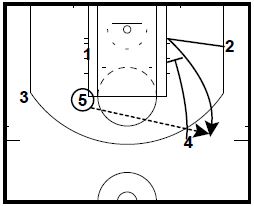
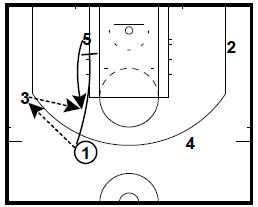
basketball-plays-spurs-4-out-down1

1 passes to 3 then screens down for 5.

5 cuts up to the elbow looking for the pass from 3.


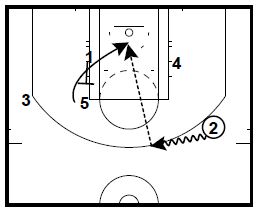
basketball-plays-spurs-4-out-down2

If 5 gets the ball but doesn’t have a shot, he turns to pass to 2 cutting up off of a down screen from 4.


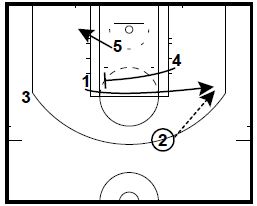
basketball-plays-spurs-4-out-down3

2 dribbles toward the top of the key as 1 sets a back-screen for 5.

2 looks to make the lob pass to 5 for a dunk.


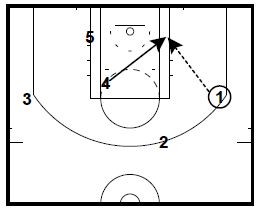
basketball-plays-spurs-4-out-down4

If the lob isn’t open, 4 screens across for 1.

2 looks to pass to 1 for a shot.


basketball-plays-spurs-4-out-down5

If 1 gets the ball on the wing but doesn’t have a shot, he looks to pass to 4 cutting to the low post.


This 4 out 1 in set play is from the 2014 San Antonio Spurs Playbook that was compiled by Wes Kosel

The Spurs Playbook and the 2014-15 Golden State Warriors Playbook make up this weekend’s featured eBook bundle. You can find out more about them at this link:

Spurs and Warriors Playbooks

If you have any questions about the Playbooks, please feel free to email me or call/text me at 317-721-1527‬.

To Yell or Not to Yell – That is the Question

By Brian Williams on April 26, 2016

This article was written and contributed by Scott Rosberg

This is the next post in a series of posts that come from some ideas I have on coaches being teachers. The majority of this post comes from a section in an upcoming course on coaching that I will be offering later this year. I will have more information on the course as we get closer to its release later this summer.

Teachers and coaches both use a variety of communication methods when dealing with their students and athletes. While most teachers don’t yell too much at their classes, we do see this happen more often in sports with coaches yelling at their teams. Today, I want to talk about the concept of yelling in coaching. Should we or shouldn’t we?

There are some people who believe we should never yell at children, and there are some who seem to make it a daily habit. As with most things in my life, I believe moderation is probably the best course to take when it comes to this. Unfortunately, too many coaches seem to believe that this is the only way to communicate with players.

Think of the long-held stereotype of a coach or the concept of an “old-school” coach. There is a good chance that part of your thoughts have a coach barking at players in some fashion, trying to “motivate” them to perform. Many of you are probably seeing a specific face in your thoughts, too. That face is probably either a coach you had in your life or a famous coach. Is the image you have of this coach one where s/he is yelling?

While yelling in and of itself is not necessarily good or bad, some of the keys to consider when deciding to do it are the audience, the timing, the purpose & intent for your yelling, what you yell, and how you yell.

Audience

When considering yelling at a team, you must first consider who your audience is. If you are coaching high school boys on a football field, chances are they expect you to yell at them. I’m not saying that is necessarily right, but it is an image that many kids have of being on a football team. However, if you are coaching 3rd graders in any sport, you really need to be re-thinking your method if you are yelling at them.

Are there moments when you need to yell, no matter who the audience is? Sure. If you need to get a large group’s attention that isn’t paying attention to you, and they are somewhat spread out in a gym or on a field, yelling at them (or more likely to them) is an acceptable method to get their attention. But for the most part, you need to consider who you are communicating with before you start raising your voice at them.

Timing

Along with the audience, another critical thing to consider is when to yell. Have they just gone through a very frustrating time in a game where they lost a lead or lost a big game? Have they had an extremely difficult, physical or mentally draining practice? Are they being lazy? Are they not paying attention? Are they being poor teammates to one another? Are they getting in trouble in school? Did the team suffer a tragedy recently?

You need to consider each of these questions and hundreds more like them before you choose to yell at your team or individual players. In other words, what is the team going through at this particular time? Is yelling at them an appropriate response to bring out the best in them, or could it have the opposite effect and basically crush their spirit? Understand their psyche at this particular time and choose your words and methods for conveying those words wisely.

Along with this, consider how much you yell. The greatest chance for success for a coach who yells is if s/he only does it occasionally. Too many coaches make yelling at teams such a common part of their approach that the team tunes them out when they start yelling. This is not good, for there may be a very important message in the words, but because they have learned to tune the coach out when s/he yells, the team never picks up the message.

For the greatest impact to occur, it is better to pick and choose your moments when to raise your voice and yell than to deliver a steady diet of it to your teams. That way, when you do yell, your teams will subconsciously think, “Uh-oh. This must be really important because we never hear coach yell at us like this.” Again, moderation is a good guide when it comes to the amount of yelling you do.

Purpose & Intent

Why are you yelling? What is your purpose in choosing this form of communication? Is it the best method to elicit whatever it is you want as an outcome from your team? Are you yelling because you believe that this will benefit your team or this player with some motivation to perform, or are you yelling to benefit yourself because it makes you feel better to “get it off your chest”? In other words what is your intent when it comes to yelling at your team?

If you truly believe that it is an appropriate way to communicate to your audience, the timing is good, and your purpose is genuinely intended to help bring out the best (or stop the worst) in your team, then by all means yell. But always keep in mind that you can’t “rewind the tape” and take it back. So if you are yelling to help you feel better, or you are yelling while you are not completely in control of your words and emotions, you need to re-consider this method of communicating at this time.

What You Yell

When most people think of a coach yelling, their first thought is that the coach is mad and that s/he is scolding the players. However, there are lot of things that coaches yell at players that have nothing to do with being upset at them. Sometimes, it is based on the arena in which they compete. To communicate across a large field or in a loud gym requires coaches to raise their voices, so they yell. At other times, they are merely yelling instructions or words of encouragement. Of course, there will be times when coaches are upset and they will yell. When doing so, though, they must choose their words wisely so as not to hurt, belittle, demean, or embarrass their players.

How You Yell

Along with the words that you yell, you must also consider how you yell. What is your body language, facial expression, and tone like when you yell? Are these non-verbals expressing what you want expressed? You must consider how you yell what you yell. In fact, you should consider this dynamic even when you are not yelling. How one says what one says speaks volumes to the audience to whom one is speaking. Choosing your words carefully is important; choosing how you communicate those words can be monumental.

The idea of coaches yelling at their teams is ingrained into our image of being involved in athletics. However, there are some parameters that all coaches should consider and abide by if they choose this method of communicating with their teams. When done incorrectly, it can create a real disconnect between player and coach, and the team’s chance for success and the athletes’ chances at having a great experience can suffer. However, when it is done with the right intent and in the right way, yelling can be a part of the team experience that actually leads to some moments of inspiration, motivation, and success.

Do you see a place for yelling in coaching? Do you yell at your teams? I would love to hear your thoughts on this in the Comments section below or on the Coach with Character Facebook page.

About the Author of this Article

Scott Rosberg has been a coach (basketball, soccer, & football) at the high school level for 30 years, an English teacher for 18 years, and an athletic director for 12 years. He has published seven booklets on coaching and youth/school athletics, two books of inspirational messages and quotes for graduates, and a newsletter for athletic directors and coaches. He also speaks to schools, teams, and businesses on a variety of team-building, leadership, and coaching topics. Scott has a blog and a variety of other materials about coaching and athletic topics on his website – www.coachwithcharacter.com. He can be reached by email at [email protected].

Scott is also a member of the Proactive Coaching speaking team. Proactive Coaching is dedicated to helping organizations create character and education-based team cultures, while providing a blueprint for team leadership. They help develop confident, tough-minded, fearless competitors and train coaches and leaders for excellence and significance. Proactive Coaching can be found on the web at www.proactivecoaching.info. Also, you can join the 200,000+ people who have “Liked” Proactive Coaching’s Facebook page at www.facebook.com/proactivecoach. Scott can also be reached through Proactive Coaching at [email protected]

Coaching Basketball: Be Precise

By Brian Williams on April 26, 2016

This article was written and contributed by Scott Rosberg

This is the next in a series of posts that come from some ideas I wrote about in my first two booklets A Head Coach’s Guide for Working with Assistants and The Assistant Coach’s Guide to Coaching. While those booklets were born out of some specific head coach/assistant coach issues I was facing with some members of a coaching staff for whom I was an athletic director, many of the ideas in them form the basis for good coaching principles in general. This post discusses the concept of being precise as we teach.

In the booklet A Head Coach’s Guide for Working with Assistants, I explain to head coaches that they need to consider how they will get their systems implemented into their programs through their assistant coaches. While we may know how we want things taught, we have to make sure that our assistant coaches know how to do this, too. Just giving assistants a drill book and sending them out to fend for themselves isn’t going to get it done. Head coaches need to make sure that assistant coaches understand how drills work and how to teach them properly.

For kids to attain a certain skill level or understand a certain concept, they must not only practice it; they must practice it correctly. The old saying is “Practice makes perfect.” A better way to put it would be, “Perfect practice makes perfect.” If you are practicing something the wrong way, you are just going to reinforce an improper way of performing a skill. You may have some type of positive result, but you are not going to attain the level of “perfection” that you are seeking.

Coaches must be demanding of their players that they perform the drills and skills the precise way, or they are setting the kids up for failure down the road. If I say to a kid that he needs to be at a particular spot to execute a certain move, I better make darn sure that he is at that spot each time that he is working on it. If he isn’t, I need to stop him and correct him to make sure that he understands the importance of doing it the right way. If I don’t correct him, it is my fault if he fails at that skill.

Early on in a season, I believe it is imperative that all the little things get corrected and taken care of right away. Then later on, you can give them a little more time where they try to work through things without correction because they have practiced it the right way so much up to that point, that now all you need to do is stop them occasionally and remind them how that skill needs to be done. At that point in the season, they will usually nod their heads, acknowledge what you are saying and go on. I don’t subscribe to the theory of “Don’t sweat the small stuff.” You need to sweat the small stuff, the big stuff, and everything in between. It is a key to your success.

Being precise is a necessity. Kids need specific direction in order to perform the way you want them to perform. By the same token, assistant coaches need the same kind of specific direction. Head coaches need to show them exactly how they want something taught, and then make sure that the assistants are teaching it that way. Head coaches need to help assistants understand the terminology and the steps of teaching the skill. Then they need to correct the assistants when they make a mistake. However, they should never correct the assistants in front of the kids. They must find a way to augment what the assistants have said, or they should have the assistants come back the next day and re-teach the skill the proper way. That way the assistants are not put into an embarrassing spot of having to explain why they taught something the wrong way.

In any situation where there is teaching to be done, it is always best to err on the side of being too precise than to not be precise enough. While I fully understand the importance of trying to be brief as much as possible, you cannot sacrifice quality instruction in order to be brief. Yes, coaches need to talk less and have players play more. I totally agree. But when it is fitting and necessary, they need to make sure they get as precise as possible. This means making sure that every word has meaning and power, so that you can pack the most power into your message in the least amount of words. This takes a lot of work for a coach to master this concept, but it is work that will be well worth it in the long run.

For more information like you find in this post, check out my blog posts on coaches being teachers and my booklets A Head Coach’s Guide for Working with Assistants and The Assistant Coach’s Guide to Coaching. Just click on any of these to be taken to that page on my website.

About the Author of this Article

Scott Rosberg has been a coach (basketball, soccer, & football) at the high school level for 30 years, an English teacher for 18 years, and an athletic director for 12 years. He has published seven booklets on coaching and youth/school athletics, two books of inspirational messages and quotes for graduates, and a newsletter for athletic directors and coaches. He also speaks to schools, teams, and businesses on a variety of team-building, leadership, and coaching topics. Scott has a blog and a variety of other materials about coaching and athletic topics on his website – www.coachwithcharacter.com. He can be reached by email at [email protected].

Scott is also a member of the Proactive Coaching speaking team. Proactive Coaching is dedicated to helping organizations create character and education-based team cultures, while providing a blueprint for team leadership. They help develop confident, tough-minded, fearless competitors and train coaches and leaders for excellence and significance. Proactive Coaching can be found on the web at www.proactivecoaching.info. Also, you can join the 200,000+ people who have “Liked” Proactive Coaching’s Facebook page at www.facebook.com/proactivecoach. Scott can also be reached through Proactive Coaching at [email protected]

Continuous Screen Defensive Drill

By Brian Williams on April 24, 2016

These defensive drills are from Matt Monroe’s former Hoops Roundtable site.

The site had a lot of really good articles that he has written as well as contributions from several other coaches.

Modify these drills to fit what types of screen the screener actions that you defend throughout the course of your season that are run by your opponents.

You could add an element of a time limit or develop a scoring system for proper defensive execution so that players are competing against each other or against a scoring standard.

Diagrams created with FastDraw

Both drills are from Tom Kleinschmidt, Head Boys’ Basketball Coach, DePaul Prep (Chicago):

Georgia Tech Continuous Screen Defense Drill

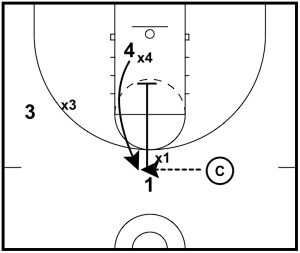
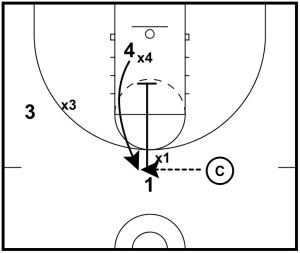
gt-screens-001

• Players align as shown, with the coach having the ball

• Each offensive player is guarded

• Drill begins with #1 screening for #4

• Coach passes to #4
 

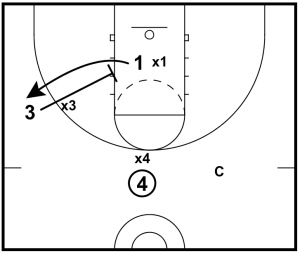
gt-screens-002

• #3 down screens for #1 and the drill continues 3 on 3

Teaching Points

1. Emphasize all fundamentals of your screen defense
2. Be physical
3. Emphasize communication
4. Later switch all screens
5. Use both sides of the floor

Foot Step Drill

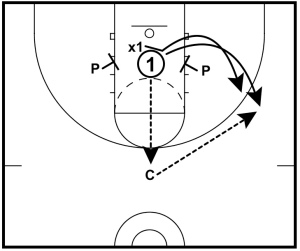
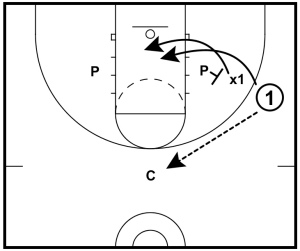
foot-step-drill-tk-001

• A coach stands at the top of the key
• Two posts (P) have pads
• #1 is on offense
• x1 is on defense
• #1 passes to the coach
• x1 tries to force #1 out one side and get through P’s screens
• Coach passes #1 and x1 “squares him up”

foot-step-drill-tk-002

• On the pass back to the coach, #1 cuts off a back screen and x1 guards his cut
• #1 will go to the front of the rim and repeat the action on the opposite side
• Emphasize hard cutting and physical screens on offense
• “Body up” to cutters and “foot step” screens

  • « Go to Previous Page
  • Page 1
  • Interim pages omitted …
  • Page 122
  • Page 123
  • Page 124
  • Page 125
  • Page 126
  • Interim pages omitted …
  • Page 288
  • Go to Next Page »

Primary Sidebar

  • Twitter
  • Facebook
  • Linkedin
coachestoolbox
personaldevelopmenttoolbox
basketballplayerstoolbox
basketballtrainer
athleticperformancetoolbox
coachingbasketball

© Copyright 2026 Coaching Toolbox

Privacy Policy