• Skip to primary navigation
  • Skip to main content
  • Skip to primary sidebar

  • Basketball Plays
    • Ball Screen Sets
    • Horns Sets
    • Man to Man Post Up
    • Man to Man Isolations
    • Backdoor Plays
    • Man to Man 3 Point Shot Plays
    • 2-3 Zone Attack
    • Baseline Inbound Plays
    • Sideline Inbound Plays
    • Combination Defense Attack
  • Drills
    • Defensive Drills
    • Offensive Drills
    • Competitive Drills
    • Passing Drills
    • Rebounding Drills
    • Shooting and Scoring Drills
    • Toughness Drills
    • Transition & Conversion Drills
    • One on One Drills
  • Blueprint
  • Practice
  • Mental Toughness
  • Skill Development
  • Offense
  • Defense
  • Store

Do You Recognize Two Signs of Emotional Intelligence?

Do You Recognize Two Signs of Emotional Intelligence?

By Brian Williams on May 12, 2016

by Stephanie Zonars, Life Beyond Sport.

A dear friend lost her husband to a sudden heart attack recently. Only in his 50’s, he was a great man and they had a beautiful marriage. Her loss is truly heartbreaking.

It’s a deeply painful time, but she will make it through this.

Certainly because of her faith. But also because of two signs of emotional intelligence (EI) that I’ve seen her exhibit.

Part of EI is the ability to recognize, understand and manage our own emotions. Experts say that high EI is a better indicator of our success in life than high IQ.

My friend is displaying high emotional intelligence at one of the most difficult times of her life.

It’s remarkable.

And it challenges me, because I have a lot of room to grow in these areas.

EI is crucial to your ability to lead well, so I wanted to share these observations:

EI skill #1: awareness of her emotions.

Granted, this is an extreme situation and her emotions are raw and intense. It’s hard to miss them.

Even so, in this first week without her beloved she can articulate the moments of the day that are hardest. She is aware of her capacity and when she needs people or time alone.

She has a keen sense of what is going on inside her and her emotional triggers.

This kind of awareness is the first step in developing emotional intelligence, and a huge hurdle for many.

Why is this important?

Because most of us have ways of responding to life that we’d like to change, but we can’t change the behavior without identifying the emotion that causes it.

One of my clients, for example, was an assistant coach with a difficult co-worker.

Every time he knocked on her office door, negative emotions welled up inside her. And they resulted in behaviors like a frustrated tone and the inability to make eye contact.

She tried to change her behavior, but it never lasted long. The route to real change was through identifying the emotions and addressing her triggers.

A feeling wheel can be super helpful here. It gives you language for emotions when you can’t find the right words. Here’s how it works.

Maybe you feel scared. That’s helpful, but using the wheel you can drill down to a more specific adjective. Do you feel anxious? Insecure? Helpless? Rejected? Confused?

And if you choose anxious, is that the right word or is overwhelmed a more accurate description?

This may appear elementary, but it’s important to pinpoint the emotion. How can you manage what you can’t identify?

One friend even kept a feeling wheel on her refrigerator to teach her children how to identify their feelings. The earlier we learn this life skill, the better.

The second sign of my friend’s emotional intelligence is equally, if not more, important.

EI skill #2: asking for help.

Not only did she notice that mornings are tough, but she calls a friend to talk or pray with her. She invites others into her grief and pain and receives support and love.

This is part of managing emotions effectively. And it’s a choice. Believe me, she doesn’t feel like reaching out.

And even in much less painful situations, neither do I. Perhaps you can relate.

One friend who just lost her first head coaching job would say that if she could try again she’d ask for help sooner.

Asking for help shows humility—that you know you can’t do it all.

What you think makes you look weak or stupid, simply makes you look human. It endears you to your staff and co-workers. People love following and working with humble leaders.

Asking for help promotes teamwork—giving others an opportunity to offer their gift to the team.

During my time on the Penn State’s women’s basketball staff, I liked being asked to help my co-workers or boss. I felt needed and valued, like my role and work mattered.

Asking for help is not a sign of weakness but of strength. It’s not an imposition, but a gift. [Tweet That!]

“Accepting help is a gift to the helper.”

—Robyn Benincasa, World Champion Adventure Racer

Regardless of the challenges you face this week, these two life skills—awareness of your emotions and asking for help—are imperative to your success as a leader.

Which one needs more of your attention this week? What action will you take to get better?

Do You Recognize 2 Signs of Emotional Intelligence? appeared first on Life Beyond Sport.
What Coach Don Meyer Taught Me

By Brian Williams on May 12, 2016

by Stephanie Zonars, LifeBeyondSport

Stephanie started a petition to encourage the NCAA to keep the Division I, II and III women’s games in the same city. Here is the link if you are interested: Petition

Coach Don Meyer’s presence made you want to sit up a little straighter.

As a counselor at his Lipscomb basketball camp (the largest basketball camps in the nation at that time), I remember one day in particular.

We had just eaten lunch in the cafeteria and he took a few moments to address the whole camp.

With his own unique style of interspersing nuggets of wisdom between recording reminders to himself on his handheld dictaphone, he told us something I have never forgotten.

None of us are too good to pick up trash.

Might seem an odd lesson to teach at a basketball camp, but it’s completely indicative of what Coach Meyer was all about: developing servant leaders.

And to this day, when I see a piece of trash I hear him reminding me to pick it up.

Coach Meyer won 923 games and 1 NAIA National Championship. But he coached a lot of champions.

The following is an excerpt from my new book, Wisdom for the BusyCoach—Volume Two:

You don’t have to win a championship to be a champion. —Don Meyer [Tweet That!]

Most BusyCoaches define a champion as the individual or team that comes in first place. Yet only a few teams finish the season with a win. In fact, many compete for years and never win a championship.

The dictionary defines a champion as a fighter or warrior. Champions keep fighting no matter what the scoreboard says. Champions battle through all the uncontrollables of competition (and life) by focusing on what they can control. Champions fight for a higher value or purpose. Champions never, ever give up.

All competitors strive for championships, and many become discouraged when they don’t achieve that goal.

Remember, hoisting a championship trophy isn’t the only way to become a champion.

But as for you, be strong and courageous, for your work will be rewarded. —2 Chronicles 15:7

Click Here for more information about Wisdom for the BusyCoach—Volume Two

What Coach Don Meyer Taught Me appeared first on Life Beyond Sport.
About Stephanie Zonars

Stephanie Zonars helps coaches build and maintain winning team cultures through her business, Life Beyond Sport. Teams at Penn State, Notre Dame, West Point and over 60 other schools have built stronger trust, communication and teamwork through her workshops. Stephanie spent three years on staff with the Penn State women’s basketball team, assisting the team to back-to-back Big Ten Championships. She’s also the author of three books. For more tips on leadership and team culture, visit LifeBeyondSport

The Lynchpin to Team Cohesion

By Brian Williams on May 12, 2016

by Stephanie Zonars, LifeBeyondSport

Stephanie started a petition to encourage the NCAA to keep the Division I, II and III women’s games in the same city. Here is the link if you are interested: Petition

The Lynchpin to Team Cohesion

Player leadership is crucial to creating a winning team culture.  You long to have a few players on the team with the courage to step up and lead on the court or field and in the locker room.

But there’s another role that is equally important to team cohesion and creating a solid team culture.

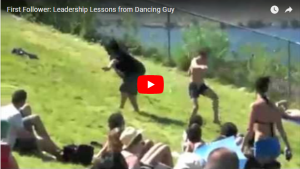
In the video below, Derek Sivers calls this person the “first follower.” Check out the fascinating video about how to start a movement in under 3 minutes, then look over the key points and finally, see how this relates to you and your team.

As outlined in the video:

The leader—

  • has the guts to stand alone and look ridiculous
  • nurtures first follower as an equal
  • makes it about them, not him/herself
  • makes it easy to follow

The first follower—

  • has a crucial role
  • shows everyone else how to follow
  • is embraced by the leader as an equal
  • calls others to join
  • has the courage to be the first one to follow and to stand out
  • typically is under appreciated
  • transforms the lone nut into a leader

The reason so many of you tell me that you don’t have leaders on your team is that most young people don’t have the courage to “stand alone and look ridiculous.” Players may say they want to be leaders, but finding ones who will actually hold teammates accountable and defend the culture seems daunting.

BUT, it may be easier if they had the certainty of a first follower. If they knew that a teammate would follow well and show the rest of the team how, it may be easier to muster up the courage to step up and lead.

One of the things I loved about our team handbook at Penn State was the page about how to be a good follower.

We talk so much about leadership, but sometimes fail to mention the importance of learning how to follow. [Tweet That!]

Just as your team leader(s) serve as a liaison between you and the team, the first follower serves as the connector—the lynchpin—between the team leader(s) and the rest of your players. When the leader(s) embrace the first follower as an equal and make it about the team, they become easy to follow.

You probably have identified players that you are helping to develop leadership skills.

Who are you looking to to fulfill the first follower role? Identify that player, make sure she knows the crucial nature of the role, then help her to embrace and fulfill it with excellence.

The Lynchpin to Team Cohesion appeared first on Life Beyond Sport.
About Stephanie Zonars

Stephanie Zonars helps coaches build and maintain winning team cultures through her business, Life Beyond Sport. Teams at Penn State, Notre Dame, West Point and over 60 other schools have built stronger trust, communication and teamwork through her workshops. Stephanie spent three years on staff with the Penn State women’s basketball team, assisting the team to back-to-back Big Ten Championships. She’s also the author of three books. For more tips on leadership and team culture, visit LifeBeyondSport

Growing as a Basketball Coach

By Brian Williams on May 9, 2016

This post was written by John Carrier and originally posted on his Coaching Basketball Blog

Notes from Minnesota State High School League’s “Why We Play” conference at Bethel University.

“Why We Play”  is a program that promotes positive coaching and teaching character through athletics. The structure was two whole group sessions with a main speaker, two breakout sessions, and everyone back together for one final session. Below are some of the best ideas that I pulled out from each presentation.

Rod Olson
Coach Olson is currently working with the Pittsburgh Pirates developing their coaches. He also works with the Navy Seals and has authored two books on coaching. Coach Olson gave two talks. One was the opening talk on “7 Marks of a Mature Coach” and then gave a talk on what he’d learned during his time with the Navy Seals. Some of the finer points of his talk are below. I am going to buy both of Coach Olson’s books and would recommend looking at his material – it’s really good!

Kids now grow up in a different “SCENE”

  • Speed: Slow is bad to kids
  • Convenient: Hard is bad to kids
  • Entertained: Boring is bad to kids
  • Nurturing: Risk is bad to kids
  • Entitlement: Work is bad
  • So the question for coaches is, based on this “SCENE” how are we going to deal with our kids and teach them that slow, hard work, that is boring and risky is actually a GOOD THING?

Quantico Test

  • Give your players a mental and physical test that takes some critical thinking. This will tell you everything you need to know about the make up of your team. The task should include everyone on the team as one group.
  • The SEALs give their trainees a length of rope and tell them they must use to get everyone over the wall.
  • Give them 10 minutes to plan and 5 minutes to execute.
  • As they try to complete the task just WATCH who is doing what.
  • Who’s leading and taking initiative?
  • Who says something isn’t working?
  • Who follows.
  • Who doesn’t care. This might be the biggest one. If you’ve got these guys they will hurt your team.

Why Game

    • This is an exercise to help you get a much deeper understanding of your players motivation.
    • The gist of the exercise is to ask them why they play basketball, and then follow that up with 3 more “why” questions about their answer.

For Example:
Q: Why do you play basketball? A: Because it’s fun.
Q: Why is it fun? A: Because I’m with my friends.
Q: Why do your friends make it fun? Because they make me feel good.
Q: Why do they make you feel good? Because they pump me up when I do things correctly.

  • As you can see from the example, you get to the real root of why players are playing. Understanding why they play is essential to motivating your athletes.
  • Coach Olson shared a story about a football player they had. Dad played in the NFL, brother was a D1 player. The player started out well but they were motivating him by telling him this was going to lead to college, pros, etc and it didn’t work. They then found out that he loved basketball and he played football because of his friends. So they started to motivate him using his friends and peer relationships – which worked a lot better.

Mike Rowe
My first breakout session was with Coach Rowe. Coach Rowe is the head football coach at ROCORI High School in Cold Spring, MN. Coach Rowe’s breakout talk was on how their program develops the whole person. Some of my favorite parts of his talk are below.

Monday Meetings

  • Take 30 min out of practice each Monday for character development.
  • Intro the theme for the week.
  • Give a short presentation on the topic.
  • Breakout session in family groups. 8 groups for the program. Group has freshmen through seniors – stay with group all 4 years.
  • Each group has an activity around the theme of the week.
  • Reference the theme during the week.

Team Building Competitions

  • They have different competitions and you get points for each competition.
  • They do the team building competitions in their family groups.

Ryan Bartlett
Coach Bartlett is the head football coach at White Bear Lake. He spoke on Building Men for Others in White Bear Lake Football. He uses a lot of the ideas from the book Inside Out Coaching by Joe Ehrmann. Below are some of the things he does in his program to teach character to the players he leads.

    • Have a Word of the Week
    • Assistants pick the word (to be involved).
    • The word has to do with some facet of character development.
    • The coach introduces the word and talks about what the word means to the team. They then relate the word to real life – especially with a story or example.
    • The players select a teacher from the school that embodies the word of the week.
    • That teacher comes to the game, is on the field for the coin toss, and addresses the team in pre game.
    • Reading Program. Has the football players volunteer to read with elementary kids.
    • In order to get the “bear paw” decal on their helmet, players must do community service. The amount is based on their grade. It must be completed before they get the decal.

Seniors – 12 hours
Juniors – 10 hours
Sophomores – 8 hours
Freshmen – 0 hours – they are new to the program and might not know.

Tom Cody and Jody Redman
Mr. Cody and Ms. Redman did a great presentation from “Top 20 Training”. They covered a number of “mentality” issues that are helpful for both players and coaches. The best thing I got was their idea of people having “frames”.

Each person looks at the world through a different “picture frame” that influences how they see the world. The frame has see which influences feel which influences do which influences get which influences see. So what we see effects our feelings, our feelings effect what we do, what we do dictates what what get. The results (get) effect our feelings on a topic. The most important thing we can do if something isn’t going well is change the “see” part.
Easiest to change – how we see things. Gives the best, and longest lasting results. “If you can’t get out of it, get into it” So ask yourself how you can change your player’s “see” on something they are struggling with. Also ask yourself: how can YOU change your “see” on team/program issues that are driving you nuts?

C2E Crossover Spin-Handle Permutations

By Brian Williams on May 8, 2016

This ball handling drill was contributed by Rick Allison, Owner/Founder/Lead Trainer of LoneStar Basketball Academy to the FastModel Sports Basketball Plays and Drills Library.

You can also find out more about FastModel Play Diagramming software by clicking this link: FastDraw

This is a training progression for one or more players to improve their ball handling transitions from one or more crossovers into a spin crossover.

It begins with a simple front cross into spin crossover and progresses to more challenging combinations and permutations as the player develops more confidence and dexterity.

Alternating dominant and non-dominant hands are incorporated to facilitate movement across the court.

There are links to You Tube videos of the drill at the bottom of the post.

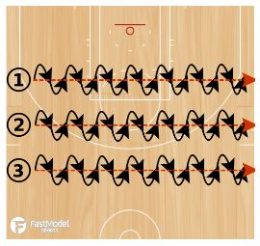
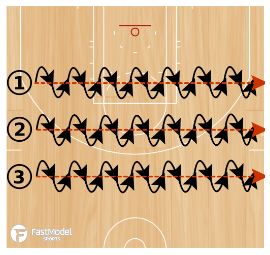
shakedown1

[note: Description is per this illustration..could have players turned around or starting on other sideline. Key aspect of progression is to have pound dribble on side toward direction of travel (illustrated by red dashed line).]

– Each player is on the left sideline, has a ball in their left hand, is in a double-wide stance, and is facing the midcourt line (left shoulder pointing in direction of the opposite sideline)

– movement starts with a left hand pound dribble, into a front crossover to the right hand, and then a spin crossover by pulling the ball and reverse pivoting 180 degrees on the left foot into a right hand pound dribble on the right side

– the player is now facing the baseline with the ball in the right hand on the right side and has progessed one body width toward the opposite sideline

– the pound dribble after the spin crossover actually begins the reverse action for the next front crossover and spin (i.e., right hand pound dribble into a right to left hand front crossover and left hand reverse pivot spin off the right foot)

– by alternating the right hand and left hand spin move in this manner the player progresses to the opposite sideline (see video clip for movement progression)

– this progression provides numerous right and left hand repetitions to allow incremental refinement, and facilitates improvements in the hand placement for the transition into the spin move (a particularly

difficult maneuver for many players)

– emphasis should be on proper weight shifting and balance, wide lateral displacement, low crossover and hand positioning, and increasing quickness

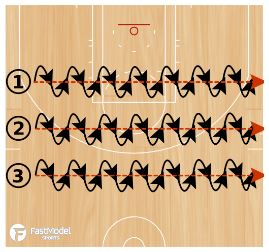
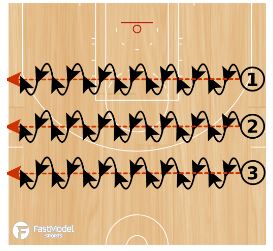
shakedown2

Return trip (change front crossover to through-the-legs crossover before spin):

[note: Description is per this illustration..could have players turned around or starting on other sideline. Key aspect of progression is to have pound dribble on side toward direction of travel (illustrated by red dashed line).]

– On return trip, each player is now on the right sideline, has a ball in their right hand, is in a double-wide stance, and is again facing the midcourt line (right shoulder pointing in direction of the starting sideline)

– movement starts with a right hand pound dribble, into a through-the-legs crossover to the left hand, and then a spin crossover by pulling the ball and reverse pivoting 180 degrees on the right foot into a left hand pound dribble on the left side

– the player is now facing the baseline with the ball in the left hand on the left side and has progessed one body width toward the starting sideline

– the pound dribble after the spin crossover again begins the reverse action for the next through-the-legs crossover and spin (i.e., left hand pound dribble into a left to right hand through-the-legs crossover and right hand reverse pivot spin off the left foot)

– by alternating the right hand and left hand spin move in this manner the player progresses to the opposite sideline (see video clip for movement progression)

– emphasis should again be on proper weight shifting and balance, wide lateral displacement, low crossover and hand positioning, and increasing quickness

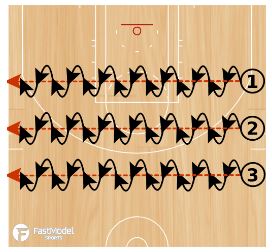
shakedown3

Repeat Outbound (change through-the-legs crossover to behind back crossover):

[note: Description is per this illustration..could have players turned around or starting on other sideline. Key aspect of progression is to have pound dribble on side toward direction of travel (illustrated by red dashed line).]

– Each player is again on the left sideline, has a ball in their left hand, is in a double-wide stance, and is facing the midcourt line (left shoulder pointing in direction of the opposite sideline)

– movement now starts with a left hand pound dribble, into a behind-the-back crossover to the right hand, and then a spin crossover by pulling the ball and reverse pivoting 180 degrees on the left foot into a right hand pound dribble on the right side

– the player is now facing the baseline with the ball in the right hand on the right side and has progessed one body width toward the opposite sideline

– the pound dribble after the spin crossover begins the reverse action for the next behind-the-back crossover and spin (i.e., right hand pound dribble into a right to left hand behind-the-back crossover and left hand reverse pivot spin off the right foot)

– by alternating the right hand and left hand spin move in this manner the player progresses to the opposite sideline (see video clip for movement progression)

– the behind-the-back crossover to spin crossover handle is a tough manuever that many players struggle with..dropping the hips and keeping hands low can help improve the ball-hand transfer

– emphasis should again be on proper weight shifting and balance, wide lateral displacement, low crossover and hand positioning, and increasing quickness

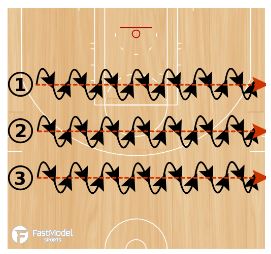
shakedown4

Repeat return trip (mix it up now by sequencing to a different crossover before each spin):

– sequence would be as follows: pound/front cross/spin.. pound/through-the-legs/spin.. pound/behind-the-back/spin.. [repeat]

– emphasis should again be on proper weight shifting and balance, wide lateral displacement, low crossover and hand positioning, and increasing quickness.

shakedown5

Advanced permutations:

1) Inside-out series: add inside-out move before pre-spin crossovers. For example:

– trip 1 (pound/inside-out/front cross/spin)

– trip 2 (pound/inside-out/thru-the-legs/spin)

– trip 3 (pound/inside-out/behind-the-back/spin)

– trip 4 (mix it up)

2) triple permutation series:

– trip 1 (pound/front cross/front cross/front cross/spin)

– trip 2 (pound/front/thru-the-legs/front/spin)

– trip 3 (pound/front/thru/behind-the-back/spin)

– trip 4 (pound/thru/behind/front/spin)

– trip 5 (pound/thru/behind/behind/spin)

– trip 6 (pound/behind/behind/behind/spin)

etc., etc., etc.

NCAA Zone SLOBs

By Brian Williams on May 4, 2016

A couple of plays to run from a sideline inbounds situation against a 2-3 zone.

With a few tweaks, you could also use these as half court set plays against a 2-3 defense.

These plays are from Wes Kosel’s Playbook “Best Zone Sets from the NCAA Season.”

You can get any 2 playbooks from our online store for $25 at this link:

4 playbooks for $35.


Michigan SLOB Zone “Chicago”

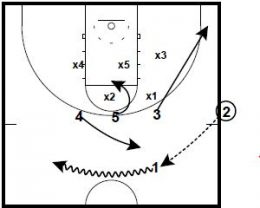
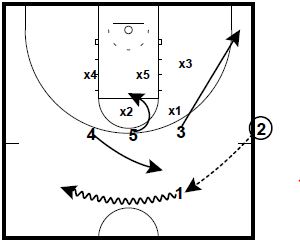
michigan-chicago1

2 passes in to 1.

5 moves to the high post and 3 to the corner.


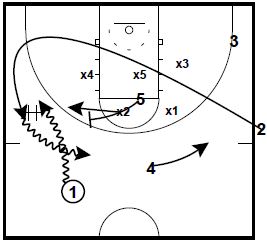
michigan-chicago2

2 cuts to the opposite corner and gets a hand off from 1 on the left wing.

5 sets a screen on x2.


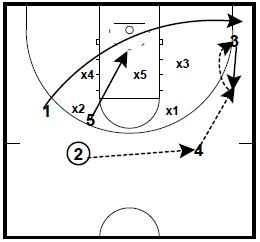
michigan-chicago3


2 passes to 4 who passes to 3 on the wing.

1 runs the baseline to the corner for a shot.

5 rolls into the lane.


Coastal Carolina SLOB Zone Runner

coastal1

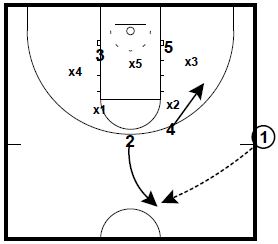
1 inbounds the ball to 2.

4 slides below the free throw line.


coastal2

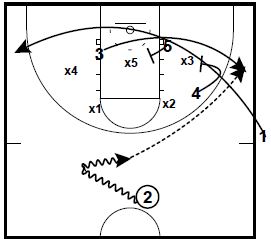
After inbounding the basketball, 1 cuts all the way through to the opposite side.

2 dribbles toward the side that 1 is cutting to, then reverses direction with the purpose of getting x2 to guard the ball.

4 and 5 screen the zone defenders as 3 cuts off their screens for a shot.


  • « Go to Previous Page
  • Page 1
  • Interim pages omitted …
  • Page 121
  • Page 122
  • Page 123
  • Page 124
  • Page 125
  • Interim pages omitted …
  • Page 288
  • Go to Next Page »

Primary Sidebar

  • Twitter
  • Facebook
  • Linkedin
coachestoolbox
personaldevelopmenttoolbox
basketballplayerstoolbox
basketballtrainer
athleticperformancetoolbox
coachingbasketball

© Copyright 2026 Coaching Toolbox

Privacy Policy