• Skip to primary navigation
  • Skip to main content
  • Skip to primary sidebar

  • Basketball Plays
    • Ball Screen Sets
    • Horns Sets
    • Man to Man Post Up
    • Man to Man Isolations
    • Backdoor Plays
    • Man to Man 3 Point Shot Plays
    • 2-3 Zone Attack
    • Baseline Inbound Plays
    • Sideline Inbound Plays
    • Combination Defense Attack
  • Drills
    • Defensive Drills
    • Offensive Drills
    • Competitive Drills
    • Passing Drills
    • Rebounding Drills
    • Shooting and Scoring Drills
    • Toughness Drills
    • Transition & Conversion Drills
    • One on One Drills
  • Blueprint
  • Practice
  • Mental Toughness
  • Skill Development
  • Offense
  • Defense
  • Store

Basketball Plays Thumb Out 54

Basketball Plays Thumb Out 54

By Brian Williams on May 20, 2016

Coach Vonn Read has submitted several plays from his playbook series The Basketball Encyclopedia of Plays to the Coaching Toolbox.

Vonn is currently a Women’s Assistant Coach at the University of Houston.

He has also served as an assistant coach in the WNBA with the Phoenix Mercury, Orlando Miracle, and San Antonio Silver Stars.

He was an advanced scout for the Orlando Magic as well as The Charlotte Sting.


Diagrams created with FastDraw

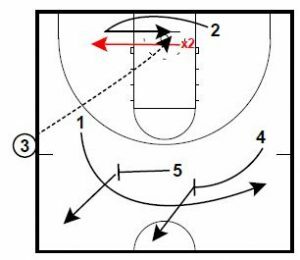
thumb-out1

Ball Screen Zone vs. 2-3 Zone.

The play starts in a 1-4 High formation.

The 1 player will pass the ball to the wing and cut to the opposite wing.

The 2 player will space to the corner.
 

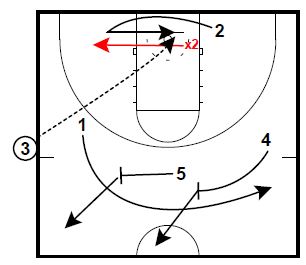
thumb-out2

The 5 player will ball screen for the 3 player, who will attack the gap for a pull up jumper at the elbow.

If X2 tries to stop the ball, the 4 player will screen X2 to slow down the rotation to the 1 player.

The 3 player will drive and kick to the 1 player for the 3-point shot. The one player should be up on the arc in the diagram.

If X4 helps, make the extra pass to the 2 player for the 3-point shot.

Coach Read has also put together The Basketball Encyclopedia of plays. You can check them out here: The Basketball Encyclopedia of Plays or read more about the books:

Any coach looking for the latest and innovative plays from the Professional, College, or High School levels can stop looking. With a compilation of over 7,700 different plays, you will never need to purchase another basketball playbook again. These playbooks can be used as a great reference tool for years to come. This 2 Volume Book includes plays from 19 different play categories, and they are the most extensive playbooks on the market.

The Basketball Encyclopedia of Plays (Platinum Series) contains over 7,700 Plays (Both Volumes combined) from the NBA, WNBA, USBL, and College levels from someone who has worked as an Advanced Scout or Coach on each level!!! This book has been intensely compiled over the last 21 years, with plays taken from a lot of NBA Coaches (past and present), WNBA coaches, and College coaches (Men’s and Women’s) from around the country.

Any coach that is serious about improving their knowledge of the game from an X and O standpoint will benefit tremendously from these books. These Books can be used to discover New Quick hitters, add a New Package to your playbook, or develop an entire Offensive System. There are a lot of new ideas and concepts in these books to study, and the Basketball Encyclopedia of Plays can be a great resource for coaches on all levels!!! This book is definitely for those X and O junkies who are always looking to improve as a Coach.

“THE GAME IS ALWAYS CHANGING? ARE YOU?” Vonn Read

Here is the link: The Basketball Encyclopedia of Plays
Here’s How Your Players Improve…

By Brian Williams on May 19, 2016

This is from Arkansas Women’s Coach Mike Neighbors.

Skill Development is not a few magical drills or some mystical Yoda-like training session. It’s a constant, consistent relationship between coach and player where the player is taken out of their comfort zone to a place they never knew they could go. It’s a relationship built around trust. It’s a relationship that requires as much of the coach as it does of the player.

Today I hope to give you some thoughts on how to make the map, plan the path, and then execute.

STEP BY STEP PROCESS OF DEVELOPING A SKILL DEVELOPMENT PLAN

1) Identify and state the end objective for each individual
2) Determine manageable and measurable criteria for determining success
3) Set sequence of steps necessary to reach the objective
4) Determine tactics and situations that will motivate each individual to reach the objective
5) Get to practice

Perimeter Players

The simple version:
1. Play
2. Possession
3. Position
4. Psychology
5. Presentation

This is what everything we do with perimeter play can be traced back to. One of the five things above encompasses everything we expect and everything we do. This is the simplest formula and what we want implanted in every perimeter player.

The are listed in the exact order that we want them to remember them. If they re-member only 1 thing… it’s PLAY. If they remember two things… it’s PLAY and POSSESSION… and so on.

Then we work on them in reverse order as we begin to develop their skills.

Obviously there is a lot more that goes into developing players than having them remember these five things, but as we have mentioned this is the simplest form and enough for them to perform with in practice and games.

#4… we have replaces Psychology (perimeter) with Physicality (for posts)… we still want toughness from our perimeters, we want them to be on the smarter side of things too!!

We have identified 4 things we ask of our perimeter players on offense:

1) Have a transition a game
2) Have an arc game
3) Have a paint game
4) Think the game

We have identified 4 things we ask of our perimeter players on defense:

1) Talk in transition
2) Guard their yard
3) Rebound
4) Think the game

Again, these are the things we want running through their mind. They are simple but we feel they are inclusive of sooooo many other things that we can worrying about preparing them for as coaches.

Post players basically play with or without angles…

The same is true for guards but in that they either play with or without space. So, we try to give them skills to operate under both conditions come game time.

Some random thoughts on Perimeters that pertain to all areas of play:

Paint Game- Dribble it in there or pass it in there
Short violent fakes– stop teaching the big exaggerated fakes the more your players develop
Catch without dribbling- Pivot for poise
Draw 2 and Play 2- if they can draw 2 defenders on offense and can guard 2 players on defense
Be great at something– everyone needs a specialty then good at everything else
Separation moves are different in back court, mid court, and half court– need them all
Think and Talk– two things most of today’s youth struggle to do
Game shots, from Game spots, at Game Speed– all drills have one of these, some have all 3
Like with post players and their one move/counter move plan, we want perimeters to have a move and a counter:
-at the arc
-off a screen
-off a ball screen
-at the rim
-from the FT line (or a move to get there rather)
Like with post peer passing drills, we do the same with guards. In that if they don’t make a proper cut or a proper fake before the attack, they don’t get to shoot…

PERIMETER PLAYER DRILLS: We try to incorporate every emphasis to as many drills as possible…

Post Players

The simple version:

1. Play
2. Possession
3. Position
4. Physicality
5. Presentation

This is what everything we do with post play can be traced back to. One of the five things above encompasses everything we expect and everything we do. This is the simplest formula and what we want implanted in every player occupying a post spot.
The are listed in the exact order that we want them to remember them. If they re-member only 1 thing… it’s PLAY. If they remember two things… it’s PLAY and POSSESSION… and so on.

Then we work on them in reverse order as we begin to develop their skills.

Obviously there is a lot more that goes into developing good post players than having them remember these five things, but as we have mentioned this is the simplest form and enough for them to perform with in practice and games.

PLAY- remember why you are in the game
POSSESSION– you want the ball (rebound, post-up, loose balls, tipped balls)
POSITION– be in the right spots at the right time/ get open and stay open
PHYSICALITY– be punishing and cause dread in those playing against you
PRESENTATION– look the part

A little more detailed description but still not the whole picture. We continue introducing in phases as the players are capable of grasping them. Each player advances at a different rate. Some based on prior experience. Some based on years in our program. Some based on time spent with coaches on development.

PLAY:

This is the easiest of the 5 to remember and sell to the players. When all else breaks down… when you are out of position, when you are scrambling to maintain a grip on the ball, when nothing is going right… MAKE A PLAY!! BE A PLAYER!!
Use the things you were blessed with to the very best of your ability.

What is the most important physical tool for posts?
We have identified 6 things we ask of our post players on offense:

1) Establish Tempo– it’s not guards who make you a running team, it’s the posts
2) Score Easy-we want posts with a small repertoire of undefendable moves
3) Draw Fouls– easy points and puts opponents at disadvantage late in games
4) Rebound– no one has ever been too good at rebounding
5) Be Punishing-we want people sending us graduation cards
6) Screen- part of our attack

We have identified 5 things we ask of our post players on defense:

1) Protect the Post– fight for space and wall up
2) Effect Shots– make players score over us not around us
3) Rebound-every single time
4) Defend screens– technique must be flawless
5) Talk– your voice is important to our Team

In the area of PLAY with Post Players it basically boils down to the fact that you need to give them skills to:

(A) Play with angles
(B) Play without angles

This accounts for everything we ask of our posts on offense/defense and for every way that a team could possibly defend us (which we have no control over btw).

On offense, a post needs a move on the block, a move at the midline, a move at the elbow, a move in the short corner, and a move in trail. We want them to start with one good move in each of those spots. It may be a power drop set for one or a mid-line spin back for another. Regardless, it has to work for them and they have to be able to execute it.

After the have one in each of those spots, let them work on a counter move.

That gives them two. IF and I really mean IF, they need and can develop a third then they are very, very special.
It may take showing them every move in the book to determine the one they can execute in crunch time, but I think it is a mistake to work every move, every day, with every player.

Working with each player to determine their arsenal of moves is an important part of your job as a skill developer. Their input helps you in holding them accountable for how they utilize them come performance time. We have a rule that if you attempt a shot in a game that we don’t work on in practice, that it is a BAD shot for our team. And our players know we define that as being selfish.

When we teach post PLAY we start with no defense, then position defense, then live vs. peer, then live vs. someone bigger/better, then introduce disadvantages.

This is a slow, steady maturation process but helps us have mastery and limits game slippage.

POSSESSION

The easiest way for a post player to gain possession for our team is through rebounding. Due to a perceived advantage of size, most people expect the tallest, strongest person to get the most rebounds. In my 30 years of experience, that is rarely the case… it’s usually the person who goes after the most plain and simple.

Tashia Phillips was a four year starter for us at Xavier University and I can count on one hand the number of times she didn’t crash the boards. As a result she is #6 on the all-time NCAA rebounding chart. Sure she got some because of her size, but she got most of them as a result of a relentless pursuit to possess the ball for her team.

Other ways to possess the ball from the post:

– Catch the passes thrown in their direction
– Use strength to win 50/50 balls
– Don’t allow smaller players to strip ball

One of our favorite sayings… Possession over Position…
A post player who can get the ball valuable to any team playing any style.

POSITION:

This is pretty much exactly what it sounds like.
Being in the right spot at the right time.
This involves the ability to get open and stay open.
This is where they learn to:
Seal up, seal down, seal out
Pin, duck in, spin/spin
Hold for a lob, bury someone deep
Have chin on shoulder on defense
How to pop back on post entry
How to hedge, plug, trap, jam ball screens
How to use a kick-stand around the basket
How to post on a body rather than an area
How to read defender in transition
How to attempt shots on our terms
How to post when the ball can find you
How to use the three pivots (front, inside, drop step)

PHYSICALITY

We want our post players to be punishing. We want them to leave a mark. We want them to be talked about by other teams.

How do they accomplish that:

Run the floor in both directions- 100% based on effort and concentration. We will control their minutes based on whether they run the court. Poor post players HATE to do this… GREAT post players love to do this
Crash the boards every time– be that person the other team is spends time on in walk thru talking about effort
HIT cutters (legally) every chance you get… and if you can get near half without being in the bonus or in foul trouble maybe even once to send a message.

SCREEN offense and defense is a time to make legal contact. Do it every time.

Effect every shot around the basket without fouling– nothing is more frustrating to finesse post players than to be bodied by a physical post player

PRESENTATION

The fifth in order we want them to think about the 5 things, but the first one we work on. In short, PRESENTATION is how we want our post players to “look”.

We stop film at random points and “look” for presentation.

Things we work on:

RUN the court- easy to see on film whether they haven chosen to do this
POST when the ball can find you- if the ball is in position to find us, are we posting for it

When POSTED:
– Do we have maneuverable balance
– Are we “H”ed up
– Can we see the back of our hands
– Are our knees under our shoulders
– Are we using our leverage points
Numbers, triceps, hips
– Do we appear to want the ball

*** In every drill we do with post players, if we don’t have good presentation, we teach our passers not to feed them the ball. It’s amazing how quickly players will do it right if they never get to shoot at the end of long, hard drill. It’s also amazing how hard they will be on each other when it comes to this. To me, when you can get their teammates to do your coaching, that is a sign you have a good culture.

On Defense:
– Do we have chin on shoulder
– Do we hit cutters
– Do we talk on defense
– Do we sprint the floor

Although we listed 5 things we look for in order, when we drill, each of them are critiqued and corrected. We all have said many times in coaching that “you get what you tolerate” so we don’t tolerate any deviation from our expectations in any drill.

PHINISHES

No move moves: Rack Series, Superman Series, Kickstands, Tower of Power, Crash, FT Rebounding, Seal Up/Seal Down/ Seal Out
Mid line moves: Chair Series, Position Post Up, Pivot Posting
Elbow moves: Garnett Shooting, High Low/Duck In, DUBS Shooting
Trail series: PITS attack, Dive series, On-Ball Series

PAWS
Catch, Z rebound, Bad Pass Drill, Crab Dribble, Passing out of Post

PHYSICALITY

Trips, Wall-Up, Closeouts, Pop Backs, Close and Contest
P’s of Post Play

You probably noticed we try to use as many “P” words when talking “Post Play” as possible… Play,

Possession, Position, Physicality, Presentation… Here are a few more:
Press and Peak-replaces Chin/Check
Paws= Hands Ped=Feet
Pause for Poise
Phight
Patience
Pasta for Posts
Let me know if you can think of more

Multiple Action Skill Drills

By Brian Williams on May 18, 2016

Some drills from Scott Peterman’s Basketball HoopScoop NBA Skill Development Bundle.

I like the ideas of players having to make multiple cuts and use multiple skills in a drill just like they have to do during the course of one possession during a game.

Use the drills to stimulate your thinking and staff conversation to find ways to more closely simulate the cuts and skills that your players use within your system during a possession.

This week’s eBook bundle is the Coach Peterman’s NBA Skill Development Playbook and Tim Springers’ NBA Scoring Drills Playbook. You can find out more about them at this link:

NBA Skill Development/Scoring eBook Bundle

Feel free to email me or call/text 317-721-1527‬ if you have any questions about the Bundle.

Diagrams created with FastDraw

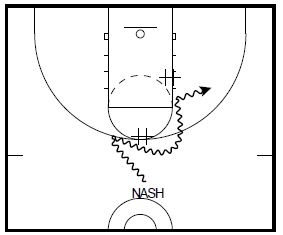
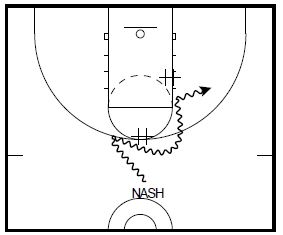
Steve Nash High Pick and Roll Bounce Out

nash

Nash takes a high pick and roll screen and attacks the elbow.

If the help is sitting in the paint he will bounce off the lane line into a jump shot.

Drill: Use the chair for a high pick and roll. Attack the elbow and bounce out for jump shot.

Make 20 from each side of the court.

Use different types of ball screens that you utilize in your offense.

When creating space on the second defender, you can also simulate an off balance closeout and drive to score with a floater or some type of finish at the basket.

Look for ways to create drills that work on not only beating their primary defender, but also having to work at beating a second helping defender.

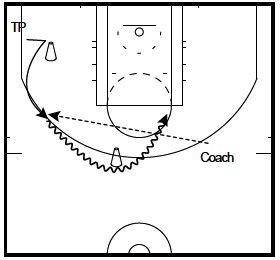
Tony Parker Down Screen into Pick and Roll

parker

Come off a down screen in the corner.

As soon as he catches it off the screen (going full speed), he will dribble into a pick and roll.

Drill: Explode off the first cone (down screen) and catch the ball into a pick and roll (2nd cone) for jump shot
at the elbow.

Make 20 on each side.

You may not have this exact action in your offense, but think about incorporating cuts and movements your players make during the course of a possession into your shooting/scoring drills

This week’s eBook bundle is the Coach Peterman’s NBA Skill Development Playbook and Tim Springers’ NBA Scoring Drills Playbook. You can find out more about them at this link:

NBA Skill Development/Scoring eBook Bundle

If you are interested in adding to your Coaching Toolbox take look at what I believe is our best offer.

CLICK HERE to select from a list of more than 70 eBooks.


Being a Leadership Educator for all Players

By Brian Williams on May 17, 2016

An Interview with Dr. Cory Dobbs.

Q:  Why do you find it necessary to add the role of Leadership Educator to the practice of coaching?  Aren’t coaches already modeling leadership for their student-athletes?

A:  Let me explain by telling you a story.  I recently met with a “brand” name coach and his staff to discuss leadership education.  The coach is highly recognized as a top coach in his field.  I opened our conversation by asking him “Are you a world-class coach?”  He looked at me with an unassuming grin.  So I said “The world certainly sees you as a world-class coach.”  His staff chuckled but agreed.  “So let’s check that box,” I said.  “And,” I declared, “would you agree that coaching is teaching?”  He and his staff vigorously shook their heads to imply a definitive “yes.”

“Now,” I continued, “are you a world-class leader?”  Again, he looked at me with a humble smile.   I asked his staff for a thumbs up or thumbs down vote of agreement.  All thumbs were pointed upward.  “Check that box too” I announced.

“Okay,” I said as I headed towards my home territory.  “Are you a world-class leadership educator?”  The grin on his face slipped into a look of bewilderment.  “Well,” I said cunningly, “if you’re a world-class coach and a world-class leader shouldn’t you be a world-class leadership educator?”  Puzzled and disoriented, the brand name world-class coach didn’t quite know how to respond.  I continued, “How do you go about developing team leaders—or in my world team leadership?”  After uttering something he asked me to explain to him just what leadership education is and how one goes about becoming a leadership educator.

A leadership educator is no different than, let’s say, a professor of management—someone who teaches management.  A leadership educator teaches leadership.  However, this role seems a little strange for many coaches.  Few engage in a planned program and curriculum with the deliberate intention to build team leaders.   Rather, most simply leave it to the seemingly natural growth of the individual.  Oh, let’s not forget that a rigorous development program can be time consuming and emotionally demanding.

“Coach,” I said, “we can’t check that box can we?”  I then began to teach: “The role of leadership educator requires a different mindset, skill set and involves very different actions from the one’s you’ve been practicing for a lifetime.”  The coach quickly acknowledged that a huge gap exists between what he and his coaching staff are doing and what they could do to develop team leaders.  He then asked if I would work with him and his staff to develop their knowledge, skills, and abilities to be high-performing leadership educators.

Q:  A leader in every locker sounds a lot like “Everyone gets a trophy.”

A:  First, there’s a big difference between welfare and well-being.  When everyone gets a trophy it’s often like a government handout—it’s freely given, no strings attached (and just as likely not to have been well-thought through as it does have extraordinary potential as a long-term positive of participation if done right).  However, when a coach is concerned for the total well-being of her student-athletes, she is delighted to have everyone on the team maximize the experience; which includes learning how to lead.

In a recent workshop a coach asked me if the idea of a leader in every locker is like a trophy for everyone.  I held back, but then I injected my research and organizational framework into my response.  I let the coach know emphatically, it’s just the opposite.  I had to first help the coach see beyond her flawed mental model of leaders are born, the driving factor behind such thinking.

The notion of a born leader appeals to our belief in intelligence, charisma, and other personal traits as attributes necessary for leadership.  Most of us have been taught since childhood, at least implicitly, that we are either a leader or a follower—mostly followers as we can only have one class president.  This plays on an almost universal theme that some people must be given the role of telling us what to do; it fits with our sensibilities that we are better off by granting some people power and agency.

To be sure, my experience—countless number of workshops plus working alongside coaches—is that in most cases coaches are cynics when it comes to the idea that everyone has the ability to lead (though anticipating the critique of this claim I’m compelled to ensure I don’t imply all are equally motivated to learn to lead).  For those of us who do not want to simply dismiss people as not capable of learning to lead—especially those who’ve had few role models in their lives—the concept of leadership development is a significant step forward.

The idea that leaders are extraordinary people with special gifts is an assumption many coaches have embedded in their minds—baked into the cake.  Most coaches operate from a paradigm—a set of assumptions about how the world works—that makes it difficult to understand why the virtues of a leader in every locker far exceed the verifiable inefficiencies of the team captain model.

What I’m advocating is this: when a coach assumes the role of leadership educator, it is to teach leadership to all his or her student-athletes.  Why in the world would you not want to teach leadership to all of your players?   And why in the world would you not want your players to develop a leadership mindset, skill set, and act like a leader?

Beginning with the end in mind, when you deploy a leadership learning system you are creating a learning organization.  When coaches honor the need to personalize learning for each student-athlete, they then create a dynamic learning environment in which everyone is learning in action and by reflection.

However, if a coach doesn’t think it’s worth his or her time, then it’s likely they are acting from what Stanford professor Carol Dweck calls a “fixed mindset.”  A coach that acts from this perspective will do little to stimulate interest and commitment to personal leadership development of the student-athlete.  Such a mindset places little value in teaching leadership.  After all, they reason, either the athlete is a “natural” leader gifted with the “right stuff” or they’re not.  This thinking suggests only a few athletes on any team are capable of leading.  Such thinking makes no sense.

Leadership is not an all-or-nothing ability, something you either have or don’t have.  As a form of social interaction, leadership can be developed when student-athletes and coaches put in effort, time, and practice.

The reality is the student-athlete (and the coach too!) has to work hard to learn how to lead, to develop a set of skills and competencies that will serve as a foundation for lifelong learning of leadership and team building.  Leadership can be learned, indeed it must be learned.  The key is that it must be practiced in order to facilitate the growth and development of the student-athlete.  Without practice, which requires time, effort, and energy, all you have is a potential leader.

Finally, in my Coach’s Guidebook: A Leader in Every Locker I make clear that most student-athletes are raised in sport to simply follow the lead of the coach; thereby making the participant a passive recipient of leadership.  After years of going along to get along the young athlete develops the habit of passive followership.  This is one of the biggest challenges of change we face as leadership educators.

Should everyone get a trophy?  Probably not (save for another day the issue of participation and achievement).

Should everyone get an opportunity to learn about leadership and explore how to lead?  Yes!  And to do so requires great effort on the part of the student-athlete.  The athlete is not given anything but opportunity.   Are all leaders equal?  No!  Everyone has a different starting line, but all student-athletes can learn to lead at some level.

Q:
  In your workshops you urge, quite forcefully I might add, coaches to rethink their
thinking?

A:  I do this because every act of coaching rests on assumptions, generalizations, and get this—hypotheses.  That is, the coach’s mindset determines to a great extent how he operates.  It is very unlikely that a coach will change his or her ways of coaching until they look in the mirror and consider who they are and what they believe and why they believe what they believe.  Once they peel away the layers and recognize how deeply held beliefs and attitudes—such as only a few athletes are capable of leading—he or she can design a culture that maximizes the experience for everyone.

It’s a shame that many coaches are intimidated by the idea that embedded within every player is a potential leader.  There is great suspicion of how things will work if everyone is potentially a leader.  A common concern about a leader in every locker came up one day when I was talking with a group of coaches.  “How can you ask us to have all our student-athletes lead?” one coach said to me.  “Isn’t that opening Pandora ’s Box?”  Recall that when Pandora’s Box was opened, all the troubles of humanity flew out.  Is this how coaches imagine what might happen should everyone learn to lead and be given opportunities to lead?

I understand their concern.  They really have no reference point to relate the practice of teaching everyone leadership.  But when coaches and players learn for example, the 5 Steps of Team Leadership, the 8 Roles of Team Leadership, and The Coach as a Leadership Educator that I’ve created it all begins to make sense.  Something else we do is utilize a specialized vocabulary.  In addition to the 5 Steps of Leadership our program includes specialized terminology and unique constructs such as the eight roles of team leadership, leadership educator, followership and leadership orientation, and leadershift to cite some of the vital elements of our way of talking, thinking, and developing leaders.

The unnatural gap between the traditional team captain model and the reality that everyone can learn to lead at some level requires a monumental change program.  It’s going to take awhile, but over time coaches will discover new things about how it all works together to the advantage of the program and the players.

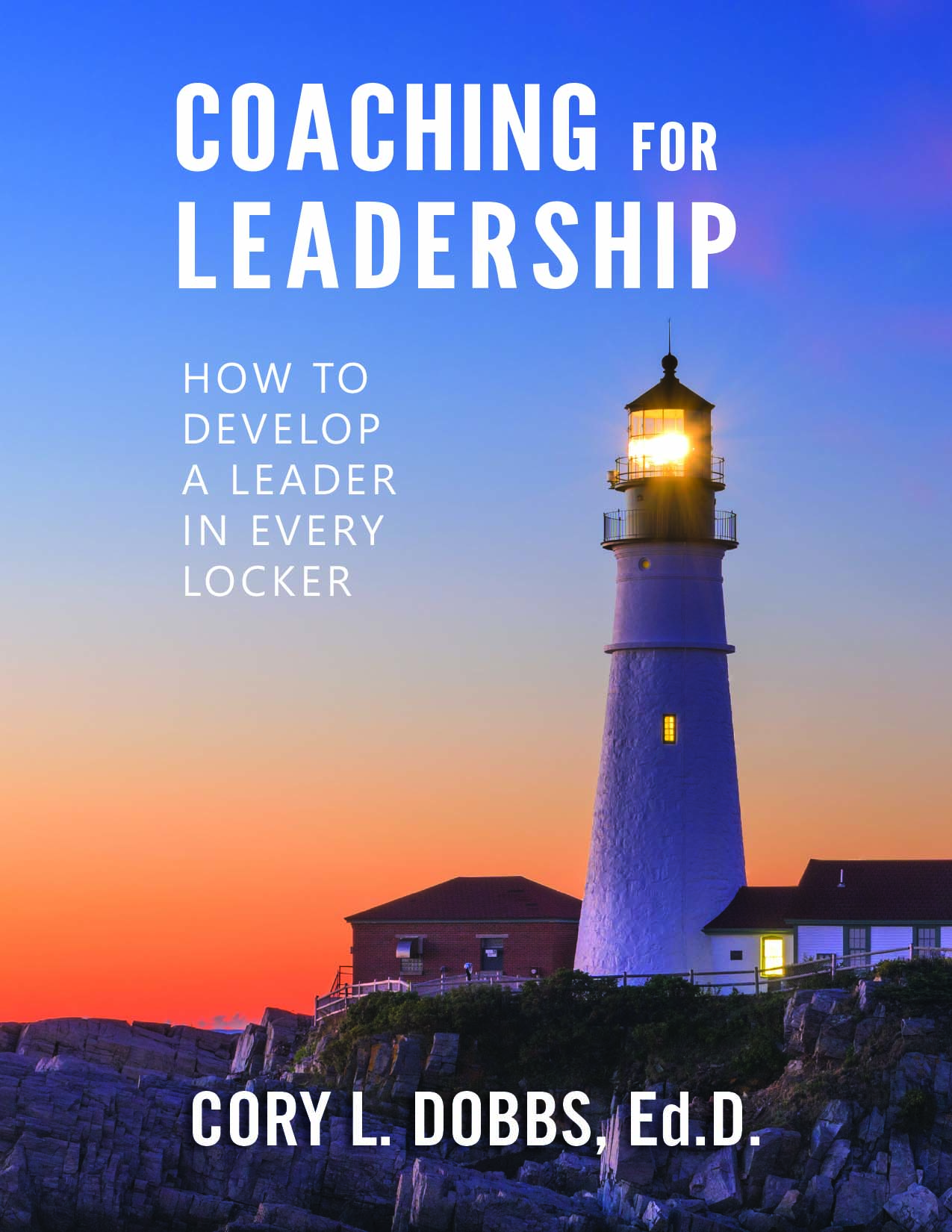
“Tell me and I’ll forget. Show me and I may remember. Involve me and I will care.” -Your Student-Athlete The world of coaching is changing. In Coaching for Leadership you’ll discover the foundations for designing, building, and sustaining a leadership focused culture for building a high-performance team. To find out more about and order Sport Leadership Books authored by Dr. Dobbs including Coaching for Leadership, click this link: The Academy for Sport Leadership Books

About the Author

A former basketball coach, Cory’s coaching background includes experience at the NCAA DII, NJCAA, and high school levels of competition. While coaching, he researched and developed the transformative Becoming a Team Leader program for student-athletes. Cory has worked with professional athletes, collegiate athletic programs and high schools teaching leadership as a part of the sports experience and education process. Cory cut his teeth as a corporate leader with Fortune 500 member, The Dial Corp. As a consultant and trainer Dr. Dobbs has worked with such organizations as American Express, Honeywell, and Avnet.

Cory has taught a variety of courses on leadership and change for the following universities:

Northern Arizona University (Graduate Schools of Business and Education)

Ohio University (Graduate School of Education / Management and Leadership in Sport)

Grand Canyon University (Sports Marketing and Sports Management in the Colangelo School of Sports Business)

Duck and “W” Basketball Shooting Drills

By Brian Williams on May 16, 2016

I received these shooting drills from Dennis Hutter, Head Women’s Basketball Coach at Mayville State University. His website, www.coachhutter.com . The website has more shooting, individual development workout, and leadership videos.

“Duck” Shooting Drill

Coach Hutter’s comments on the drill:

We picked this drill up from the coaches at the University of Oregon Women’s Basketball Program. This is a great shooting and competition drill for your players.

The shooter will shoot for 5:00 straight from seven different spots. Corner, Wing, Pro Spot, Top of Key, Opposite Pro Spot, Opposite Wing, Opposite Corner. Shooter starts in the corner. The goal is for the shooter to make two shots in a row, once they make two shots in a row, they advance to the next spot.

They keep working around the arc, advancing every time they make two three’s in a row. Spots “7” & “8” are both located in opposite corner and spots “14” & “15” are back at starting corner spot, and spots “21” & “22” are back in opposite corner and so on. Your score is the spot you finish up on when the 5:00 is up.

26-30 – Excellent Shooter
21-25 – Above Average Shooter
16-20 – Average Shooter

“W” Shooting Drill

Because we are a transition team, we like to use drills that involve a lot of sprinting and shooting off of the sprint, like we would in transition. With “W” shooting, we use the same seven spots as we use in “Duck Shooting” (Corner, Wing, Pro Spot, Top of Key, Opposite Pro Spot, Opposite Wing, Opposite Corner). The shooter will start in the corner. Shooter will shoot and then run and touch the half line and then advance to the next spot. Shooter will shoot a total of seven shots. Goal is for shooter to make five or more shots in 40 seconds or less.

10 in 75 Drill

Shooting Technique Thoughts & Ideas from Coach Hutter

-Quality of the jump shot comes from the feet:
-Quality = how open you are, low quality = high contested shot attempt
-“Shot first” mentality on all catches – Be an offensive threat with the ball
-Great balance on all catches, before the shot
-Balance starts with a great base of support with the feet and low center of gravity
-2 biggest keys in shooting for us is: “Get the ball up” & “Get the ball straight”
-Analyze your misses – don’t miss two shots in a row – THE SAME WAY
-NSM = Next Shot Mentality
-4 Points in the shooting technique need to start and finish in a straight line
-Shooting foot
-Shooting knee
-Elbow
-Hand/Follow Thru

-Proper consistent technique will bring about consistent results
-We want consistent shooters and that starts with having consistent technique
-Proper shooting technique starts with the feet and builds up from there
-NO FEET = NO SHOT
-You are the most open you will be when you first catch the ball
-so get ALL of your work done before you receive the ball
-Catch and shoot the ball in rhythm
-Shooting is a rhythm skill – like swinging a baseball bat – no hitches, no pauses – JUST FLUID
-Shooting the ball is one upward FLUID motion – Rhythm
-Hold a high one second follow thru on every shot
-We want quiet/quick feet on all catches – Stay light on your feet
-Make your workouts like games, so your games can be like your workouts – DEVELOP GOOD HABITS
-Every pass should hit the shooter in the hands and lead to a rhythm jump shot for us

Shooting Workout Thoughts & Ideas from Coach Hutter

-Never miss two shots in a row the same way
-Clean makes to end a drill
-makes the shooter concentrate more when they are most fatigued to complete the drill
-Use drills that involve making 2 and 3 in row – makes shooters have to focus on consistent technique
-Chart shots in individual workouts – allows players to see improvement
-also creates motivation to improve when they see improvement
-also creates competitiveness within players to achieve higher score than previous workout
-Chart shots as a team during practice and team shooting workouts – makes players focus on team more
-every shot from every player within every drill COUNTS towards team’s success
-Make shooting drills competitive during practice – Have team compete against the game as one team
-add time and score to drills to have team compete against the game
-will also make you a better passing team
-Have individual shot charts for players during practice and games, instead of team shot charts
-Categorize your shots so you can see who and how your players are getting shots

1. Lay Up
2. Post Shot/Block
3. Post Shot w/ Dribble
4. Lane Shot
5. Lane shot Off Dribble
6. Mid-Range Shot
7. Mid-Range Shot Off Dribble
8. “3”

-Inside/Out “3” is the best “3 to shoot in rhythm
-Shooter is already squared up and facing the rim – shooter does not have to fight w/ their feet
We want players to shoot 60% or better from behind the arc in drills that involve no defense

Basketball Plays SLOB Loop High Backdoor Special

By Brian Williams on May 15, 2016

Coach Vonn Read has submitted several plays from his playbook series The Basketball Encyclopedia of Plays to the Coaching Toolbox.

Vonn is the an assistant coach at Houston

He has also served as an assistant coach in the WNBA with the Phoenix Mercury, Orlando Miracle, and San Antonio Silver Stars.

He was an advanced scout for the Orlando Magic as well as The Charlotte Sting.

This is a good End of Game Play from Side out of Bounds.

Diagrams created with FastDraw


eog

The 1 player will make a loop cut over the top, with screens set by the 5 and 4 players.

This is a decoy action.

The 2 player will cut hard to the corner, and then backdoor to the basket for a layup.

Run this play against a very aggressive defender.

Coach Read has also put together The Basketball Encyclopedia of plays. You can check them out here: The Basketball Encyclopedia of Plays or read more about the books:

Any coach looking for the latest and innovative plays from the Professional, College, or High School levels can stop looking. With a compilation of over 7,700 different plays, you will never need to purchase another basketball playbook again. These playbooks can be used as a great reference tool for years to come. This 2 Volume Book includes plays from 19 different play categories, and they are the most extensive playbooks on the market.

The Basketball Encyclopedia of Plays (Platinum Series) contains over 7,700 Plays (Both Volumes combined) from the NBA, WNBA, USBL, and College levels from someone who has worked as an Advanced Scout or Coach on each level!!! This book has been intensely compiled over the last 21 years, with plays taken from a lot of NBA Coaches (past and present), WNBA coaches, and College coaches (Men’s and Women’s) from around the country.

Any coach that is serious about improving their knowledge of the game from an X and O standpoint will benefit tremendously from these books. These Books can be used to discover New Quick hitters, add a New Package to your playbook, or develop an entire Offensive System. There are a lot of new ideas and concepts in these books to study, and the Basketball Encyclopedia of Plays can be a great resource for coaches on all levels!!! This book is definitely for those X and O junkies who are always looking to improve as a Coach.

“THE GAME IS ALWAYS CHANGING? ARE YOU?” Vonn Read

Here is the link: The Basketball Encyclopedia of Plays
  • « Go to Previous Page
  • Page 1
  • Interim pages omitted …
  • Page 120
  • Page 121
  • Page 122
  • Page 123
  • Page 124
  • Interim pages omitted …
  • Page 288
  • Go to Next Page »

Primary Sidebar

  • Twitter
  • Facebook
  • Linkedin
coachestoolbox
personaldevelopmenttoolbox
basketballplayerstoolbox
basketballtrainer
athleticperformancetoolbox
coachingbasketball

© Copyright 2026 Coaching Toolbox

Privacy Policy