• Skip to primary navigation
  • Skip to main content
  • Skip to primary sidebar

  • Basketball Plays
    • Ball Screen Sets
    • Horns Sets
    • Man to Man Post Up
    • Man to Man Isolations
    • Backdoor Plays
    • Man to Man 3 Point Shot Plays
    • 2-3 Zone Attack
    • Baseline Inbound Plays
    • Sideline Inbound Plays
    • Combination Defense Attack
  • Drills
    • Defensive Drills
    • Offensive Drills
    • Competitive Drills
    • Passing Drills
    • Rebounding Drills
    • Shooting and Scoring Drills
    • Toughness Drills
    • Transition & Conversion Drills
    • One on One Drills
  • Blueprint
  • Practice
  • Mental Toughness
  • Skill Development
  • Offense
  • Defense
  • Store

Decision Making Drills

Decision Making Drills

By Brian Williams on June 30, 2016

These decision making drills were contributed by Gerard Hillier Director of Coaching & Development at the Southern Peninsula Basketball Association, which is located on the Mornington Peninsula of Australia to the FastModel Sports Basketball Plays and Drills Library.

You can also find out more about FastModel Play Diagramming software by clicking this link: FastDraw

Whether you run Dribble Drive Motion, or not, your players are still forced to make decisions and hopefully these drills can get you thinking about similar drills that you can use that fit your system of play.

Here is what Coach Hillier said about the drills:

The importance of being able to create a “split” (where two defenders commit to the ball carrier) is paramount within our system, and just as important is the ability to find the open player (from where the 2nd defender came from) for a high percentage & open scoring option.

We encourage questions like “what was your thought process on that decision?” & “what did you see that triggered that decision?”

2 v 1 Decision Making
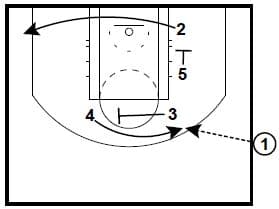
2v1decisionmaking1

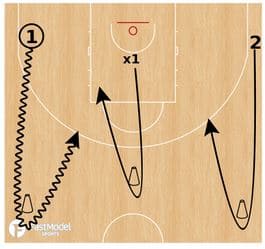
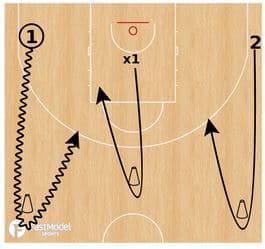
O1’s primary responsibility is to “finish at the rim” (basket)

X1’s responsibility is to meet O1 as early as possible and force them out of the paint

O2’s responsibility is to create a weak-side shooting option (3pt shot)

If O1 cannot score in the paint, they must kick out to O2 for a catch n shoot finish (3pt shot)

Drill starts on the 1st dribble from O1

You can move the cones to wherever suits your particular teams’ needs
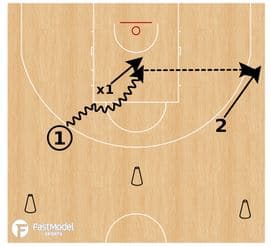
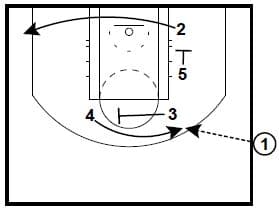
2v1decisionmaking2

O1 MUST get two feet in the paint prior to kicking out to O2, this creates an aggressive mindset & attack mentality


2 v 2 Decision Making
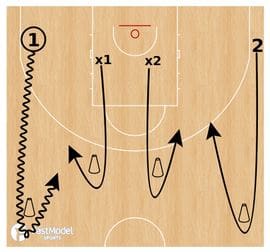
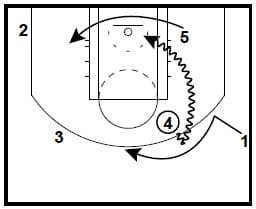
2v2decisionmaking1

O1’s primary responsibility is to “finish at the rim” (basket)

X1’s responsibility is to meet O1 as early as possible and force them out of the paint

X2’s responsibility is to cover split-line

O2’s responsibility is to create a weak-side shooting option (3pt shot)

If O1 cannot score in the paint, they must kick out to O2 for a catch n shoot finish (3pt shot)

Drill starts on the 1st dribble from O1

You can move the witches hats/cones to wherever suits your particular teams’ needs
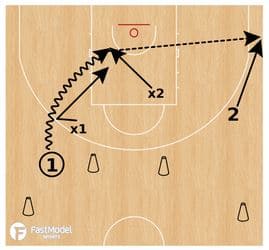
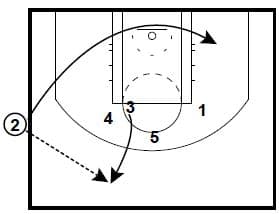
2v2decisionmaking2

O1 MUST get two feet in the paint prior to kicking out to O2, this creates an aggressive mindset & attack mentality
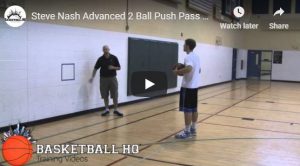


Steve Nash Push Pass Drill

By Brian Williams on June 27, 2016

This passing drill is among the thousands of resources for both coaches and player available from basketballhq. They have several more videos as well as basketball coaching resource articles.

Make sure that your speakers are on to hear the narration and that you can access YouTube to see the videos.

Like everything I post on the site, you will need to tweak the drill to fit your philosophy. If you would rather the pickup and pass be made with two hands, you could have the player dribbling one basketball doing crossovers, pick up with two, and pass with the hand that the coach calls. The idea is an overload drill and not to make it gamelike.

You could also set it up so that the player is passing to two shooters so that you are better able to simulate the receiver’s shooting pocket. The idea is for you to think about it and make it your own, or decide that the drill isn’t for you.

Click the play arrow to begin the video.


Steve Nash Advanced 2 Ball Push Pass Drill

You Can’t Do That!

By Brian Williams on June 23, 2016

This article was written and contributed by Scott Rosberg

My most recent post in my series on the “Coach as Teacher” was titled “There is Power in Your Words.” While today’s post is not in the realm of “Coach as Teacher,” it does fit into the concept of the Power of our Words, so it is fitting to have it be the post following the one with that title. It is a little bit of a rant about something I have been concerned with for some time, and I only see getting worse. It was written a month ago when two things happening simultaneously held our country’s collective interest – our presidential primary elections and the end of basketball seasons around the country. You might be asking, “What could the presidential primaries and the end of basketball seasons have in common?” Glad you asked. Let me explain.

Now, please understand – this is not going to be a political post. While I have my opinions on the candidates, I am not going to go into those here. What I am going to talk about, though, is the climate, the atmosphere, and the discourse that we have coming from the primaries. And I think you will see a correlation between them and fan behavior at games.

I never imagined that I would see people running for the office of President of the United States of America resort to the kind of name-calling and bullying that we have seen them sink to in this race. I have seen and heard supposedly adult men attack one another by picking on the other man’s height, the size of fingers (as well as the subsequent allusion that led to another part of the male anatomy), poor spelling, and getting thirsty while giving a speech. I have heard men tell each other to “Shut up!” I have heard, “Get him the hell outta’ here!” and “If you need to rough him up a bit, I’ll pay the bills.” Seriously? This is how our supposed leaders speak in public to other people?!

We have watched the climate at some of the rallies devolve into supporters/fans of opposing sides yelling at one another, pushing, shoving, and punching each other. We have seen candidates and supporters alike pointing fingers of blame all around them, but nobody seems to want to point the finger in the mirror and say to himself or herself, “You’re better than that. You need to own it and fix it right now.” There is no accountability for this abhorrent behavior – only finger-pointing and name-calling. It is a scary political climate that we have crossed into.

We have also crossed into a similar climate with the fans at basketball games. Of course, this could go for all sports, but the basketball seasons are coming to or have already come to a close, so it is most prevalent right now. Over the final few weekends of the high school basketball season here in Montana, I watched a few games at a Divisional Tournament and a State Tournament. I also watched a lot of college conference tournaments on TV, and the “Big Dance” of March Madness. Madness is a perfect term for what has been created in all of these venues.

Listen to the student sections at these games. High school kids take their cues from college kids. That is nothing new, and it is not exclusive to sports fans. However, sports fans are the focus here. While I love the “Cameron Crazies” of Duke University, they are 18-22 year-old college students cheering for and against other 18-22 year-old college students. While that in and of itself doesn’t make it okay for them to cross the line and yell some of the things they do, at least the people they are yelling at are adults (for the most part). Also, they do have some very creative, non-threatening chants that are clever and funny.

Hearing “Airball” and “You got swatted” and “You can’t do that” are not the worst things that those players are going to have to deal with during the course of their involvement in competitive athletics. Of course, those also aren’t the worst things that get yelled at them. Far worse chants directed at specific players about their families, GPA’s, and questionable things they have done occur all too often. Also, it is the tone and tenor of the variety of chants that is problematic. It is all about demeaning, belittling, embarrassing, and hurting the “other guy.” In the athletic world, we have worked really hard over the last 10-20 years to get coaches to stop treating their players in demeaning, embarrassing ways. We need to be doing the same with our fans.

However, the bigger problem is that high school student sections quite often take their cues from the college student sections. So we start to hear the same kinds of chants with the same kind of tone and tenor being directed out at the players. Only in this venue, they are yelling out at 14-18 year-olds. These are children that they are yelling at.

I know that 17-18 year-olds are looked at as young adults. But they are still in a much more fragile and tenuous time of their lives than the college kids, and many of the high school players aren’t even 17 yet. Most high school kids don’t have a strong sense of self-confidence. They struggle with their self-image and sense of worth. They critique every aspect of their being. Being yelled at the way they are yelled at by fans can be extremely unnerving.

There are also other extremely impressionable young people at these games. Consider how many middle school and elementary school kids are sitting there listening to what is being yelled from student sections. Just like those kids watch the players and take their cues from them to figure out what it means to be a high school athlete, they are also doing the same thing watching the fans. They are learning that the kind of behavior and chants being yelled at the players is appropriate, and they begin to join in and do the same.

Now consider those same kids watching snippets of the debates and rallies of the presidential candidates. Are they really seeing anything that is all that different from what they are seeing in the basketball stands? Aren’t the way our presidential candidates – people who want to LEAD our country – and our student sections at our games doing pretty much the same thing? Aren’t they yelling inappropriate comments and bullying people on “the other team” to try to put them down and beat them? Where has this come from? How has this become acceptable? Most importantly, isn’t it time we do something about it?

It is time for us to take back our bleachers. It is time to hold our fans accountable for their actions and let them know they are going too far. As a former athletic director, I know it’s not fun to confront an entire student section. However, confront them we must when they cross the line. But we have to establish what the line is first. Then we have to tell them what that line is. We have to give them the expectation of what it means to be a fan.

I know that some state athletic associations have come under fire and taken some heat for wanting to legislate fan behavior too much. People cried “Foul” when some states wanted to outlaw the “Airball” chant and others like them. The problem with so many of the chants, though, is that they are directed at someone on the opposing side as opposed to for someone on our side. This starts with one student section yelling at one team. Then the other student section yells back at the other team. As is often the case, though, (especially with kids) they have to take it up a notch. “Airball” becomes “You got swatted” or “You can’t do that.” That receives a return chant we might hear when a team is shooting a free throw, “Bounce, Bounce, Bounce, You Suck!” They have now leaped over a line of appropriateness.

Consider this scenario that played out in one of the final weeks of the season in Massachusetts. Catholic Memorial HS outside of Boston banned its students from attending the state tournament semi-final game after their student section chanted “You killed Jesus!” in the previous game against Newton North HS, a predominantly Jewish school. Their chant was in response to Newton North’s chant of “Where are your girls?” and “Sausagefest” towards Catholic Memorial, an all-boys’ school.

This problem is happening everywhere. An administrator at a school here in Montana had to send out an email to the entire school district’s parents after the Divisional Championship game warning everyone that they would forfeit their state tournament games if they had any type of behavior from the fans (and players) similar to what had happened during their Divisional Championship game. I’m sure everyone who reads this post could talk about some situation that they heard about or witnessed that would fall into the same category as these.

So when state associations say they want to limit what gets yelled and how it gets yelled, it is not in the spirit of not wanting kids and fans to have fun, be spirited, and enjoy the game experience. It is because all too often, the fun and spirit and experience devolves into something ugly, divisive, and sometimes violent. Just like our presidential primaries have devolved.

So how do we fix it? That is not an easy answer. But one answer is that since these things seem to trickle down, let’s start at the top. How about demanding that our leaders (presidential candidates, for instance), coaches, teachers, administrators, and parents model proper behavior? We ask teachers, coaches, and administrators to do this all the time. We need to hold them accountable when they don’t. When these people handle themselves the right way, then it is easier for them to demand the same from others.

As I said earlier, we also need to establish expectations. No, we don’t have to completely curtail all of the chants that happen at games. But we need to give students (and adults) guidelines on what is and is not acceptable to yell. We must say, “Here is the line that you cannot cross.” Then when someone crosses it, we must have the strength to confront the behavior and say, “That is unacceptable. No more of that or you will be removed.” Again, I know that is not always easy, but it must be done.

Administrators can work with student councils, captains’ councils, leadership classes, and teams to enlist them to help police their own student sections. When fellow students turn to others and say, “Hey, we don’t say that here. We’re better than that,” it goes a lot further than when administrators reprimand and punish kids. As with so many things, education is the key.

We must all work together to fix this problem NOW! It isn’t going to get better on its own. It is going to take a concerted effort on the part of a lot of different people in a lot of different circles in a lot of different communities to fix this. But fix it we must, or else consider where we will be in another 5-10 years. Is anyone looking forward to the presidential primaries for 2020?!

** I had intended to talk about both student-fan behavior and adult-fan behavior in this post, as well as treatment of officials. However, this is by far the longest post (1900+ words) I have written in the eight months that I have been writing these posts. So stay tuned – I will be addressing adult fan behavior & treatment of officials in the future.

About the Author of this Article

Scott Rosberg has been a coach (basketball, soccer, & football) at the high school level for 30 years, an English teacher for 18 years, and an athletic director for 12 years. He has published seven booklets on coaching and youth/school athletics, two books of inspirational messages and quotes for graduates, and a newsletter for athletic directors and coaches. He also speaks to schools, teams, and businesses on a variety of team-building, leadership, and coaching topics. Scott has a blog and a variety of other materials about coaching and athletic topics on his website – www.coachwithcharacter.com. He can be reached by email at [email protected].

Scott is also a member of the Proactive Coaching speaking team. Proactive Coaching is dedicated to helping organizations create character and education-based team cultures, while providing a blueprint for team leadership. They help develop confident, tough-minded, fearless competitors and train coaches and leaders for excellence and significance. Proactive Coaching can be found on the web at www.proactivecoaching.info. Also, you can join the 200,000+ people who have “Liked” Proactive Coaching’s Facebook page at www.facebook.com/proactivecoach. Scott can also be reached through Proactive Coaching at [email protected].

There is Power in Your Words

By Brian Williams on June 23, 2016

This article was written and contributed by Scott Rosberg

There is power in the words we speak. Our words carry great weight for those to whom we say them. However, the words alone are not what make them powerful. It is our intention, our tone, our inflection, and our desired outcome of speaking those words that give words their greatest power.

Words spoken or written on a page but independent of each other do not carry nearly the same weight and power as they do when they are put together into sentences. The way we string together certain groupings of words into sentences give meaning, life, and strength to the words. It is critical that we choose our words carefully and wisely in all instances. Many of us have uttered things that we wish we could go back and “rewind the tape” so as to not say what we said. But our words cannot be unsaid; our actions cannot be undone. While we can augment, tweak, clarify, apologize, and re-state, we cannot “un-state” the words we have stated.

Therefore, it is important that we choose our words wisely. As teachers & coaches, it is absolutely critical that we “watch what we say” and “how we say it,” especially to the young people in our charge. We must always keep in mind that children are taking their cues from us.

While it is true that actions often speak louder than words, our words still speak very loudly. Kids are constantly listening to what we tell them (even when we feel like they haven’t heard a word we said!). Be careful what you say to and around them. You never know what they are picking up. Kids have a funny way of reminding you of something you said days, weeks, months, or even years later. They will talk about what you said at halftime of a game 10 years ago, and you will not even recall saying what they tell you that you said.

The other issue with that is the difference between your intended message, the actual message, and the received message. These three messages can end up being quite different from each other. I might know what I am trying to say. However, my words may come out different than the way I am thinking it. The person to whom I speak it filters the message through his/her own ideas to determine what was meant. My intention might be quite different from the final perceived message of the person to whom I spoke. Or I may have intended a message for one person, but there were others there who picked up a completely different message.

Have you ever had a parent question you on why you said a particular thing to their child, and your response was, “I never said that.”? This happens all the time. When you “rewind the tape” to consider where the miscommunication happened, think about the words you chose, your inflection, your tone of voice, and your body language. Maybe you thought you were saying a certain thing, but what came out was not exactly what you thought you were saying. Then consider what the child’s state was during the conversation. Was s/he focused & attentive? Did you get confirmation from him/her of their understanding of what you said? These types of miscommunication are common, but they can be reduced by just being more in tune with your own communications and how your audience is receiving them.

We must always keep in mind our intention with the communication we are about to have with our players. Am I saying this to serve my needs or to serve their needs? Are the words I am about to speak going to help build up these young people or tear them down? Am I creating a positive, trusting relationship with these words, or am I destroying the trust that I am trying to create? Keep these questions in the back of your mind as you are building relationships with your kids.

Our tone of voice and our body language play a major role in giving power to our words. Just as words have more power when they are strung together with other words to intentionally give them power, our tone of voice and our accompanying body language give added power to our words.

We must be careful that our tone is conveying the intended consequence in the receiver. The exact same words said in different tones of voice can mean very different things to the receiver of those words. Listen to yourself and to your players utter the simple exhortation of “Come on!” Is it said as a positive form of encouragement, or as a desperate cry for help or condemnation, or even a sarcastic dig? The tone of voice says everything in a statement like this. Be careful that your tone conveys the right message.

Also, your demeanor when you say the words can create a certain feeling and response. As the leader of your program, you need to be the face (and body) your team needs to see. A scowl on your face with your shoulders back and your hands clenched will convey a very different meaning than a smile while seated. Whatever you are trying to convey, recognize that your facial expression and your body language play a huge role in how your words are interpreted.

Children learn many things in a variety of manners from the teachers and coaches in their lives. We need to constantly be considering our words, our tone, and our body language when we are communicating with the young people in our lives. We are not only giving them a message for the moment in which we are speaking to them; we are also instilling in them the ways that they will communicate with others as they make their way through life. Never forget that there is great power in your words.

For more great info on the concept of the power of our words, check out the DVD “The Power of Your Words by Bruce Brown of Proactive Coaching. Bruce gives a powerful presentation that will resonate with coaches, teachers, and parents. You can find “The Power of Your Words“ at Proactive Coaching’s website – www.proactivecoaching.info.

About the Author of this Article

Scott Rosberg has been a coach (basketball, soccer, & football) at the high school level for 30 years, an English teacher for 18 years, and an athletic director for 12 years. He has published seven booklets on coaching and youth/school athletics, two books of inspirational messages and quotes for graduates, and a newsletter for athletic directors and coaches. He also speaks to schools, teams, and businesses on a variety of team-building, leadership, and coaching topics. Scott has a blog and a variety of other materials about coaching and athletic topics on his website – www.coachwithcharacter.com. He can be reached by email at [email protected].

Scott is also a member of the Proactive Coaching speaking team. Proactive Coaching is dedicated to helping organizations create character and education-based team cultures, while providing a blueprint for team leadership. They help develop confident, tough-minded, fearless competitors and train coaches and leaders for excellence and significance. Proactive Coaching can be found on the web at www.proactivecoaching.info. Also, you can join the 200,000+ people who have “Liked” Proactive Coaching’s Facebook page at www.facebook.com/proactivecoach. Scott can also be reached through Proactive Coaching at [email protected].

Billy Donovan SLOBs

By Brian Williams on June 22, 2016

Two end of quarter/half/game/end of shot clock sideline inbounds plays from Billy Donovan and the Oklahoma City Thunder.

You will want to put your players in the spots where they can be most effective regardless of whether the positions they play in your system match the traditional numbers that are shown in the plays.

The plays are from Billy Donovan’s Oklahoma City Thunder Playbook (assembled by Gibson Pyper).

Diagrams created with FastDraw


OKC Keep

slobs3

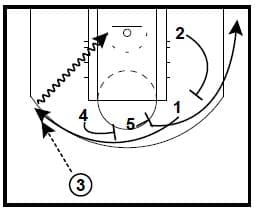
3 sets screen for 4.

5 sets down screen for 2 who rejects it to opposite corner.

1 inbounds to 4.


slobs4

4 fakes hand off to 1 and then quickly attacks.

5 clears to opposite block.


OKC Side Out Hammer

slobs5

3 cuts to the top. 2 passes to 3 and cuts opposite.


slobs6

1 Iverson cuts off 4 & 5 looking to attack.

2 sets hammer screen for 5.

1 drives to score or to make baseline hammer pass to 5.


Octopus Dribbling/Driving Drill

By Brian Williams on June 21, 2016

I received these two driving/finishing drills in an email from Dennis Hutter, Head Women’s Basketball Coach at Mayville State University. His website, www.coachhutter.com . The website has more shooting, individual development workout, and leadership videos.

Both of these videos are You Tube videos, so please be sure to be on a server that allows you to access You Tube.

Editor’s notes from Brian:
When working to improve players’s dribbling & driving skills, I like the idea of using a time and when possible, two basketballs. You can add pieces to the drills to challenge your players more such as requiring a live ball move such as crossover, between the legs, etc… Whatever moves you want players to be able to make in a game. You can add in a defender poking at the basketballs as they are being dribbled. You can add in a defender offering some contact at the rim on the finishes. You can change the amount of time you require to complete the circuit. There are many ways that the drills can be modified to make them your own. It may take some live experimenting with your players before you can tell exactly how you want to run the drill, but IMO, that is ok. There is nothing wrong with players being exposed to your thinking process as you tinker with ideas to help your program. It is also a good time to get some input from them.

The remainder of the post is what Coach Hutter included in his email:

Octopus Dribbling 2 Basketballs

This drill is done with two basketballs. The object of the drill is to complete the course in 25 seconds or less. If the player completes the drill in 25 seconds or less, we have them do the drill again. This time they to try and beat their previous time. We try to keep the drill as competitive as we can. We believe competition adds pressure and effort to drills. Player will two ball dribble around each individual cone and then come back to the rim and dribble around the cone under the rim. They will weave back and forth advancing to the next spot after they are under the rim. We have five spots on the floor that the player must dribble around. This is another really good warm up drill to start an individual workout.

Click the Play Arrow to view the video of the drill

Octopus Dribbling 1 Basketball

The object of this drill is to complete the course in 30 seconds or less while making all 5 lay ups. Try to have your players change the way they score around the rim. You can also add shot fakes to the drill if desired. Drill starts under the rim, and player dribbles around first cone and comes back to rim for a lay up. They then complete the course advancing to the next spot after each lay up. We usually do two right handed lay ups and two left handed lay ups. The middle spot we leave optional for the player to decide what hand they would like to use. This is a great warm up drill to start an individual workout.

Click the Play Arrow to view the video of the drill

  • « Go to Previous Page
  • Page 1
  • Interim pages omitted …
  • Page 116
  • Page 117
  • Page 118
  • Page 119
  • Page 120
  • Interim pages omitted …
  • Page 288
  • Go to Next Page »

Primary Sidebar

  • Twitter
  • Facebook
  • Linkedin
coachestoolbox
personaldevelopmenttoolbox
basketballplayerstoolbox
basketballtrainer
athleticperformancetoolbox
coachingbasketball

© Copyright 2026 Coaching Toolbox

Privacy Policy