• Skip to primary navigation
  • Skip to main content
  • Skip to primary sidebar

  • Basketball Plays
    • Ball Screen Sets
    • Horns Sets
    • Man to Man Post Up
    • Man to Man Isolations
    • Backdoor Plays
    • Man to Man 3 Point Shot Plays
    • 2-3 Zone Attack
    • Baseline Inbound Plays
    • Sideline Inbound Plays
    • Combination Defense Attack
  • Drills
    • Defensive Drills
    • Offensive Drills
    • Competitive Drills
    • Passing Drills
    • Rebounding Drills
    • Shooting and Scoring Drills
    • Toughness Drills
    • Transition & Conversion Drills
    • One on One Drills
  • Blueprint
  • Practice
  • Mental Toughness
  • Skill Development
  • Offense
  • Defense
  • Store

Assistant Coaches’ Role in Preparing Scouting Reports

Assistant Coaches’ Role in Preparing Scouting Reports

By Brian Williams on August 16, 2016

By: Bert DeSalvo

As a former women’s college basketball head coach, I always believed that our scouting reports were a key component to our success on the court. Having the necessary information on each opponent has allowed my programs a great amount of success during my head coaching tenures. This success was due largely because of the efforts of my coaching staff and their approach to their scouting report responsibilities.

In order to be as best prepared as we could be for our upcoming opponent, I clearly defined the following objectives for my assistants when building scouting reports:

  1. Do Your Work Early – This is something my programs have always stressed to our student-athletes, both on and off the court, and it also applies to the entire coaching staff. Although I have only had the opportunity to have a coaching staff of myself and another, my assistant was directed to be done with the personnel and statistics portion of the scout a full game ahead (about 3-4 days). If the next opponent happened to play the same night as us, my assistant would update the necessary stats to keep the scout as accurate as possible. This allowed us maximum time for creating a winning game plan and preparing paper scouts and sets.
  1. What To Give – One of the most crucial aspect in preparing scouting reports is to decipher what information to give the student-athletes. This greatly depends on the basketball IQ of your team and what they can retain. It makes no sense to give players information that they will either forget or that makes them tense and anxious. The coaching staff must find the right balance of information that will make their players perform better. Coaches cannot forget that a scouting report’s sole purpose is to make players feel comfortable and to give them confidence. Assistants must snuff out tendencies when watching personnel, as any tips can make all the difference! It was my assistant’s job to put more in their initial version of the scout so that we could, and ultimately I, could make the final decision as to what we would present to the team in the final version of the scout.
  1. Same But Different – Consistency is key. I wanted my assistant to organize the scout using the same template for each game. This uniformity allows the head coach and student-athletes the ability to easily access information at any time before, during and after the contest. Scouting report templates must be discussed by the coaching staff prior to the start of the season and the entire staff must agree on the presentation. Consistency is important, but so fending off the monotony of a long season. Therefore, there may be times to change the scouting format, especially if it is the second time you have played an opponent. This will get the attention of the players and may help them if they need a spark to keep them sharp and interested in the task at hand.
  1. Challenge the Head Coach – In order to get the best results possible, assistant coaches must come to the game planning meeting with their own ideas. One thing I was careful to avoid as a head coach was to not hire “yes” men. Instead I wanted an assistant who could argue a point but not be argumentative during the process. It is very important that assistants realize that they make suggestions, while the head coaches make decisions. Nevertheless, a strong relationship between the head coach and his/her assistants will only strengthen game plans because all ideas will be considered and evaluated on their merit.
  1. Be Realistic – I would rather have my assistant(s) be realistic on personnel/actions/alignments that they thought could really give us trouble, rather than having them “sugarcoat” everything with an unrealistic positive spin just to make me feel better. A good talk of what we need to watch out for and how will we make adjustments if something were to occur is the best way to handle an assignment from an opponent. In saying that, there does not have to be “gloom and doom” or a negative feeling amongst the coaching staff, and it is the head coach’s job to create an atmosphere of calmness within the program. Remember, preparation builds confidence and confidence leads to positivity and enthusiasm.

In addition, here are what some respected assistant coaches from NCAA Division II institutions (where coaching staffs tend to be much smaller than their D1 counterparts) have to say about their goals and timeline requirements when preparing scouts:

“My goal when preparing scouts is to get as much useful information to my head coach as possible and in a timely manner. What I try and do is watch film on the opponent 3-5 days ahead of time. That way we have ample time in practice to work on any actions or situations that we may see. I try to watch the opponent’s last full game and then break downs of clips through our video editing system. I watch and take notes on the following:

  1. Opponent’s Man and Zone Offense
  2. Opponent’s Man and Zone Defense
  3. Opponent’s Press Defense
  4. Ball Screen Defense
  5. EOG Situations and ATO Sets

We prepare our team with both a paper scout and video scout. Both scouts include information on the notes taken, plus information on top personnel for the opponent. We give this to our team a day before the game. Our video scout is clipped and trimmed to about 15 minutes. We show this with our team and also sent it to them so they can watch it on their own time.”

– Julie Kaufman, Assistant Women’s Basketball Coach, Seton Hill University (NCAA DII – PSAC)

“As an assistant, it is vital to scout and know your opponent almost as well as you know your own team and have film and paper scout prepped and ready to go (for the head coach) two to three ahead of the game. This allows the head coach to access it and start the preparation and discussion on the opponent whenever he/she is ready to, as well as to start to look at what adjustments, wrinkles, and game plans you’ll take into practice and scout.

Along with that, it is paramount that when giving the scout to the team and going through film that you are comfortable and confident because it has serious carryover to the level of confidence and understanding the team will take into the game.

Both the players and head coach don’t necessarily need to know it like you do but they need to know it well enough to execute the game plan and understand that they can trust you in times of adversity during the heat of the game.”

– Kyle Cooper, Assistant Women’s Basketball Coach, West Liberty University (NCAA DII – Mt. East)

“From the first day on the job, the expectations Coach DeSalvo had for me regarding scouting reports were very clear. Still, I felt it was my job to exceed his expectations. I strived to make sure that scouts were prepared prior to him asking and made sure he did not have to ask twice.

Being the only assistant on the staff in my previous role, I worked to be as efficient as possible and strived to go above and beyond to help put the program in the best position to be successful and to never make the head coach have to wait for me. I did my best to be a full scout ahead to keep our preparation early.”

– Courtney Burns, Assistant Women’s Basketball Coach, Southern New Hampshire University (NCAA DII – NE-10)

In conclusion, assistants must have a “will please” motto and do what is asked of them in regards to preparing scouting reports to make the head coach’s life easier. Remaining ahead of the head coach’s timeline and expectations are essential to continue to prepare players for upcoming opponents as well as building their trust and respect in the process.

Moreover, head coach must always be communicating effectively with their coaching staff. If assistants are not performing to the head coach’s standards, it is the head coach’s responsibility to discuss this with the assistant immediately and professionally. This can be difficult based on friendships that develop, but must occur nevertheless. Most of the time though, if assistants know what is expected of them, this is not an issue.

Lastly, head coaches must be aware that scouting reports are where their assistant(s) can make a huge impact for the program (either positive or negative) and can help to earn a positive reputation and prepare them for the career ambitions. Therefore, head coaches must empower their assistants in the scouting process. Giving assistants the necessary direction and clearly defined timelines while still allowing their assistants to have the freedom to complete the assignment in the way that works best for them, should be how head coaches blend their management and leadership styles during the scouting process.

And, here are some defensive notes from Coach DeSalvo’s blog “Expressions from the Hardwood” that came from Charlie Spoonhoor

“What we are trying to do is interrupt what you are doing. We want to destroy your comfort level, to take away what you want to do.”

“If you don’t run back and get your defense set, people will score against you while you are disorganized and that’s when you are going to get beat.”

“I think the reason why you have a problem with transition defense is that your team is mad.”

“We always pressure the ball, no matter who catches it.”

“We deny interior passes. Anything that goes into the defense is an interior pass.”

“We don’t switch unless it is part of the defensive plan for a game. We will do it if the scouting report dictates it.”

“Get everybody to mentally be a part of your defense. If you can do that, you are in business. You can’t have three or four players guarding.”

“Scouting is very important. Knowing where people score and how they score is very important, so you need shot charts. If you don’t, you can get the wrong idea of how you should cover someone.”

“On your half-court defense, if you are going to play man, that’s fine. If you are going to play zone, that’s fine. I think it’s good to have a secondary defense because it can change the tempo of the game. If you let teams get into a rhythm, they will beat you. You need to find a way to change the tempo of the game.”

“The whole this with your defense is this: Your defense is how hard you work. It must be effort.”

About the Author

Bert DeSalvo is a former D1 men’s assistant coach, D2 and D3 women’s assistant coach, as well as a D2 and D3 women’s head coach. Follow Bert DeSalvo on Twitter @CoachDeSalvo and his blog “Expressions from the Hardwood.”
6 Ways to Be Coachable

By Brian Williams on August 15, 2016

This article was written by Mason Waters and posted on The Coaching Toolbox with his permission

It first appeared on Medium.com

Players, coaches want you to be successful.

As a coach, I know I can say that honestly. I want my players to be successful. I really do. And I could care less about the ‘glory’ of it, if anyone knows I helped along the way. The game’s about the players, not me. There’s ten thousand coaches around the globe who share that same heartbeat of coaching. At the end of the day, a player’s success is a two way street. So, great players have to have the humility and the hunger to receive coaching.

Players, your job is to make your job, and your coaches job easier by being coachable. Here’s a few ways to make your coaches job easier, more enjoyable, more rewarding, and more successful. If you can make these points habit, you’ll also improve quicker and more efficiently. And your relationship with your coach will be amazing, which is a magnificent thing!

6 Amazing Ways You Can Contribute to Your Team

1. Just say “Yes Coach” – One of the most frustrating things as a coach is correcting a player or teaching them a point and them say “Well coach, John was in my way…” or a very rapid “I know” before I can even finish my sentence that I intend to help the player. Along similar lines, Players, just say yes sir or yes ma’am when a coach corrects you, thank them, and implement what they’re saying.

Be confident, not insecure when a coach (or team leader) corrects you. Confident players receive correction and think, “My teammate or coach is revealing a weakness in my game that needs to improve. I’m thankful they want to see me improve.” Confident players want as many good basketball eyes on their game so they can have a better understanding of what they need to work on.

Insecure players reject the truth that their game has deficiencies and thinks, “I don’t have that weakness in my game.” “I don’t need a coach.” Insecure players receive correction as an insult, and think they can be great alone.

2. Make and Keep eye contact  –  Eye contact is respectful. It shows you care. You’ll listen better and learn more. Your play will improve. Coaches and players need to consistently work on this and remember, how does it feel to talk to someone who’s eyes are on the clouds passing overhead?

3. Ask “What’s Next?”  – Either to yourself or your coach, be asking this question. In practice, prepare yourself for the next drill or station, and be ready to direct your teammates to transition into the next drill fast. Successful practices really only need one player to be vocal and fully aware of what’s going on.

4. Invite coaching  – Here’s the attitude to have and phenomenal things to say to your coach:

“Coach, I don’t want to be mediocre. I want to achieve my best. If I’m ever out of line of that, please correct me.” Or, “Coach, I want to be the most coachable guy on the team. If I’m ever not being coachable, please correct me and I’ll adjust.” What kind of athlete do you want to be? Better yet, what kind of person do you want to be? Let your coaches and teammates you trust know and invite them into your development because to be our best, we’d be wise to let those around us know the type of person we want to become.

5. Stay out of trouble  –  I could list a thousand reasons why, but I’m sure you already know 999 of them.

6. Eliminate ABC  –  Arguing. Blaming. Complaining. Honestly, I love it when people embody these three words with their actions. Everything is better. When someone argues, blames, or complains, I become full of inspiration and motivation to fulfill my dreams. Please tell me you hear the sarcasm in that.

For a second here, forget others and consider just how this ABC impacts you! It takes your focus off your mission. Those who argue, blame, and complain focus on all that’s wrong and all the reasons something can’t get done as opposed to finding and creating reasons for things to get done, like winning a game.

Replace this ABC with LOP (Listening, Own it, and Positivity)

  • When you want to argue, take a step back and listen. Arguing is a waste. You and your team will benefit from that.
  • When you make a mistake, own it. Say “That was my fault. I’m gonna win the next play though.”
  • When you or a teammate complain, do something positive. Give a high five, dance, clap, or tell a teammate, “Dang, that was an awesome play!”

It flows over …

The beauty of sports is that the lessons learned in the locker room or at practice are typically lessons that last a lifetime and flows over into every aspect of life. If WE ALL (coaches and players) make these points habits, we’ll surely benefit on the court, and even more importantly in our relationships with everyone else.

I’m cheering for you,

Mason Waters

About the Author of this Article

Mason Waters is in his fourth season with Collegiate Prep Basketball Academy in Atlanta, Georgia.

Australia – Point PTP Sprint

By Brian Williams on August 13, 2016

This play was run by the Australian National Team and then diagrammed and contributed by Wes Kosel to the FastModel Sports Basketball Plays and Drills Library.

Wes is a former college basketball coach.

You might not want to use the plays that I post in their entirety, but my hope is that you can take parts of the plays and use them where they fit for your system.

This is what Coach Kosel said about the play:

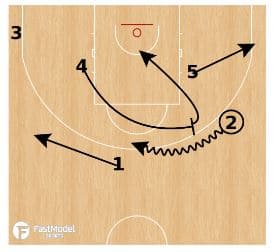
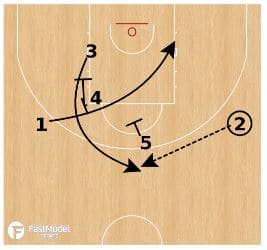
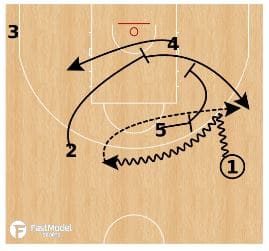
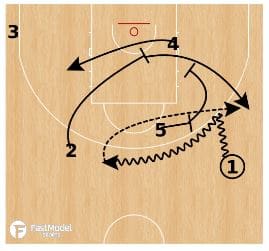
Australia uses a pick the picker action in this play with a cross screen / down screen combination.

If nothing is there, the big sprints out to set a ball screen.


australia1

1 dribbles off of a high ball screen from 5.

2 screens for 4.

5 rolls into a down screen for 2.

1 passes to 2.


australia2

4 sprints out to set a ball screen for 2.


Lithuania DHO UCLA Shuffle

By Brian Williams on August 13, 2016

This play was run by Lithunia in the Olympics and then diagrammed and contributed by Matt Wheeler to the FastModel Sports Basketball Plays and Drills Library.

You can also find out more about FastModel Play Diagramming software by clicking this link: FastDraw

Coach Wheeler is the Head Boys Coach at Olympia High School in Orlando, Florida.

This is what he said about the play:

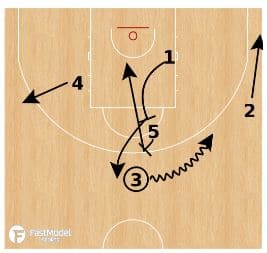
Lithuania ran this unique shuffle cut variation in their opening round game against Brazil.

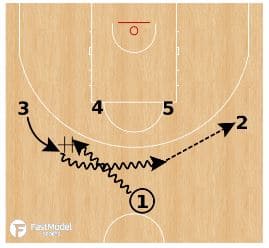
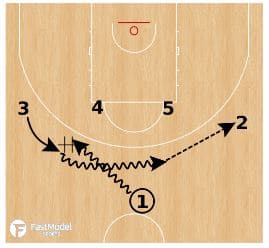
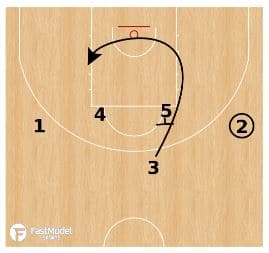
Typically shuffle cut actions put the player receiving the staggered screen in the weak side corner . This way they can easily come off of the staggered screen after the shuffle screen takes place. In this play, 3 uses the UCLA cut to look for a layup on the strong side.

If 3 isn’t open he moves to weak side block to open up a cutting area for 1, who is using the shuffle screen from 4. 4 & 5 then immediately set a staggered screen for 3. If 3 doesn’t have a shot, Lithuania has added a ball screen option where the point guard sets a back screen for the 5 to free him up for a layup.

lithuania1

1 runs a DHO with 3.

3 turns the corner and passes to 2.


lithuania2

3 makes a UCLA cut off of 5’s screen


lithuania3

4 screens for 1.

4 & 5 set a staggered screen for 3.

2 passes to 3 for the shot.


lithuania4

PNR Option

If 3 doesn’t have the shot, 5 sets a ball screen for 3.

1 screens for 5 on the roll, then pops up top.

5 and spread out for spacing.

Tennessee Competitive Practices

By Brian Williams on August 11, 2016

These are some of the notes presented by Dean Lockwood. Dean is currently the Associate Head Women’s Coach at Michigan State. He was an assistant in the Tennessee Women’s Program for 15 years. He was also an assistant in their men’s program for 5 years. In between those stints at Tennessee, he has been the men’s head coach at Saginaw Valley State, and Northwood University.

It takes more time and thought to plan practice to make it as competitive as possible.

Players must be held accountable for competing, but it is the coaching staff’s responsibility to set the tone.
The UT staff will not accept a player not competing–it is one of their non-negotiables
What do your players say are the most important things in your program? At Tennessee one of those things is competing.
Competition is valued highly at UT because we all compete in life almost every day.
Competitors are harder and harder to find and to create.

Establish competition in practice early and be consistent.
Tennessee starts competitive drills and games the first day of practice
Emphasize supporting the players through the competition
Be precise and demanding about how you want your players to compete–specific time and score
Your entire staff must know what you are looking for

Competitive drills help to keep players from hiding in practice
Have something on the line a lot
Competitions keep the coaches from always being the “Bad Guy”
Don’t stop a competitive drill to correct a mistake.
Don’t stop the masses for the one–you can get that on player with a coach for your teaching

Competitive drills promote “readiness.” There is a difference between readiness and preparation
Always recognize selfless acts made for the benefit of the team–example a screen that leads to a shot. Show
appreciation and respect for outstanding efforts. Include those types of plays in your film breakdowns.

Utilize peer pressure within your team
Have no more than 2 areas of emphasis for a drill. Everyone runs on unmet goals of emphasis. It is a team thing.
No missed lines on sprints.
Place a time on all running
Put pressure on seniors and veterans when their team loses in scrimmage or drills
If the first team is beating the second team in a scrimmage, switch scores and force the first unit to play from behind.

Put your best player with the 2nd team. Helps your first team practice playing without him or her, makes the scrimmage more competitive, and raises the level of play for your second unit.
Every competitive game is charted and winners get marks on a scoreboard in the locker room.

Some ideas for competitive drills.

Warm Up Drills: set a standard of execution. For example, if you run 5 star passing or a similar drill, set a specific number of passes that must be thrown and caught correctly and with no fumbles. If there is an error, start over. In layup drills, each player must make 2 from each side so that there are no misses–12 player team must make 48 consecutive layups or start over. You can come up with similar standards for your drills.

50 Pass Drill: Drill is to work on passing, catching, spacing, cutting. Defense can do anything regarding denying, switching, trapping. Players cannot make consecutive passes back and forth to each other except for a give and go. The offense is not allowed to dribble. No shots are taken except layups. The offense scores 1 point for each completed pass and 10 points for a made layup. With a turnover or the rebound of a missed layup attempt, the teams change who is on offense and who is on defense. The first team to 50 wins.

Spurs Drill: Starts 5 on 5 Half Court. If the offense scores, they keep the ball in the half court and play against the same defense. If the defense makes a stop, play it out in transition to the basket on the other end of the court. If that teams scores in transition, they get the ball in halfcourt and if they score, they keep and stay in half court. Play to a specific score that you establish.

Attack Cut Throat: Play Cut Throat, but the team coming on to offense sprints to half court. Tennessee plays it this way to promote an attacking offensive mentality and to prevent a back it out and set it up mentality.

Start at 2 Drill:
To work on valuing each possession. It is a short, but intense game. Half court offense. The score starts at 2. Each basket or foul is a plus one for the offense. The defense gets a minus one for a stop. If the score of the drill gets to 4, the offense wins. If the score gets to 0, the defense wins. There is a consequence for the losing team such as running.

PGC/Glazier Basketball Clinics is a preferred partner of The Coaching Toolbox

Ball Screen Shooting Drills

By Brian Williams on August 9, 2016

Mike Neighbors, Women’s Coach at Arkansas, is one of the best coaches around to learn from. 

Any drill is only good if it gives your players a chance to improve their skills that are needed within your system.  You will want to modify this to your needs.

BALL SCREEN OFFENSE DRILLS

2 ON 0 SHOOTING DRILL

  1. Start with posts on the baseline and perimeter players on the wing.
  2. Coach will start with the ball at the guard position and pass the ball to the wing who can use any method to get open.
  3. The second player in line on the baseline will have a ball
  4. The first baseline player in line will make an L cut to set the screen for the wing player
  5. The wing player will dribble hard off the screen to get to the kill area for a jump shot
  6. The screener will roll to the basket and receive the pass from the baseline post for a shot going to the basket
  7. The drill will continue with the following progression:

    • The wing will pass to the screener rolling to the basket and the wing will receive a pass from the baseline player at the kill area for a shot
    • The screener may roll to the basket or step back for a pass and a shot
    • The wing will keep the dribble and bounce toward the half court line as if double teamed or hard hedge and pass the ball to the screener who short rolled to short corner for a shot. The wing will receive the baseline pass for a 3 point shot
    • The screener will slip the screen and receive a pass from the wing. The wing will receive the baseline pass for a 3 point shot at the wing
    • Same shots from other side of the court

  8. 3 ON 0 SHOOTING DRILL

  9. Start with a point guard, wing and baseline post line. The point guard will start with a pass to the wing and cut through to the opposite corner. The baseline post player will make a L cut to set the screen for the wing who has the ball.
  10. The second player in the baseline post line will have a ball as well as a coach standing under the basket
  11. As in the 2 on 0 drill, the wing comes off the screen and gets to the kill area but now will pass the ball to the point guard who has cut through to the baseline for the first shot
  12. The wing will receive the pass from the coach under the basket for a shot at the kill area and the screener will roll and receive the pass from the baseline post for a shot
  13. The drill will continue with the following progression:

    • The wing can pass to the screener with the coach passing to the point guard on baseline with the wing receiving the pass from the baseline for shot at FT line
    • The drill may use all the options of the 2 on 0 shooting drill with the coach passing to the point guard cutting through to the baseline
    • An extra pass may made with the wing coming off the screen and passing the ball to the screener rolling or stepping back for a shot, the wing receives the pass from the coach and passes to the baseline point guard for a shot and then the wing receives the pass from the baseline post for a shot at the free throw line
    • The point guard will cut to ball side corner and receive the pass from the wing after he comes off the screen. The screener rolls to low post and will get the pass from the point guard who has lifted to the wing. Coach will pass to wing for a shot at the FT line. Baseline pass will be to the point guard for a shot at wing

  14. 4 ON 0 SHOOTING DRILL

  15. Start with a line on the baseline, wing, point guard and high post extended
  16. The point guard passes to the wing and cuts baseline. Wing comes off screen and passes to the high post extended who passes to screener for lay up. Coach passes to the high post for shot. Baseline pass goes to corner for point guard shot. After the lay up, the screener will pass back to wing for shot at elbow. Four shots total
  17. Alter the drill with a ball side cut by the point guard and add the pass from the point guard to the high post for shot, screener gets the baseline pass, coach passes to point guard for shot, wing gets the ball back from screener for shot
  • « Go to Previous Page
  • Page 1
  • Interim pages omitted …
  • Page 112
  • Page 113
  • Page 114
  • Page 115
  • Page 116
  • Interim pages omitted …
  • Page 288
  • Go to Next Page »

Primary Sidebar

  • Twitter
  • Facebook
  • Linkedin
coachestoolbox
personaldevelopmenttoolbox
basketballplayerstoolbox
basketballtrainer
athleticperformancetoolbox
coachingbasketball

© Copyright 2026 Coaching Toolbox

Privacy Policy