• Skip to primary navigation
  • Skip to main content
  • Skip to primary sidebar

  • Basketball Plays
    • Ball Screen Sets
    • Horns Sets
    • Man to Man Post Up
    • Man to Man Isolations
    • Backdoor Plays
    • Man to Man 3 Point Shot Plays
    • 2-3 Zone Attack
    • Baseline Inbound Plays
    • Sideline Inbound Plays
    • Combination Defense Attack
  • Drills
    • Defensive Drills
    • Offensive Drills
    • Competitive Drills
    • Passing Drills
    • Rebounding Drills
    • Shooting and Scoring Drills
    • Toughness Drills
    • Transition & Conversion Drills
    • One on One Drills
  • Blueprint
  • Practice
  • Mental Toughness
  • Skill Development
  • Offense
  • Defense
  • Store

Chris Mack Defensive Drills

Chris Mack Defensive Drills

By Brian Williams on September 12, 2016

These are some notes from Chris Mack, former Head Men’s Coach at Xavier, now at Louisville.

You can see the archives of their basketball coaching newsletter at this link: Xavier Newsletter

Regardless of what you run on offense or defense, you must have a defined system you believe in
– Your team must have an identity
– Everyone in your league should know what you’re about

– When you have a system, it gives your players answers and accountability to what they’re doing. For example, we don’t give up baseline – if you give up baseline you understand you’re coming out of the game
– It simplifies scouting. Identify the common offensive actions you face and teach a standard way to defend. Start at the beginning of the season practicing these actions in your shell drill. This allows you to focus on your opponent’s offensive concepts (rather than detailed set plays) when going over the scouting report.

– Your system should create “Regenerative Learning” (Tony Dungy), where upperclassmen can teach underclassmen.

Why play the Pack Line?:
– On offense, kids are way better ball handlers and way worse without the ball in their hands compared to 20 years ago.
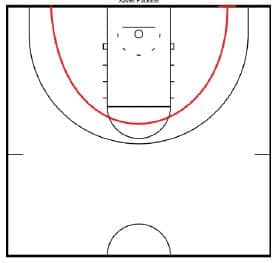
packline2

There is nothing “soft” about Xavier’s Pack Line:
– Aggressive
– Ball pressure
– Smart positioning off the ball

What is the Pack Line Defense Philosophy?

– 16-17’ from the basket, mirrors the 3 pt line
– Tape it down every day before practice

Rules
– GOLDEN RULE: You must have two fee inside the PL when your man does not have the ball. Only two exceptions:
Your man becomes a cutter or Your man becomes a ball screener
– On-ball defender must play with extreme ball pressure
– On-ball defender CANNOT get beat baseline under any circumstances, nor can he get beat in a straight line (from a poor close out). It’s all about what you emphasize: A Xavier basketball player WILL NEVER get beat baseline – this  is nonnegotiable!

Close Out
– One of the most important fundamentals to this defense! You must work on this every single day (including pre-game warm-ups)
– Xavier Way: “Close out with two high hands”  Why “two high hands” instead of one?  Discourages rhythm shots and quick passes over the top Creates a mentality to “take away vision”

Diagrams created with FastDraw

Drill: “VEGAS CLOSE OUTS”
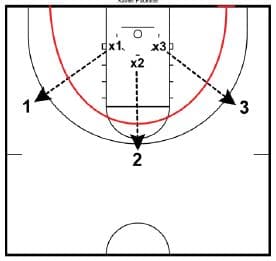
packline3

– We do this drill every single day (practice, shoot around, pre-game warm-ups, etc.)
– Each defender tosses the ball to offensive player
– Xavier Way to close out: 2 High hands, Elbows bent, Low stance, Short/choppy steps, Stay square, Yell “SHOT” early
– The offense will catch, triple-threat, jab step and rip the ball through a couple of times.
 

Drill: “BLACKHAWK”
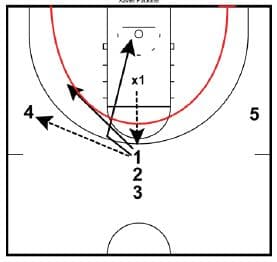
packline1

– Great drill that incorporates closing out, ball pressure, jumping to help position, fronting cutters, and closing out from help position.
– ***Closing out from a help position is one of the toughest fundamental to master defensively***

    • x1 throws ball to first offensive player (1) inline and close out
    • 1 can pass to either wing, x1must “jump and swipe” to get to appropriate help position, 1 basket cuts, x1 must use arm bar and “bump cutter” to the logo (below the FT line)
    • Wing will pass to next offensive player in line (2), x1 must close out again – this time from a help position
    • After two or three passes from wing to top to wing back to top, the Coach will yell “LIVE”
    • Two players play 1-on-1 off the close out
    • Offense has 2-3 dribble max to score
    • x1 must get a stop to complete the drill – if offense scores, x1 restarts drill
    • Coaching Points Make sure x1 keeps proper fundamentals during the dummy period of the drill

This is a video of the Blackhawk Defensive Drill

Click the play arrow to see the drill and make sure your sound is on.

There is nothing to purchase to see the drill, however if you are interested in see more about the DVD that it came from, you can use this link:

Chris Mack Drills to Build the Packline Defense

Drill: “2-on-1 Position”
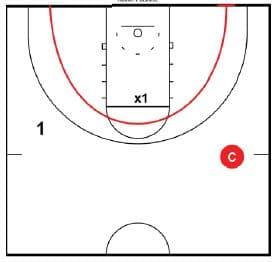
packline4

– Coach starts with the ball, x1 is matched up with 1
– Coach can pass to 1, dribble him out, cut him through, etc. forcing x1 to play on and off the ball
– Drill lasts for a prescribed amount of time, no one looks to score – just focus on constant offensive movement
– Coaching Points:
o Make sure x1 plays with proper fundamentals throughout the drill:
o Close outs from ball to help & help to ball
o Jump & Swipe
o Bump Cutter
o Protect against baseline & straight line drives
– Intense ball pressure
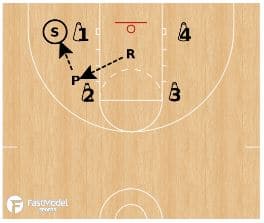
Basketball Drills: UNO Shooting Drill

By Brian Williams on September 10, 2016

This shooting drill was diagrammed and contributed by Joel Hueser to the FastModel Sports Basketball Plays and Drills Library.

You can also find out more about FastModel Play Diagramming software by clicking this link: FastDraw

Coach Hueser is the Head Boys Coach at Papillion-LaVista South High School High School in Nebraska.

This is what he said about the drill:

We are big fans of a UNO (University of Nebraska Omaha) shooting drill Coach Derrin Hansen (@DerrinHansen) shared with us almost ten years ago. Throughout the course of the summer and fall many of our players will do this drill 2-3 times a week if not more. When it’s all said and done, each player will have made 100 shots (80 field goals and 20 free throws). The workout can be finished in 20-25 minutes depending on age, skill level and intensity. We like the variety of game-like conditions presented in this workout: shooting, passing and rebounding.

You can modify the drill to shoot more 3s if that is what you are looking for. There are 2 videos of players executing the drill below the diagrams.

The drill has 3 phases.

To complete each portion of the drill, the players must make the specified number of shots. Have the rebounder count out loud how many they are shooting after each shot attempt. Example: 1 for 2, 2 for 3, 3 for 4, 3 for 5, etc…

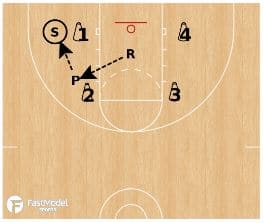
Phase #1: 4 Spot Shooting (40 Made shots–32 FGs 8 FTs)

basketball-drills-uno-shooting

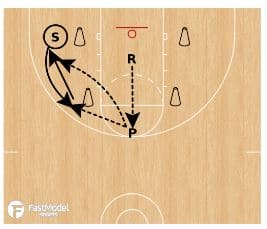
Shooter makes 8 from spot 1 (cone).
Shooter then makes 2 freethrows.
Passer rotates to Shooter and Rebounder to Passer.
Repeat until all 3 players have shot from all 4 spots (cones).

Points of Emphasis:

-Be shot ready.
-Good pass equals a good shot.
-3 players and 2 balls are needed for this drill.
***Coach Derrin Hansen of University of Nebraska-Omaha deserves the credit for this shooting drill***

Phase #2 Back & Forth (40 Made shots–32 FGs 8 FTs)

basketball-drills-uno-shooting2

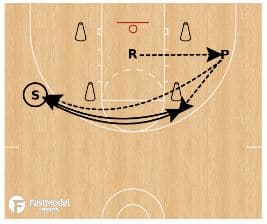
Combo 1: Shooter cuts back & forth from spot 1 to 2 (corner-elbow) and makes 8.
Shooter then makes 2 freethrows.
Passer rotates to Shooter and Rebounder to Passer.
Repeat until all 3 players have shot.

Points of Emphasis:
-Get your homework done early (we emphasize inside step).
-Game speed.
-Overhead pass when the shooter moves away from the passer.

basketball-drills-uno-shooting3

Combo 2: Shooter cuts back & forth from spot 2 to 3 (wing-elbow) and makes 8.
Shooter then makes 2 free throws.
Passer rotates to Shooter and Rebounder to Passer.
Repeat until all 3 players have shot from all 4 combos.

Points of Emphasis:
-Combos 3 & 4 are the same on the opposite side.
-Shooter should always land 6″ forward.
-Mastery of the overhead pass!

Phase #3 Around the World (16 FGs 4 FTs)

basketball-drills-uno-shooting4

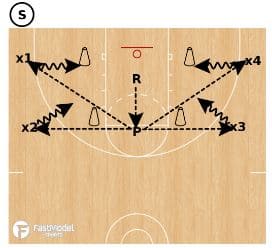
Round 1: Shooter moves around the arc and makes 8 from the 4 spots off the catch (no dribble).
Shooter then makes 2 freethrows.
Round 2: Shooter moves around the arc and makes 8 from the 4 spots off the dribble (1-2 bounces).
Passer rotates to Shooter and Rebounder to Passer.
Repeat until all 3 players have done both.

Points of Emphasis:
-Shooter should catch outside the arc relative to the 4 spots.
-Utilize blow-by and crossover moves.
-Drive the ball; don’t dribble it.

Here are a couple of You Tube videos with players going through the drill:


I Just Don’t Read

By Brian Williams on September 4, 2016

This article was written and contributed by Scott Rosberg

Today’s post comes from a comment I have heard various coaches make through the years – “I just don’t read.” As an English teacher for 18 years, reading was obviously a very big part of my job, and it was a huge part of what I was trying to get my students to do. As teachers, we expect our students to read the various assignments that we give them. No matter the subject, reading is extremely important to the success of our students.

Reading is also extremely important to my success as a teacher. Of course, I need to know what I am teaching, but I also should know a variety of material that would support or be in the realm of what I am teaching, too. It also helps to have a general knowledge of various elements in the world. Obviously, the more I know, the better prepared I can be. Reading is one of the best ways for me to prepare to be my best.

This same concept is important in athletics, as well, especially when it comes to coaches. There are a variety of ways for coaches to improve themselves. Live coaching clinics & workshops, DVD’s, online video clinics, meetings with mentor coaches, online magazines, blogs, podcasts, YouTube videos, downloadable PDF’s, newsletters, print magazines, books, eBooks, and booklets are all ways to learn more about one’s sport, coaching & athletics in general, or any other self-improvement topic that could help one become a better coach. Looking at that list, there is a wide variety of media that a coach can turn to learn more about his/her craft.

Each of those methods of learning has value, merit, and worth. I always suggest to coaches that they open themselves up to as many methods as possible to improve at their craft. Reading is one of those methods, and I would argue that it is quite possibly the most important of those methods because there are more chances to read than any other medium out there.

However, when talking with coaches about various written materials that I think they should read, I sometimes hear from them, “You know, I just don’t read all that much.” While I don’t say it, some of my first thoughts are usually, “Seriously?! Why not? Do you want to be the best you can be? What if your players said to you, ‘I just don’t ________.’ about something that you tell them they need to do to help be the best they can be?”

I realize that coaches come in all varieties, and some just aren’t as into developing themselves as much as others. Some are just helping out a team in a rec league to offer the head coach a little help, so they are not necessarily focused on getting too much information on coaching. However, I would submit that these people are prime candidates to learn a bit more on the topic of coaching and coaching their sport, so they can maximize their chances for helping the kids have a great experience.

Other coaches fall into the realm of “long-time veteran” coach. They sometimes feel they have all the knowledge they need, so there is no need for them to read more on coaching or on their sport. Well, I fall into that category of “long-time veteran” coach, and I have always read as much as I could on coaching and on my sports. There is always more to learn, and it is also enjoyable reading about something for which I have a passion.

In between the novice and the long-time veteran are the majority of coaches – coaches who have been coaching for a few years, but who still have a lot to learn. These are the coaches that are the most disappointing when I hear any of them say they “just don’t read,” as their reason for not reading certain books that could help them become better coaches. They have the most to gain and to give, so increasing their knowledge is critical to their success and their ability to help their players and teams develop.

Now, it could be that they just don’t read anything, not just coaching materials. Some people have struggled to read their whole lives or they just were never into reading, and so they just didn’t do it much. For some people, reading may be difficult, so they choose not to do it. Or they may feel they are too busy to read. However, for anyone who struggles with these situations, there are other ways to “read” materials to help them.

Audiobooks are a great way to “read” a book. You get the same information, you often get it in the writer’s voice, and you can do it while doing something else, so you don’t have to set aside extra time for it. Podcasts are another great medium to get a lot of information to help you improve. While podcasts are not exactly like audiobooks, many podcasts are basically blog posts or some other form of the written word conveyed through audio. But even for those that aren’t, there is often a lot of great information for listeners to consume that will help them improve in whatever they desire. I have been listening to podcasts for two years, and many have really helped me in my coaching and other areas of my life.

Webinars and online courses are also great formats to learn a lot of information packed into a fairly short amount of time. So are online videos. While there is not much in the way of reading in the video format, you can get a lot of information, and you can see it put into action. Video is a great way for coaches who don’t read much to still pick up a lot of great information.

No matter what method you use to “read,” make sure you do so. While I prefer actually reading a book, booklet, article, post (like this one!), etc. over most other formats, any method of consuming helpful information will give you new ideas and strategies to help you improve your coaching. Please don’t use the excuse that “I just don’t read” to limit yourself from becoming a better coach. Find some way that works for you, carve out the time necessary to do it, and then get ready for new levels of growth and development.

Then again, if you have read this far in this article, you are probably already doing those things. I guess it’s time for me to do a podcast and a video of this post for all those people that “just don’t read”!

I would love to hear your thoughts on these ideas in the Comments section below or on the Coach with Character Facebook page. My next post will focus on some different books, blogs, podcasts, etc. for you to consider “reading” this summer.

About the Author of this Article

Scott Rosberg has been a coach (basketball, soccer, & football) at the high school level for 30 years, an English teacher for 18 years, and an athletic director for 12 years. He has published seven booklets on coaching and youth/school athletics, two books of inspirational messages and quotes for graduates, and a newsletter for athletic directors and coaches. He also speaks to schools, teams, and businesses on a variety of team-building, leadership, and coaching topics. Scott has a blog and a variety of other materials about coaching and athletic topics on his website – www.coachwithcharacter.com. He can be reached by email at [email protected].

Scott is also a member of the Proactive Coaching speaking team. Proactive Coaching is dedicated to helping organizations create character and education-based team cultures, while providing a blueprint for team leadership. They help develop confident, tough-minded, fearless competitors and train coaches and leaders for excellence and significance. Proactive Coaching can be found on the web at www.proactivecoaching.info. Also, you can join the 200,000+ people who have “Liked” Proactive Coaching’s Facebook page at www.facebook.com/proactivecoach. Scott can also be reached through Proactive Coaching at [email protected]

End of Summer–Beginning of Future!

By Brian Williams on September 4, 2016

This article was written and contributed by Scott Rosberg

At Wal-Marts, Targets, JC Penneys, and just about every other department store out there, the signs are plastered all over the place – BACK TO SCHOOL! While those three words conjure up all kinds of feelings for just about everybody who reads them, one thing they always indicate is that summer is coming to an end. The hope and promise of summer that we all had as Memorial Day hit (which seems like about three weeks ago!) faded quickly, as within no time we were watching the parades and fireworks on the 4th of July. And now the “Back to School” signs are telling us that it’s over. The never-ending sunshine, warm days, barbecuing, sleeping in (for students and many of you), the feeling that nothing is as urgent as it is during the school year, and overall feeling of freedom and laziness are about to be gone for another 9 months.

Don’t Wait For the Future – Create It

And yet, along with those signs are some other signs – signs of anxiousness, excitement, possibility, and hope. While the end of summer is just that – an end – it is also a beginning, the start of something new. Many people wonder, “What will this school year bring?” Well, here’s a thought for you – don’t focus on what the year might bring to you.

Go get whatever you want from the school year.

The concept that something or someone is going to bring me something is very passive. It means that I am waiting for whatever is going to happen to happen. While there is nothing wrong with hoping for certain things to come our way, it is much better to go after the things that we seek in life. This is an active mentality, a mentality that says, “I am going to create my future, not wait for my future to come to me.”

For coaches & advisors (as well as your athletes, and activities participants), it is imperative that you work to create your future. If you sit around and wait and see what happens, the success you seek will never come. In fact, many of you don’t take the summer off the way that others do. The best coaches, advisors, teachers, athletes, musicians, actors, etc. put in a lot of time and effort throughout the summer to work on their crafts. Many worked on their skills, read books, watched videos, strengthened their bodies, went to camps, and played in tournaments trying to improve themselves. They understood that the off-season is a great chance to impact their future by doing something in the present.

To those of you that put in the time to your professional development and your team’s skill development, strength training, and team-building, “Thank you.” You have demonstrated a commitment that is necessary for any team to develop to its potential. The more of you and your team members who did so, the better the chances are that your teams will have the kind of success you are all seeking.

Commit to Be Your Best to Help Your Kids Be Their Best

For those of you who weren’t able to work as much as you would have liked to on your or your team’s development, now is the time to rev it up and kick things into high gear. While you can’t go back into the past and re-do your summer, you can do all that you are capable of now. It’s not too late to get “caught up” on your own professional development, so that you are ready to move your teams forward in the direction you want to go, and to develop yourself and your teams to your potential.

The start of school is a great time to commit to your & your team’s future. Don’t wait for your future to come to you. Decide what you want your future to be and go get it. Determine what culture you want to create for and with your teams, and then do all you can to develop that culture. Attack this new school year with a sense of purpose, desire, and focus, and don’t let anyone or anything knock you off track. Create great habits that will help you focus and allow you to reap the benefits of your efforts and help you overcome the inevitable dips in motivation and excitement that will hit after the first few weeks back. Anything is possible this year if you focus your effort and attention, and you then act on that focus.

Before you know it, we will be in full swing with our fall sports and activities practices and competitions, and school will be back in session. Enjoy the last bit of summer that you have left, but make sure that while you are doing that, you are also preparing yourself for your seasons by taking care of last-minute duties and responsibilities. That way when it all starts up for you, you will be ready to go full-speed ahead. Have a great end of your summer and a fantastic start to your new school year!

For those of you who receive my AD Newsletter and Coaches’ Newsletter to send to your coaches and parents, you saw this post a couple weeks ago in your Coaches’ Newsletter. For those of you athletic directors out there who would like to receive those two newsletters to send out to your people, email me at [email protected] and let me know you are interested in those. Around the 15th of each month, I will email you the following month’s newsletters, so you can tweak them for your specific audiences and send them out with your school’s newsletter at the beginning of the month.

About the Author of this Article

Scott Rosberg has been a coach (basketball, soccer, & football) at the high school level for 30 years, an English teacher for 18 years, and an athletic director for 12 years. He has published seven booklets on coaching and youth/school athletics, two books of inspirational messages and quotes for graduates, and a newsletter for athletic directors and coaches. He also speaks to schools, teams, and businesses on a variety of team-building, leadership, and coaching topics. Scott has a blog and a variety of other materials about coaching and athletic topics on his website – www.coachwithcharacter.com. He can be reached by email at [email protected].

Scott is also a member of the Proactive Coaching speaking team. Proactive Coaching is dedicated to helping organizations create character and education-based team cultures, while providing a blueprint for team leadership. They help develop confident, tough-minded, fearless competitors and train coaches and leaders for excellence and significance. Proactive Coaching can be found on the web at www.proactivecoaching.info. Also, you can join the 200,000+ people who have “Liked” Proactive Coaching’s Facebook page at www.facebook.com/proactivecoach. Scott can also be reached through Proactive Coaching at [email protected]

Make 2 Before Missing 1 Shooting Drill

By Brian Williams on August 30, 2016

These two shooting drills are among the thousands of resources for both coaches and player available from basketballhq.

They have several more videos as well as basketball coaching resource articles.

BasketballHQ has just released their Basketball Coaches Training Group. In the group you will get access to different workout plans that are going to be for the team as a whole, by position, by the number of players and more. This is an all inclusive training group that is going to allow you to walk onto the court with a full workout plan in hand for your players through our easy to use Iphone and Android App. Every drill comes with a video breaking down the details of the drill, and all of the videos are instructed by a Pro or College coach and demonstrated by a high level player. click here for More Information on the Basketball Coaches Training Group.

I have posted a sample from the Coaches Training Group below the second video.

The drills are coached by Ryan Panone.

I encourage you to think about the best way to tweak the drills before you implement them so that they offer the most benefit for your players.

Even as you are first implementing them, you may need to continue the process of making some adjustments so that they are contributing to the improvement of your players.

Make sure that your speakers are on to hear the narration and that you can access You Tube to see the videos.

Click the play arrow to begin each video.

Make 2 Before Missing 1 Shooting Drill

Double or Nothing Shooting Drill

Here is a 2:00 minute sample of the type of content that is available in the BasketballHQ Coaches Training Group.

Fearless Followership

By Brian Williams on August 29, 2016

Cory Dobbs, Ed.D.

A TEAM LEADER FACILITATED ACTIVITY

NOTE: This exercise is designed to be facilitated by a student‐athlete team leader. Have all members of the team read the short narrative and then answer the questions that follow.

Fearless Followership

Pursuing a Higher Standard of Leadership and Followership

Imagine going to your school’s health office for a visit because you’re experiencing dizzy spells. Before you’ve had a chance to describe your symptoms, the doctor writes out a prescription and says, “Take two of these pills two times a day, and call me next week.”

“Excuse me, but—I haven’t told you what’s wrong,” you say, trying to articulate your condition. “How do you know this will help me?” “Why wouldn’t it?” says the doctor. “It worked for my last patient.”

Confused by the doctor’s message and not wanting to offend her you just go along with the doctor’s directive. Rather than confront your doctor you take a sheepish approach and figure that you’ll just wait until later when not in her presence to sort things out.

In this scenario the leader is the doctor with you in the role of the patient. As a patient you are expected to follow the doctor’s directions. To question her is to question her legitimacy and authority. However, as you can see in this scenario, this presents a problem for you as your needs of the moment were neglected.
[thrive_leads id=’36827′]

The traditional stereotype of the follower is of someone that is unwilling or unable to play a significant role in the direction a group desires to go. It is then assumed they are better suited to follow someone willing to provide direction. Generally, the role of followership has a negative connotation. Merely conceptualizing a follower “conjures up images of docility, conformity, weakness, and failure to excel” (Chaleff, 1995). Our culture tends to label followers as passive individuals lacking the “right stuff,” or someone without drive and ambition. However, effective leadership doesn’t happen without dynamic and committed followers.

Followership is important in any discussion of successful team leadership for several reasons. First, leadership and followership are fundamental roles that all athletes will move into and out of depending on the circumstances. It’s a given that as a team leader your primary role is that of a follower of your coaches. Second, just as you expect to influence the attitudes and actions of teammates you should be open to being influenced by teammates. Third, many of the characteristics that are desirable in a team leader are the same qualities possessed by committed and productive followers. Finally, the nature of the leader-follower role in team sports involves you being open to influence and change just as you look to
influence and change teammates committed to common goals.

To succeed as a team leader it is essential you appreciate and respect your teammates as followers. One way in which you can do this is to embrace fearless followership. Fearless followership is the courage to take a bold stand and demonstrate the initiative to engage with teammates in an extraordinary way. A fearless follower will challenge a teammate who threatens the cohesiveness, values, or goals of the team. That is, the fearless follower is willing to hold teammates—including a team captain—accountable for team norms, standards, and expectations. Both leaders and followers have got to encourage active and attentive followership and build the relationships needed to move the team forward.
[adinserter name=”Basketball in article display ad 2 rebecca”]
Think of it this way, if you and I agree that team captains should lead with integrity shouldn’t we expect followers to follow with integrity. If a team member falls short of expectations—including team captains—teammates must be comfortable calling them on it, but by letting them know the team needs them. In other words, not attacking the teammate but bringing them into the collective aspirations of the team.

Together, team leaders and followers striving toward a collaborative relationship based on fearless commitment to each other will create a more cohesive team capable of achieving team goals.

Followers want to be:
Accepted Connected Trusted Cared about
Supported Valued Respected A friend
Followers don’t want to be:
Rejected Disconnected Judged Neglected
Disrespected Not Valued Left out A foe
Exercise: Team Leader to Facilitate
Appoint one or two member’s of your team to facilitate a conversation regarding the
following:

The facilitator asks: What do you do when a teammate is:

  • Unfocused
  • Coasting
  • Feeling superior
  • Undisciplined
  • Not coachable at a crucial moment
  • Showing disrespect for teammates
  • Making excuses
  • Showing a lack of respect for competitors
  • Has failed to keep a commitment

*This is a leadership tool created by the Academy for Sport Leadership. The Academy for Sport Leadership is a leading educational leadership training firm that uses sound educational principles, research, and learning theories to create leadership resources. The academy has developed a coherent leadership development framework and programs covering the cognitive, psycho‐motor, emotional and social dimensions of learning, thus addressing the dimensions necessary for healthy development and growth of student‐athletes

“Tell me and I’ll forget. Show me and I may remember. Involve me and I will care.” -Your Student-Athlete The world of coaching is changing. In Coaching for Leadership you’ll discover the foundations for designing, building, and sustaining a leadership focused culture for building a high-performance team. To find out more about and order Sport Leadership Books authored by Dr. Dobbs including Coaching for Leadership, click this link: The Academy for Sport Leadership Books

About the Author

A former basketball coach, Cory’s coaching background includes experience at the NCAA DII, NJCAA, and high school levels of competition. While coaching, he researched and developed the transformative Becoming a Team Leader program for student-athletes. Cory has worked with professional athletes, collegiate athletic programs and high schools teaching leadership as a part of the sports experience and education process. Cory cut his teeth as a corporate leader with Fortune 500 member, The Dial Corp. As a consultant and trainer Dr. Dobbs has worked with such organizations as American Express, Honeywell, and Avnet.

Cory has taught a variety of courses on leadership and change for the following universities:

Northern Arizona University (Graduate Schools of Business and Education)

Ohio University (Graduate School of Education / Management and Leadership in Sport)

Grand Canyon University (Sports Marketing and Sports Management in the Colangelo School of Sports Business)

  • « Go to Previous Page
  • Page 1
  • Interim pages omitted …
  • Page 110
  • Page 111
  • Page 112
  • Page 113
  • Page 114
  • Interim pages omitted …
  • Page 288
  • Go to Next Page »

Primary Sidebar

  • Twitter
  • Facebook
  • Linkedin
coachestoolbox
personaldevelopmenttoolbox
basketballplayerstoolbox
basketballtrainer
athleticperformancetoolbox
coachingbasketball

© Copyright 2026 Coaching Toolbox

Privacy Policy