• Skip to primary navigation
  • Skip to main content
  • Skip to primary sidebar

  • Basketball Plays
    • Ball Screen Sets
    • Horns Sets
    • Man to Man Post Up
    • Man to Man Isolations
    • Backdoor Plays
    • Man to Man 3 Point Shot Plays
    • 2-3 Zone Attack
    • Baseline Inbound Plays
    • Sideline Inbound Plays
    • Combination Defense Attack
  • Drills
    • Defensive Drills
    • Offensive Drills
    • Competitive Drills
    • Passing Drills
    • Rebounding Drills
    • Shooting and Scoring Drills
    • Toughness Drills
    • Transition & Conversion Drills
    • One on One Drills
  • Blueprint
  • Practice
  • Mental Toughness
  • Skill Development
  • Offense
  • Defense
  • Store

Decathlon Shooting Challenge

Decathlon Shooting Challenge

By Brian Williams on October 4, 2016

This shooting drill was diagrammed and contributed by Joel Hueser to the FastModel Sports Basketball Plays and Drills Library.

You can also find out more about FastModel Play Diagramming software by clicking this link: FastDraw

Coach Hueser is the Head Boys Coach at Papillion-LaVista South High School High School in Nebraska.

This is what he said about the drill:

Each year, preseason and sometimes during the season, we test our players for assessment purposes. The Decathlon is a good indicator of player strengths and weaknesses. The test consists of ten shooting skills performed for one minute each, one skill right after the other. We have acquired over 25 years of data using this test. As a result, we have a pretty good idea of a player’s offensive skill set when it’s all said and done. We like to factor these numbers into our selection process.

To date, in my 25+ years of coaching, not quite 20 players have scored 200 baskets or higher. The highest is 218. The first 3 minutes set the tone. A fundamentally sound player can score close to 100 or more baskets right out of the gates.

We consider the following grade levels and scores very good:

Freshmen 160 or more
Sophomores 170 or more
Juniors 180 or more
Seniors 190 or more
Skill Level Scale:

000-100 | Poor!
100-115 | Very Low Skill Level
115-130 | Low Skill Level
130-145 | Average Skill Level
145-160 | Above Average Skill Level
160-175 | High Skill Level
175-190 | Very High Skill Level
190-205 | Outstanding!

Editor’s Note from Brian: You can develop your own scoring system, scoring standards, and change the shots. You don’t have to use the drill exactly the same way that Coach Hueser does. The idea is to modify the challenge and make it YOUR OWN. For example, this uses a lot of layups, you might want to include more jump shots. Or, you could possibly use this as one data point for tryouts.

Since the player is moving for 10 consecutive minutes, if you have 6 baskets, you could use it at the end of practice as a conditioner while handling and shooting the basketball or to see who is in shape for your early season practices.

There is a video at the bottom of the post to see the decathlon in action.
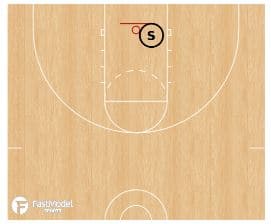
decathlon1

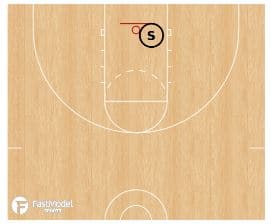
1) Strong Hand Lay-ups

-Stand wherever you want (we suggest as shown) and score as many baskets as possible.

-No rebounders (using the glass is recommended).

-1 minute.
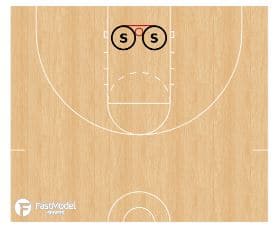
decathlon2

2) Weak Hand Lay-ups

-Same as strong hand lay-ups, but this time you must shoot with your weak hand.

-Your strong hand is to be held behind your back (Shooter is allowed to shoot from either side).

-1 minute.
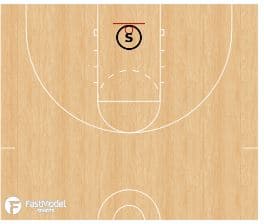
decathlon3

3) Mikan Drill

-Shoot baby hook shots, alternating from the right side to the left side.

-Shoot off the correct foot on each side.

-1 minute.
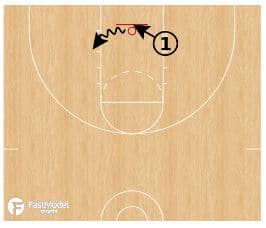
decathlon4

4) Block-to-Block

-Shoot just outside the freethrow lane near the low block.

-Use the glass and move back and forth without traveling.

-1 minute.
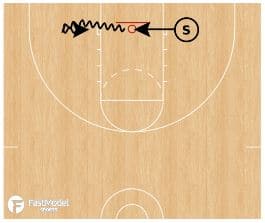
decathlon5

5) Corner-to-Corner

-Same as block-to-block, but this time the shots are from the short corner (two strides from lane).

-Move back and forth without traveling.

-1 minute.
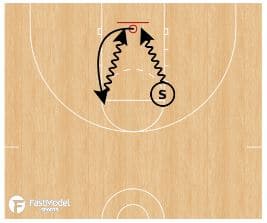
decathlon6

6) X-Out Lay-ups

-Start at the right freethrow line elbow, dribble in and score a lay-up.

-Then sprint out to the left elbow (dribble is not mandatory). Do the same, but with the left hand.

-1 minute.
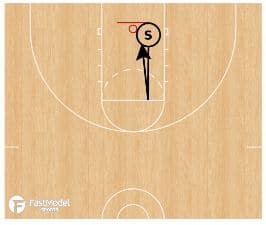
decathlon7

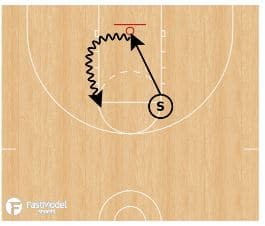
7) Lay-up Bust

-Start under the basket and shoot a lay-up.

-Whether it is made or missed, run and touch the free throw line with your hand.

-Then come back to the ball and attempt another lay-up or shot.

-1 minute.
decathlon8

8) Elbow-to-Elbow
-Shoot from the right freethrow line elbow and follow your shot.
-Dribble out to the left elbow with your outside hand and shoot again.
-Alternate from elbow-to-elbow; always dribbling with your outside hand.
 

decathlon9

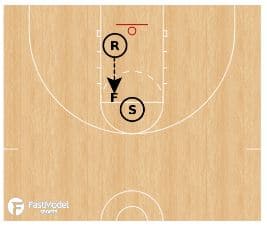
9) 15′ Rapid Fire

-Use two basketballs and two teammates as a feeder and rebounder.

-Fire as many jump shots as possible from the freethrow line.

-1 minute.
decathlon10

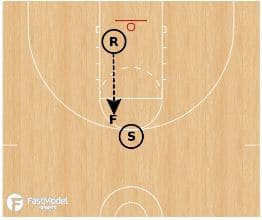
10) 20′ Rapid Fire

-Same as 15′ Rapid Fire, but from behind the 3-point arc.

-1 minute.


Here is a You Tube video of the drill.
Elbow Pivot Finishing Series Drill

By Brian Williams on October 3, 2016

These two post player drills are among the thousands of resources for both coaches and player available from basketballhq.

They have several more videos as well as basketball coaching resource articles.

I encourage you to think about the best way to modify the drills before you implement them so that they fit your system and offer the most benefit for your players.

Even as you are first implementing them, you may need to continue the process of making some adjustments so that they are contributing to the improvement of your players.

I also think you should have a finishing drill similar to the first one for when your players catch in the short corner if that is something you do in your offensive attack against man to man or zone defenses.

Make sure that your speakers are on to hear the narration and that you can access You Tube to see the videos.

Click the play arrow to begin each video.

The first video (Elbow Pivot Series Finishing Drill) is coached by Mike Roberts, Associate Head Coach at the University of North Carolina Greensboro.

The coach in the second video is Chris Capko, Assistant coach at USC.

Elbow Pivot Series Finishing Drill

Drop Step Post Move Drill

NBA Sideline Inbounds Plays

By Brian Williams on October 2, 2016

These Plays are from the Arizona Basketball Coaching Newsletter.

If you are interested in being added to their monthly basketball coaching newsletter, email me your:

Name
School/Team
Coaching Position (Head Coach, Assistant)

That is the information they request to add coaches to their list.

With each post I make on the site, I am not prescribing that this is what everyone should do, but rather offering ideas that hopefully will stimulate your thinking to come up with ideas that will fit your needs.

For example, you might need to change the positions that are on the diagrams to put your players in the spots that fit them the best.

The first play was diagrammed by Denis Godlevskiy from a play run by Doc Rivers when he was with the Celtics.

The second play was diagrammed by Coach Alan Peel.

Diagrams created with FastDraw

Boston Celtics SLOB

celtics-slob1

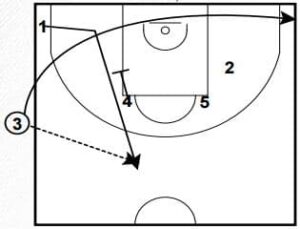
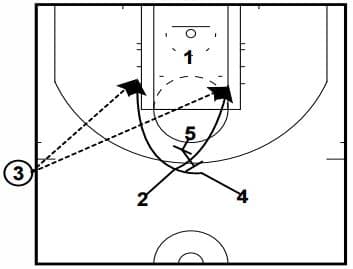
1 starts in the ballside corner and comes to the NBA slot off a screen from 4. (Obviously #4 needs to screen the defender guarding #1. It might be on the other side than the diagram shows.)

1 receives the inbounds pass.

3 cuts through to the opposite corner.

celtics-slob2

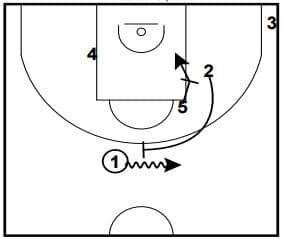
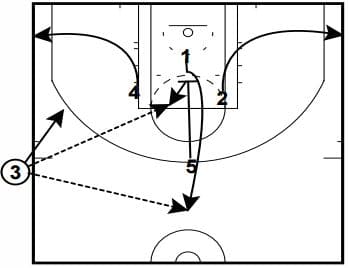
5 pins down for 2.

2 sets screen for ball handler & pops out,


celtics-slob3

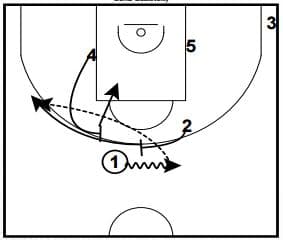
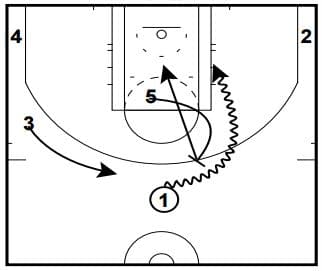
On pop out action 4 sets flare screen for 2 & rolls to to the basket

1 can use quick pass for the 2 or hit 4 who rolls to the basket


Portland SLOB

portland-slob1

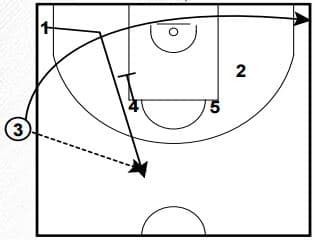
The play begins with #5 setting a back screen for #2.

After #2 clears, #5 will then set a back screen for #4.

The options for the inbounds passer (#3) are #2 and #4 in that order.

portland-slob2

If the lob passes are not open, #2 will clear to the help-side corner and #4 will clear to the ball-side corner.

From here, #5 will turn and set a down screen for #1 who comes and catches between the circles.

If the defense switches, #3 will throw the inbounds pass to #5 who steps back to the ball.

As soon as the ball is inbounded, #3 will fill the corner on his side.

portland-slob3

When #1 catches, he will use a middle ball screen set by #5 and go away from the side on which the ball was inbounded.

As soon as #1 clears the ball screen, #5 will roll to the basket and #3 will fill the slot on his side to maintain defensive balance.

The Art of Leadership

By Brian Williams on September 29, 2016

Cory Dobbs, Ed.D.

Lessons from the Art Studio

“Students who are truly student-athletes have a chance for a life-transforming, life-shaping experience. I can tell you how thankful I am for having had that experience and how it’s shaped me in countless ways. It’s an absolutely formative experience.” –
U.S. Secretary of Education Arne Duncan,
Speaker at the 2010 NCAA National Convention in Atlanta, Ga.

Leadership is one of the most important topics of our time. And it’s likely one of the most important attributes for effectiveness in any human endeavor. The success of any institution, organization, group, or team, is grounded in the effective application of leadership. For any organization to sustain success it must invest in the development of leaders—current and future— to avoid a regression towards mediocrity.

Since the dawn of civilization, groups have utilized leadership for various purposes beginning with the need for survival. Organizations today view leadership as a necessity for success and it is hard to find a person today who does not give at least lip service to the importance of developing leaders.

Yet despite this apparent intent to nurture the development of leaders, we still find ourselves desperately searching for leaders that can create and sustain success. Perhaps part of the problem is the way we teach leadership.

I teach leadership courses in two different graduate colleges for the same university. Different students, same classroom. The classroom consists of a podium, tables with chairs and a white board. The rooms are designed for teachers to stand and students to sit.
[thrive_leads id=’36827′]
However, the classroom in which my colleague teaches art is quite different. In her art studio she often does not stand and students don’t sit. The simple reversal of classroom roles leads to a different mode of learning. Students in the art classroom poke around, observing the work of their fellow students. They ask questions, share stories, exchange insights, and offer praise or constructive critiques.

I’ve learned some powerful lessons from studying learning in the art studio. Two, of them in particular have reshaped the way I approach leadership development.

1. Anything worth doing is worth doing badly.
2. The fear of failure will guarantee failure.

Anything Worth Doing is Worth Doing Badly

Not the orthodox way of looking at excellence. However, leadership is a messy proposition for anyone learning to lead. Since leadership is a social process, it follows that team leaders will need to experiment with such things as peer accountability. Invariably, the beginning leader will stumble. Encourage your student-athletes to get going, start leading, and take the lumps that come with learning to lead.

The art studio encourages the student to explore. Taking risks—experimentation—and being willing to do leadership badly are part of the learning process. In the art studio students are encouraged when they do something badly. They quickly look at the bad product and figure out how to improve upon their work. Poor outcomes are not seen as failures. Rather, the art student returns to the canvas to try again.

To offer some real-world perspective on bad leadership as a learning opportunity, take a quick look backwards to when you took your first coaching job. Who among us can’t look back and see incompetence and failure in some leadership efforts during our formative years? I’m on pretty safe ground here knowing that all competent coaches attended Hard Knocks University.

Here’s a simple way for you to guide your student-athletes to face the fact that risk is necessary for them to fully develop as a leader. Have them set up a matrix that involves listing leadership goals on one side of the ledger with possible risks on the other.

Sample Leadership Goal

To promote team unity through a weekly players only meeting.

Risk

One or more team members do not want  to attend and see the leaders as “better than them”

Fear of Failure Will Guarantee Failure

While the artist’s palette contains a wide-array of vibrant colors, the only color emerging leaders see is gray. Nothing appears to be black and white for the beginning leader. She’s not sure where to start, what to do, how to take leadership action. Fear of failure is real.

Failure often affects confidence and self-esteem. However, failure is not fatal. Giving your leaders the license to fail is a starting point. Creating a learner-centered approach to leader development can help the novice and the experienced team leader. Artists that persevere face their fear of failure. Failure in the art studio is guaranteed. Perfection is desired, but failure is acknowledged as part of the process.

I’ve noticed far too many young leaders fearful of leaving their comfort zones, clinging to what is comfortable and secure. The art student is encouraged to venture out and explore new styles and tools. In the art studio it is folly to discount mistakes and failure.

In the art studio, students are confronted with reality. What they put on canvas is available for all to see. Sometimes the visible picture doesn’t match the artist’s heart and effort. Such moments can be both disheartening and empowering. Vulnerability is a vital part of learning to become an artist—and a team leader.

Leadership certainly can begin to be taught in a classroom. Yet conventional methods of leadership training often fail to prepare students for the messiness of leadership. The art studio provides another model to explore as a bold approach for developing your team leaders. Experimentation, exploration, and action will involve mistakes and failure. Guiding your young leaders through the risks of leadership may well be the most important role you assume as a leadership educator.

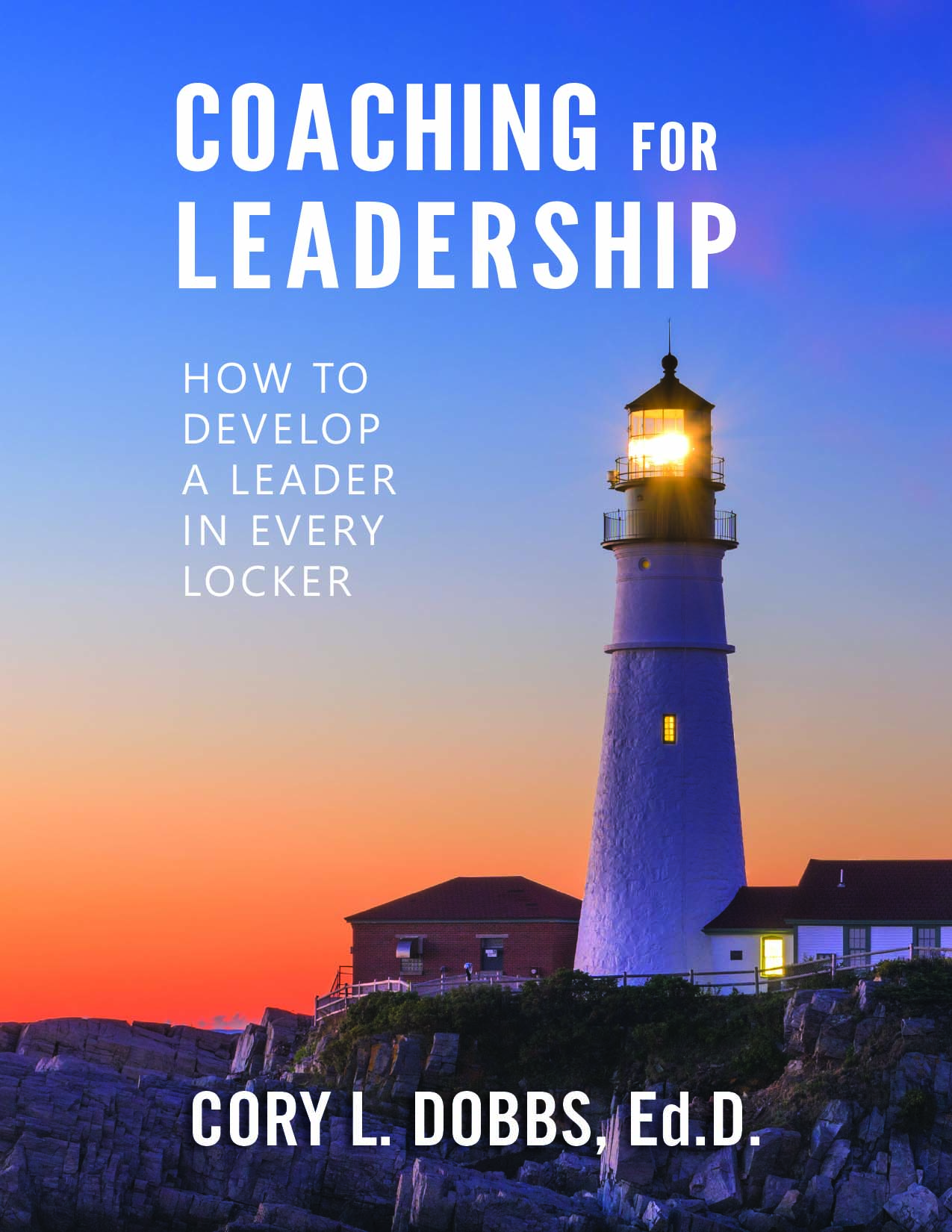
New to the Second Edition of Coaching for Leadership!

We are pleased to announce a new chapter to the second edition of the best-selling Coaching for Leadership. The chapter, The Big Shift: Unlock Your Team’s Potential by Creating Player-Led Teambuilding, connects the previous edition of this book to its origin, as well as to the future of team sports.

The new chapter sets forth a practical and applicable agenda for change and improvement. The reader is introduced to seven vital elements of change; seven shifts of traditional mental models that lead to the new core principles necessary for creating a player-led team culture. Click here for more information about Coaching for Leadership

About Cory Dobbs, Ed.D.

Cory Dobbs is the founder of The Academy for Sport Leadership and a nationally recognized thought leader in the areas of leadership and team building.  Cory is an accomplished researcher of human experience. Cory engages in naturalistic inquiry seeking in-depth understanding of social phenomena within their natural setting.

A college basketball coach, Cory’s coaching background includes experience at the NCAA DII, NJCAA, and high school levels of competition.  After a decade of research and development Cory unleashed the groundbreaking Teamwork Intelligence program for student-athletics. Teamwork Intelligence illuminates the process of designing an elite team by using the 20 principles and concepts along with the 8 roles of a team player he’s uncovered while performing research.

Cory has worked with professional athletes, collegiate athletic programs, and high schools teaching leadership and team building as a part of the sports experience and education process.  As a consultant and trainer Dr. Dobbs has worked with Fortune 500 organizations such as American Express, Honeywell, and Avnet, as well as medium and small businesses. Dr. Dobbs taught leadership and organizational change at Northern Arizona University, Ohio University, and Grand Canyon University.

Roy Williams Mine Field Defensive Drill

By Brian Williams on September 26, 2016

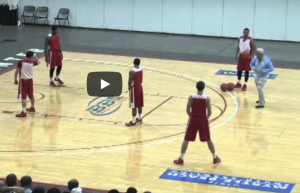
This post contains a videos of a defensive drill from North Carolina’s Roy Williams.

Make sure your sound is on as you watch.

All videos are You Tube videos.

Make sure that you are on a server that allows You Tube access.

You can make adjustments to the rules and requirements of the drill that fit your team.

If you are interested in finding out more about the DVD that the video sample came from, click here:

Roy Williams: Breakdown Drills for Individual and Team Defense

You might not want to run this drill exactly as Coach Williams does, but it might give you an idea to repurpose something that you use, or take his scheme and tweak it to meet your philosophy or defensive rules.

Mine Field Drill

Full Court Shooting Drill

By Brian Williams on September 22, 2016

This shooting along with conditioning drill was posted on the FastModel Sports Basketball Plays and Drills Library.

You can also find out more about FastModel Play Diagramming software by clicking this link: FastDraw

Ladder Shooting Drill

This drill was contributed by Coach Fabian McKenzie, Cape Breton University Women’s Basketball.

He has been a head coach at the university level for 16 years, and has been involved as a coach at this level for 20 years.

He has been involved with the Canadian Women’s National team program for the past 8 years.

This is what he said about the drill:

This is a great conditioning drill which requires focus on shooting the ball.

Great in pre-season.

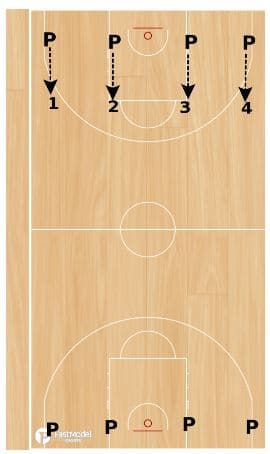
ladder-shooting-drill1

You can work on 15 foot shots, 3 point shots, dribble pull ups, etc.

P’s are passers. They must constantly hustle to rebound and have a ball ready for their next shooter

We do a “ladder” of time

15 sec. per group
30 sec. per group
45 sec. per group
60 sec. per group
45 sec. per group
30 sec. per group
15 sec. per group

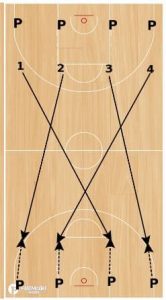
1,2,3,4 receive a pass and shoot the ball

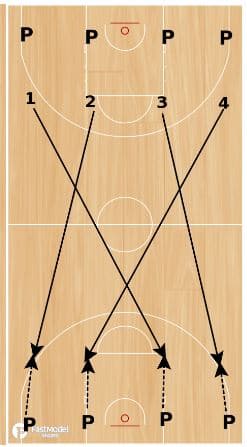
ladder-shooting-drill2

As soon as 1,2,3,4 shoot the ball they turn and sprint to opposite end.

Our rule is that they cannot shoot from the opposite spot on the floor twice in a row. They must pick a new spot.

Once the time is up, 1,2,3,4 become passers and one of the passing groups become the shooters.

Challenge the players to beat their takes and makes each time i.e. First time they do 15 sec. they may get 3-4 shots. Challenge them to do more and make more each block of time


Here is another version of the drill:

If you are interested in seeing information on the DVD that this drill came from, click: Individual and Team Drills for Building a Transition Offense

  • « Go to Previous Page
  • Page 1
  • Interim pages omitted …
  • Page 108
  • Page 109
  • Page 110
  • Page 111
  • Page 112
  • Interim pages omitted …
  • Page 288
  • Go to Next Page »

Primary Sidebar

  • Twitter
  • Facebook
  • Linkedin
coachestoolbox
personaldevelopmenttoolbox
basketballplayerstoolbox
basketballtrainer
athleticperformancetoolbox
coachingbasketball

© Copyright 2026 Coaching Toolbox

Privacy Policy