• Skip to primary navigation
  • Skip to main content
  • Skip to primary sidebar

  • Basketball Plays
    • Ball Screen Sets
    • Horns Sets
    • Man to Man Post Up
    • Man to Man Isolations
    • Backdoor Plays
    • Man to Man 3 Point Shot Plays
    • 2-3 Zone Attack
    • Baseline Inbound Plays
    • Sideline Inbound Plays
    • Combination Defense Attack
  • Drills
    • Defensive Drills
    • Offensive Drills
    • Competitive Drills
    • Passing Drills
    • Rebounding Drills
    • Shooting and Scoring Drills
    • Toughness Drills
    • Transition & Conversion Drills
    • One on One Drills
  • Blueprint
  • Practice
  • Mental Toughness
  • Skill Development
  • Offense
  • Defense
  • Store

Beware of Great Plays

Beware of Great Plays

By Brian Williams on October 18, 2016

GREAT PLAYERS DON’T MAKE GREAT PLAYS

—Excerpted from the book, “Stuff Good Players Should Know” by Dick DeVenzio

Posted with permission from PGCBasketball

Beware of great plays.

Common sense might seem to tell you that great plays are what make the difference between a good player and a mediocre player. But most coaches would disagree. More often, they would say, great plays—or the attempts to make great plays—are what make good players mediocre. Since this seems to defy common sense, a few definitions might be useful.

WHAT IS IT THAT SEPARATES A MEDIOCRE PLAYER FROM A GOOD PLAYER?

Both are in many ways the same. Both could have about the same speed and quickness, the same strength, the same height and weight, about the same shooting and dribbling ability. Often, the only difference comes with regard to great plays.

Many players are mediocre because they try to make great plays. They want to score a fancy layup, and they miss it. Or they try to throw a lightning-quick pass to a cutter six inches ahead of his man, and it goes out of bounds. They try to hit a fade-away jumper, and it goes off the rim. Or they go for the game-winning steal, but they miss it and the other team puts the game out of reach.

Mediocre is sometimes just another name for at erratic or inconsistent or “always striving to make great plays.”

It may surprise you to learn that good players don’t strive for great plays. Great plays come to them occasionally, but only when they are in the process of concentrating on their job, trying to do all the little things right.

Take Michael Jordan for example. He made a lot of great plays, but his value, even more important to his team than all those spectacular dunks, was that he didn’t miss many dunks. He was consistent. On the plays where a spectacular dunk had a good chance of missing, Jordan “happened” not to try it at all. “Ah,” said the fans, “he should’ve dunked that one.” But he didn’t dunk every chance he got. He dunked the ones he could dunk, and he didn’t attempt the ones he could not. If it was 50-50, he didn’t try it.

READ MORE: ARE YOU NEGLECTING TO PRACTICE THIS ESSENTIAL SKILL?

Good players don’t like those odds. Good players are not gamblers— they are performers. That is why great plays are not what make an outstanding player. It is knowing limitations.

A good player knows that he doesn’t need a slam dunk in the final seconds to be credited with winning the big game. If he can stop his man from scoring and go down to the other end and get a good shot, he can win the game just as well. And more often. He isn’t running around searching for a way to look spectacular; he is out there trying to get a job done, doing “whatever it takes.”

If somewhere along the line he gets a chance to do something spectacular, fine, that’s icing on the cake, a bonus. But he doesn’t seek it out. His concentration is on the little things, playing the game right, getting good defensive position, being there for rebounds and always taking high-percentage opportunities, whether shooting, passing, stealing or penetrating.

A lot of players are potentially good. They try hard to show everyone how good they are, how many great plays they can make. Along the way they make some great plays, but they also make a lot of mistakes.

They go quickly from good to mediocre, and many of them spend their entire basketball careers hearing coaches say, “You could be good.” But they aren’t.

Good players get the job done. They do the little things and are always looking to do just a little…
Click To Tweet

Good players are those guys who get the job done, who do the little things and who are always looking to do just a little more. They have the habit of usually making things appear quite easy. Often, they can be pretty boring since their pride is in playing intelligently. They don’t like looking stupid or missing dunks that should have been easy layups. They would rather have fans go away disappointed that they didn’t do anything spectacular than to hear someone saying their stupid play lost the game.

Good players have a pride about things like that. It’s not just that they don’t want to be labeled “erratic.” They really don’t want to make any mistakes at all.

It’s Not What You Do, But How You Do It

The following video is with Dena Evans, Owner and Director of PGC Basketball

To learn more about PGC Basketball, including additional training tips and videos, you can visit their YouTube Channel
Wildcat 3 on 3 Basketball Drill

By Brian Williams on October 17, 2016

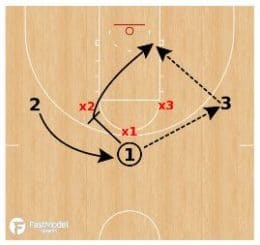
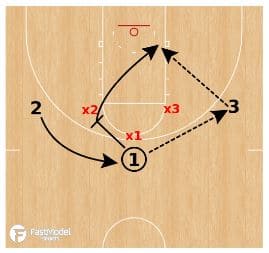
This 3 on 3 basketball drill was diagrammed and contributed by John Leonzo of Cedarville University to the FastModel Sports Basketball Plays and Drills Library.

You can also find out more about FastModel Play Diagramming software by clicking this link: FastDraw

Editors’ Note from Brian: I like the idea of establishing special scoring rules in your drills and in your 5 on 5 play that reinforce the things you will need to do to be successful.

I hope this drill gets you thinking about rules that you can incorporate into all drills and scrimmages your practices to emphasize your coaching points.

These rules force your players to not waste dribbles and to space behind the arc.

Scoring the drill by 2s and 1s puts an even greater premium on 3 point shooting.

If you would rather not do that, you can go to 15 by 2s and 3s.

I have included some thoughts on utilizing special rules in your practices below the diagrams of the Wildcat 3 on 3 drill.

I do not recommend using too many rules, it disrupts the flow of the scrimmage when you award points. Pick 3 at most each day that fit the way you play. It could be a different group of 3 the next day.

Play live 3v3 but with the following rules.

basketball-drills-3-on3-1

Rule 1: Any dribble that does not attack or break the plane of the 3 point line is a turnover.


basketball-drills-3-on3-2

Rule 2: The only place the ball can be caught is on a cut to the rim or behind the 3pt line.

Play make it take it to 10 by 1s and 2s.

It is often very challenging to create competitive drills and scrimmages between your first and second teams. There is a way to allow the players in your rotation to play together and in their roles and still force the first team to compete like they would have to in a game.

To produce the needed challenges for your first team, make special rules in practice that cause the them to be challenged by you as their coach and the scoreboard when the second group is not physically able to provide that challenge necessary for improvement.

Some years your starters will need more challenges to push them than others. So each year, revisit what you are doing with your special rules and make adjustments and adaptations that fit your current team. The rules should make the scrimmages competitive so that with their implementation, the second team has the opportunity to score more points and win the scrimmage, which forces the starters to compete. This serves to make your practice much more competitive which is crucial to the improvement of your team.

Make the rules fit your offensive and defensive systems and goals for each game. For example making a rule that every time the second team makes a pass in a scrimmage counts as a point for them is great if you are working on playing a pressure man to man defense that denies all passes. But, makes no sense if you are a team that plays a zone or a packing man to man where you don’t pressure the non penetrating passes. A better rule for a defense designed to keep the ball out of the middle is that each time the second team gets the ball in the paint; it is a point for them.

Your players must understand the purpose of the rules. It must make sense to the players as to how your rules will develop practice habits that will carry over to games. Players don’t have to agree with everything, but if they see a method to your madness, there is a much higher likelihood that your system will produce the intended results.

Make the rules should be simple to implement and easy to track. They should not interfere with the flow of the scrimmage by causing the players and the coaches to have to slow down to figure out what just happened and how that affects the score.

Run the clock and the scoreboard like a game when you scrimmage in practice. Make every special rules violation either result in a turnover, adding points to the score of the second team, or both. It is too difficult for the individual who is keeping score to take points away from a team. If you just yell, “Two points for the red team because the white team did not chin the defensive rebound,” the players know why the points were lost and the manager can just add them to the score of the second team. The point differential is the same regardless of whether you add to the second team’s score or subtract from the first team, so it makes sense to make it easier on your scorekeeper. If you have enough managers or assistant coaches, keep a possession chart and record what violation resulted in the points so that you can analyze what rules you are violating the most frequently and then work to improve those areas. If you don’t have access to a scoreboard, you can still designate a coach or manager to keep a possession chart on a clipboard and call out the score.

Here are some suggestions for special rules. The key is to keep them pertinent to how your team plays and to make practice scrimmages competitive.

• 2 points to second unit for a shot that isn’t contested by the first team, regardless of whether it goes in or not.
• Regular rotation players cannot dribble.
• Any foul by first team is automatic 2 points for second team.
• Every turnover by 1st team is 2 points for the 2nd group.
• Anyone on the first team not chinning a rebound is a turnover—loss of possession and the two points that are the result of every turnover.
• If a player takes an unacceptable shot, for us that is anything except an open jumper or power shot inside, award two points to the defense.

The purpose of the rules—to make practices competitive–must be understood by all of your players. Most second units can’t match the first team in size, skill, and experience the way that the other schools you play will. It keeps them from getting away with mistakes that will cost them on game night and allows your reserves some hope of winning your practice scrimmages.

basketball-practice-ebook-cover

Click here for information on my basketball practice e-book “130 Great Ideas to Get a Lot More Accomplished in Practice”


Point Huskies Free Throw Game

By Brian Williams on October 16, 2016

This free throw shooting drill was designed by Mike Neighbors, Women’s Basketball Coach at Arkansas. At the time of this post, Mike was the coach at Washington.

We are always looking for new ways to incorporate free throw shooting into our full team practices.  This is one we came up with to compete as a team and also have the element of individual competition.

We have six goals in our gym.  We split off to shooters and rebounders at each goal.  10:00 goes onto the game clock.

Each shooter shoots until they miss.

The shooters must make at least 5 in a row to get a POINT HUSKIES (this is a reference to what our PA announcer says at our volleyball games)

5 makes in a row equals 1 point.
10 makes in a row = 3 points.
15 in a row = 5 points.
20 = 9 points.
25 = 12 points.
30 = 15 points
35 = 20 points.
40 = 25
45 – 32
50 = 40

from 50 on the team gets one point extra per make

The team total is added for each shooter.  So at the end of ten minutes we have a team score.

We also chart individual scores to keep record boards for individuals.

Couple of things to have provisions for:

1) As the time is geƫting close to zero… any streak that was begun before the 1:00 minute mark can be completed until there is a miss.

2) Any streak that begins within the last :30 seconds can only go to the next increment of five.

3)  How long will you go before you allow “distractions”

Our total team record is 270 so far.  Individual highs are 145 ( yes, 145),  57, 48, 33, 32 and several in the
high 20’s.

Love the competition this breeds.  It is also NO FUN to not have your name called out for long streaks…
We hope this drill will conƟnue to keep us in the Top 10 naƟonally for FT Percentage.

Ball Screen Wave Drills

By Brian Williams on October 11, 2016

These drills were put together by Nate Hill.

He is the Assistant Boys Coach at Colonel Crawford High School in North Robinson, Ohio.

Coach Hill has provided several drills and has been generous enough to allow me to post them on the site.

He has also started a basketball coaching newsletter.

You can see find more information about the Newsletter at this link: Next Level 419 Coaching Newsletter

He provide a post where he outlined what he believes to be the strengths and weaknesses of five different methods of defending ball screens. Here is the link to that article on 5 options for defending pick and roll.

Since the drills uses both sides of the floor, you could use it as either a practice drill or a pre-game warm up drill if you run a ball screen offense.

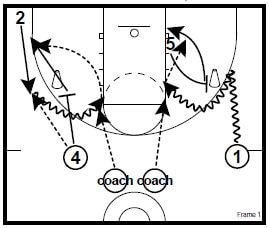
4 Player Wave Drills Guards and Posts

basketball-drills-wave1

Combo drills: 4 balls, 2 posts, 2 guards, 1-2 coaches.

1 dribble entry into a side ball screen with 5.

The 5 uses a “1” cut and rolls to basket.

1 hits 5, then gets pass from coach for a jumper.

4 starts with ball, and passes to 2 lifting, then sets a ball screen.

4 uses a “2” cut and pops to space. Switch sides and cuts.

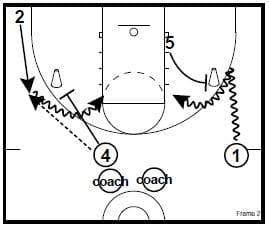
basketball-drills-wave2

Combo drills: 4 balls, 2 posts, 2 guards, 1-2 coaches.

1 dribble entry into a side ball screen with 5.

4 starts with ball, and passes to 2 lifting, then sets a ball screen.

Change up the cuts – 1. Roll, 2. Pop, 3. Slips, 4. Dribble hand off.

Alternate passes and angles.

Basketball Plays: Slip vs. 2-3 Zone

By Brian Williams on October 9, 2016

These two actions to run against a 2-3 zone defense are some notes from Chris Mack, Head Men’s Coach, Xavier University

You can see the archives of their basketball coaching newsletter at this link: Xavier Newsletter

Xavier runs these sets out of their secondary break, but you could use them as quick hitters or after timeout sets as well.

Diagrams created with FastDraw


Screen Backside

zone-slip1

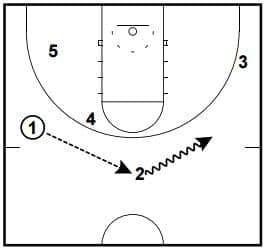
1 dribbles toward 2.

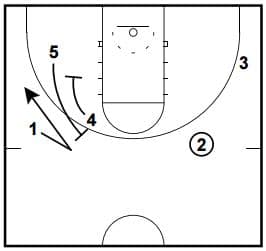
5 and 4 screen in the forward and the top of the zone.

2 cuts off the stagger.


zone-slip2

1 passes to 2.

2 dribbles toward 3.


zone-slip3

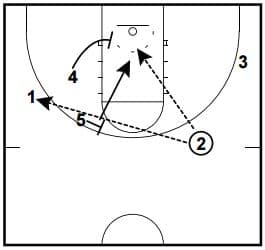
5 and 4 X Screen

5 screens in the defender at the top of the zone.

4 screens in the forward.


zone-slip4

2 can skip pass over the top of the zone to 1.

Or, 2 can pass to 5 slipping the screen.


Break Hand Off Pairs

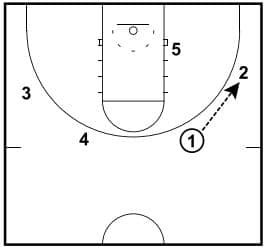
zone-slip5

Out of Xavier’s Break Alignment

1 passes to 2.


zone-slip6

1 sprints behind 2 to receive a hand off.

3 and 4 interchange on the opposite side.


zone-slip7

5 screens in the bottom of the zone for 4.

3 screens in the opposite guard for 2.

1 sees both 4 and 2 cutting.

3 and 5 can slip.

Budenholzer and Lue Man to Man Sets

By Brian Williams on October 5, 2016

Two man to man sets, one from the Atlanta Hawks Mike Budenholzer and the second from Tyronn Lue of the Cleveland Cavaliers.

The plays are included in the Basketball HoopScoop’s Atlanta Hawks Playbook & the Tyronn Lue Cleveland Cavaliers. The eBooks were assembled by Gibson Pyper.

You can learn more about the bundle by clicking this link: Hawks and Cavaliers Playbook

Diagrams created with FastDraw


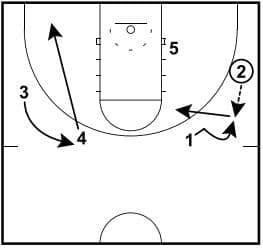
Hawks Strong Horns Slip Stagger

hawks1

1 passes to 4 who reverses to 3.

5 cuts to opposite side.


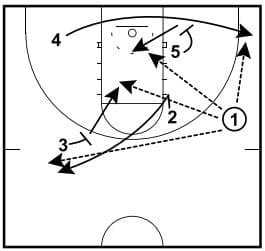
hawks2

1 & 4 set double screen for 2.

3 passes to 2.


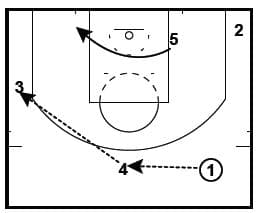
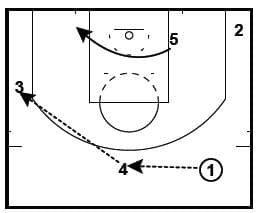
hawks3

2 passes to 4 at the elbow.

5 & 2 set stagger away screen for 3.

2 slips the stagger screen to the rim for a layup.

The other option is for 4 to hit 2 coming off the double screen.

Cavaliers Elbow Series Rice

cavs1

1 passes to 2 and cuts off a UCLA screen from 4.

4 steps out and receives the ball from 2.


cavs2

1 continues across the land and sets a flex screen for 3.

5 sets a wide down screen for 1.

4 has the option of passing to either 3 or 1.


cavs3

If 1 does not have a shot, 5 turns and sets a ball screen.


You can learn more about the bundle by clicking this link: Hawks and Cavaliers Playbook


If you are interested in adding to your Coaching Toolbox take look at what I believe is our best offer.

CLICK HERE to select from a list of more than 70 eBooks.


  • « Go to Previous Page
  • Page 1
  • Interim pages omitted …
  • Page 107
  • Page 108
  • Page 109
  • Page 110
  • Page 111
  • Interim pages omitted …
  • Page 288
  • Go to Next Page »

Primary Sidebar

  • Twitter
  • Facebook
  • Linkedin
coachestoolbox
personaldevelopmenttoolbox
basketballplayerstoolbox
basketballtrainer
athleticperformancetoolbox
coachingbasketball

© Copyright 2026 Coaching Toolbox

Privacy Policy