• Skip to primary navigation
  • Skip to main content
  • Skip to primary sidebar

  • Basketball Plays
    • Ball Screen Sets
    • Horns Sets
    • Man to Man Post Up
    • Man to Man Isolations
    • Backdoor Plays
    • Man to Man 3 Point Shot Plays
    • 2-3 Zone Attack
    • Baseline Inbound Plays
    • Sideline Inbound Plays
    • Combination Defense Attack
  • Drills
    • Defensive Drills
    • Offensive Drills
    • Competitive Drills
    • Passing Drills
    • Rebounding Drills
    • Shooting and Scoring Drills
    • Toughness Drills
    • Transition & Conversion Drills
    • One on One Drills
  • Blueprint
  • Practice
  • Mental Toughness
  • Skill Development
  • Offense
  • Defense
  • Store

Missing a Free Throw on Purpose

Missing a Free Throw on Purpose

By Brian Williams on November 3, 2016

This post came from an online discussion about what to do when shooting a free throw at the end of the game down 3, but is also worth putting some thought in regarding being down 2 when shooting one free throw.

This post is not to say that this is the only way to and THE way you should handle this situation. This is what I believe is best, but the main purpose of the post is to provide food for thought to establish your philosophy and then to implement it in practice to be able to prepare for a game.

This situation is something that needs to be covered by the first game, but at some point in the season, practicing these types of scenarios keeps practices interesting, does not require a lot of running and jumping when you are cutting back on that during late season practices, and is good preparation for post season play.

End of game, shooting the second of two free throws down 3 points, what do you do?

Regardless of what you do, there is not doubt that this is a difficult situation to pull off and no matter how well prepared you are, there is a very low percentage of times that this will ever work. That is why I believe in fouling at the end of a game where you have a 3 point lead. Here is the link to the article that I wrote about that: Foul at the End to Preserve a 3 Point Lead

If there are 8 seconds or more remaining

I would want the player to try to make the free throw (not miss on purpose), have a sub at the scorers table so that after the free throw goes in, we can match up in a man to man press while the substitute is coming onto the floor, and try to get into a press to force am immediate turnover and if no turnover, foul immediately.

If we miss the free throw, then our players in the offensive rebound spots should go after the offensive rebound aggressively and if we can’t get the ball, at least get an over the back foul on the rebound to stop the clock.[thrive_leads id=’26113′]3 or 2 Seconds.

(If there is one second remaining, I think you are better off trying to make the free throw and then force a turnover on the inbounds as you don’t have enough time to miss, rebound, and call timeout.)

I count each end of game action as 1 second. So, if there are 3 seconds left, you have 1 second of that to shoot, with the remaining 2 seconds available for a combination of dribbles and passes. However, in this case, I believe that the scramble for the ball could take 2 seconds, so I would call timeout upon gaining possession of the offensive rebound and then have either a BLOB or a SLOB for a 3 to run out of the timeout.

4 to 7 second remaining

Missing the free throw intentionally. I believe that the best way to miss a free throw for this situation (when trailing) is to hit it off the rim as hard and quickly as possible. Obviously, you would need to have practiced that and your rebounders would need to know what to expect so they could be ready. You can have a call to remind the players of what they will be doing.

As soon as the shooter receives the ball from the official, he or she shoots as quickly and hard off the rim as possible. I believe that if your offensive rebounders are ready and the defense is not ready for the quick and hard miss, throwing it hard will give you a higher percentage chance to get the offensive rebound than a soft miss off the iron like you would shoot as a coach for a defensive rebounding drill.

The teaching point in practice for the shooter/thrower is quick and hard are important, but the most important key is accuracy in hitting the rim. I have seen this play attempted where the shooter shot quickly, but missed the rim or crossed the line before the ball hit the rim. I know most players know the rules, but I think you have to overemphasize those details in practice so that they are what the player is concentrating on when walking to the line. I like to give them points to think about in pressure situations to help calm their mind under pressure.

If there are 4 to 8 seconds remaining, I believe that you have time to get the rebound and get the ball to a shooter behind the arc. I also believe that the defense will be in scramble mode and it is best to attack them in that state. Have your designated spots for the shooters to get to. The rebounder should know where to expect the shooters to be to throw the ball to so they don’t have to look and find the shooters. Only call timeout if they can’t get the pass to the shooters.

I think you can experiment with either having the free throw shooter go for the rebound or drift back for a 3. I don’t think you can stress it enough in practice that the shooter has to wait until the ball hits the rim if you choose to have him or her crash. I think he would be the most likely to be unguarded for a 3, but obviously, you have to get the rebound so it is risky to send the free throw shooter to the arc. I also think it would depend on who is shooting the free throw. Some guys I would rather rebound than get behind the arc. You could also experiment with using the shooter as a screener to get a shooter open because I doubt he would be guarded and that would eliminate a switch.

It has been my experience that players try to beat the clock which means that they end up hurrying and either making a mistake or shooting an alligator arms shot. They have to have a mindset that they are going to use up every fraction of a second in order to execute properly. There is not going to be enough time for an offensive rebound.

If it is high school, without video replay, I think the most important thing in getting the call on a gray area is to make the basket. It might be counted even if late. But, if you throw up less than your best shot in an effort to beat the clock, those will never go in and the officials don’t have to make a decision.
Managing Players in Foul Trouble

By Brian Williams on November 2, 2016

The purpose of this post is not to say that these ideas will work for every situation and every player. Every situation is different.

The purpose of this post is to say that thinking through scenarios ahead of time without the additional baggage of in-game emotions will allow you to reach better decisions on what you should do. I think it is also best to base our beliefs on sustained thought using data and not simply accepting the traditional approach.

When do you put a player back in the game with 4 fouls? There are many factors that influence your decision such as your team’s depth and the temperament and experience of the individual player. To make these types of decisions most effectively, we need to spend time thinking about then before they have to be made.

Bill Walsh state in his book The Score Takes Care of Itself: “The more thorough your preparation, the more extensive your thinking on the topic, the more rehearsed, the better you perform under the pressure of any situation that calls for an immediate decision. When you prepare for everything, you’re ready for anything.”

The traditional thinking is that a coach should remove a player, particularly if that player is one of the team’s best players, when he or she is 1 foul from fouling out of the game. The coach’s decisions then become, “When do I put the player back in the game for good?” or “Do I substitute on offense and defense to try to get some use out of the player.”

I have always felt that it is better to put a player back in too soon and have him foul out than to keep him on the bench too long and feel (after the game is over) that I should have put him back in sooner. If he fouls out, then at least I know that I got every second out of him that I could have. If he finishes up with four fouls, then I wonder how much more time he could have played before fouling out rather than wasting on the bench.

Some would argue that if an important players fouls out, you don’t have him around for “crunch time.” My argument is that baskets and free throws at the end of the game count the same as at any other time during the game. If you could have your player for the last minute or for an extra three or four minutes earlier in the game which would you choose? I’ll take the extra minutes. What if a player won’t play hard–not wanting to pick up the fifth foul. If I see that, I do take them out and make sure they know that they are not coming out because of foul trouble, but because they are not playing hard.

Whether or not you agree with me, I urge you to give it some thought and decide how you will handle end of game foul trouble now without the pressure of competition when you can think more clearly. There are definitely several decisions we all make that would improve and become more clear to us if we applied some sustained thought to them.

A study analyzed approximately 5000 NBA games from 2006 to 2010. (The source of the study is the book “Scorecasting.”)

The study used the plus/minus statistic (How much did the team win or lose by when that player was in the game. If the team outscored the opponent by 9 points while that player was in, the player’s plus/minus score is +9) to determine the value of a player to his team. “Non-star” players had an average plus/minus of 2 points lower in 4th quarter of a game than during the 1st quarter of a game.

“Star” players (Made the All Star Team or All NBA team), plus/minus rating is only .17 points lower in the 4th quarter than in the 1st quarter. Comparing “stars” (minus .17 plus/minus in the 4th quarter) to “non-stars” (minus 2.0 plus/minus points in the 4th quarter), it is clear that replacing a star with a non-star is definitely puts that team at a disadvantage.

Two other pieces of data from the Scorecasting study are that: 1) A player with five fouls, will foul out 21% of the time in the NBA. 2) Leaving a “star” player with 5 fouls in the game rather than putting him on the bench improve the team’s chances of winning by 12%. So, you have pretty good odds that a player will not foul out and you are improving your chances of winning by leaving him or her in the game.

Yes, you can occasionally get a bad call that puts a player’s 5th foul on him. I believe that a bad call on the 5th foul is almost never the reason for a player to foul out. It is usually the silly fouls that he picked up earlier in the game that put him in foul trouble. Reaching fouls, over the back with no position and no chance at the rebound, driving out of control, fouling a jump shooter, and other needless fouls are what players need to eliminate. Then, an occasional bad call is not going to cost them and their team.

One other type of foul that I want our best players to steer clear of is fouling to stop a breakaway layup. The two points he surrenders by not contesting the layup are much less costly to our team than him getting one foul closer to disqualification.

cover3d_0-76535600-14550520221

Click the link to see more about 130 Winning Special Situations

This eBook contains 130 ideas that will improve your team’s performance in special situations, addressing areas such as:

Emphasizing the importance of every possession,
End of game communication.
21 examples of specific time and score situations – and how to teach and practice them.

You can also download 13 of the 130 ideas!

Basketball Full Court Drills

By Brian Williams on October 31, 2016

These full court basketball drills were posted on the FastModel Sports Basketball Plays and Drills Library.

You can also find out more about FastModel Play Diagramming software by clicking this link: FastDraw

The first drill, Hit Ahead Layups, was contributed by Coach Fabian McKenzie.

Coach McKenzie has been a head coach at the university level for 17 years, and has been involved as a coach at this level for 20 years. He has been involved with the Canadian Women’s National team program for the past 9 years.

It is a good early season conditioning drill to help with passing and finishing with speed.

The second drill (Illine Fastbreak Game) was contributed by Coach Joel Hueser, Head Boys Coach at Papillion-LaVista South High School High School in Nebraska.

Here is what Coach Hueser said about the drill:

“Illini Break is a competitive, team transition drill. The offense has the advantage and gets to play fast. Forcing the defense to get back with a high sense of urgency. We want to always fastbreak on defense. But first, we must emphasize our offensive board coverage (OBC). Then, if we do not secure the offensive rebound, all five players must get into the habit of always sprinting back. We consider your first three steps “out of the gate” as the most important. Guarding the basket is our number one priority and then stopping the ball. Once back, all five defenders need to establish ball side and help side position. This drill demands that, and more. Get ahead of the ball! No back pedaling, buddy running (remaining side by side with your match-up) and/or pouting after a missed shot or turnover.”

Since players are constantly coming into play, the drill also forces players to communicate as to who they are guarding.

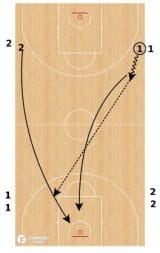
Hit Ahead Layups

full-court-basketball-drills1

Players line up as shown at free throw line extended – out of bounds.

Player 1 starts the drill as Player 2 sprints up the floor.

Player 1 gets 1 dribble and must deliver a pass on time and on target so 2 can lay the ball up without dribbling.

1 must sprint after the pass and rebound the ball.


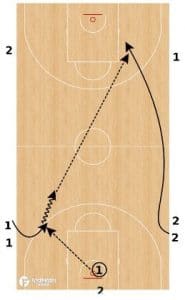
full-court-basketball-drills2

Original 1 gets the rebound.

As they are getting rebound, next person in 1 line circles for an outlet pass. As the outlet pass is happening, next in 2 line is sprinting wide up court.

1 gets 1 dribble and must hit 2 on time and on target for layup. 1 must sprint to rebound the ball.

The pattern for the drill continues.

Can change sides at any time or put a person on defense in middle of court forcing the offense to throw it high and over the head of the defender.

Rotation: after 2 takes layup they go to line 1. Once 1 makes the outlet pass, they fill line 2.

Illini Fast Break Game

full-court-basketball-drills3

Team 1 starts on offense and team 2 on defense.

Play out the possession.

Upon change of possession, team 2 outlets to teammates along baseline waiting to come on.

Team 1 must get back on defense.

At this end, play out the possession and team 1 outlets to teammates along the baseline.

Emphasize OBC and compete!

Score like a game. Either play to an established score, or for a specific time limit.

Post Player Development Basketball Drills

By Brian Williams on October 30, 2016

These two post player drills are among the thousands of resources for both coaches and player available from basketballhq.

They have several more videos as well as basketball coaching resource articles.

The Coach in both of these videos is Sean Hanrahan, Head Men’s Coach at Warner University.

Click the play arrow to view the videos.

Please make sure that your sound is on.

These are YouTube videos, so please make sure that you are able to access YouTube on the servers that you are on.


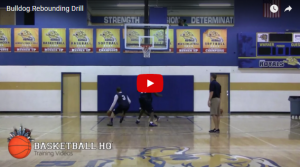
Bulldog Rebounding Drill

1 on 2 Competitive Finishing Drill

Defending 3 Point Shots

By Brian Williams on October 27, 2016

This article was written by By Stephen Shea, Ph.D and published on his blog: Basketball Analytics. You can find out more about Dr. Shea and his work in the field of Basketball Anayltics at the end of this article.

This is an edited version of the original article. For the entire article, click on: The Defensive 3 Point Revolution.

Even though the data is derived from the NBA, I feel that the implications are similar for high school and college. I know that coaches cannot get the data for your teams, but I feel the NBA results are worth considering as you work on your defense.

The Defensive 3 Point Revolution

NBA offensive and defensive strategies are evolving. They aren’t just changing with the whims of a current coach or executive. They are changing out of necessity. The current NBA talent pool is different from the past. For example, current players are much more accustomed to shooting threes than previous generations that grew up without the shot. There have also been significant defensive rule changes. Hand-checking fouls now make it easier for perimeter players to drive. The abolishment of illegal defense allows teams to collapse into the NBA’s version of a zone (which must respect the current defensive 3-in-the-key).

Current strategies find their roots in past practices. There is value in this model since “survival of the fittest” is at play. The best past strategies have endured the longest (if perhaps with modifications). There are consequences as well. Often elements of past strategies linger beyond their expiration. Ideally, coaches would be able to harvest the wisdom of past experiences without carrying the burden of a bias towards past success when designing strategies that consider the constraints of today’s game. But that isn’t realistic.

Red Auerbach once proclaimed, “Basketball offensive weapons are developed first, and it always takes a while for the defense to catch up.” Recent years agree with Red; NBA offenses are evolving faster than defenses are responding.

The components of the modern offensive evolution can be subtle, such as replacing a few pick-and-rolls with dribble hand offs or encouraging less pursuit of offensive rebounds to better defend transition.

There is no subtlety to the growing importance of the 3-point shot. It’s become the hallmark of today’s game. In 2015-16, NBA teams averaged 24.1 3-point attempts per game. That’s up 33% from 18.0 attempts per game just 5 years earlier, and up nearly 90% of the 12.7 attempts per game in 1997-98 (which was the first season after a 3-year trial of a shorter 3-point line).

The 3-point growth shows no sign of slowing down. Teams shot 1.7 more 3-point attempts per game last season than the prior season (although a faster pace league-wide contributed to that growth).

It’s not that weaker teams are heaving more threes in desperation. The Eastern and Western Conference Champions, the Cavs and Warriors, were in the top three in both 3-point attempts and in % of the team’s FGA from behind the 3-point line. 10 of the top 11 teams in 3-point attempts made the playoffs.

The increased usage of 3-pointers is justified. As the NBA talent pool became increasingly efficient from deep, the shot’s value surpassed almost any FGA besides a wide-open dunk. In 1982-83, NBA teams shot 23.8% on 3-pointers. That’s equivalent to 0.71 points per FGA. By comparison, teams shot 49.2% on twos or generated about 0.98 points per shot. A two-pointer was a much better shot. Today, teams are still generating about 0.98 points per two-pointer, but improved 3-point shooting has teams averaging 1.06 points per 3-point attempt. For the Golden State Warriors, 3-point attempts generate 1.25 points per shot. (That’s why they take 31.6 of them a game.)

When we focus on the “good” 3-point attempts, efficiencies improve significantly. Teams averaged 1.13 points per corner 3 attempt and 1.11 points per catch-and-shoot 3-point attempt last season.

Compared to a “good” 3-pointer, a “bad” two-pointer looks inexcusable. Teams scored just under 0.8 points per mid-range jumper in 2015-16. An average team could pick up 2 points per game just by replacing 6 mid-range jumpers with 6 corner 3s.

The threat of a 3-point shot can be as valuable as the shot itself in that it provides spacing for the rest of the offense—room to drive, cut or post-up. For more on this idea, see our previous post.

If offenses have changed so radically, so then must the defense. As the 3-point shot became more efficient and as teams began implementing offenses to specifically generate 3-point attempts, teams needed to devote more defensive resources to paroling the 3-point line, running off shooters and heavily contesting shots. The defensive changes needed to be as extreme as the offensive shift.

Penetration and Kick outs
If an NBA player wants to pull-up for 3 in traffic, there is little that the defense can do about it. Fortunately for the defense, that’s not the type of 3-point attempt that they need to be concerned about. Rather, it’s the catch-and-shoot opportunities that are troubling.

NBA defenses won’t intentionally leave a capable shooter open enough to catch and shoot a 3 in rhythm. Instead, NBA offenses have to penetrate, draw help defenders and force defensive rotations to create enough space for perimeter shooters.

Understanding how teams defend the 3 means understanding how teams defend penetration and kick outs.

The best defense of a catch-and-shoot 3 is to not allow the shot. In theory, there are two ways this can happen. First, a team can guard the perimeter players so closely that a kick out isn’t attempted, or when it is, the perimeter player is coaxed to drive or pass. The second method would be to position the defense to create turnovers either by occupying passing lanes or by aggressively trapping the ball handler before the pass attempt.

That’s the theory, but are teams practicing either strategy and if so, are they successful? There is a remarkable amount of real estate on the 3-point line, and many teams now play lineups with at least 3 perimeter threats. Can teams consistently and significantly create turnovers or reduce catch and shoot 3-point attempts?

Yes, and the defensive systems that are being employed are remarkably different than those from the past.

The minimal help model
All other variables the same, the closer the shot, the easier it is to make. Prior to the 3-point line and even in the first few years of its existence, the best shots (by far) were those near the hoop. As a result, NBA defenses protected that region at all costs. Teams collapsed with help defense to the best of their ability (under the old illegal defense rules). In those days, forcing a kick out on penetration was a win for the defense.

Today, the best defenses are doing the opposite. They are sending minimal help on the drive. In particular, teams are not leaving the corners open, and they are terrified to leave an elite shooter (e.g. Steph Curry, Kyle Korver or J.J. Redick) alone anywhere behind the arc.

To assess defensive strategy on penetration we’ll use measurements of offensive and defensive stretch, which were introduced in Basketball Analytics: Spatial Tracking.

We looked at every halfcourt possession in the NBA in 2014-15. (In other words, we eliminated transition.) In those halfcourt possessions, we marked the first instance the offense penetrated (moved from possession outside 15 feet to possession inside 10 feet.) This could be a pass to the post or a cutter, or it could be a drive from the perimeter. Using spatial tracking coordinates provided by SportVU, we looked at the position of all players on the court the first instant the offense had possession within 10 feet of the hoop. Then, we calculated the offense’s spacing minus the defense’s stretch. The teams with the smallest difference are the ones that help off the perimeter the least. Here are the results

Rank Team Offense Spacing Minus Defensive Stretch (sq. ft)
1 CHI 273.1
2 POR 275.7
3 CLE 275.7
4 SAS 281.0
5 GSW 282.8
6 WAS 283.8
7 UTA 286.6

Chicago, Portland, Cleveland, San Antonio, and Golden State helped the least. These teams were the leaders in the minimal help model, a defensive strategy on penetration that is in direct contrast to traditional defense.

(We don’t mean to suggest that the above 4 teams employ identical defenses. The teams employ defenses strategy that align in their stretch during penetration and in their strategy to reduce 3s on kick outs.)

Does it work? There are costs to not helping as much on defense. It means less obstacles for the penetrating player, and possibly higher opponents’ efficiency around the rim. It can mean less resources around the hoop for rebounds. So, if a team is going to intentionally not help, there must be a benefit. The goal of not helping is to prevent catch-and-shoot threes. Were these teams able to do that?

We looked at how many catch and shoot 3-point attempts (C&S 3PA) each team gave up in 2014-15. We adjusted for opponent tendencies by looking at each game individually and recording how many more or less C&S 3PA a team allowed than their opponent usually attempted. For example, if San Antonio held Golden State to 15 C&S 3PA, which was 6 less than they usually attempted, it was seen as a reduction. In contrast, if San Antonio allowed 15 C&S 3PA from Minnesota, which was about 5 more than they usually got, it was seen as an increase. We adjusted for pace by looking at percentages of typical opponent “shots” (FGA+0.44FTA) instead of totals. For ease of interpretation, know that 1% equates to approximately one shot per game.

he teams that help the least (have the smallest CHAO-CHAD) are able to reduce opponents’ C&S 3PA. The leaders in this category (San Antonio) are holding opponents to 3-4 less C&S opportunities per game than they typically get. That’s a sizable chunk when teams are averaging 16.5 of these shots a game.

Preventing opponent C&S 3-point attempts has lessened opponents’ shooting efficiency. The top three defenses in opponent points per shot in 2014-15 were Golden State (0.940), Chicago (0.946) and Portland (0.952). San Antonio was a healthy 6th at 0.968. Those were the top 4 in terms of lowering opponent C&S 3PA.

The swarming defense
With 4:20 left in the 1st quarter of a January 31st, 2015 matchup between Portland and Milwaukee, Nicolas Batum feeds Lamarcus Aldridge on the block. Upon the penetration, all five Bucks sag into or around the paint. (This wouldn’t have been allowed before the NBA replaced it’s illegal defense with the defensive 3-in-the-key.) This leaves two Portland players (including Damian Lillard) open above the break. Portland is helping Milwaukee by having no players available in the corners.

Aldridge turns towards the paint, but is immediately met by Lillard’s man, Brandon Knight. Knight knocks the ball loose for a turnover.

Knight had to leave Lillard open for a C&S 3 when he trapped Aldridge. It was a risk. Most times, Knight isn’t going to get the steal. NBA players tend to see traps coming, and are poised and strong with the ball.

Knight’s gamble doesn’t have to work every time. Milwaukee’s swarming defense understood that it would give up a good amount of C&S threes, but believed that they would get enough turnovers to be an efficient defense overall. They were correct; Milwaukee had the 3rd best defensive rating that season (per Basketball-Reference.com).

When the minimal help model prevents a 3, it’s usually exchanging that 3-point attempt for a different (and hopefully less efficient shot). When the swarming defense prevents a 3, it’s through a turnover. If the swarming defense can keep its turnover % high enough, it can offset the increased efficiency realized by the opposing offense through more C&S threes.

In 2014-15, Milwaukee, Atlanta and Philadelphia all saw at least some degree of defensive success with a version of this swarming defense. Their success is reflected in the percent of turnovers they induced. All three teams forced opponents to turnover the ball on at least 14.9% of possessions. They were the top 3 teams in this category.

Miami also employed a swarming defense. After being 1st in the league in opponent turnover % in 2013-14 (at 15.8%), Miami dropped to 8th in 2014-15 (with 14.2%). The inability to turn the swarming gamble into a turnover often enough meant the team slid to 21st in defensive rating.

If swarming defenses are consistently collapsing on penetration, we should see that in the spatial tracking data. he four teams that collapsed the most were Milwaukee, Miami, Atlanta, and Philadelphia.

Rank Team Offense Spacing Minus Defensive Stretch (sq. ft)
30 MIL 326.0
29 MIA 306.0
28 ATL 305.1
27 PHI 304.3
26 TOR 302.9
25 OKC 299.4

The teams that collapsed the most (produced the highest Offense Spacing Minus Defensive Stretch) also gave up more C&S 3PA.

Be extreme
We discussed earlier how we still see great variation in perimeter shooting ability and usage among NBA offenses. The swarming defense would appear to be ideal against a team with minimal perimeter shooting since when the kick out to the open shooter is successful, the shooter will be less efficient on the shot. In contrast, it would seem that a swarming defense would struggle against a great passing and perimeter shooting team like Golden State.

The ideal defense might be one that can employ both defensive strategies. However, the 82-game regular season provides little opportunity for teams to prepare for specific opponents. Often teams won’t have a real practice between games.

Since the analysis averages Offense Spacing Minus Defensive Stretch (sq. ft) across the season, a team that alternated styles could appear as central and non-distinct. We did study the game-by-game numbers, and as the difficulty of this strategy would suggest, no team altered strategies in a way that correlated with the 3-point shooting of the opponent. Yes, teams do scheme for particular 3-point threats, such as Curry or Korver, but otherwise swarming defenses swarm. Any adjustments for individual players were not significant enough to alter team stretch totals.

The defenses on the extreme in spacing minus stretch outperformed those in the middle. The bottom 8 teams in defensive rating were ranked between 13 and 26 in spacing minus stretch (where the minimal difference was ranked 1st). The skew here suggests that not collapsing is generally better than swarming. The minimal help model also wins when we look at the top of the defensive rating board.

For the sake of this argument, suppose that a spacing minus stretch < 285 indicates a minimal help model. No minimal help model finished in the bottom 12 in defensive rating. There is a difference between system and execution. The minimal help model will only be successful if it actually reduces opponents’ C&S 3PA%. Consider the model effective if it reduced opponents C&S 3PA by at least 1% (of the total offense). There were 5 effective minimal help models (out of the 6), and those 5 teams were in the top 11 in defensive rating. Two of these models (GSW and SAS) were the top 2 in defensive rating. If we consider a team as swarming when spacing minus stretch >300, we have 5 swarming models. This model is effective only if the team is able to induce a high amount of turnovers. Let’s make that cutoff 14.5%. We then have 3 effective swarming models. Two of them (Milwaukee and Atlanta) were in the top 6 in defensive rating, while the third (Philadelphia) was 13th.

The bottom 17 teams in defensive rating qualified as neither an effective swarming nor an effective minimal help model. In other words, all 8 effective modern defensive models were in the top 13 in defensive rating.

Team Takeaways
What actions should a team take now with the above information in hand?

On Offense
This article is about defensive strategy, but we can’t help but again suggest that modern offenses need to be a threat both inside and out. Lineups need at least one player that is dangerous around the hoop. With modern hand-checking fouls and the typically superior free-throw shooting of perimeter players, this is often a guard that can drive (perhaps off a screen).

During penetration, offenses need to force defenses to make tough decisions. A player that is efficient attacking the hoop begs help defenders to collapse. Spacing the floor with 3-point threats (and we recommend at least 3) makes it dangerous to leave the corner unmanned.

We suspect that as offenses get better at shooting 3s, teams will help less on penetration. In other words, the minimal help model will be become the most popular. Thinking ahead, what does this mean for offenses? It’s possible that this opens the door for the return of the dominant post center (in the mold of Olajuwon or Shaq). More likely, NBA offenses will be able to counter with stronger and more athletic driving ball handlers that won’t be as affected by one defender on their shoulder. LeBron is the ideal, but this might also be Ben Simmons in Philadelphia or Giannis in Milwaukee (as examples).

On Defense
Teams need to decide on a defensive strategy. Ideally, teams would have the flexibility to play both modern models described above. However, it’s not realistic to expect young players to be able to switch from one helping extreme to the other on the fly. The middle ground defensively, which can happen through indecision, hesitation and confusion, is the worst. Thus, it probably makes sense for teams (and especially younger teams) to commit to predominantly one style for the regular season.

As teams trend towards better perimeter shooting, we suspect that the minimal help model will surpass the swarming defense in effectiveness. The swarm will have it’s role, but in small doses like a blitz in football.

Length and athleticism in defenders is remarkably helpful regardless of system. A perimeter shot contested by Kawhi Leonard is different than a perimeter shot contested by Jason Terry. And if the perimeter defender is left with little help when his player penetrates, a paint shot contested by Leonard is different than a paint shot contested by Terry.

In addition, length and athleticism translates to positional versatility. It allows players to switch screens without creating major mismatches in speed or size. Switching screens cuts off the space that offensive players use to get a step to the hoop or launch a 3.

Final Thoughts
We scan the NBA landscape and see elite offenses with 3-point shooting at their core. The natural reaction is to expect NBA defenses to be designed with preventing the 3 as a core principle.

Certainly some teams have adapted quickly. San Antonio and Golden State both employ effective minimal help models (and not surprisingly, are very successful franchises). Coach Tom Thibodeau pioneered the model as an assistant coach for the 2008 Champion Celtics. He then employed his defensive model with great success for years in Chicago.

Milwaukee and Atlanta have found defensive success with a modern swarming model. Their success is in part due to a focus on bringing in long and positionally-versatile wings that can switch screens and occupy passing lanes.

Yet, we still see a number of teams seemingly unsure of what to do in response to the 3-point revolution. To understand why teams appear so stubborn, we have to understand where today’s coaches and managers came from.

Many of the executives and coaches in today’s NBA have been involved in high-level basketball for 30 years or more. The first 25 of these years, these individuals never encountered a team like Golden State. Furthermore, these coaches and managers are where they are because they were so successful in the past. We have individuals that have seen decades of success with certain systems and philosophies. Why would we expect them to change so quickly?

We can’t ignore the practical challenges of finding the right personnel for a modern defensive system. When the 3-point shooting giants first presented, it was also new for NBA players. A minimal help model might be nice in theory, but how successful would a team be at implementing it if all of its players have no experience in anything similar?

While we sympathize with the challenges NBA decision makers face when trying to counter the 3-point revolution, the challenges do not negate the reality that teams must adapt.

About the Author, Stephen Shea

Stephen Shea is an associate professor of mathematics at Saint Anselm College in Manchester, NH. He earned a Ph.D. in mathematics from Wesleyan University in Middletown, CT, and a B.A. in mathematics from The College of the Holy Cross in Worcester, MA. His mathematical expertise and publication record is in the areas of probability, statistics, dynamical systems, and combinatorics. For years, he has been applying his abilities in these areas to study professional and amateur sports. Stephen is a managing partner of Advanced Metrics, LLC, a consulting company that provides analytics solutions to basketball and hockey organizations. At Saint Anselm College, he runs a course on sports analytics. His sport writing has been featured in the Journal of Quantitative Analysis in Sports, Psych Journal, the Expert Series at WinthropIntelligence.com, and the Stat Geek Idol Competition for TeamRankings.com. In 2013, Stephen coauthored the book, Basketball Analytics: Objective and Efficient Strategies for Understanding How Teams Win, and co-created the accompanying blog BasketballAnalyticsBook.com. In 2014, he authored Basketball Analytics: Spatial Tracking.

Coaching Basketball Defensive Concepts

By Brian Williams on October 24, 2016

These defensive concepts from 3 highly successful college basketball coaches were posted on Bob Starkey’s Basketball Coaching Blog, hoopthoughts.blogspot.com.

Even if you don’t play a pack style defense, I hope this might get you thinking about terminology and philosophy that can be applied to improving your system.

Jim Boone, Head Coach Delta State Men

Here’s a few concepts and teaching points from Jim Boone in regard to the way he plays Pack Line defense.

Keys in Teaching:
1. Position players in such a way to already be in help.
2. Build a wall to stop the ball.
3. Five players working together.
4. Communication

Coach Boone: “We are zoning the ball.”

Five Things to Work on Daily:
1. Conversion defense
2. Low post defense
3. Pressure on the ball
4. Help/recover
5. Blockout

Coach Boone: “You can’t play transition defense while you’re in transition.”

Coach Boone: “Low post defense dictates how you set your entire defense up.”

Five Defensive Goals:
1. Pressure the ball
2. Contest all shots
3. Keep the ball out of the lane
4. No second shots
5. Do not foul

Coach Boone: “We want to determine what shots you get.”

Conversion Defense:
1. No fast break lay-ups
2. Out number the offense
3. Build from the lane out

Chris Mack, Head Coach Xavier Men

Pack Line defense helps give you a “system” to play defense.

1) Gives players answers and accountability

Certain things players can/can’t do do

They are given specific rules ex. “You can’t play behind the post” vs “Play hard”

2) Simplifies Scouting

Their coaches watch a ton of film but do not give it all to the

players. Instead they play certain actions in very specific ways and practice these

every day.

Example:  Practice defending staggered screens so when they play a team they already know how they will defend this and get better at it through out the year.

3) Creates a culture your players can believe in.

Varsity players “pass” down the defense by teaching your younger players without a lot of involvement from coaches.

GOLDEN RULE: When your man does not have the ball YOU MUST HAVE 2 FEET IN

THE PACK LINE.

Exceptions: If your man is cutting you must chase the cutter.

1) On the Ball: Have extreme ball pressure — do not get beat to the outside NEVER GIVE UP BASELINE

Keep your butt to the basket

Don’t get beat baseline

If your man goes towards the middle do not get beat through the elbow, they can’t attack you on a straight line.

2) You must have two feet inside the pack line when your man does not have the ball and you are trying to form triangles

Defining Your Team

  1. How do you close out?
  2. Close out with two high hands to discourage rhythm shots
  3. Play in then out

KEY: Your positioning is your help

Discourage shots, play the drive, call shot when the shot goes up.

Mike Neighbors, Head Coach Washington Women

When your man has the ball on the perimeter:
1. You were there on the catch.

2. You were the to take away the quick shot or quick pass

3. You were close enough to pressure without getting beat off the bounce.
 a. Don’t get beat to the outside
 b. Don’t get beat in a straight line

When your player does not have the ball on the perimeter:
1. You are about half way between the ball and your player

2. You are a step off the line that would connect the ball to your man

3. You are actively able to see both ball and man

Ball being passed to their player:
1. Move on the air time of the pass

2. Start with sprint and end with chops

3. High hands to active hands

Ball being passed but NOT their player:
1. Move on air time of the pass

2. Sprint to gap.

Teaching Points
1. Players must begin in proper position

2. Players must be vocal in communication of their responsibilities

“Ball” = this means I have the ball

“Gap” = this call means my player does not have the ball but I am in your dribble gap

“Help” = this call means my player does not have the ball but is on the opposite half of the court than the ball is.

  • « Go to Previous Page
  • Page 1
  • Interim pages omitted …
  • Page 106
  • Page 107
  • Page 108
  • Page 109
  • Page 110
  • Interim pages omitted …
  • Page 288
  • Go to Next Page »

Primary Sidebar

  • Twitter
  • Facebook
  • Linkedin
coachestoolbox
personaldevelopmenttoolbox
basketballplayerstoolbox
basketballtrainer
athleticperformancetoolbox
coachingbasketball

© Copyright 2026 Coaching Toolbox

Privacy Policy