• Skip to primary navigation
  • Skip to main content
  • Skip to primary sidebar

  • Basketball Plays
    • Ball Screen Sets
    • Horns Sets
    • Man to Man Post Up
    • Man to Man Isolations
    • Backdoor Plays
    • Man to Man 3 Point Shot Plays
    • 2-3 Zone Attack
    • Baseline Inbound Plays
    • Sideline Inbound Plays
    • Combination Defense Attack
  • Drills
    • Defensive Drills
    • Offensive Drills
    • Competitive Drills
    • Passing Drills
    • Rebounding Drills
    • Shooting and Scoring Drills
    • Toughness Drills
    • Transition & Conversion Drills
    • One on One Drills
  • Blueprint
  • Practice
  • Mental Toughness
  • Skill Development
  • Offense
  • Defense
  • Store

Post Line Ups Finishing Drill

Post Line Ups Finishing Drill

By Brian Williams on December 15, 2016

These two finishing drills are among the thousands of resources for both coaches and player available from basketballhq.

They have several more videos as well as basketball coaching resource articles.

The Coach in the first video is Matt McCall, Head Men’s Coach at The University of Tennessee at Chattanooga.

At the time this drill was filmed, he was an Assistant Coach at Florida.

The idea is to modify these drills with the types of finishes that you want your players to use.

Click the play arrow to view the videos.

Please make sure that your sound is on.

These are YouTube videos, so please make sure that you are able to access YouTube on the servers that you are on.

Post Line Ups Finishing Drill

This second drill is a perimeter drill, but is still a good finishing and conditioning drill.

The Coach in the second video is Sean Hanrahan of Warner University
One foot Competitive Finishing Drill

Infuse Your Team with Passion

By Brian Williams on December 11, 2016

 by Dr. Cory Dobbs

Every team has players who always do less than they are asked; still others who will do what they are asked, but no more; and some who will do things without anyone asking. What every team needs is more of the third group, players who serve to inspire those around them to do things that will make the team better. These are the players who constantly renew their commitment to being their best for the team and whom others would do well to model.

A fun and energizing environment is much more productive than a routine and stale environment. Student-athletes who enjoy their sport and their teammates come to practice with more energy—more passion. And this can be contagious.

To help lift your team’s performance look for ways to infuse your team with passion. Help teammates believe in themselves. Build their confidence and self-esteem. Search for ways to make your teammates feel important and appreciated. Celebrate and get excited about
the successes and accomplishments of your teammates. Make it a daily goal to point out the strengths and contributions of those around you.

You can infuse your team with passion by acting out the following eight principles in your daily activities:

1. Keep Your Fire Burning. Fill your energy tank frequently. Your teammates feed off your fire. Avoid burn-out by regularly relaxing and refreshing your mindset.

2. Take Charge of Your Moods. Recognize your present mental and emotional state and take time to reflect on how your attitudes impact and influence your teammates.

3. Listen to Teammates. Spend time with your teammates and attempt to understand their feelings, perspectives, and experiences. Make it a way of life rather than a one-time event.
[thrive_leads id=’36827′]
4. Be There for Others. Team building is about recognizing, respecting, and appreciating your teammates. Your friendship can be just the encouragement a teammate might need to make it through a challenging time. The smallest gesture, a simple act of kindness, at just the right time can make a big difference.

5. Act with Integrity. Blaming, finger-pointing, and accusing others will lead to negative reactions. Do what you say you will do. In other words, walk the talk. Your attitudes and actions should be consistent with your words.

6. Be Genuine. Your teammates will see right through you if you are phony and superficial. They want you to care about them and help them achieve their goals. Belief in your teammates will breed trust and healthy relationships. Point out others’ strengths and contributions—daily!

7. Refrain from Excuse-Making. Players that are committed to excellence identify what top-notch performance looks like and then take action steps towards that standard, never making excuses for disappointments and failures along the way.

8. Mend Broken Fences. Great teammates are those willing to admit mistakes. Durable and enduring relationships are built by pushing through adversity. Conflict is natural. Restore relationships where conflict has caused tension. Be patient, persistent, and pleasant when restoring a relationship.

New to the Second Edition of Coaching for Leadership!

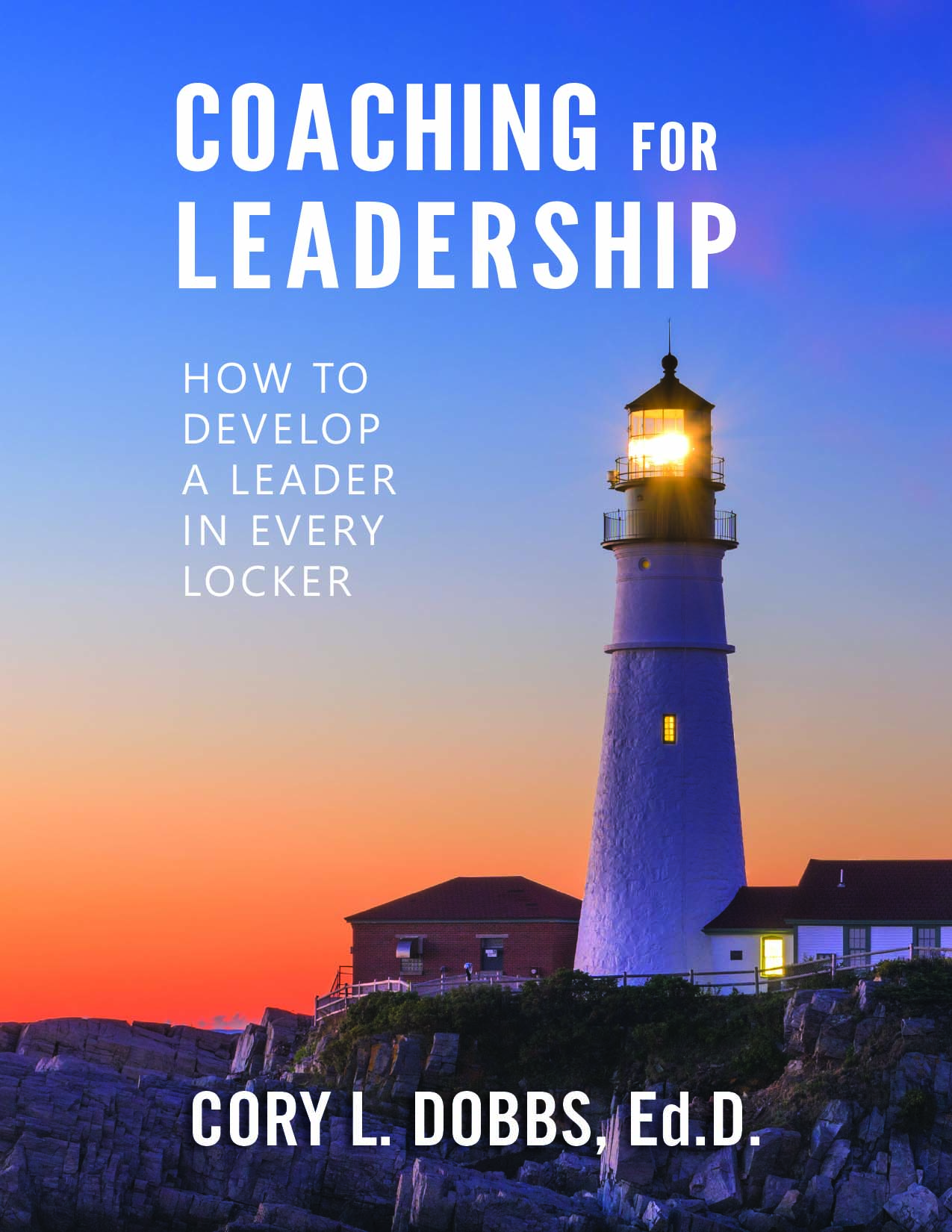
We are pleased to announce a new chapter to the second edition of the best-selling Coaching for Leadership. The chapter, The Big Shift: Unlock Your Team’s Potential by Creating Player-Led Teambuilding, connects the previous edition of this book to its origin, as well as to the future of team sports. The new chapter sets forth a practical and applicable agenda for change and improvement. The reader is introduced to seven vital elements of change; seven shifts of traditional mental models that lead to the new core principles necessary for creating a player-led team culture. Click here for more information about Coaching for Leadership

“Tell me and I’ll forget. Show me and I may remember. Involve me and I will care.” -Your Student-Athlete The world of coaching is changing. In Coaching for Leadership you’ll discover the foundations for designing, building, and sustaining a leadership focused culture for building a high-performance team. To find out more about and order any of the Sport Leadership Books authored by Dr. Dobbs including Coaching for Leadership, click this link: The Academy for Sport Leadership Books

About Cory Dobbs, Ed.D.

Cory Dobbs is the founder of The Academy for Sport Leadership and a nationally recognized thought leader in the areas of leadership and team building.  Cory is an accomplished researcher of human experience. Cory engages in naturalistic inquiry seeking in-depth understanding of social phenomena within their natural setting.

A college basketball coach, Cory’s coaching background includes experience at the NCAA DII, NJCAA, and high school levels of competition.  After a decade of research and development Cory unleashed the groundbreaking Teamwork Intelligence program for student-athletics. Teamwork Intelligence illuminates the process of designing an elite team by using the 20 principles and concepts along with the 8 roles of a team player he’s uncovered while performing research.

Cory has worked with professional athletes, collegiate athletic programs, and high schools teaching leadership and team building as a part of the sports experience and education process.  As a consultant and trainer Dr. Dobbs has worked with Fortune 500 organizations such as American Express, Honeywell, and Avnet, as well as medium and small businesses. Dr. Dobbs taught leadership and organizational change at Northern Arizona University, Ohio University, and Grand Canyon University.


Characteristics of a Coach of Excellence

By Brian Williams on December 6, 2016

These characteristics of coaches of excellence were posted on Bob Starkey’s Basketball Coaching Blog, hoopthoughts.blogspot.com.

Coach Starkey is an assistant coach in the LSU women’s program.

Editors’ note from Brian: Even though these concepts came from a very successful NFL executive, most of the thoughts can be applied to any level of coaching for any sport. Also, the article is written with male references, but in my opinion, my of the lessons can be applied to man and women, boys and girls.

Bill Polian is one of NFL’s best General Managers.  He has a proven formula of success and that has transcended from one organization to the next.  Hired as the Buffalo Bills GM following a 2-14 season, he soon had the franchise going to three straight Super Bowls.  From there he became the GM of the Carolina Panthers where he had the team in the NFC Championship Game in only their second year of existence.  From there he took over the Colts organization and one of his first moves was to draft Peyton Manning who would ultimately guide the team to a Super Bowl Championship.

Each spring I’m honored to be a part of Felicia Hall Allen’s A Step Up Assistant Coaching Symposium,”which is a unique format to help assistant coaches become better at their craft.  Obviously, one of the topics each year is moving  into the head coaching position.  Felicia brings in a wide variety of people to help paint the picture they need to move up.  One of the obvious speaker choices new head coaches that have just made the jump.  But she also brings in Athletic Directors, Search Firms and Head Hunters to give us a unique look at what the people doing the hiring are looking for.

I think sometimes as coaches we tend to lean on other coaches maybe too much for information instead of stepping outside our comfort zone and meeting with the true “decision makers.”  Have you met with your Athletic Director and discussed what he/she looks for in a candidate?  Do you have the courage to ask that AD what your deficiencies are and what you should look for?

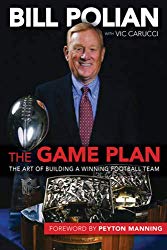
Polion has an outstanding book that I’ve read a couple of times titled “The Game Plan: The Art of Building a Winning Football Team.”  For those interested in becoming a head coach, Chapter 2: Deciding on the Decision Maker is worth the price of the book alone as Polion gives great insight to what he is looking for.  Below, is a brief look in to what he views important.

  1. Organization. That ranges from how he organizes his playbook to his practice plans, from year-round staff assignments to his off-season program.  Each of those areas and many more must be laid out in writing and explained completely, step by step, especially with a candidate who has never been a head coach before.

Today, every coaching candidate shows up for an interview with a “book” detailing all aspects of his program.  But the book is only as good as the person reading it.

  1. Leadership. Does he have the philosophical approach, verbal skills, physical presence, stability, and courage to lead and motivate the coaching staff, the players, and the support staff?
  1. Communication. Does he have good verbal skills?  Does he listen?  Does he respond to questions in a thoughtful way, or does he just tell people what to do?  Is he open to suggestions? Can he interact with ownership, management, and other departments on their terms?

Can he sell his program to all of the team’s stakeholders?  Does he care and communicate that care to others or are they just numbers to him?

Can he teach or is he a lecturer?  A teacher gets everyone involved.  He is able to illustrate his lessons with real-life examples and sometimes funny parables.  He gets his students invested and involved in what he’s teaching.  A lecturer just stands at the podium and spits out notes.

  1. Emotional Stability.  Can he function well under pressure from players, staff, ownership, fans and the press?  Does he remain cool on the sidelines?  Does he remain composed, organized, and does he take the lead at halftime?  Doe he use genuine anger as a motivational tool or does he come apart when he’s frustrated?

Is he coherent in his remarks to the players, staff, ownership, and the press after a loss?  Does a loss stay with him too long?  Can he keep everyone in the program, including the general manager focused by his own leadership when the “roof is falling down?”

  1. Vision.  This is the most important quality of them all.  Does he have a clear picture of how he wants his team to look and play?  Can he articulate it verbally and in writing?

Can he make long-term decisions in order to implement his vision when pressure is great for him to make a short-term, quick-fix decision?  Has he organized the program in such a way as to implement his long-term plan?

  1. Strategy.  Is he mentally prepared to make decisions on the sideline or does he react?  Does he have direct responsibility for key strategic decisions?  I other words, is he the guy making them or is he going to lean on somebody else?  He’s got to be the one to decide whether to go for it on fourth-and-goal.  He’s got to be the guy to decide whether he’s going to kick a field goal or go for a touchdown.

As Marv Levy always used to say, “If we’re penalized for having 12 men on the field, that’s my responsibility.

  1. Flexibility.  Can he adjust to changing trends and rules, personnel, opponent schemes, personality or culture of players?  And then I ask two rhetorical questions.  First, can he change the nuts and bolts of his program to adjust to circumstances without changing his approach to the fundamentals?

Secondly, can he be flexible and take advantage of circumstances or does he buy someone else’s program, lock, stock and barrel?  I other words, does he say, “Oh, gee, Pittsburgh won using a 3-4; let’s switch to a 3-4?”

  1. Ability to judge talent. He’s got to be able to see potential rather than just saying, “This is college player A and this is college player B.”  He’s got to be able to see what the potential of college player A is versus college player B.
  1. Public relations. Essentially, it boils down to, can he handle himself well in this media maelstrom that he’s forced to endure these days?

If interested in finding out more about the book, you can click the image of the cover below to the left.

  1. Player respect. Does his knowledge, leadership, teaching ability, approach to squad morale and discipline, and his personal habits and dignity earn player respect? Do they look up to him?

Is his approach to discipline fair?  Do his personal bearing, conduct, and dignity — which encompasses work ethic, temperament, personal habits, etc. — generate respect from the players?  Not liking, but respect.

  1. Character.  It boils down to one thing: do you want this man as a standard-bearer for your franchise.

Archie Miller Scoring Drills

By Brian Williams on December 5, 2016

I found these scoring drills from Archie Miller (Indiana University Head Coach, formerly University of Dayton) on his outstanding site with posts on various coaching topics at www.pickandpop.net

Some of these drills were set up to be used during improvement season workouts, but I hope you can find ways to use them in your practices too.

Diagrams created with FastDraw

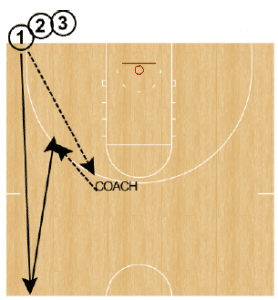
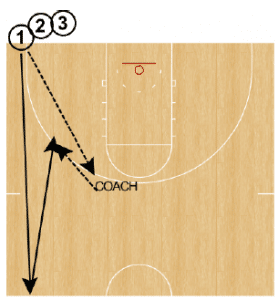
“Sideline Touches”

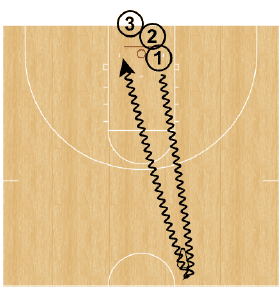
Player passes the ball to the coach, sprints to half court and then back to the basket where he receives a pass from the coach for his finish

• Will do same finishes every day (2 reps of each finish on each side of the floor). The fact they do the same finishes allows the drill to run quickly. 6-8 mins
• Will start practice with this (you can tell really quickly who is ready to practice).
• Next guy goes as soon as the guy in front of him catches the ball from the coach.

• Finishes:
1. Power Finish (off 2 feet)
2. Baby Hook (dribble with outside hand / skirt across the lane to use the other side for a defender approaching from a block from behind)
3. Pull-Up Jumper (top of the block)
4. Step Through (counter to jumper, finish with outside hand in front of rim—jumping off 2 feet)
5. Jail Break (ball thrown to him at half, try to get to rim in 1 dribble—2 dribble max)
6. Perimeter to Post (Attack into a crab dribble)

sideline-tourches

-Using the pad is important because you need to get your players to not pick up their dribble when they meet contact. Give them a way to play when they make contact.

-I want all my players to do the same skill work. Our bigs do the same drills as our guards.

-We are a “dominant pivot foot” program. Our right-handed players play with a left foot pivot, lefties play with a right. First to last day, same way every day.

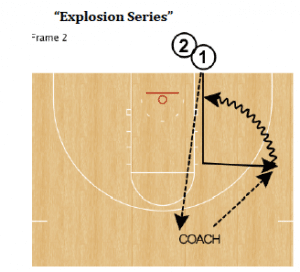
“Explosion Series”

explosion-series

• Coach throws the player a bad pass to make it more difficult for him to get to triple threat.
• Keep that ball in tight and get your nose over your knees (in triple threat).

• Finishes:
1. Power Finish (off 2)…baseline + middle
2. Baby Hook (off 1)…baseline + middle…using the other side of rim
3. Perimeter to Post (as he blasts baseline, he flips his hip when he meets resistance to back the defender down to play in front of the rim)…going baseline + middle (get to elbow).

-Ball-handling work is useless unless the player is tired when he does it. The player needs to be tired in order for the drill to be effective.

“Circle Scoring”

circle-finishes

• Shouldn’t be any more than 2 dribbles after the can/cone.
• Put the can/cone anywhere you want/any angle.

• Finishes:
1. Power Finish (off 2)
2. Baby Hook
3. Pull Up Jumper (inside FT line)
4. Drop Dribble to Step Through (rather than circling the can, as soon as the player gets behind the can, he drops the dribble back to the side he
came from to attack with his right (outside) hand. He dribbles hard at the right block and makes a step through move).
5. Wrap to “Perimeter to Post” (square your shoulders to rim as you get behind the can and wrap the ball around your body to attack back
left.

“Full Court Finishes”

• Coach slams the ball on the floor. Player leaps to grab it and heads up the court. On the Coach’s “Stop” call, the player foot-fires. When coach calls “Go” he explodes down the court.

• Moves (every finish is a “Power Finish”)
1. Hesitation
2. Inside-Out (ball and body to opposite knee)
3. Crossover (finish on other side of rim)
4. Through Legs (finish on other side of rim)

-We never shoot without a clock. We never talk about shots in terms of reps with our players. I don’t care how many shots you can get up unless they’re on my terms.

-We shoot in 60-second intervals, 90-second intervals and, only sometimes, 3 minutes at a time.

-We chart all our shooting drills and talk about everything in terms of percentages. The big goal is trying to break 70%. That’s a good shooter for us.

“1-2 Step Spot Shooting”

• Passer/rebounder/shooter
• 60 seconds: aiming for about 25 attempts.
• Stress the importance of passing in these drills (assuming it’s a player passing).
• We’ll either do 60-seconds for that day or 90-seconds.
• 5 spots.
• For 3-minutes, a good score is in the 40’s. If we’re doing 3-minute intervals, we’ll only go 3 spots (9 minutes total).
• Coach’s job is to make sure fatigue doesn’t wear the player down and causes him to stop shooting the same shot every time (happens with players not 1-2 stepping).
• The best shooters get good at the end of the round.

“Hubies”

• Corner-to-wing. One shot in the corner, one shot on the wing.
• 60-second rounds. 4 rounds (corner-to-wing; wing-to-TOK…flip side). Anything above 40 for the day is really good.
• Shoot while you’re breathing.
• Run to each spot, don’t slide.
• Skip pass as the player moves away / chest pass as he moves towards the passer.

“3 Men / 2 Balls”

• Groups of 3 players all over the gym at their own hoops. Get your rebound and pass to your partner. The three players at one hoop are on a team competing against the other baskets.
• Regular scoring: 2’s = 2, 3’s = 3’s
• Dock points if they’re not sprinting
• Rounds:
1. Catch & Shoot 2’s
2. Catch & Shoot 3’s
3. Eye the Rim One Long Dribble (catch outside the 3, one dribble to a pull-up)
4. Half court finishes (3 guys spread out across half court. Have to catch over half court and start in triple-threat. 3 players alternating through 2 balls.
5. 3 in a Line: pick your spot. Coach/rebounder
• Add the scores up and declare winner

-It is so so so important to chart and record your players’ shooting numbers. You need to be able to show them their progress (much like you would do in the weight room). I have a file that shows me what Kendall Pollard has made in every shooting drill he has ever done at Dayton.

1-3-1 Zone Offense Prout Push

By Brian Williams on December 4, 2016

This play was contributed by Bert DeSalvo FastModel Sports Basketball Plays and Drills Library.

You can also find out more about FastModel Play Diagramming software by clicking this link: FastDraw

Here is a zone offense that I (Coach DeSalvo) have used to prepare for 1-3-1 zone defense.

It is designed to get your best player in the middle of the zone to make a play in the heart of the zone.


1-3-1 Zone Offense Prout Push

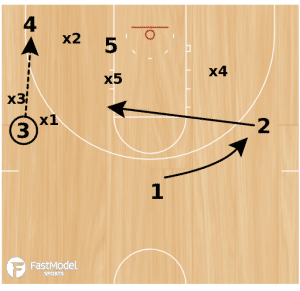
1-3-1-zone-attack

Start in 1-3-1 alignment

(Start to one side of the floor, the side your most dynamic players is on)

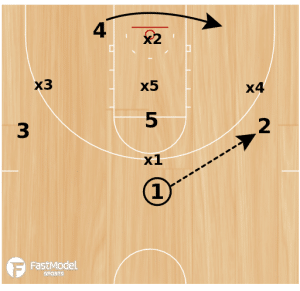
1 passes to 2


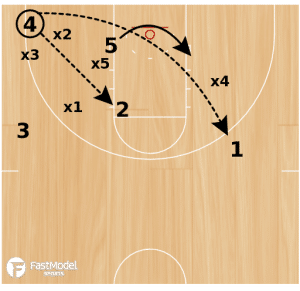
1-3-1-zone-attack2

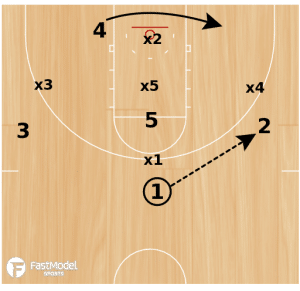
2 reverses to 1

1 reverses to 3


1-3-1-zone-attack3

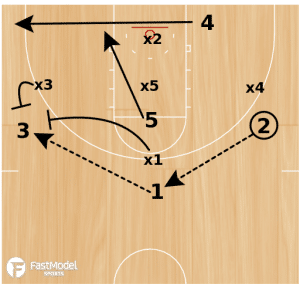
3 enters to strong side corner

2 (best player) flashes to high post

1 fades to weak side wing


1-3-1-zone-attack4

4 looks to high post for 2 or to skip for 1 for 3 point shot

3 is safety

5 disappears to the opposite box


5 on 4 to 5 on 5 Transition Drill

By Brian Williams on November 29, 2016

These 2 full court drills were located in the FastModel Sports Basketball Plays and Drills Library.

You can also find out more about FastModel Play Diagramming software by clicking this link: FastDraw

The first drill was contributed by Kyle Gilreath, Head Boy’s Basketball Coach at Astronaut High School, Titusville, FL. Kyle is also the author of the basketball coaching website, Words on the Bounce.

Here is what Coach Gilreath had to say about the drill:

This is another drill that I got from watching Bellarmine University practice. This is a great drill because it not only works on scramble situations having 4 players defend 5 in the half-court, but it also forces the offense (new defense) to sprint back after change of possession to prevent any easy lay-ups.

After making your one transition stop after a made shot or the defense secures the rebound and repeat the drill the other way. Make sure you switch the offense and defensive teams who must scramble each time and rotate the players that are back. Do this drill for time or until a team reaches a pre-set point total.

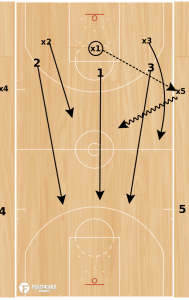
5 on 4 to 5 on 5 Transition

fasttradepreview

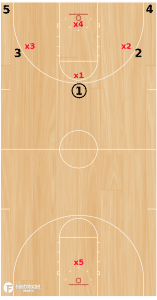
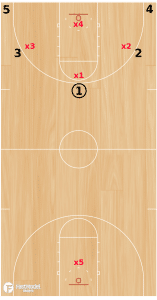
Team plays live 5 on 4 until a score or missed shot.

On score or missed shot, defense is pushing the ball down the floor as as quick as possible.

The 5 offensive players (now on Defense) must Sprint back to the pain as the 5th offensive player is already down the court.

Bob Hurley Sr. 3 on 3 Conversion

This drill was contributed by Dan Murphy, Assistant Coach at Ledyard High School in Ledyard, Connecticut.

Coach Murphy describes the drill in this way:

Drill stolen from Coach Bob Hurley of St. Anthony H.S. He in turn got it from Dick Harter. As a rule the player who defensive rebounds or takes the ball out of bounds after a score is on offense and the old offense always converts to defense. This is similar to 11 man break or other 3-3 drills where the defense comes in from the sideline, but in my opinion is a little more practical because the defense had to convert from offense and is in a more realistic game scenario.

Many successful coaches believe transition defense is one of the top 3 skills a team must have. As such, defensive transition should be drilled daily. A note about drills-make sure to teach the skills you want. Stopping the ball, protecting the basket, communicating, screening, passing, cutting etc. You can play this drill for a set amount of time ie. 8 minutes and keep score. Depending on what you as a coach want to emphasize, points can be given or taken for offensive rebounds, turnovers etc. Because it is 3-3 conversion, a short clock can be used to promote an aggressive offensive attack.

fasttradepreview-1

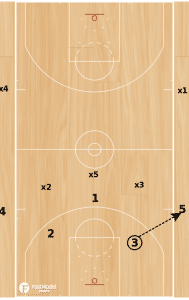
1,2,3 play 3-3 vs x1, x2, x3

Defensive player that rebounds or takes ball out of bounds outlets to x4 or x5

Editor’s note from Brian: IMO, it is better to have x4 and x5 inbounds to receive the pass.


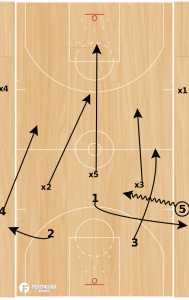
fasttradepreview-2

x2, x5, x3 are now on offense

1,2,3 are now on defense

3 defensive rebounds

3 outlets to 4 or 5


fasttradepreview-3

3,4,5 now convert to offense

x2, x5, and x5 who were just on offense now convert to defense


  • « Go to Previous Page
  • Page 1
  • Interim pages omitted …
  • Page 104
  • Page 105
  • Page 106
  • Page 107
  • Page 108
  • Interim pages omitted …
  • Page 288
  • Go to Next Page »

Primary Sidebar

  • Twitter
  • Facebook
  • Linkedin
coachestoolbox
personaldevelopmenttoolbox
basketballplayerstoolbox
basketballtrainer
athleticperformancetoolbox
coachingbasketball

© Copyright 2026 Coaching Toolbox

Privacy Policy