• Skip to primary navigation
  • Skip to main content
  • Skip to primary sidebar

  • Basketball Plays
    • Ball Screen Sets
    • Horns Sets
    • Man to Man Post Up
    • Man to Man Isolations
    • Backdoor Plays
    • Man to Man 3 Point Shot Plays
    • 2-3 Zone Attack
    • Baseline Inbound Plays
    • Sideline Inbound Plays
    • Combination Defense Attack
  • Drills
    • Defensive Drills
    • Offensive Drills
    • Competitive Drills
    • Passing Drills
    • Rebounding Drills
    • Shooting and Scoring Drills
    • Toughness Drills
    • Transition & Conversion Drills
    • One on One Drills
  • Blueprint
  • Practice
  • Mental Toughness
  • Skill Development
  • Offense
  • Defense
  • Store

Coaching the iY Generation of Basketball Players

Coaching the iY Generation of Basketball Players

By Brian Williams on February 9, 2017

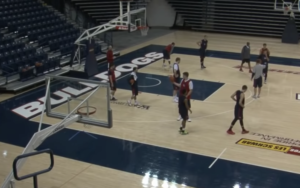
This video was filmed at a PGC/Glazier Basketball Clinic.

The Coach in the video is Arkansas Women’s Head Coach Mike Neighbors.

At the time this video was filmed, he was the Head Coach at Washington.

Coach Neighbors led the Huskies to the 2016 Final Four and has had them ranked in the top 10 for 2016-17 season.

He is absolutely one of the best coaches at any level to study and learn from if you want to become a better coach.

Coaching the iY Generation: Keeping Kids Accountable

Even though it looks like nothing is there, the video will play once you click on it.

It is a little over 10 minutes long and is very good.
After Time Out Zone Quick Hitters

By Brian Williams on February 8, 2017

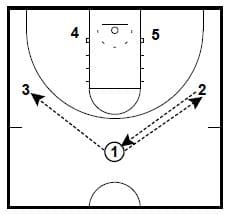
Today’s post contains two quick hitting plays that you can set up during a time out or to start a quarter or half when you are facing a 2-3 zone defense.

Adjust these sets to fit your players and philosophy and/or take bits and pieces to combine with what you already run against 2-3s.

The plays are from The Best of Special Teams Playbook assembled by Chris Filios. The playbook contains 210 basketball plays from 40 different NCAA teams.

Diagrams created with FastDraw

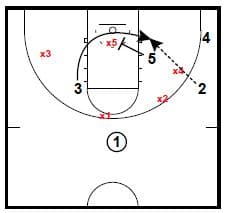
UNC Wilmington Sprint High Ball Screen

1 passes the ball to 2, gets a return pass, and then reverses to 3 to force the zone to shift.


As 3 passes back to 1, 4 sprints into a ball screen.

5 seals in x5 to open up a drive for 1.

2 can move to an area for a pass from 1 if x4 helps on the drive.


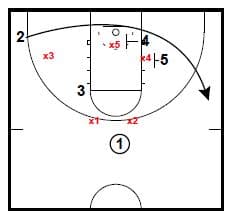
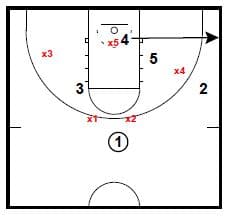
San Francisco Cross Screen

2 starts in the corner and cuts to the opposite wing.

4 and 5 screen in the middle and low defenders of the zone.


After screening in, 4 cuts to the corner on the same side of the floor as 2


5 screens the middle defender and 3 cuts to the ball side block.


The plays are from The Best of Special Teams Playbook assembled by Chris Filios. The playbook contains 210 basketball plays from 40 different NCAA teams.


Gonzaga Trapping Drill

By Brian Williams on February 7, 2017

You have probably seen this or a similar drill before, but I like the idea of setting the 40 second time limit and the defense having to tip turn the offense over 4 times with 4 basketballs in that time span.

The video is from a Gonzaga Practice.

If you are facing a pressing team, you could tweak the scoring system and make it an offensive emphasis drill.

Editor’s Note from Brian:

I understand that most teams don’t have two 7 footers who can throw the ball over the trap.

Also, I know that the offense seems disinterested.

The purpose is not to evaluate this practice session. The idea behind the post is for you to get a couple of ideas to improve upon this drill and use it or that might make your current trapping/pressure handling drills better.

If you are interested in finding out more about the DVD that the video sample came from, click here:

All Access Basketball Practice with Mark Few

Make sure your sound is on as you watch.

The video is a You Tube video.

Click the video to start the presentation.

Gregg Popovich Coaching Notes

By Brian Williams on February 6, 2017

These are a few of my takeaways from my latest reading on Texas A & M women’s assistant Bob Starkey’s HoopThoughts. If it is not on your regular reading list, I recommend to add it. There are great articles on all aspects of coaching basketball.

Bob received these notes from Steve Finamore.

Gregg Popovich Notes

  • On what it means to play the right way: “It mostly means that everybody is going to play unselfishly, respect each other’s achievements, play hard enough every night to give yourself a chance to win, to fulfill your role.”
  • “I don’t want to go to practice with a bunch of problem players.Life is short, I can’t imagine traveling around for 100 games with guys who are jerks. We do a lot of investigating and research before we draft a guy.These are adults; you’re not going to change anybody. You’re not going to take a jerk and turn him into someone who embraces the community.  That’s a waste of time.”
  • “Sometimes being quiet and letting the player play is much more important than trying to be Mr. Coach and teach him this or teach him that. So I think as time evolves and you get older in the business you figure out what’s really important, and you don’t waste time trying to make people what they’re not going to be.”
  • Following a loss: “If you lose, you were less aggressive, and you didn’t have the effort; that’s all baloney. That’s psycho-babble. You don’t think Patty Mills and those guys played hard? You don’t think Timmy tried to play hard? That’s silly. They played better than we did. It’s got nothing to do with effort.”
  • Following a win: “I know we didn’t look pretty. I’m more interested in results than how we look. So I thought they performed well. [The Spurs] did a great job of finding the open man; hitting somebody with a little bit better shot. We only know how to play one way, and that’s what we do. We didn’t do anything different. We just ran what we always run, whether (Duncan) is there or not. If Tony was out or Manu was out, we run our same stuff.”
  • “Each game is different, different people will play based on what’s going on in the game on that particular night
  • “We’re always trying to move the ball from good to great (shots). Penetrate for a teammate, not necessarily for yourself.”
  • On how the Spurs with Tim Duncan, Tony Parker and Many Ginobili have sustained greatness over the years: “I think that it’s a real simple answer. Nobody really likes it. They want me to say something different. It’s a total function of who those three guys are. What if they were jerks? What if they were selfish? What if one of them was, you know, unintelligent? If, if, if. But the way it works out, all three of them are highly intelligent. They all have great character. They appreciate their teammates’ success. They feel responsible to each other. They feel responsible to Patty Mills or to Danny Green. That’s who they are and how they’re built. I think when you have three guys like that; you’re able to build something over time.So I think it’s just a matter of being really, really fortunate to have three people who understand that and who commit to a system and a philosophy for that length of time. I don’t know what else to tell you. It’s on them.”
  • “Relationships with people are what it’s all about. You have to make players realize you care about them. And they have to care about each other and be interested in each other. Then they start to feel a responsibility toward each other. Then they want to do it for each other. We win or lose as a group.”
  • The remainder of the points were taken from the book “Forces of Character.” By Chad Hennings

  • “Being able to enjoy someone else’s success is a huge thing. If I’m interviewing a young guy and he’s saying things like, “I should have been picked All-American but they picked Johnny instead of me,” or they say stuff like, “My coach should have played me more; he didn’t really help me,” I’m not taking that kid because he will be a problem one way or another. I know he will be a problem. At some point he’ll start to think he’s not playing enough minutes, or his parents are going to wonder why he’s not playing, or his agent’s going to call too much. I don’t need that stuff. I’ve got more important things to do. I’ll find somebody else, even if they have less ability, as long as they don’t have that character trait.”
  • “Work ethic is obvious to all of us. We do that through our scouting. For potential draft picks, we go to high school practices and to college practices to see how a player reacts to coaches and teammates. The phrase that we use is seeing whether people have “gotten over themselves.”When there’s a guy who talks about himself all day long, you start to get the sense that he doesn’t listen real well. If you’re interviewing him and before you ever get anything out of your mouth he’s speaking, you know he hasn’t really evaluated what you’ve said. For those people, we think, Has this person gotten over himself? If he has then he’s going to accept parameters. He’s going to accept the role; he’s going to accept one night when he doesn’t play much. I think it tells me a lot.”
  • I like to see if they participated in some function in the community, or if they’ve overcome something or had a tough injury and came back. That sort of thing tells me what kind of character they have. I think all those things together tell me about their inner fiber. When I think about character I want to know about the fiber of an individual. I want to know what, exactly, they’re made of; what’s attached to their bones and their hearts and their brains. It’s all those things that form their character to me.”
  • The other thing I’ll do in practice on a regular basis when we run drills is I’ll purposely get on the big boys the most. Duncan, Parker, and Manu Ginobili will catch more hell from me than anybody else out there. You know the obvious effect of that. If you do that and they respond in the right way, everyone else follows suit. The worst thing you can do is let it go when someone has been egregious in some sort of way. The young kids see that and you lose respect and the fiber of your team gets frayed a bit. I think it has to be that way. They have to be willing to set that example and take that hit so everybody else will fall in line. It’s a big thing for us and that’s how we do it.
  • “I’ve been doing this a long time, and one of my biggest joys is when somebody comes back to town with their kids, or one of my players becomes one of my coaches, and you have that relationship that you’ve had for the last ten years, fifteen years. It might be only three years in some guys’ cases, but the lessons they learned from you paid off – even if you traded them or you cut them. Years later they come back and say that you were right, that now they know what you were telling them.
  • I think all of that relationship building helps them want to play for you, for the program, for their teammates. Beyond that, from a totally selfish point of view, I think I get most of my satisfaction from that. Sure, winning the championship is great, but it fades quickly. It’s always there and nobody can take it away. The satisfaction I get from Tony Parker bringing his child into the office, or some other player who came through the program and now I hired him as a coach and he’s back. That’s satisfying.  You can’t just get your satisfaction out of teaching somebody how to shoot or how to box out on a rebound. That’s not very important in the big picture of things. If you can have both I think you’ve got some satisfaction. It’s one of the motivations. That’s the selfish one I guess, but it’s real.”
  • “No one is bigger than the team. If you can’t do things our way, you’re not getting time here and we don’t care who you are.”

You can find out more about the book and read a portion of it by clicking on the image of the book cover at the left.

To read the entire blog post from HoopThoughts, click here: QUOTES, THOUGHTS AND CONCEPTS FROM GREGG POPOVICH

1 on 1 to 3 on 3 Basketball Drill

By Brian Williams on February 4, 2017

This post was adapted from a post made in the Fast Model Drills and Plays Library by John Leonzo, Assistant Women’s Basketball Coach at Cedarville University.

You can see the orignial post at this link: Blind 1 on 1..

You can also find out more about FastModel Play Diagramming software by clicking this link: FastDraw

As with any drill that you see anywhere, you should adjust it to fit what you are looking to teach and improve before installing it.

I like the idea of drilling a lot of one on one (both in-season and during the improvement season) but only with the purpose of applying it in a team offensive concept.

That is what was appealing to me about this setup.

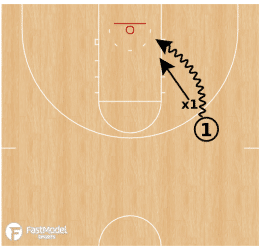
the drill starts 1 on 1 and then builds to 3 on 3.

You can move the starting position and move where the 2nd and 3rd offensive players and defenders are positioned to make it fit what you see in your games.

I also think it is a good idea to add a scoring and or timing component to the drill.

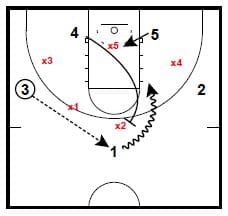
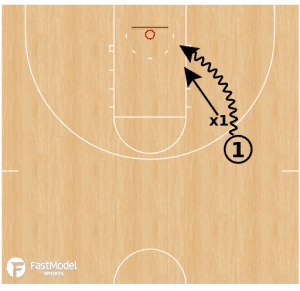
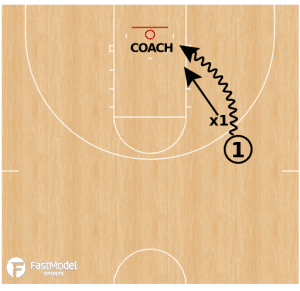
x1 is facing the hoop with their heels on the 3pt line.

As soon as 1 puts the ball on the floor, it turns into live 1v1.

Editor’s Note from Brian: You might not like this method of starting the drill. You could start it with a pass from the top of the key with the defense closing out on the receiver.

The second level now is to add a coach to the drill to be a guided help defender.

This is a great time to teach the drive to land on 2 feet so they are balanced, strong, and controlled as they meet the help.

Be sure to emphasize straight line drives and players will try to loop drive to avoid the help.

The diagrams’ offensive drives are not a good example of a straight drive, but are slightly arced to distinguish the offensive movement from the defensive movement.

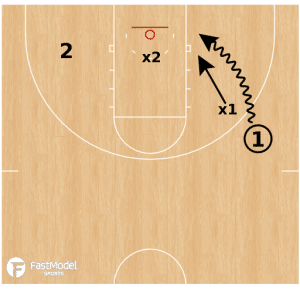
The next progression is to 2v2.

It is now that you are teaching the driver to do 2 things:

1. Read the help defender (x2)

2. Score if the helper stays, giving the advantage to 2 if x2 steps to help on drive.

Editor’s Note from Brian I also think this is a good time to emphasize driving to put the ball in the basket, and not on contorting and getting off balance to draw a foul. Driving to draw a foul leaves the decision up to the official and I don’t consider that to be a smart play. You might not get the call you want or the defender might be able to avoid contact.

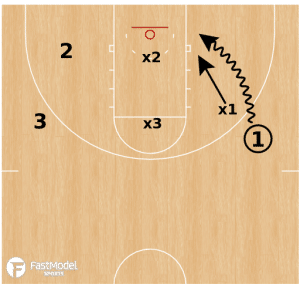
The last progression is to take it to 3v3. The same reads apply for the driver on the attack, but now you are also training 2 to keep or increase the advantage.

If x2 stops ball and 1 passes to 2, 2 then has to keep the advantage. 2 can accomplish this by:

1. If he is open, on balance, and in range – shoot the ball
2. If x3 stays home and x2 recovers hard, 2 can drive the ball
3. If x3 drops to help, 2 keeps the advantage by hitting 3 with a “click pass” (a pass that is in and out of the passers hand within a half second or less). 3 then shoot if open, drives a hard closeout, and makes a pass.

Bob Hurley: The St. Anthony Way

By Brian Williams on February 2, 2017

These notes from the 2013 TPG Master in Coaching Clinic were posted by Zak Boisvert on his basketball Coaching Website: Pick and Pop

Bob Hurley

St. Anthony HS (Jersey City, NJ)
“Over 40 years of sustained success—the St. Anthony way”

-St. Anthony players receive a contract on the first day of school. They must bring it home to sign.
• Lists 20 expectations of them
• Covers everything they to do to be a successful student-athlete
• Parents must sign as well

-St. Anthony curfew extends to social media (no Twitter/Instagram/Snapchat posts past a certain time).

-This is a scary time because our gyms are filled with a generation of kids who don’t like to work on their games.

-Hard to keep this up, but tries to schedule practices with the court open an hour in advance. Appoints a coach to be there an hour early working with any kid that shows up on offensive skill work.

-What you’re responsible for at St. Anthony (as a player) every single day:
1. Be enthusiastic
2. Correct mistakes

-The purpose of practice:
1. To get better
2. To prepare for the next opponent

-Everything in practice is game-speed and everything is competitive.

-Our day-before practice is the same speed, it’s just not as long.

-If I don’t like a kid’s effort, I give him a warning. If I see it again I point to the door.

-The things you struggle with will show their face against the best teams on your schedule.

-We constantly remind our players about the things we feel they need to work on.

-St. Anthony starts practice with 7 players in maroon every day. If you end the day in maroon, you start the next practice in maroon.

-Hurley’s view: St. Anthony plays every game to build for the post-season.

-During St. Anthony’s 83-game winning streak, Hurley didn’t talk about winning a single time. The focus every day was on getting better.

-Use your assistants—the power of delegation.

-Save your best stuff for Post-season.

-Simple objectives
• Play hard
• Play smart (“or we try to”)
• Be unselfish
• Don’t give opposing team points
• Be in good shape

-Hurley’s teams play straight man-to-man defense for the first ten games of the year.
He wants to establish the way they play without the help of gimmicks.

-After the first 10 games, Hurley will use zone press off free throws (make or miss).

-St. Anthony will zone the opponent’s first 2 BLOBs of the game and then play man-to-man.

-After game 10, Hurley will look to mix in his Box-and-1, Triangle-and-2, different zones as he sees fit.

-First three steps of conversion: make up for a lack of speed by transitioning quickly mentally.

-What “being really solid” means to Hurley:
1. Sprint back every possession
2. Block out on every shot
3. Organized press O

-St. Anthony WIN stat: a culmination of deflections, charges, defensive rebounds, shot contests, loose balls, block-outs, throw aheads (and more).

• Game leader is excused from all conditioning during practice(s) until the next game

-Passing is the most important skill in the St. Anthony program.

-Attack the x5 for 32 (or 40) minutes. Put him in a ball screen the first play of the game.

-As a coach, Hurley puts the onus on himself to find 10 points per game on special situations.
• Hurley tells his team this
• Team has do their part as well, but knowing the playbook inside-out, paying attention to details, having great huddles, and executing every part of their duty on a given play.

-Tries to shoot the last shot of all four quarters (important though to shoot with enough time on the clock to get an offensive rebound).

-After the season, Hurley lets the year breathe for one week before scheduling meetings with every player in the program (and his entire staff) to discuss what theplayers can do to improve.

-It sounds bad, but it’s probably in the kid’s best interest to be the 1st or 2nd option on his AAU team. He needs opportunities to develop—those opportunities may not come during the high school season where the success of the program is paramount.

-Your JV team should mirror your varsity. As the varsity head, you need to pay close attention to your freshmen and JV teams.

-Hurley loves Rex Ryan’s “Play Like a Jet.” Develop an identity for your program and a way your players should play/act and hold them accountable to your vision.  Editor’s Note from Brian.  I do realize that Rex Ryan is no longer coaching any team.   The purpose of this site is not to judge coaches or to criticize that saying Rex Ryan and Jets is outdated.  The purpose of the site is to provide as many good ideas as I can for coaches to pick and choose from.  I think the idea of “Play like a (fill in your school’s mascot)” or something similar, is worth considering for adoption for your program.

-Hurley knows how frustrating it can be to work with the big kid whose skill level is woefully far behind the rest of his teammates. He urged coaches to stay positive with that kid and keep working with him.
• “Treat that kid great until he loves the game. As soon as he does: treat him like everyone else.”

  • « Go to Previous Page
  • Page 1
  • Interim pages omitted …
  • Page 100
  • Page 101
  • Page 102
  • Page 103
  • Page 104
  • Interim pages omitted …
  • Page 288
  • Go to Next Page »

Primary Sidebar

  • Twitter
  • Facebook
  • Linkedin
coachestoolbox
personaldevelopmenttoolbox
basketballplayerstoolbox
basketballtrainer
athleticperformancetoolbox
coachingbasketball

© Copyright 2026 Coaching Toolbox

Privacy Policy