• Skip to primary navigation
  • Skip to main content
  • Skip to primary sidebar

  • Basketball Plays
    • Ball Screen Sets
    • Horns Sets
    • Man to Man Post Up
    • Man to Man Isolations
    • Backdoor Plays
    • Man to Man 3 Point Shot Plays
    • 2-3 Zone Attack
    • Baseline Inbound Plays
    • Sideline Inbound Plays
    • Combination Defense Attack
  • Drills
    • Defensive Drills
    • Offensive Drills
    • Competitive Drills
    • Passing Drills
    • Rebounding Drills
    • Shooting and Scoring Drills
    • Toughness Drills
    • Transition & Conversion Drills
    • One on One Drills
  • Blueprint
  • Practice
  • Mental Toughness
  • Skill Development
  • Offense
  • Defense
  • Store

Basketball Drills

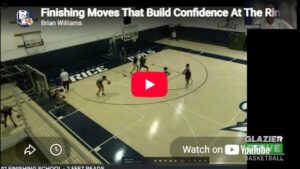
Finishing Moves That Build Confidence At The Rim

By Brian Williams on July 15, 2026

Chris Kreider, Asst Men’s Basketball Coach, Georgia Tech

This video is a segment from one of the 120 Videos in Glazier Drive Basketball.

Explore coaching clinic replays, practice plans, skill development videos, and more.  Click here to see all that’s included.

The full video that this clip came from is available on Glazier Drive:  Player Development & Small Sided Games

WHAT THIS VIDEO COVERS

This is a practice film breakdown from a coach walking through their team’s finishing progression at the start of practice. It opens with a real example: a new player used a stride-stop finish in a live scrimmage that had just been drilled pre-practice, showing the direct carryover from rep to game action.

THE FINISHING PROGRESSION

The team builds finishing work in layers:

  • Ball-handling into finishes — starting reps with pounds/crossovers (e.g., pound-cross back to the strong hand, then a middle drive going left) to connect handling with finishing, and deliberately working the weak hand.
  • Playing off two feet — a major emphasis, since it slows players down and gives them more control. The “stride stop, show the ball to the inside hand” finish is highlighted as a simple, teachable move.
  • Bodies over cones — using live bodies (coaches, GAs, managers) as passive defenders to give players a real read to finish against, rather than finishing against inanimate objects.
  • Reads based on defender positioning — if the defender’s hands are down, attack straight into the shot; if the defender takes away space, use an extra pivot to find an angle.
  • One-foot finishes — introduced once players have an advantage (transition, end-of-clock situations), including different pickup points, sweeping low, and bringing the ball over the top.
  • Variety of finish types — overhand, underhand, inside-hand reverse, and outside reverse, all run off the same side.

SHOT SELECTION LANGUAGE (COLOR SYSTEM)

The coach references their program’s color-coded shot quality system:

  • Green — high-quality shots: shots at the rim, free throws, open catch-and-shoot threes.
  • Yellow — lower-efficiency shots: off-the-dribble twos, off-the-dribble threes.
  • Red — worst shots: contested mid-range, contested threes, or a contested finish when a pass was available.

Finishing drills are tied directly to hunting “green” shots at the rim.

COACHING CUES EMPHASIZED

  • Eyes and feet on finishes
  • Finding the “high spot” on the glass, using the backboard
  • Giving layered reads (start scripted, then add live defenders)
  • Running two groups/two baskets simultaneously for reps efficiency

BIG PICTURE TAKEAWAY

The coach frames this as “finishing school” — a repeatable, daily menu of finishing reps done early in practice, scaffolded from simple mechanics to live reads, designed so players have an actual plan for finishing in the paint rather than reacting randomly.

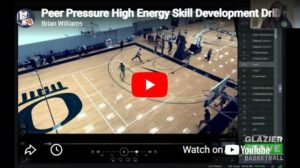
Peer Pressure High Energy Skill Development Drills

By Brian Williams on July 8, 2026

Lisa O’Meara, Oregon, Asst Women’s Basketball Coach

This video is a segment from one of the 120 Videos in Glazier Drive Basketball.

Explore coaching clinic replays, practice plans, skill development videos, and more.  Click here to see all that’s included.

The full video that this clip came from is available on Glazier Drive:  Offensive Drills: 1v1, Shooting, Peer Pressure, Transition

OVERVIEW

This transcript covers “peer pressure” drills — a category of competitive, team-accountability drills that this program runs daily during practice, typically right after stretching, to build intensity, sharpen fundamentals, and get players moving at full speed early in the session.

WHAT “PEER PRESSURE” MEANS

These are drills done in a row where mistakes reset the count for the whole group — missed layups, travels, bad passes, or fumbles mean starting over. The shared consequence creates pressure and forces the team to execute cleanly together, not just individually.

KEY DRILLS COVERED

Diagonal Layins — Players dribble down, make a stop, and deliver a controlled pass to a “guided defender” (coach or manager) at the top. A cone marks where the cutter can begin their angle to the basket. After the finish, players sprint out and make an outlet pass — emphasizing transition speed rather than standing in the corner.

Three-Player Break — Uses a point guard, wing, and big. The big rips and outlets to the point guard, who pushes the ball, hits a trailing post player for the first shot, then sprints to touch the free-throw line before a coach outlets the ball back to start the next phase.

Loop — A continuous passing drill built around cones. Only the player finishing the layup is allowed to dribble; passers must loop around designated cones after passing. Emphasizes floor awareness, discipline against unnecessary dribbling, and full-speed movement.

Three-Lane Rush — Similar looping/passing concept in a three-lane setup, with a passer looping around a cone before the finish. Focused again on clean, game-speed passing and catching.

COACHING PHILOSOPHY / TAKEAWAYS

  • Passing gets neglected in modern training (players get plenty of shot reps via personal trainers, but not enough passing reps) — these drills intentionally build that back in.
  • Drills can be simple; the “peer pressure” format (counting reps, resetting on mistakes) is what drives intensity and accountability.
  • Communication (“calling for the ball”) is treated as a core skill within the drills, not an afterthought.
  • The presenter credits this daily-drill approach to Kelly Graves at Oregon, describing it as a program staple for reinforcing fundamentals and starting practice with high energy.

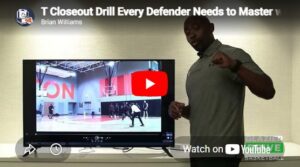
T-Closeout Drill Every Defender Needs to Master (with Variations)

By Brian Williams on June 24, 2026

 
Anthony Fobb, Asst Mens Basketball Coach, Sam Houston State

This video is a segment from one of the 120 Videos in Glazier Drive Basketball.

Explore coaching clinic replays, practice plans, skill development videos, and more.  Click here to see all that’s included.

The full video that this clip came from is available on Glazier Drive:  Defensive Drills for Better Man-to-Man

THE T DRILL — OVERVIEW

The T drill is a progression-based man-to-man defensive drill named for the T-shaped movement pattern players make on the court. It builds directly on the fundamentals introduced in the I drill, adding layers of complexity with each variation.

STARTING POSITION AND SETUP

The defender starts at the midline (or straddling the lane line for scout-based schemes). Two coaches or managers are positioned on both sides. The drill can be run with multiple players simultaneously, keeping everyone engaged.

CLOSE OUT FUNDAMENTALS

On the skip pass (which all players must call out loud), the defender sprints to close out past the three-point line before breaking down — chopping feet, getting the butt low, and throwing hands high. The emphasis is on contesting without giving up threes, which the coaching staff views as a game-losing flaw.

FIGHTING THE DRIVE

The drill progresses to live ball situations where the defender must read the offensive player’s dribble direction. The core principle is no middle — never surrendering the paint. The defender cuts off the dribbler with their chest, sending them baseline, staying in front at all times.

CONTESTING THE SHOT

When the offensive player leaves their feet, the defender jumps — critically, a high jump, not a long jump. A long jump leads to fouls. After the contest, the defender boxes out and pursues the rebound. A competitive add-on: the ball cannot hit the floor more than two or three times.

KEY COACHING POINTS

Always work both sides of the floor. Stress constant communication — calling “skip” and “shot” keeps everyone locked in. Defenders must see both their man and the ball without ball-watching. Teach A, B, C, D in order — never skip steps in the progression.

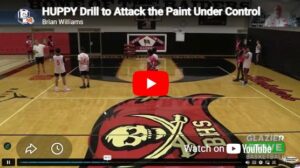
HUPPY Drill to Attack the Paint Under Control

By Brian Williams on June 17, 2026

 
Rob Brost, Head Boys’ Basketball Coach, Bolingbrook HS, IL

This video is a segment from one of the 120 Videos in Glazier Drive Basketball.

Explore coaching clinic replays, practice plans, skill development videos, and more.  Click here to see all that’s included.

The full video that this clip came from is available on Glazier Drive:  Getting Comfortable Playing at an Uncomfortable Pace

This is a coaching clinic transcript explaining a drill called the “Huppy” (adapted from PGC Basketball about a decade ago). Here’s the breakdown:

Core concept: Huppy is a mental/physical checklist players run through every time they catch the ball in attacking situations, designed to improve decision-making in the lane and cut down on charges.

The five principles:

  • Peek — every time hands touch the ball, players peek at the rim (checking for a shot or an open teammate). This applies on both ends, including immediately after a defensive rebound to look for an outlet.
  • Powerful, low, wide stance — body positioning once attacking the rim.
  • Three points of contact — both hands on the ball plus a third contact point (shoulder or hip), used to protect the ball and absorb contact in the lane.
  • Patient in the lane off a one-two step — players land on a two-foot jump stop so they can pivot, then stay patient rather than forcing a play immediately (the coach notes they’ve never had a three-second call on a player using this footwork).
  • Fake, then purposeful and decisive — use fakes to let teammates relocate/get open, then commit fully to a pass, shot, or finish.

Drill structure: Five lines (top of the key, both wings, both baselines). The first player in each line starts at least one foot behind the three-point line — intentionally not on it. The coach explains this spacing matters for two reasons: it opens driving lanes, and it sets up “step-in threes” (a player can step forward into a three only if they start behind the line; standing on the line means stepping in turns a three into a long two). Drive-and-kick reads prioritize shots at the rim first, step-in threes second.

The drill is run daily (sometimes twice per practice), starting with fewer balls/lines and progressively adding more to increase chaos and decision-making speed. The coach frames it as a low-cost, repeatable habit-builder rather than a complex scheme — the goal is fewer charges and more disciplined, patient attacks of the rim.

Constraint Drills to Teach Hunting Dominoes

By Brian Williams on June 10, 2026

Matthew Cline, Asst Men’s Basketball Coach, Missouri

This video is a segment from one of the 120 Videos in Glazier Drive Basketball.

Explore coaching clinic replays, practice plans, skill development videos, and more.  Click here to see all that’s included.

The full video that this clip came from is available on Glazier Drive:  Implementing Offense with a Constraints Led Approach

WHAT ARE DOMINOES?

Dominoes is a decision-making concept built on one core rule: one defender cannot guard two offensive players. The moment an advantage is created, players must make a 0.5-second decision to capitalize on it — just like a chain reaction.

THE 0.5 DECISION STANDARD

Players must make reads and decisions in under half a second after catching the ball. The philosophy: you are most open the moment you first catch the ball. The Indiana Pacers are cited as a real-world example, with average ball hold times consistently under one second.

HOW TO TRAIN IT — KEY DRILLS

2v1 Shooting Drill

  • No dribbles, maximum two passes
  • Only “silver medal” shots (high-quality looks)
  • Deflection = -1 point, made shot = +1
  • Players must crash the offensive glass if they don’t shoot, then respace — building habits through repetition

4v3 Dominoes

  • Offense stays on for 60 seconds straight
  • Defense rotates in from the baseline each rep
  • Only layups or threes allowed — no mid-range
  • Constraints: 0.5 decisions, respace, one can’t guard two

THE COACHING PHILOSOPHY BEHIND IT

Constraints are simply boundaries placed on players to manipulate a desired behavior. The drills are intentionally messy and chaotic — because that’s what games look like. The goal is transfer and carryover, not clean-looking practice. Players should be exploring, problem-solving, and figuring things out rather than running predetermined plays.

CULTURE & BUY-IN

The staff rewards domino execution after games with a large painted wooden domino (black and gold). The language used daily is “hunting dominoes” — reinforcing the mindset of always seeking and attacking advantages.

Turbo Transition Offense Drills (Hard to Guard)

By Brian Williams on June 10, 2026

 
Ryan Kapustka, Asst Men’s Basketball Coach, Dartmouth

This video is a segment from one of the 120 Videos in Glazier Drive Basketball.

Explore coaching clinic replays, practice plans, skill development videos, and more.  Click here to see all that’s included.

The full video that this clip came from is available on Glazier Drive:  Transition Offense & Concepts.

OVERVIEW

This video covers a basketball coach’s preferred drills and concepts for teaching transition offense (“turbo”), emphasizing pace, decision-making, and player development in fast break situations.

KEY CONCEPTS

The coach stresses getting all five players — especially big men — skilled enough to sprint the floor, pass, catch, and finish. The goal is to create an offense that is nearly impossible to guard when all five players can handle and move the ball at pace.

FEATURED DRILLS

The video walks through several drills: 2-on-2 early opportunity drills, a 5-man bust-out drill focused on dribbling ahead and looking opposite, a full-court transition shooting drill, and the “Cycle Drill” — their most important daily drill — which incorporates outleting, throwing ahead, paint attacks, proper spacing, and make/miss identification, all with a target of scoring in 7 seconds or less.

ADVANTAGE/WILLIAMS DRILL

A progression drill starting 2-on-1, building to 5-on-5. The coach values this as much for offensive aggression and quick decision-making as for the defensive reps most coaches focus on.

COACHING PHILOSOPHY

Live play is emphasized as the best teacher. Coaches must be “maniacal” about holding players to standards — especially early in the season and during scout-heavy stretches when habits slip. Celebrate the right plays, give constant feedback, and never assume good habits are automatic.

  • « Go to Previous Page
  • Page 1
  • Page 2
  • Page 3
  • Page 4
  • Interim pages omitted …
  • Page 97
  • Go to Next Page »

Primary Sidebar

  • Twitter
  • Facebook
  • Linkedin
coachestoolbox
personaldevelopmenttoolbox
basketballplayerstoolbox
basketballtrainer
athleticperformancetoolbox
coachingbasketball

© Copyright 2026 Coaching Toolbox

Privacy Policy