• Skip to primary navigation
  • Skip to main content
  • Skip to primary sidebar

  • Basketball Plays
    • Ball Screen Sets
    • Horns Sets
    • Man to Man Post Up
    • Man to Man Isolations
    • Backdoor Plays
    • Man to Man 3 Point Shot Plays
    • 2-3 Zone Attack
    • Baseline Inbound Plays
    • Sideline Inbound Plays
    • Combination Defense Attack
  • Drills
    • Defensive Drills
    • Offensive Drills
    • Competitive Drills
    • Passing Drills
    • Rebounding Drills
    • Shooting and Scoring Drills
    • Toughness Drills
    • Transition & Conversion Drills
    • One on One Drills
  • Blueprint
  • Practice
  • Mental Toughness
  • Skill Development
  • Offense
  • Defense
  • Store

Stop Spray-Out 3s Ball Screen Defense That Actually Works

By Brian Williams on August 6, 2026

Stop Spray-Out 3s Ball Screen Defense That Actually Works

Daniel Dyck, Assistant Men’s Basketball Coach, Point Loma

This video is a segment from one of the 120 Videos in Glazier Drive Basketball.

Explore coaching clinic replays, practice plans, skill development videos, and more.  Click here to see all that’s included.

The full video that this clip came from is available on Glazier Drive:  Ball Screen Defense

THE CORE PHILOSOPHY

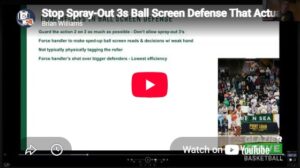
The coach’s ball screen defense is built around guarding the ball screen two-on-two as often as possible. They avoid hedging or blitzing, and don’t send off-ball defenders to tag the screen. The priority is denying spray-out catch-and-shoot threes — not necessarily stopping the roll man, since their league doesn’t feature many elite rim-running lob threats.


WHY DROP/ICE COVERAGE

By staying attached to their own man off the ball instead of helping on the screen, drop and ice coverage naturally take away the pass out to shooters. This puts extra pressure on the on-ball defender and the screener’s defender, but it’s a system they drill daily.

FORCING WEAK-HAND DECISIONS

Defenders try to funnel ball handlers into using their weak hand in ball screens — right-handed players going left, left-handed players going right (with some exceptions based on scouting). The idea: very few guards can consistently make sped-up reads and passes with their off-hand under pressure.

NOT TAGGING THE ROLLER

The defense intentionally does not send a low man to tag the roll man, because that invites a kick-out to the “shake man” and creates a long closeout — a situation they consider bad for the defense and exactly what the offense wants. They’d rather guard one-on-one without a closeout.

SHOT PRIORITY THEY’RE WILLING TO CONCEDE

The stated efficiency hierarchy the scheme is built around:

  1. Pass to the roller (highest efficiency — avoided at all costs)
  2. Spray-out catch-and-shoot three (second highest — taken away by the coverage)
  3. Ball handler pull-up jumper over the top (lowest efficiency — the shot they’re willing to give up)

SELLING IT TO PLAYERS

Bigs coming from different systems sometimes get frustrated early when a shooter hits a contested pull-up in practice. The coach counters this with data — citing something like a 33% opponent shooting rate on those two-point jumpers — to reinforce that the coverage is working over the long run.

ON-BALL DEFENDER STANDARDS

Despite being a “passive” coverage scheme by name, the on-ball defender is coached to be anything but passive:

  • No rejected ball screens allowed, ever
  • Stay physically attached (crawling into the handler’s hip) and visually locked in — no “dirty eyes” peeking for the screen
  • Contest every pull-up jumper like the game is on the line, with active hands to disrupt pocket and shake passes
Print Friendly, PDF & Email

Related Posts:

  • Stop Fast Breaks Before They Start: Tag Up…
  • 2 Drills to Build Relentless Man Defense FAST
  • Run & Jump Press: 3 Drills, 4 Rules, Endless Steals
  • Finishing Moves That Build Confidence At The Rim
  • 10 NBA/WNBA BLOBs Every Basketball Coach Needs to Steal

Primary Sidebar

  • Twitter
  • Facebook
  • Linkedin
coachestoolbox
personaldevelopmenttoolbox
basketballplayerstoolbox
basketballtrainer
athleticperformancetoolbox
coachingbasketball

© Copyright 2026 Coaching Toolbox

Privacy Policy