• Skip to primary navigation
  • Skip to main content
  • Skip to primary sidebar

  • Basketball Plays
    • Ball Screen Sets
    • Horns Sets
    • Man to Man Post Up
    • Man to Man Isolations
    • Backdoor Plays
    • Man to Man 3 Point Shot Plays
    • 2-3 Zone Attack
    • Baseline Inbound Plays
    • Sideline Inbound Plays
    • Combination Defense Attack
  • Drills
    • Defensive Drills
    • Offensive Drills
    • Competitive Drills
    • Passing Drills
    • Rebounding Drills
    • Shooting and Scoring Drills
    • Toughness Drills
    • Transition & Conversion Drills
    • One on One Drills
  • Blueprint
  • Practice
  • Mental Toughness
  • Skill Development
  • Offense
  • Defense
  • Store

Individual Basketball Scoring Drill

Individual Basketball Scoring Drill

By Brian Williams on June 4, 2017

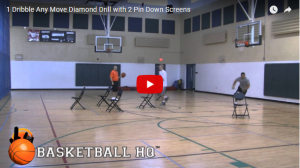
This individual scoring drill drill is among the resources for both coaches and player available from basketballhq. They have several more videos as well as basketball coaching resource articles.

Please make sure your sound is on to see the video.

Click the play arrow so see the drill. The drill is a YouTube video, so you will need to be able to access YouTube to see the drill.

The Coach in the video is Ryan Panone, one of the co-founders of Basketball HQ.

I do realize that there are no chairs on the floor during a basketball game. I do realize that defenders move during a game. You can set the drill up with whatever landmarks you want to use to show your players where to execute their dribble moves, or you can just have them use their imagination as to where to practice their moves. I do feel that is essential to have players practice moves before using them in a game.

Any drill you pick up from another program or coach has to be modified to fit your needs. My philosophy behind this site is to get you thinking about ways to improve the drills that you use.

You can come up with a scoring or timing system to make this drill competitive as well.
Any Move Double Pin Down Diamond Drill

Chris Mack Attitude Rebounding Drill

By Brian Williams on June 1, 2017

This video is with Chris Mack coaching a rebounding drill that he describes as an attitude drill.

Split your team into two teams. Pair players to compete against each other who are similar in size.

The team that wins the most one on one rebounding battles is the winning team for the drill. To add an element of pressure to any drill you run, make the winning team “validate” their win by making a free throw. Choose one player to shoot the validation free throw. If he or she misses, then the losing team gets a chance to become the winning team by making a free throw.

You might not like how much physicality Coach Mack allows in the drill. You will need to decide if you want to only allow contact that would be allowed in a game, or if you will allow more.

The video is a YouTube video so make sure that you are on a server that allows YouTube access.

If you are interested in learning more about the DVD that this sample was taken from, click here: Chris Mack: Smorgasbord of Basketball Practice Drills

Make sure your sound is on

The video is 4 minutes long.

Thoughts on Extending Your Coaching Career

By Brian Williams on May 30, 2017

This post came from Bob Starkey’s (Longtime D1 Assistant Coach–currently at Texas A & M) Basketball Coaching Blog, hoopthoughts.blogspot.com.

Last night I was talking to a colleague about our profession.  At times it can certainly seem like a roller coaster.  He wanted to know what the key was for having an extended career in coaching.  I was reminded off a presentation I gave a few years back at the A Step Up Assistant Coaching Symposium.  The topic given to me by Felicia Hall Allen was “The Art of Extending Your Career.”

I opened with this:

THE GOAL IS NOT THE GOAL

“While I am assigned to talk to you about extending your career, I’m going to go a different direction saying that extending your career should not be the goal.  The goal is to become the best assistant coach you can become on a daily basis and an extended career will follow.”

I think the first thing we need to decide in coaching is what is our “Why.”  We must have an overriding purpose for coaching — it has to be the centerpiece of our culture and what we stand for.  For me, the growth of the student-athlete has to be #1 on the priority list.

“It doesn’t matter where you coach,  it matters why you coach.”
-Don Meyer

I spoke about studying Nick Saban and the philosophy he has in regard to the process.  The process is keeping focused on the task at hand — executing as well as you can with what directly lies in front of you at that very moment.   Coach Saban does not want his players looking at the scoreboard.  His belief is that the time and score have absolutely nothing to with the intensity and concentration you need to utilize on the very next play.

I believe the same is true with our careers.  If we are getting up in the morning thinking about extending our career or looking ahead at that next job than we are taking away energy that we need to utilizing on what is really important — today!  The absolute best way to move of the ladder as well as extend our career is to own and master that which has been given to us at this very moment.

One of the areas that I spoke about was Professionalism.  I firmly believe that ethical choices are a full-time job.  It must be character over victory.  Don’t let a short-term gain for a win be overshadowed by a poor choice you made to try and get an edge.

THE TRUE IMPORTANCE OF WINNING

Of course, our biggest obstacle is winning.  We are expected to win immediately and constantly.  And don’t get me wrong, winning is important as the following thought from Vince Lombardi points out:

“No leader, however great, can long continue unless he wins battles.  The battle decides all.”
–Vince Lombardi

It’s true.  If we want to continue to impact young people through coaching…if we want to have a positive contribution to our communities — we have to win — to keep our jobs.

I gave the example of a coach being hired at a BCS program and having a record of 38-47 after his first three years.  The last home game of his third season, he lost to his rival by 24 points.  He then went to his conference tournament and lost by 43!

I asked the coaches at the clinic “What do you think the athletic director did the next week?”

Of course, they all answered “Fire the coach.”

They were stunned when I told them the AD gave the coach an extension.  I then told them the AD was Duke’s Tom Butters and the coach was Mike Krzyzewski.

Those days are over.  The days when an administrator can see through the losses to see that a coach is doing the right things and building something.  I’ve heard Coach K speak at clinics and he even admits that if he were hired today and got off to the same start that he’d never see his fourth year.

Still, we can’t let winning be a conflict of interest.  We can’t be overly consumed or blinded so much in trying to win that we turn our head to discipline and our culture.  The best coaches are willing fight for the culture even if it might cost them a victory.

That’s not to say winning isn’t important.  Certainly we have to teach winning to our teams.  As a young student at Marshall University, the basketball coach at the time, the late Stu Aberdeen spoke about the importance of winning.  As he explained, when we are on the operating table fighting for our life, we better hope that the doctors and nurses have a strong desire to win.  Coach Aberdeen explained that should we ever be falsely accused in a court of law, that we better hope our attorney has driven to win.

As I mentioned earlier, ethical choices are a full time job — and I do believe there is a right way to win and a wrong way to win.  If you are a principled person that means a great deal.  I posed the question to the coaches at the symposium — “are you willing to lose your job?”  Do you believe so much in the principles of integrity that you would walk away from a job that did not share in your beliefs?

BE A CONTINUAL LEARNER

The second part of the process of staying in this business is becoming a continual learner.  There must be a fire within to constantly be seeking knowledge to help you grow as a person and a teacher.

My suggestion to the coaches in the audience was to become an expert at something in the game: post play, shooting, zone defense, etc.  Pick something and learn it at the highest level.  I think it is always important to be a good recruiter but don’t be labeled as such because you don’t excel in other areas.

Today there are so many ways to improve.  We had just came off of a Final Four season at LSU and one summer I went to Oklahoma to watch Sherri Coale and her Sooners practice for three days in preparation to go overseas.  The next year we again made it to the Final Four and I headed to Duke to watch Gail Goestenkors to again observe several practices before she took her team overseas.

Today there are so many clinics to attend: Coaching U, Nike, PGC/Glazier.  There are tons of great blogs and Youtube loaded with information.  Have you attended an NBA or WNBA practice session? If not, you are missing out on some of the game’s best teachers.

One other factor in being a continual learner today is the not just accept but to embrace technology.  Whether it’s social media, apps for our phones and iPads or every improving methods of watching and breaking down video — it’s all there in front of us to help us improve.

FIND BALANCE

The next part of extending a career is to find balance.  I spend a great deal of time in my office — always have and always will.  But I find a way to incorporate my wife with our program.  She has always been a big part of our culture.  Whether it’s having the team over to decorate our Christmas tree, throwing a Mardi Gras party in February or just having them over for an occasional home cooked meal, Sherie has always been active in helping us serve our student-athletes.

It’s also important to plan family time.  Schedule time for your spouse and children throughout the season — and honor those commitments.  I learned most of this the hard way.  I once coached eight consecutive summers without a vacation.  I stayed up all night in the office two nights a week during the season watching video and getting scouting reports ready.  Then my wife was diagnosed with breast cancer!  It was an amazing paradigm shift for me and give me instant perspective.

Coach Don Meyer also talking about having “your time,” where it is just you.  It can be a time of meditation or reflection.  For me, I like to do it early in the morning while everyone is still asleep.  I can catch up on some reading or spend some time writing in my journal.

Yet another example of helping you with balance is creating a circle of influence.  A handful of people that your believe in and trust.  Most importantly, these people need to be someone that love you enough to tell you the truth. Someone that can tell you you’re full of crap when you are.  Some can be coaches but it’s always good to have some non-coaches in your circle.

TAKE CHARGE OF YOUR FINANCES

Part 4 of an extended career is the handling of your finances.  I shared with the coaches, and especially tried to get through to the younger ones that my biggest regret in coaching wasn’t a decision on the floor but it was not getting involved with a financial planner early in my career.  I have had one the past 20 years and the results (and security) are amazing!  Many young coaches don’t think they make enough money to work with a planner — that’s actually all the more reason you should.  One of the first things that Kay Martin of Ameriprise did was talk to me about short-term and long-term goals.  Part of that process was to create an emergency fund that I would pay into gradually to where we would have three months worth of salary to live on should anything happen.  Well, we have far more than three months now and its a great feeling to have that type of security — not just for me but for my family.

I also have a special tax accountant that understands my profession and helps to keep that organized and more importantly, helps me maximize all of the possible exemptions and write offs available to me.

“You must gain control of your money or the lack of it will forever control you.”
-Dave Ramsey

BE FLEXIBLE

Next on the list of theories for having a long career is your ability to have flexibility.  It is a game, no a world, that is constantly evolving and changing. As assistant coaches we have to adjust to changes on our staff…we tend to change jobs a couple of times we must adjust to head coaches…we must adjust to administration…we must adjust to the times.  The best way to adjust is to stay open minded — be a good communicator (which means a lot of listening as an assistant coach).

We must also adjust to the players.  This does not mean give in and allow the players to dictate policy.  But I firmly believe every player has a story and it is our job as coaches to learn that story.  Our ability to know them at a deeper level is critical for us to help them.  At UCF, we utilized Bill Rogers (who worked with Pat Summitt’s Lady Vols along with some professional teams) in order to learn about their personalities.  What was their leadership potential? What were the primary motivators for each individual?  How did they best learn — were they audio, visual or physical learners?  And then we adjust how we teach to meet them in the middle, where they can best be taught.

BE A PROBLEM SOLVER

 Whether at clinics, via email or phone conversations, I often get the question “what are the attributes for being a successful coach?”  There are several in my opinion, most of them are obvious.  But one that is critically important is that you must be a problem solver.  Coaching is about solving problems.

Not enough resources? Solve it.
Not enough post players or shooters? Solve it.
Lacking in facilities? Solve it.
Team chemistry problems? Solve it.

I’m not sure that there is not at least one minor problem per day in coaching — but you have to solve it.  Solving problems to me begins with attitude.  Working for Coach Dale Brown I learned that we were not to use the word “problem” but we were to use the word “opportunity.”  Coach Brown would tell us not to come in his office with a problem unless we were ready to offer a solution.  When people ask me what made Coach Brown so successful, again there are several reasons.  But one was he was a solution-oriented person when it came to problems.  He would amaze me with his attitude — almost excited that a problem had arisen because he loves the challenge of defeating it.

HAVE A SYSTEM OF ORGANIZATION

The final area I touched on was to become organized and primarily I was talking about improving your ability to document everything.  All conversations I have I follow up with the person I was speaking to with a short email of bullet points.  I do this with my players as well.  If I meet with a player to go over video, we both take notes and I email them to her.  Of course discussions of behavior — both positive and negative — are followed up with an email.

I’m a big believer in writing handwritten notes — even with all the technology today.  I love to write a handwritten note to a player and stick it in her locker.  I also screen shot text messages — positive and negative with players for my files.  I want as complete a written file on dealings with players, coaches, administrators, media and anyone else on the professional level.

We live in a time where you need to have your bases covered.

The final suggestion for extending your career?  Enjoy the ride! Embrace the grind — even the problem solving.  The best coaches I’ve been around get a rise out of solving a problem.  You must be passionate about what you do but you still need a plan — the role of an assistant coach is never easy but it is important.  Accept that role and challenge yourself to be the very best your can be.

The 5 Stages of a Coach’s Career

By Brian Williams on May 30, 2017

Editor’s note from Brian.  I saw this thought on another blog and thought that it fits in well with the message of this post:

Rocking Chair Statement
-As a coach, write a statement about what you want players to remember about you when you are old in a rocking chair on your front porch!

Let me tell you what I think about coaches: we’re crazy in our preparation and dedication, we work long hours and love it, we give up our nights and weekends, we mentor our student-athletes, we demand big things from them and even more from ourselves, we’re passionate in our belief in our team and our love for our sport, we believe in the power of sport to have a positive and long-lasting impact in our athlete’s lives.  So when I saw “The 5 Stages of Your Career” over at Bob Starkey’s blog, I wanted to expand on it over here.  It’s interesting to figure out what stage you’re in and those that you’ve already gone through…or have you circled back around to some you thought you were finished with?  Check them out and see what you think.

The 5 Stages of Your Career

1.       Survival: Don’t Know What You Don’t Know
Coaches, you remember what this stage felt like don’t you?   Or maybe you’re in the middle of this stage now and feel like you’re flailing.  I remember being beyond clueless…that’s back when I thought I just needed to know volleyball to be a volleyball coach!  Turns out also I needed to formulate a recruiting plan, balance a budget, create practice plans, order equipment, manage assistant coaches, and make in-game adjustments.  Color me unprepared, but thank goodness for a veteran coach who took me under his wing.

2.       Striving for Success: You Want Folks to Recognize You Can Coach Your motivation?  Winning, plain and simple.  You’re obsessed with conquering the competition and put in hours and hours of your time to make it happen.  Being the best is what drives you and to be the best, you need the tangible accolades that go along with that:  lots of W’s in the win column, all-league awards for your team, and maybe a coach of the year for you.

3.       Satisfaction: You Relax, Set Another Goal, & Want To Get Better
Now that you’ve achieved a few of your goals, you can relax and know that you’re a good coach and you have the respect of your peers.  You attend conferences to network and visit with old friends as much as you do to learn some new things…you’re getting established.  Each year you set new goals to accomplish that will push you and your team forward…you’re focused.

4.       Significance: Changing Lives For The Good
At this stage you’re more concerned with how you impact your teams and your legacy than you are with personal glory…after all, you’ve already accomplished a lot.  Now you want to make sure your teams understand the value of sport and hope that you’re teaching them how to be better people, not just better players.  With all of your experience and years in the game, you’re very knowledgeable.  And because of the success you’ve had in your career, this is the stage where people solicit your opinion and ask for your help with their coaching conundrums.

5.       Spent: No Juice Left, Can’t Do It Any More
The busses, the trips, preseason, recruiting, the hustle, the grind…you’re over it.  You’re ready to hang with the family and actually make it home before nine o’clock at night.  And your weekends?  You want them back.  Not even the prospect of that super sweet and talented recruiting class that you just brought in is enough to bring you back into the fold.  As much as you love your sport, you’re just not that fired up about the season this year…it’s time to hang it up.

So what stage are YOU at?

About the Author of this Post

Dawn Redd-Kelly retired as the head volleyball coach at Beloit College.  Her volleyball teams have earned the best winning percentage in school history.  She has coached at the high school, club, Division I and III levels…taking her first collegiate head coaching job at age 24 with the University of Rochester.  She played volleyball at the University of Wisconsin-Madison. Coach Dawn Says: “I believe in the power of sport to teach winning and losing with grace, to inspire its participants to excel, and to create a common goal for the greater good.”

21 Token/21 Live

By Brian Williams on May 22, 2017

This one on one drill came from the FastModel Sports Basketball Plays and Drills Library.

You can also find out more about FastModel Play Diagramming software by clicking this link: FastDraw

The first drill was contributed by Kyle Gilreath, Head Boy’s Basketball Coach at Astronaut High School, Titusville, FL. Kyle is also the author of the basketball coaching website, Words on the Bounce.

Coach Gilreath was a graduate manager for Billy Donovan at Florida and learned the drill from Coach Donovan.

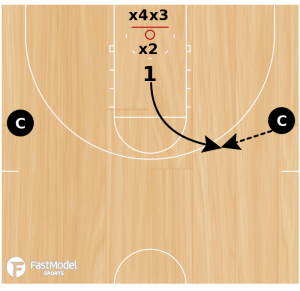
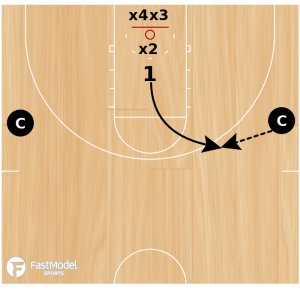
“21 Token”= Offensive Player stays on versus token defense (coaches/managers/walk-ons) until he gets 21 points. 3-pointer=3, jumper=2, lay-up=1. Player must run and touch the charge circle between each rep and cannot pop to the same spot on the floor 2 times in a row.

Editors note from Brian: You might not want your players to play half speed, but this would be a good way to warm up and to work on specific moves and reads at a pace that would allow players to think before they have to react going full speed.

“21 Live”= Best with a group of 4, defense is live. One a score, offense runs and touches the charge circle before popping back against a new defensive player (Offense must change sides of the floor from where they scored previously). On a miss, the defense runs to touch the charge circle to become the new offensive player as a new defense comes on (Offensive player who did not score goes to end of line). Play with a 3 dribble max.

Editor’s note from Brian: You can and should change the scoring system to reflect the types of shots you are looking to get in games. If you only make the layup worth 1 point, then you will not have players taking the ball to the basket in this drill. One way to play to play would be to count 3s as 3, layups as 2, and midrange shots as 1 to discourage settling for mirage pull-ups.

I also would rather allow a player to maintain possession than take a bad shot, so if they don’t have a shot after 3 dribbles they can pass to a coach and get the ball back.

You could have one player stay on offense until he or she scores 21 points and then change offensive players. That would force them to have to score with a simulated feeling of being exhausted late in a game. You can score it by counting possessions, shots, dribbles, or time that it takes to get to 21 points.

You can create your own rule for how to handle fouls. A suggestion would be 2 shots and the ball back to discourage the defense fouling and to reward the offensive player for drawing fouls.

Archie Miller Shooting Drill

By Brian Williams on May 21, 2017

This shooting drill is coached by new Indiana University Men’s Coach Archie Miller.

In this drill, the shooter has 2 minutes to make 2 consecutive shots from 10 spots.

If the shooter completes the 10 spots in under two minutes, he or she can continue to attempt to complete more spots until the two minute time limit is up.

Coach Miller records and posts the number of shots made and attempted during each round as well as the completion time when a player completes the drill successfully.

The idea of the post is to stimulate ideas. You should change the rules, scoring, timing, expectations, techniques, and emphasis of any other coaches’ drills that you see anywhere to fit your team’s needs.

There is sound with the video, so please make sure that your sound is on.

The video is hosted on You Tube, so you will need to be on a network that allows you to access that site.

Click the play arrow to play the video with the drill.

If you are interested in learning more about the Championship Productions Basketball Coaching DVD that this drill came from, you can click the following link: Archie Miller’s Shooting Program

  • « Go to Previous Page
  • Page 1
  • Interim pages omitted …
  • Page 92
  • Page 93
  • Page 94
  • Page 95
  • Page 96
  • Interim pages omitted …
  • Page 288
  • Go to Next Page »

Primary Sidebar

  • Twitter
  • Facebook
  • Linkedin
coachestoolbox
personaldevelopmenttoolbox
basketballplayerstoolbox
basketballtrainer
athleticperformancetoolbox
coachingbasketball

© Copyright 2026 Coaching Toolbox

Privacy Policy