• Skip to primary navigation
  • Skip to main content
  • Skip to primary sidebar

  • Basketball Plays
    • Ball Screen Sets
    • Horns Sets
    • Man to Man Post Up
    • Man to Man Isolations
    • Backdoor Plays
    • Man to Man 3 Point Shot Plays
    • 2-3 Zone Attack
    • Baseline Inbound Plays
    • Sideline Inbound Plays
    • Combination Defense Attack
  • Drills
    • Defensive Drills
    • Offensive Drills
    • Competitive Drills
    • Passing Drills
    • Rebounding Drills
    • Shooting and Scoring Drills
    • Toughness Drills
    • Transition & Conversion Drills
    • One on One Drills
  • Blueprint
  • Practice
  • Mental Toughness
  • Skill Development
  • Offense
  • Defense
  • Store

Tempo, Tempo, Tempo!

Tempo, Tempo, Tempo!

By Brian Williams on November 1, 2017

This post was written by Andy Rochon. He is the boys JV coach and Varsity Assistant at Ocoee High School in west Orlando. His site is about his system of Symmetrics. He has several other posts on the site with ideas for quantifying ball movement and player decision making. Click the link to see more of his concepts: Symmetrics

Editor’s Note from Brian. I realize that many coaches reading this blog do not have the time or the resources to apply all of these ideas. However, I hope that you might be able to apply some of the concepts on a smaller scale. If you have a player or two that you are trying to get to react quicker or be more aware, you could apply some of these ideas to help them. Or, you could time just a few possessions just to identify where the sweet spot is for your team.

**Pete Carril said, “be good at all things that happen a lot.” I truly believe that is the cornerstone of what Symmetrics is about!**

Now it is time to take a look into HOW we track Tempo. The 3 parts of Tempo are Pace(total number of possessions), Player Movement(average speed at which players cut/sprint while performing decision/action), and Average Length of each possession on offense/defense). When I was an assistant at State College of Florida I had one player that these three numbers helped tremendously, especially on the defensive side of the ball. It was a neat process to watch him go from being inactive/disinterested to a bouncy/active defender who averaged 2.8 blocks per game at 6’6.

Here is how you can apply the numbers to your coaching philosophy/game plan. Knowing the Pace or how many possessions your team creates in a game is important. This lets you know if you are getting enough offensive opportunities. Opportunities are vital for teams, while the amount of good opportunities may be important for others. Either way my colleagues has expressed know how many possession their team averages a game is a stat they want to know.

Next, is Player Movement and this is a little bit tougher to track each instance an action/decision is committed. This is why we have each player perform 5 trials of a given action/decision, add each individual score and divide people total number of teammates who performed the action/decision, and that is how we get a verage speed of each action/decision. These numbers are very similar to average speed numbers the NBA is tracking on the SportVu cameras(average speed while sprinting up/down floor, total miles ran, ect). These numbers let a coach know if their players are are putting in the EFFORT or playing with ENERGY you want your players to play with.  In Symmetrics we call this the   JUICE INDICATOR and will be solely based on how much energy you expend while playing the game(aka the faster you move the more energy you produce).

The last and most important part(my opinion)to tracking Tempo is the average time spent on offense vs average time spent on defense. Why is this important you might ask? Back in ‘07 when the Phoenix Suns 7 seconds or less uptempo style was popular it was important for them know how many times they got a shot in 7 seconds or less, how many possessions did this take place, and stats showing how efficiently they performed in these situations(makes/misses, turnovers, fouls, ect). Knowing that information allows the staff to know whether or not to tell them to perform the action more or less based on stats look. For example, when I was at SCG our offensive style was similar to the Spurs. We wanted to come up the floor, move the ball, drive and kick to get 3 or best shot in the paint. If our time on offense was only averaging 10 seconds I would urge our players to make a few more passes, foot fight with their defender when they catch, or enter the ball to the post. All three of these decisions that turn to actions allowed us to possess the ball just a few seconds longer. Which gives more time for the defense to breakdown or make a mistake. May seem minor, but ball/player movement makes all the difference possession by possession when wearing down an opponent. Defensively, to wear down opponents we would really get out and put pressure on the ball. Our secondary defenders aka help side would sit in gaps to protect against dribble penetration(pack line principles w/pressure on the ball). This didn’t allow for ball handle to be comfortable and make direct line passes, and it didn’t up as many uncontested shots because we closed out to everything like pack line teams do.

Here is how Raheem and I would go over these numbers. On the bus ride home(it’s juco so usually 2+ hour trips)we would sit and just talk hoops. He would tell me about his life living between Canada and the United States, the players he has had the opportunity to play with and against, as well as his overall knowledge of the game. Somewhere in between him talking about his Juco stint in Casper, Wyoming he said something that I’ll never forget. Raheem said, “Coach I feel like in my head I know what to do, but I can’t get my teammates to do it or sometimes I mess it up.” To me this is a kid who is trying to be a leader for a team full of players who were trying to get theirs. This is when we started talking about Player Decision-Making.

After, each game we got on the bus and sat down and talked about the good, the bad, and the downright horrific!! Yes, there were times where we would have to agree to disagree. That is the beauty of Symmetrics, it is all about tracking your decisions/actions and you do not have to change if you do not want to(Your playing time may though). A typical night riding home on a big charter bus we would watch college basketball on our phones and I would go through the team report. For example, I’d say, “Heem as a team we were 1st help defender was Late to help on dribble penetration 18 times, we gave up 14 points on 4/6 shooting(2 3pt FG), they drew 5 fouls, and our 2nd help wasn’t there 11 of 18 times our 1st help was late. I’d explain to him what a contested shot looked like, how many he attempted vs how many he made, and other actions/decisions he could do more of to score a few extra basketball because of his great athleticism(Offensive Rebounds/Tip ins).

Now I’m telling you we did this almost after every game, except for the really hard loses or the few major wins we had that year. He truly changed as a player, not because I am a genius, but because he was willing to listen and grow as a player. I wanted to observe to see how well he would understand terminology, how quickly he was able to apply the information, and Symmetrics was the reason he became aware enough to ACT instead of REACT to situations on the floor.

Over the last three seasons I have tracked Tempo in this way and have found it extremely useful for our coaching staff and players.

Now I want to share Symmetrics with as many coaches possible who are looking to have an immediate impact on their team! This is not to reinvent your philosophy or revamp your style of play. Symmetrics is just to categorize and organize your philosophy into simple cues, in your terminology, that players and your coaching staff can easily remember and apply to practice or games right away!

Thanks again for reading this if you stuck around until the end. Spend some time this weekend thinking about which decisions/actions you value or do not value. Then begin plugging them into the various Risk categories. Is the decision which leads to an action low in risk and high in reward? Then it belongs in the Low Risk category. Is the decision high in risk and low in reward? Then it needs to be added to the High Risk category. If the action is something that depends on the player’s skill set, time/situation, and/or positive only outweighs negative by a little or vise versa then it belongs in the Mid Risk + or – category pending on which one carries more weight.(ie: 50/50 ball= Mid Risk+ because there are more positive outcomes by diving for a loose ball instead of trying to dribble a loose ball).

About the Author of This Post

This post was written by Andy Rochon. He is the boys JV coach and Varsity Assistant at Ocoee High School in west Orlando. His site is about his system of Symmetrics. He has several other posts on the site with ideas for quantifying ball movement and player decision making.
Kobe Shooting Drill

By Brian Williams on October 26, 2017

These are some notes from Chris Mack, former Head Men’s Coach at Louisville.

He put this out when he was at Xavier.

You can see the archives of their basketball coaching newsletter at this link: Xavier Newsletter

You can adapt the drill to fit your needs.

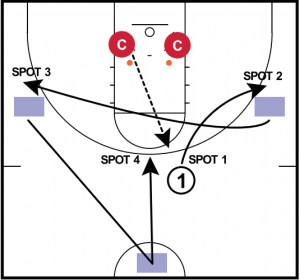
Diagram created with FastDraw

Shooter starts out at the top of the key.

2 coaches or managers under the basket to rebound and pass.

Clock starts on the first made 3 at the top of the key.

After a make, player sprints to SPOT 2, taps the chair, receives a pass and shoots until a shot is made.

After a make, player sprints to SPOT 3, taps the chair, receives a pass and shoots until a shot is made.

After a make at SPOT 3, player sprints to half court, taps the chair, sprints back to the top Of the key for his final shot at SPOT 4.

Goal is to make a’ 4 shots as quickly as possible. Spots can be moved in for forwards / bigs.

Getting Open in the Post: Yoda Move

By Brian Williams on October 24, 2017

Coach Christian Mueller. As Lead Instructor and “Chief Post Advocate,” Coach Mueller has nine years of experience as both a head coach and assistant at the Division 1, 2, and NAIA levels.

He began his college years as an assistant at Valparaiso University from 2004-2006. Most recently, Coach Mueller directed post play at the University of the Incarnate Word. In the 2011-12 season, he was instrumental in the team’s march to the Lone Star Conference title game.

Mueller’s specialty is coaching post play. In his first four years coaching in college, five of his post players were recognized as 1st-Team All-Conference. Two signed professional contracts to play overseas. One was an honorable mention All-American. And still, another finished her career ranked 18th all-time in career FG percentage.

After working with the Cardinals in 2011-12, Mueller took over the head coaching duties at Round Rock Christian Academy, serving as boys’ varsity coach.

In the 2012-2013 season, he turned around a program that had gone 1-19 the previous year and led them to 18 wins, a district championship, and an Elite 8 TAPPS 3A finish.

For more information about this course click the link Pivotal Basketball: Dominant Post Play

The Advantages of a Leadership Council

By Brian Williams on October 23, 2017

by Bob Starkey.  This article was originally posted on his blog.  You can see the original post and all of his other great coaching resources that he has posted at: The Advantages of a Leadership Council

If you ever heard Coach Don Meyer speak, he would at some point ask you,“who’s running your locker room?”  It is in incredibly important question.  While coaches have an opportunity to lead their team during practice sessions, team meetings and games, it is all the time away from the coaches where leadership is most valuable.  I learned this at LSU while coaching Temeka Johnson who did an amazing job of leading our team the 21 hours out of the day when we weren’t around them.

The locker room, or anyplace away from the court and the coaches, can be a place to strengthen and secure your culture, or it can be a toxic area that create cancers within your team. They key is being able to find the right team members, educating them on leadership, and then giving them a venue to which they positively effect their teammates.

We are not talking about “captains” necessarily.  As Coach Meyer would also point out, “you can pick captains, but you can’t pick leaders.”

Coach Mike Krzyzewski says, “The single most important ingredient after you get the talent is internal leadership. It’s not the coaches’ as much as one single person or people on the team who set higher standards than that team would normally set itself.”

The key is getting the players to buy in to the culture and philosophy that you as a staff feel is essential for growth and success.  To do that, you need to create at atmosphere of ownership for the players.  As Tom Izzo says: “A player-coached team is always better than a coach-coached team.”

One of my staff responsibilities at Texas A&M is to head up our “Leadership Council.”  It is a group of our student-athletes that meet weekly to discuss the elements of leadership and how we can best apply them to improving our team.  Often we spend time working on basketball skills as coaches — shooting, passing, dribbling and rebounding — but not leadership.  I often hear coaches talk about how they lack leadership on their team and I always respond, “are you teaching it?”

I got the idea of having a Leadership Council watching and studying how Nick Saban, then the head football coach at LSU, created one and utilized in his program.  I’m a big believer that leadership is a best executed with a group of core leaders as opposed to a single person.

This biggest part of our Leadership Council is not me preaching but me listening a lot.  We have six members this year on our council and my number one goal is to create ownership of our culture with our team.  It’s their vehicle…they have the keys…now where and how are we going to drive it.  Their voice, thoughts and ideas are critical to developing successful leaders — not just for our basketball team but for later in life.

Our objectives with the council include:

#1 To develop and improve upon our leadership as individuals.

#2 To create a leadership culture that will positively impact our team.

“Leadership isn’t a difference maker, it’s THE difference maker.” -Urban Meyer

Last year’s council included Taylor Cooper, Alyssa Michalke, Curtyce Knox, Jasmine Lumpkin, Anriel Howard and Danni Williams.

And our council last year was been outstanding.  The previous year we had lost three starters — all who spent some time in the WNBA.  We lost the SEC 6th Person Player of the Year and our top post player off the bench.  Coaches and sportswriters alike pegged us to finish in the lower half of the SEC.  Terms like “rebuilding” were used often.  Yet there we were finishing in the top half of the SEC, winning two games in the SEC tournament, owner of 21 regular season victories and a dance ticket to the NCAA Tournament.

And a big reason had to be the job our council has done in communicating with our team and providing a great example.  The season can be a grind and the response of a team to the difficulty and adversity that is face is essential.  We talk about making sure that our leadership council wins the locker room.  The leadership is magnified significantly AWAY from practices and games.

We meet weekly in our conference room with the letters “Leadership Council” above us.  In the past, we have had individual photos of each member of the council.  This year, we exchanged that for a team photo with the quote “Life’s most urgent question is what are you doing for others,” by Dr. Martin Luther King.

Learning to lead is not an easy thing to do.  It takes time and understanding of what goes into it.  The reason most reject opportunities to lead is because of the great responsibility that comes with it.

We tell them to follow the words of Jim Rohn: “Don’t wish it was easier, wish you were better.  Don’t wish for less problems, wish for more skills.  Don’t wish for less challenge, wish for more wisdom.”

The first thing we do each year is create a Mission Statement.  This year our council came up with the following:

By serving selflessly as leaders, setting an example worth following, and establishing a positive culture, we will develop strong, confident leaders capable of overcoming adversity and challenges in pursuit of their goals.

One of the things we do each we is discuss passages from “The Daily Reader” by John Maxwell.  I am always blown away with each our student-athletes and what they bring away from the daily reading that they choose to share.

Last year we asked our council to then go into detail about how we can put our mission statement to work and, lead by Alyssa, they came up with the following:

Serving Selflessly as Leaders

◄Listen and understand the needs of our teammates

◄Provide mentorship and guidance to underclassmen and new-comers

◄Praise our teammates in public, while saving criticism for private conversations

◄Always put others first, no matter the situation

◄Setting an Example Worth Following

◄Have a positive attitude at all times

◄Body language, tone, execution during practice, etc.

Take coaching and criticism well

◄Use it as an opportunity to grow and develop into a better person and player, not a chance to talk back to a coach or teammate

◄Exhibit a strong desire to improve with every rep, every drill, every practice

◄Encourage and support our teammates who are facing adversity

◄Behave appropriately, respectfully, and maturely at all times, including road trips, study hall, team dinners, etc.

◄Be respectful and appreciative to those people serving us (managers, practice players, coaches, waiters, staff, etc.)

◄Be a quiet professional, but know when to speak up to make a point

Establishing a Positive Culture

◄Hold each other accountable to high standards, knowing that our example and our choices carry considerable weight

◄Call each other out when we’re not practicing well, when we miss a team function (weights, study hall)

◄Challenge and push each other to become better individuals first, better athletes second

◄Be firm, fair, and consistent, both when praising and holding our teammates accountable

◄Don’t encourage, tolerate, enable, or cause behavior that is detrimental to our team

Developing Strong, Confident Leaders

◄Challenge others to step outside their comfort zone in pursuit of personal development and improvement

◄Set an example of strength, confidence, and maturity when faced with challenges

◄Provide opportunities for others to showcase their strengths and abilities

◄Of course, as in the game of basketball itself, game plans are important but they are insignificant if not followed by execution.

What an amazing document!  I’m proud of them for their vision but more importantly for their effort they’ve put forth in executing that vision and then following through with their execution.

Thank you Leadership Council for a job well done — and more importantly, leaving a legacy for this year’s group.

In the words of Mahatma Gandhi: “The best way to find yourself is to lose yourself in the service of others.”

Championship Rebounding Drills

By Brian Williams on October 19, 2017

With Coach Jamy Bechler. Coach Becher coached at the NCAA Division I, II, III and NAIA levels, as well as both men and women during his coaching career.

He was one of the youngest NCAA head coaches in the nation when he took control of his first program at the age of 27 years old.

Regardless of the school or level of play, his teams have consistently been among the nation’s elite when it comes to rebounding, including 2014 when they set a national record for having a +19.9 rebound margin.

Two drills – for rebounding when guarding a perimeter player.


Check Out

Championship Rebounding – Check Out from coachtube.com on Vimeo.

Hit and Get

Building a Transformational Culture

By Brian Williams on October 19, 2017

This article was written and submitted by J.P. Nerbun.

Forget about setting uncontrollable mid-level goals this season. Instead make the necessary commitments to build a transformational culture that values people.

Commitment 1: Be authentic and vulnerable with your team.

Start the process to become a transformational coach AND open up with your team about the journey you are setting out on.  Buy “Transformational Leadership” by Joshua Medcalf and Jamie Gilbert or “Inside Out Coaching” by Joe Ehrmann. Don’t just read one of these books, but fully engage with the activities they outline to help you become a transformational coach. And then be authentic and vulnerable by sharing with your team (coaches and players) that you are setting out on a process to become not just a better coach, but a better person. Explain how transformational coaches use their platform to help mentor and serve the people in their care. By sharing your journey with them throughout the season they will gain a greater respect for you and be more more apt to forgive you when you do fall short and make mistakes as a leader. Model the transformation and openness you want to see in others!

Commitment 2: Read and journal together as a team.

Purchase a book and a journal for every member of your team, then commit 20-30 minutes at the end of every practice and game to read and write as a team. Jon Gordon says, “A team that reads together grows together.” Spend 5-10 minutes reading aloud and then have THEM discuss what they learned from the reading. If you need recommendations for books suitable for this exercise please contact me. After the team reads, everyone gets out their journals and does a success log or a what went well diary. Everyone writes down 5 things that they did well in their practice, 1 area of improvement, and 1 thing they learned. “10 Minute Toughness” by Jason Selk outlines the many benefits of this activity. We need to train our minds to see the good not just the bad, and THEN focus on learning and growth.

Commitment 3: Stop using conditioning as punishment.

Stop using running or other physical conditioning as punishment. Instead start to use it to develop mental toughness and create positive associations with conditioning. Mistakes should be embraced as part of the learning process, not reprimanded or punished. Conditioning our players hard and then getting them to execute when tired helps build mental toughness. One activity you can employ to change the negative connotations with conditioning is what I call a GUT CHECK. Put everyone on the line and have them run a sprint. Whoever comes in last stands on the sideline to cheer everyone else on. Continue until only one man is left standing. The team cheers and praises the people who run the most and give their best. You will even start to see other players continue to keep doing the sprint because they start to value  conditioning!

Commitment 4: Use boundaries and consequences to develop self-discipline.

The best discipline is self-discipline. People will not develop self-discipline if they never experience consequences for their actions. So stop yelling and using conditioning to discipline, it only motivates through fear. Henry Cloud’s book “Boundaries” discusses the importance of this principle to building healthy relationships. Motivate through love, not fear. Set a really high standard for their attitude, work ethic, and respect for others. When they fail to be striving towards or living up to that standard, encourage them. If they continue, let them know they have lost their opportunity to get better and send them home for the day. Instead of reinforcing a culture of entitlement, most of them will come to actually appreciate the boundaries and develop greater self-discipline.

Commitment 5: Give your players a voice at every opportunity.

Talk less, listen more. Use questions! Stop with the pre-game and halftime lectures going on about what they need to do! For example, instead of huddling together with your coaching staff at halftime and “making adjustments”, go ask your players what is going well and what adjustments they think need to be made. You can still help steer the focus of these conversations, and they will be much more engaged and committed if they are allowed to speak up.

Commitment 6: Stop chasing talent and start investing in grit.

Stop determining your lineup, playing time, or even cuts based on the talent level of a player. Start rewarding and valuing players with the traits you claim to believe to be the most important. Angela Duckworth’s book “Grit” discusses the naturalness bias. Research shows leaders believe they value strong workers over the naturally talented, but when it came to actually selecting people, they favored the “naturals”. What do you believe is most important for your team to reach your potential? Attitude, work ethic, respect, body language, selflessness? Start to favor with actions, not just words, the people who display a commitment to the process and the character traits you claim to value.

You can check out his Podcast “Coaching Culture” on iTunes.

Visit the coaching forum at or subscribe to his email list for more resources at thriveonchallenge.com

  • « Go to Previous Page
  • Page 1
  • Interim pages omitted …
  • Page 80
  • Page 81
  • Page 82
  • Page 83
  • Page 84
  • Interim pages omitted …
  • Page 288
  • Go to Next Page »

Primary Sidebar

  • Twitter
  • Facebook
  • Linkedin
coachestoolbox
personaldevelopmenttoolbox
basketballplayerstoolbox
basketballtrainer
athleticperformancetoolbox
coachingbasketball

© Copyright 2026 Coaching Toolbox

Privacy Policy