• Skip to primary navigation
  • Skip to main content
  • Skip to primary sidebar

  • Basketball Plays
    • Ball Screen Sets
    • Horns Sets
    • Man to Man Post Up
    • Man to Man Isolations
    • Backdoor Plays
    • Man to Man 3 Point Shot Plays
    • 2-3 Zone Attack
    • Baseline Inbound Plays
    • Sideline Inbound Plays
    • Combination Defense Attack
  • Drills
    • Defensive Drills
    • Offensive Drills
    • Competitive Drills
    • Passing Drills
    • Rebounding Drills
    • Shooting and Scoring Drills
    • Toughness Drills
    • Transition & Conversion Drills
    • One on One Drills
  • Blueprint
  • Practice
  • Mental Toughness
  • Skill Development
  • Offense
  • Defense
  • Store

Marquette Magic Shooting Drill

Marquette Magic Shooting Drill

By Brian Williams on June 23, 2018

This full court shooting drill is with former Marquette Men’s Coach Steve Wojciechowski.

The video is hosted on YouTube.

You will need to be on a network that allows you to access that site.

The shooter has two minutes to make 3 in a row from all 5 spots.

To make the drill fit your level of coaching and system of play, you can change the spots that you require your players to make three in a row from, or you can give them more than 2 minutes to finish.

I like the pressure of having to hit a third in a row after the shooter has made the first 2. I also like the time limit and the mental and physical fatigue that sets in as the two minute time limit approaches.

The video is from the Championship Productions You Tube Channel

If you are interested in learning more about the Championship Productions Basketball Coaching Video (available in both DVD and Instant Video Format) that this drill came from, you can click the following link: 4-Out Drive & Kick Offense for 3-Point Shots

Click the play arrow to view the video.

There is narration with the video, so please make sure that your sound is on.
Game Situation Trapping and Passing Drills

By Brian Williams on June 21, 2018

This video is with PGC Basketball Directors TJ Rosene, Micah Hayes, and Graham Maxwell.

Tj (Head Men’s Basketball Coach) Micah, and Graham (Assistant Men’s Basketball Coaches) coach at Emmanuel College in Franklin Springs, Georgia.

In addition to a drill to work on trapping, rotating, and passing out of traps, there is a segment on working on game-like passes that you throw in your offense.

The second part of the video deals with some ideas to help both coaches and players to bring energy to practices and games.

This video is a part of the 20 Week PGC Coaches Circle. You can sign up for free at this link: PGC Coaches Circle

You can see more drills and posts from PGC Basketball by visiting their Basketball Blog

Please make sure that your sound is on and click on the video to play.

Click the play arrow to view the video.

The video is a YouTube video, so you need to be on a network that does not block YouTube access.

7 Ways to Get Off-Season Player Buy-In

By Brian Williams on June 19, 2018

This article was written and submitted by JP Nerbun.

Over the last month, one of the most dominant challenges and topics of conversations I have had with mentees and other coaches has been getting “player buy-in” to an offseason program.

One feeling coaches continue to articulate is this: “I care so much more than my players. They just don’t seem to want it like I do.”

Does this sound familiar to you? Probably. I know, I can empathize.

Standards to Control or Empower

When we are building a program, what is one of the first things we look to do? Set standards! We tend to believe everyone needs more standards and higher standards. We can all work harder, smarter, and more consistently! Right? And we seem to have this belief that if we simply raise standards kids will rise to that standard as if that is all it takes! But the flaw in this approach is that they are often done in a way to “control” behavior instead of empower individuals and build character.

And when we set standards in an effort to control or get compliance, we get relationships built on fear and players who see those standards as obligations instead of opportunities to learn and grow. Controlling standards are often set, communicated, and enforced in such ways that they fail to consider the circumstances and needs of the person.

The reality is that most kids have a lot going on in the off-season, other sports, summer jobs (which are invaluable life experiences), vacations, and just being a kid.

Leisure Athlete versus Performance Athlete

Mark Bennett, the founder of PDS Coaching, spoke about leisure athlete versus performance athlete in the Way of Champions Podcast Episode 31. An absolute must listen!

If you were to categorize your athletes as performance or leisure, many coaches might classify them based upon skill level or ability, but Mark defines the performance athlete as an athlete giving his/her very best outside of “practice” time or the basic required
training your team or club requires. When a coach is not holding them accountable, are they training hard by themselves, eating right, sleeping right?

Now, based on that standard, very few teams have performance athletes. Bennett suggests that we have almost two pathways or systems of support, one for those athletes who choose the performance pathway and one for those who choose the leisure pathway. The leisure athlete can and should be held to a high standard of giving their best in practices and games, but what differentiates the pathways is the support we give in training behaviors and the process outside of our required training time.

We need to be having this conversation with each of our athletes and supporting not shaming them in whatever path they take. Athletes shouldn’t feel ashamed to change their mind on the path they want to take, with both doors always being open.

Regardless of whether we are at youth, high school, or collegiate level, the truth is we don’t need or shouldn’t want a bunch of performance athletes. We need to be supportive of the holistic development of all the people we work with. Performance athletes
will sacrifice and miss out on valuable life experiences: summer internships, trips abroad, mission trips, and other high school and college experiences.

So, the challenge is to have two pathways and let the path be the choice of the athlete. Some coaches are eager to design and implement the most complete off-season program EVER! Great, but don’t expect every kid to be brought in and have 100% commitment, because the reality is that it doesn’t align with their aspirations. Sure, he or she may want to win a championship, be a starter, or make the all-star team, BUT it isn’t the only thing they want in their life and it shouldn’t be.

Regardless of whether they are leisure or performance athletes, below are some ways to get buy-in and raise the standards and behaviors in your program.

1. Individual Meetings: Connect with them and work to understand them as an athlete and person. Ask questions like:
◦ What are your aspirations for the upcoming season?
◦ What other aspirations and goals do you have in life?
◦ What are you willing to commit to doing?
◦ What are some of the challenges in following through on those commitments?

2. Team Meeting: Bring prospective players into the room and instead of handing them the plan for the off-season, start by getting their thoughts and ideas around what it should look like. Ask questions like:
◦ What do we hope to achieve this off-season?
◦ If you were the coach, how would you start to develop an off-season program?
◦ What do we want to do as a team? Team camps, team retreat, strength program, skill workouts, pick-up games, etc.
◦ What opportunities do we want as a team or individually?
◦ What else should we be involved in to have an enjoyable and healthy offseason? Summer jobs, family vacation, other sports, etc.

3. Agree Upon Standards, Schedule, and Consequences
◦ What should the minimum standard for all players be? Are we okay with players not coming to anything in the off-season and then coming out for the team?
◦ What are acceptable excuses for not attending our off-season program?
◦ As best as possible, work to schedule off-season workouts and camps without creating conflicts with other sports, family vacations, and summer jobs.

4. The Path for the Performance Athlete
◦ Meet with players who choose this path to set higher standards and make more commitments.
◦ Offer them additional training, nutritional plans, off-season book, journaling, keys to the gym.

5. Communicate with Parents
◦ Share your final plan moving forward with the parents.
◦ Consider bringing the parents in to discuss and take part in the summer planning as well.
◦ Ask them what they expect from an off-season program? What challenges do they anticipate? What days are they headed on family vacation?

6. Empower them to Plan and Schedule
In one of James Clear’s recent blogs, he discusses a simple tool to double the chances of follow through.

“A study in the British Journal of Health Psychology found that 91% of people who planned their intention to exercise by writing down when and where they would exercise each week ended up following through. Meanwhile, people who read motivational material about exercise but did not plan when and where they would exercise showed no increase compared to the control group.” – James Clear

So, it is great to talk with them about their goals and to encourage them, but one of the best things we can do is to have them not only write out their goals but very specific commitments and when and where they plan on following through on those commitments.

7. Address Incompatible Team Expectations and Individual Aspirations
At certain times we may need to communicate with the athlete and the parents that their individual goals and aspirations (or lack of) are incompatible with the teams. As the coach, you will work to create a culture of high standards in season and sometimes in the off-season.

These standards will depend on the level of your team. At the lower levels, your standards may be focused on development, but the athlete and parents want exposure. At the higher levels, you may have expectations of high commitment and performance, but the athlete and parents may be unwilling to make those commitments.

When this incompatibility arises, it is best to address it sooner than later!

Call to Action
Don’t just focus on player improvement! Create an off-season coach improvement plan for yourself with reading, clinics, and work with a mentor.

Also, don’t forget to enjoy your off-season as well! Start by scheduling time with your family and time away from your sport.

Works Referenced
James Clear Blog
https://jamesclear.com/implementation-intentions

Podcast Way of Champions
https://itunes.apple.com/us/podcast/way-of-champions-podcast/id1223779199

7 Spot Shooting Drill

By Brian Williams on June 16, 2018

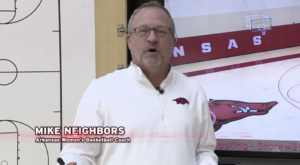
This drill is from Mike Neighbors, Arkansas Women’s Basketball Coach. The drill is available on the Arkansas Women’s Basketball YouTube Channel

This shooting drill is another from his green light shooting drill series.

Like all drills that you see other programs use, you can either modify it or take parts of the drill for your use and your needs.

He has a standard for many of his drills to give players the following criterion for their shots;

Green light
Yellow light
Red light

The drill is a standard drill, but I think Mike has some very good teaching points included that you can apply to a lot of the drills that you use in your program.

Please make sure your sound is on to see the video.

Click the play arrow to see the drill.

The drill is a YouTube video, so you will need to be on a server that allows you to access You Tube to see the drill.

Humility is Not Optional

By Brian Williams on June 14, 2018

Humility is not Optional.  It’s a Necessity

Cory Dobbs, Ed.D.  The Academy for Sport Leadership

“Humility is not thinking less of yourself, it’s thinking of yourself less.” –C.S. Lewis

As we descend deeper into a society characterized by polarization and division, cooperation is increasingly a curious characteristic.  First, let me suggest that cooperation is a product of humility, a dispositional drive of a selfless ego.  I introduce cooperation here to set it up as a desired individual behavior to be exercised in a team environment.

Consider humility to be a serious personality characteristic; one that is geared toward the positive construction and building of healthy relationships.  But don’t align humility with meekness or shyness—as is usually the case.   Resist the temptation to dismiss humility simply because it hasn’t been lionized like “grit,” or “mental toughness.”

One of the biggest mistakes coaches make is thinking that humility means a lack of self-confidence or a personal shortcoming such as a fragile sense of one’s self.

In team relationships humility shows through by the team members’ commitment to serve and support one another, through showing appreciation for the contributions of teammates, expressing encouragement, and acceptance of each other.  The person possessing a healthy dose of humility is generous with his or her support of others as expressed through loyalty and respect for teammates.
[thrive_leads id=’36827′]
The humble teammate displays a strong sense of duty to the team.  Let me be clear: humility is the social glue that holds the team—a fragile eco-system—in balance.  Humility always contributes to unity.

It is worth exploring how to mesh cooperation with competition.  Competition—a cherished quality in the field of sport—is often considered to be the opposite of cooperation.  Competition is the drive and compulsion to win, to earn, to get, to have, to do.  Sports and competition are synonymous.  Yet, an ego attuned to only competition breeds a self-interested ego.  At this point I’m sure you’re saying…”and so?”

We live in a culture with a high tolerance for individualism.  This breeds status and ego.  It promotes selfishness (might I get creative and say “selfieness”), and an “It’s all about me” attitude.  Society rewards those who use self-promotion to stand-out.   Of course, many young people have bought into this approach to life.  However, there is often a darker side to ego.  Ryan Holiday, author of Ego is the Enemy, reveals:

“The ego we see most commonly goes by a more casual definition: an unhealthy belief in our own importance.  Arrogance.  Self-centered ambition….The need to be better than, more than, recognized for, far past any reasonable utility—that’s ego.  It’s the sense of superiority and certainty that exceeds the bounds of confidence and talent.”

An ego out of control can and often does promote a sense of self-justification giving an individual the “freedom” to say and do whatever is in their best interest.  Ego driven people often are self-absorbed and seek only individual fulfillment.  Certainly such behavior can and often is displayed on the playing field.

However, don’t confuse this with a default proposition that competitiveness is bad; it’s clearly not.  But when an ego (triggered by a social or psychological event) is out of touch with reality it can quickly put a person on a path to self-destruction.  And when this happens good luck reaching the person; you likely won’t until they meet with a fall that humbles them.  Reality meets humility.

A humble person, one driven by a strong and stable sense of humility, is simply more likely to help a teammate, to regard others as equals and worthy of a deep, close relationship.   Simply said, the humble person who practices humility keeps their accomplishments, gifts, and talents in a proper perspective. They possess self-awareness, avoid self-serving distortions, and are keenly aware of their limitations. They value the welfare of teammates and have the ability to mindfully attend to the uniqueness of each team member.  Humility always contributes to unity.

About Cory Dobbs, Ed.D.

Cory Dobbs is the founder of The Academy for Sport Leadership and a nationally recognized thought leader in the areas of leadership and team building.  Cory is an accomplished researcher of human experience. Cory engages in naturalistic inquiry seeking in-depth understanding of social phenomena within their natural setting.

A former basketball coach, Cory’s coaching background includes experience at the NCAA DII, NJCAA, and high school levels of competition.  After a decade of research and development Cory unleashed the groundbreaking Teamwork Intelligence program for student-athletics. Teamwork Intelligence illuminates the process of designing an elite team by using the 20 principles and concepts along with the 8 roles of a team player he’s uncovered while performing research.

Cory has worked with professional athletes, collegiate athletic programs, and high schools teaching leadership and team building as a part of the sports experience and education process.  As a consultant and trainer Dr. Dobbs has worked with Fortune 500 organizations such as American Express, Honeywell, and Avnet, as well as medium and small businesses. Dr. Dobbs taught leadership and organizational change at Northern Arizona University, Ohio University, and Grand Canyon University.

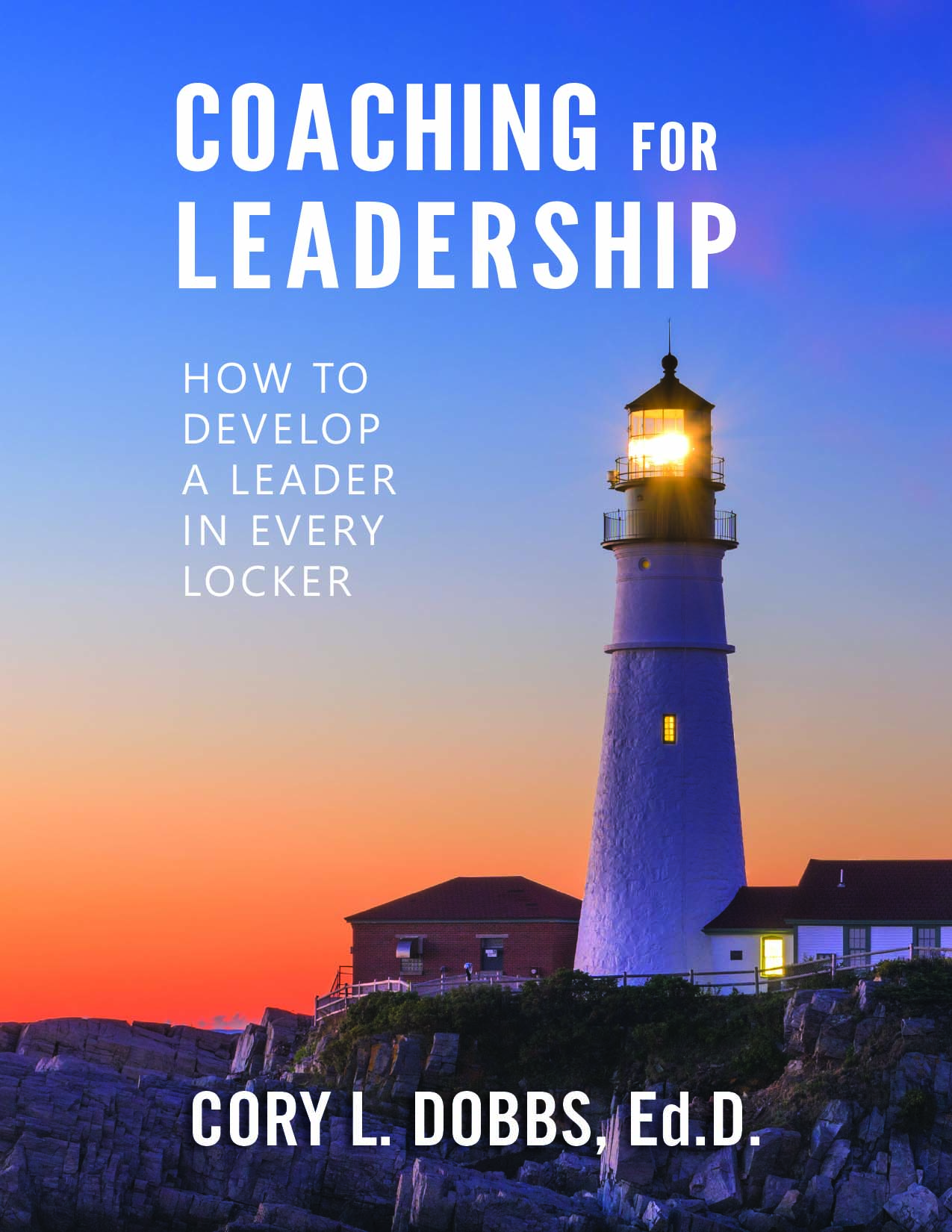
“Tell me and I’ll forget. Show me and I may remember. Involve me and I will care.” -Your Student-Athlete The world of coaching is changing. In Coaching for Leadership you’ll discover the foundations for designing, building, and sustaining a leadership focused culture for building a high-performance team. To find out more about and order Sport Leadership Books authored by Dr. Dobbs including Coaching for Leadership, click this link: The Academy for Sport Leadership Books

Summer Camp Passing Drills

By Brian Williams on June 12, 2018

The first passing drill was contributed by Fabian McKenzie to the FastModel Sports Basketball Plays and Drills Library.

Coach McKenzie has been a head coach at the university level for 17 years, and has been involved as a coach at this level for 20 years.

He has been involved with the Canadian Women’s National team program for the past 9 years.

You can also find out more about FastDraw Play Diagramming software by clicking this link: FastDraw

These are Fabian’s comments on the drill:

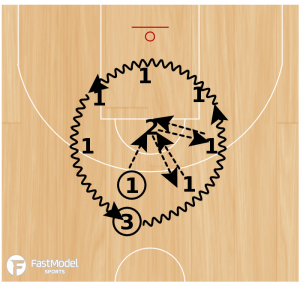
This is a good drill to challenge young players to work on passing form and dribbling with speed.

Players form a circle. Vary the size of the circle to challenge the players.

Player 1 and 3 have basketballs.

When coach blows whistle, 3 begins to dribble around circle.

Player 1 with ball passes to 2.

2 passes to next 1 and receives a pass back from 1.

2 must continue the pattern around the circle.

The goal for 3 is to get back to the starting spot before the ball makes it back.

1’s and 2 must pass as quickly as possible to try and race 3 back to the starting spot.

5 Out Jump Stop & Kick Passing Drill

This second drill was contributed by Mike Shaughnessy. Here is the link to the original post: 5 Out Jump Stop & Kick

Mike Shaughnessy is a Player Development Coach for Dr1ven Training LLC.

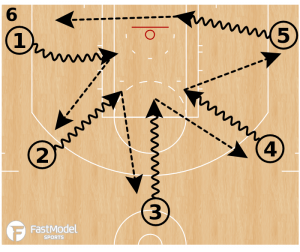
All 4 players with the ball are driving.

2 bounces to the box coming to a jump stop on 2 feet.

Players will pivot to where they are passing and snap the pass to the next person in line and rotate to the line they pass to.

5 in the corner will throw the drift pass being the only one that does not come to a jump stop (Stride Pass).

  • « Go to Previous Page
  • Page 1
  • Interim pages omitted …
  • Page 63
  • Page 64
  • Page 65
  • Page 66
  • Page 67
  • Interim pages omitted …
  • Page 288
  • Go to Next Page »

Primary Sidebar

  • Twitter
  • Facebook
  • Linkedin
coachestoolbox
personaldevelopmenttoolbox
basketballplayerstoolbox
basketballtrainer
athleticperformancetoolbox
coachingbasketball

© Copyright 2026 Coaching Toolbox

Privacy Policy