• Skip to primary navigation
  • Skip to main content
  • Skip to primary sidebar

  • Basketball Plays
    • Ball Screen Sets
    • Horns Sets
    • Man to Man Post Up
    • Man to Man Isolations
    • Backdoor Plays
    • Man to Man 3 Point Shot Plays
    • 2-3 Zone Attack
    • Baseline Inbound Plays
    • Sideline Inbound Plays
    • Combination Defense Attack
  • Drills
    • Defensive Drills
    • Offensive Drills
    • Competitive Drills
    • Passing Drills
    • Rebounding Drills
    • Shooting and Scoring Drills
    • Toughness Drills
    • Transition & Conversion Drills
    • One on One Drills
  • Blueprint
  • Practice
  • Mental Toughness
  • Skill Development
  • Offense
  • Defense
  • Store

Basketball Drills Animal Drill

Basketball Drills Animal Drill

By Brian Williams on March 29, 2011

Scroll down for a video demonstration

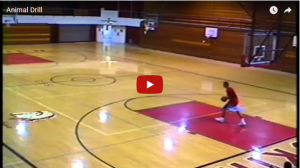
Procedure for doing the Animal Drill:

The player starts with the ball at the free throw line, tosses the ball off the board and times his jump to be able to catch the ball in the air and hit it against the board before landing and scoring.

To make it more challenging for taller players or very good leapers, have those players hit the ball off the rim before landing rather than off the board.

There are several reasons that we like this drill. Among those reasons are:

  1. It improves timing going for rebounds
  2. It improves strength in hands when the ball is pounded off the board
  3. The players are making jumps similar to how they will jump in a game going for a rebound.
  4. It is a good conditioning drill.

To make the Animal Drill competitive, see how many baskets the player can score in 30 seconds.
Pete Gillen on Attacking Match-up Zones

By Brian Williams on March 25, 2011

From a clinic presentation by Pete Gillen

Match up is a zone with man to man principles.  The man is as important as the ball.  The defense will take the shape of the offensive set.

The purpose of a matchup is to get you confused, indecisive, and out of sync.  Attacking it is 80% mental.  We are going to run the offense that we want to run and act rather than react.

Our ten Principles for attacking the matchup.

1.  Attack the zone with the fast break.  The fast break is the toughest thing to defend in basketball.

2.  Send cutters through.  Cutters cause confusion as to who is guarding the cutter.  If you just stand, you are doing the matchup a favor.


3.  Attack the baseline and then reverse the ball to the other side’s baseline.  When the ball is on the baseline, all zones become 2-3s.

4.  Dribble penetration.  I asked Don Casey, who was a great zone coach, what hurt his zones the most.  His answer was dribble penetration.  You must work at dribble penetration against a zone in practice.   You need to use the dribble after several passes that stretch the zone first.  Our rule is that anytime we catch the ball at the point from the wing, that player must penetrate as deep as he can and look to pass to the post or wing.

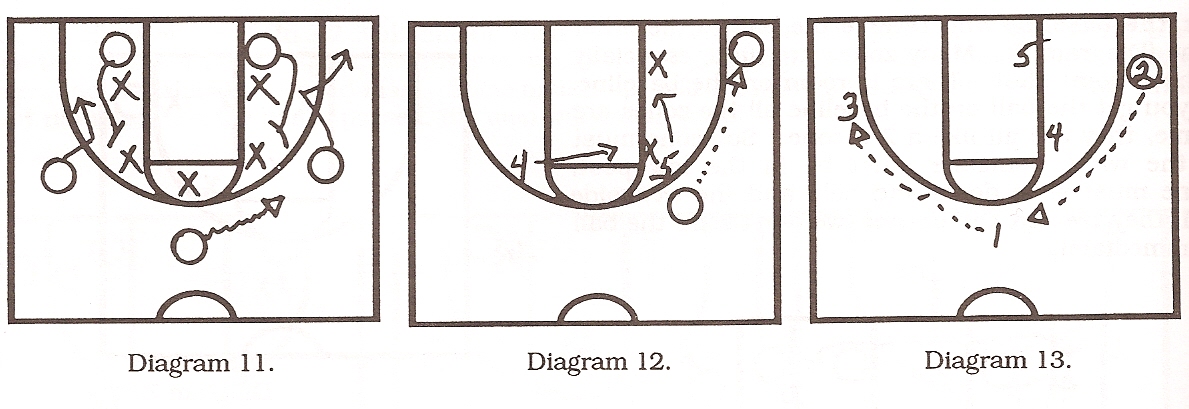
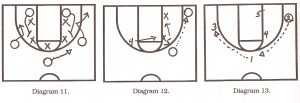
5.  Screen the wings.  (Diagram 11) The point guard must dribble at our wing players.  Those wing players fade to the corner.  That puts pressure on the back man in the zone.  Does he stay in our play the man in the corner?

(Diagram 12) If we make the pass to the corner, 5 rolls to the basket and 4 fills the high post, so we have a quick 2 on 1 on the back of the zone with the corner and 5

(Diagram 13) If the corner passes back to the point, the ball is reversed to 3

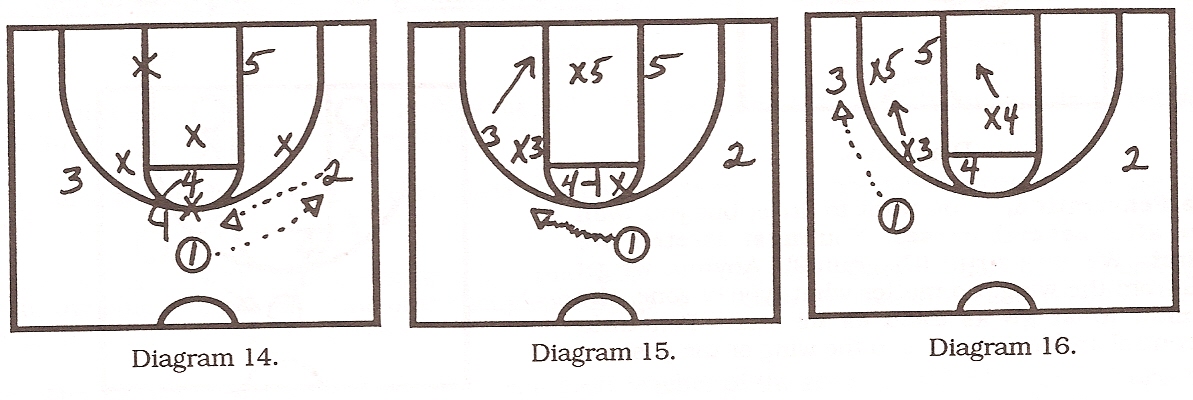
6.  Screen the point.  (Diagram 14).  1 passes to 2 and 4 screens the point.  Diagram 15 shows the ball being passed back to the point.  We run a screen and roll with 4 and 1.  3 fades to the baseline.  1 can take the jumper, dribble into the gut of the zone and pass to 3, if X3 comes up to stop the drive. Or, he can pass to 5 as shown in diagram 16.  If we pass to 3 in the corner, X5 must cover him, so 5 comes across the lane.  X3 is coming to 3.  X5 must either play 5 or 4 because of the high/low situation.

Basketball Plays

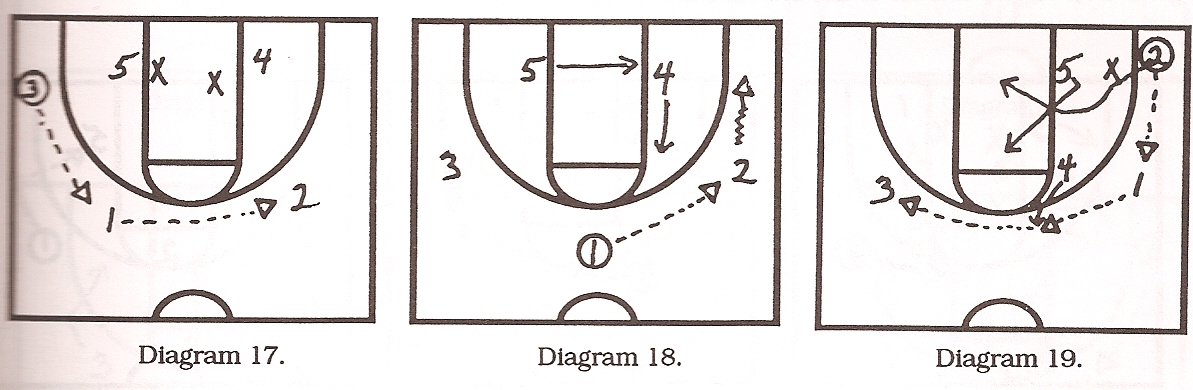
7.  We also like to screen in the block area (Diagram 17)  The defense is matched up, but when the ball is reversed, 4 screens the back of thd zone.  Then 4 ducks in.  Don’t flash to the ball unless you screen first (Diagram 18).  Have the wing dribble to the corner.  Who takes him?  4 comes up the lane.  5 comes behind in diagram 19.  Now, we have a box overload.  We back-pick with 5 as we step out the 4 and reverse the ball.  We send 2 across, but are really looking for 5 ducking in after the screen.  Ball goes 2-1-3-2-5.

Basketball Plays

8. Skip pass after a ball fake.  Stretch the zone.  You can’t telegraph it, you must freeze the zone.

9.  We send four men to the offensive boards because it is difficult for a zone to block out .

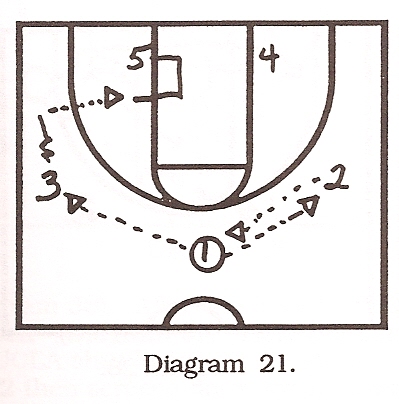
10.  Duck in and seal back move.  1 to 2 back to 1.  5 ducks in and 1 looks to get the ball to 5.  5 moves the defense by moving several steps along the baseline before ducking in.  If we can’t pass to 5, pass to 3.  3 dribbles hard to the baseline and 5 moves outside the lane to receive a bounce pass from 3.  The ball goes 1-2-1-3-5.

The Coaching Toolbox has hundreds of resources for coaching basketball including basketball practice, basketball plays, basketball drills, basketball quotes, basketball workouts, basketball poems, and more!

Michigan State Rebounding Concepts

By Brian Williams on March 22, 2011

This handout is posted on Coach Steve Smiley’s site www.snsbasketball.com

Michigan State Basketball Rebounding Concepts & Philosophy

Mike Garland


1. In the Michigan State Basketball program, rebounding, without question is a top priority.  From the seasons’ beginning until its end, rebounding is a big point of emphasis each day throughout the entire duration of our practice sessions.  Everything we do either begins or ends with the rebound or attempt to rebound the chance (made shot).

2.  We coach rebounding on every shot taken in practice. One of our staff members and sometimes two assigned to coach rebounding only during practice.  Which phase of rebounding he will coach is usually determined before practice and will change in accordance to what we are working on during a particular drill or scrimmage situation offensively or defensively.

3.  Important point- we grade our players rebounding performance on effort not the number of rebounds they get in a game session.

  • Offensive rebounding-we chart the number of times a player makes an all-out effort to get to the offensive boards (attempts) against the number of chances he actually had to go to the boards.  The percentage basis calculated by dividing the number of chances to go to boards into the number of times a player attempted to get to the boards.
  • We also do the same collectively as a team the same way.
  • Ours is to be 90% or above in our effort.
  • We want to get back 50% or better of our missed shots

Defensive rebounding- we chart defensive rebounds in a similar manner except we calculate the number of chances to cutout (block out) by the number of time a player individually or our team collectively actually did cut out his offensive player when show was taken.

  • Our goal is 90 %
  • We don’t ever penalize a player for not making an unnecessary cut out (we actually discourage the unnecessary cut out.)

Offensive Rebounding

1. At Michigan State we believe the missed shot is our best offensive play.

2. We tell our players to always assume the miss when the shot is taken either offensively or defensively.

  • We tell our players to pursue the ball
  • Don’t go to a back-avoid contact
  • Keep hands above the shoulders (don’t get arms pinned down)
  • IF you can’t get the rebound try to tip it to someone else or keep the ball alive- get a hand on the ball or a finger-whatever-keep the ball alive- we do a better job of this that nay team in the country (War Drill)

The remainder of the notes are from John Zall’s Michigan State Defensive Playbook. It is combined with his NBA Playoffs Playbook as this week’s eBook Bundle. You can find out more here:

101 NBA Playoff Sets with Michigan State Defensive Playbook

Principles:
“Hit, Find and Fetch” – this is Michigan State’s rebounding mantra.

Tom Izzo preaches stepping towards the player are boxing out and making contact to force them away from the rim.

Instead of holding your seal and letting the ball hit the floor; Michigan State players are taught to go find th
basketball and rebound it out of the air.

• Use 2 hands to go after the basketball
• Rebound ball above head = good rebound
• Low man wins when making initial contact

• Sends 4 t0 the offensive glass (Point Guard gets back). This forces the other team to adjust.
• Must be able to get back behind post player on shot attempt

Teaching Points
7O% of rebounds go in opposite direction from where they are shot
Important to contain basketball. Multiple help rotations lead to players being out of position to rebound
Weight lifting is a big part of rebounding.

Capture


Michigan State War Rebounding Drill

Diagrams created with FastDraw

Coach will shoot the ball to initiate the rebounding hit, find, and fetch.

86400 Seconds

By Brian Williams on March 17, 2011

Imagine there is a bank account that credits your account each morning with $86,400. It carries over no balance from day to day.

Every evening the bank deletes whatever part of the balance you failed to use during the day. What would you do? Draw out every cent, of course?

Each of us has such a bank. It’s name is TIME.

Every morning, it credits you with 86,400 seconds.

Every night it writes off as lost, whatever of this you have failed to invest to a good purpose.

It carries over no balance. It allows no over draft. Each day it opens a new account for you. Each night it burns the remains of the day.


If you fail to use the day’s deposits, the loss is yours. There is no drawing against “tomorrow.”

You must live in the present on today’s deposits. Invest it so as to get from it the utmost in health,

happiness and success!

The clock is running!! Make the most of today.

To realise the value of ONE YEAR. ask a student who failed a grade.

To realise the value of ONE MONTH, ask a mother who has given birth to a premature baby.

To realise the value of ONE WEEK, ask the editor of a weekly newspaper.

To realise the value of ONE HOUR, ask the lovers who are waiting to meet.

To realise the value of ONE MINUTE, ask a person who just missed a train.

To realise the value of ONE SECOND. ask someone who just avoided an accident.

To realise the value of ONE MILLISECOND, ask the person who won a silver medal at the Olympics.

Treasure every moment that you have! And treasure it more because you shared it with someone special, special enough to spend your time with. And remember time waits for no one.

Yesterday is history. Tomorrow is a mystery. Today is a gift. That’s why its called the present.

Continuous 1 on 1 Basketball Drill

By Brian Williams on March 10, 2011

I think it is important for all players to play one on one both during practices during the season and during out of season workouts.  I also think that it is important to make the one on one meaningful and as close to game-like as it can be.  Here is an idea to improve the way players play one on one and what they get out of it.

Continuous 1-on-1 Players need to play 1-on-1 in practice and in workouts.  In continuous  1-on-1 there is no “checking up top.”  Once a player scores, the other player who is now on offense, takes the ball out of the net and spins it out  anywhere behind the three point arc, goes out and meets the pass, squares to the basket and plays from there.  Even if the shot is missed, if the defender gets the rebound, he or she spins it out  behind the arc and  plays from there.  It is a good toughness and conditioning drill to finish a workout with  and it forces players to go from offense to defense and defense to offense in a more game-like way.

Another version of this drill is to play with the same rules, but make it “make it, take it.”  So, if you score, you get the ball out of the net and spin it out behind the three point arc.  You lose the transition from Offense to Defense, but it does reward the defense for a stop when they get one.

The Coaching Toolbox has hundreds of resources for coaching basketball including basketball practice, basketball plays, basketball drills, basketball quotes, basketball workouts, basketball poems, and more!


Defensive Anchors

By Brian Williams on March 9, 2011

By Shane Dreiling, Team Arete

PLAY HARD

It is important that we take pride in our defensive effort. This is one area of the game that can and should be constant. We will play harder than anyone else in the nation.

SEE THE BALL

We must be aware of where the ball is at all times, even if it comes at the expense of the man we are guarding. An offensive player cannot score without the ball. Guarding a player with the ball our position is BALL-YOU-BASKET.


PRESSURE THE BASKETBALL

The key of our defensive philosophy is that we must look to apply IMMEDIATE and CONSTANT PRESSURE on the ball. We must force the ball to be dribbled to the outside, take away the outside shot, and take away any easy ball movement. We must attack the ball without fouling, or giving up our stances, or allowing penetration.  TOUCHES, DEFLECTIONS, COVER THE BALL. Guarding any player one pass away our position is a DENY STANCE-ON THE LINE, UP THE LINE. If the ball is on the side of the floor, we keep one body part in the passing lane. This means that the defender is between the offensive player and the ball. We want to put the offensive team under constant siege for the full game. “FOULING NEGATES HUSTLE.” We want to play aggressively and smart using sound techniques and principles.

COMMUNICATION

It is essential that all five players communicate with each other. Calling “ball”, yelling “help”, “skip” or “double” helps ensure that all five defenders will be in good position and know what is happening on the court. Three talking rules: Early, Loud and Often.

NO DIRECT PASSES OR DRIVES

We want to make the offense throw passes below or above us, not through us.  Therefore, the only acceptable pass to give up is a lob pass. We force the offense to their weak hand to take away the straight line drive.

STANCE AND SPACE

Our basic stance is bucket down, chest out, hands and feet shoulder width apart with hands high and out. Our left foot, left hand is forward. WEWANT TO PUSH THE PLAYER AWAY FROM THEIR STRONG HAND. When guarding the ball, our outside hand should mirror the ball, trying to touch the ball as often as possible. Our inside hand is our deflector hand. Defensively, we want to take up space and we are looking to defend in the neutral zone.

SPRINT TO THE BALL

Any time the ball is passed YOU MUST SPRINT TO THE BALL. Move on airtime. Make gradual, quick, immediate adjustments in your stance. You must be in position before the ball is caught. Sprinting to the ball allows you to be in proper position to front cutters, avoid screens (be a moving target), and help teammates. Any time the ball is dribbled you must make the proper ball side or help side adjustments in positioning.

TRANSITION AND COMMUNICATION

Quick, organized transition with communication by all five players is a must for a great defensive team. We must STOP THE BALL. We must sprint to the level of the ball, eliminate all cheap baskets, and make opponents go against our set defense. NO LAYUPS, NO THREES, NO FOULS, NO SECOND SHOTS. When in doubt, recover to the paint and then find their man.

QUICK HELP AND EARLY RECOVERY

There is no such thing as helping too quickly. This is not a suggestion but a requirement. We protect the gap and deny one pass away. When your teammate steers the ball into the next outside gap, be ready to provide quick help with your rear to the ball. When you help, you must recover on line to your offensive player as the ball is picked up. When guarding screens, we must talk and communicate with our teammates.  It is our goal not to switch when facing screens. Rather, we want to hedge and recover, opening a gap for our teammate to slide through so they can continue guarding their man.

BLOCKOUT AND OUTLET

Our defensive effort is completed when we have POSSESSION OF THE BALL (ICE). We use the word ICE (Identify, Contact, Explode) to relay our rebounding message. When the ball is shot we must have ALL FIVE PLAYERS fulfilling their rebound responsibility until the ball is CHINNED. Our team will rebound covering the paint in a triangle shape with our guards blocking out then moving to the elbow areas. We want to play the odds when rebounding a jump shot and will flood the weak side with a guard to give us additional rebounding strength. If we don’t get out rebounded, we will not lose.

The Coaching Toolbox has hundreds of resources for coaching basketball including basketball practice, basketball plays, basketball drills, basketball quotes, basketball workouts, basketball poems, and more!

  • « Go to Previous Page
  • Page 1
  • Interim pages omitted …
  • Page 266
  • Page 267
  • Page 268
  • Page 269
  • Page 270
  • Interim pages omitted …
  • Page 288
  • Go to Next Page »

Primary Sidebar

  • Twitter
  • Facebook
  • Linkedin
coachestoolbox
personaldevelopmenttoolbox
basketballplayerstoolbox
basketballtrainer
athleticperformancetoolbox
coachingbasketball

© Copyright 2026 Coaching Toolbox

Privacy Policy