• Skip to primary navigation
  • Skip to main content
  • Skip to primary sidebar

  • Basketball Plays
    • Ball Screen Sets
    • Horns Sets
    • Man to Man Post Up
    • Man to Man Isolations
    • Backdoor Plays
    • Man to Man 3 Point Shot Plays
    • 2-3 Zone Attack
    • Baseline Inbound Plays
    • Sideline Inbound Plays
    • Combination Defense Attack
  • Drills
    • Defensive Drills
    • Offensive Drills
    • Competitive Drills
    • Passing Drills
    • Rebounding Drills
    • Shooting and Scoring Drills
    • Toughness Drills
    • Transition & Conversion Drills
    • One on One Drills
  • Blueprint
  • Practice
  • Mental Toughness
  • Skill Development
  • Offense
  • Defense
  • Store

Man on the Bench

Man on the Bench

By Brian Williams on August 31, 2012

From our basketball poems file… We have more basketball poems, prose, basketball quotes, and inspirational articles in our FILING CABINET.

I like to include theis in our players’ notebooks.

This was written far enough back that it is written in the masculine form, but I believe that it can be adapted for girls and women’s programs.

Author Unknown

The Man on the Bench

The man on the bench is the man for me
He’s not the star, but he’s the key .
Without his aid and help each day,
I doubt if there would be a play.
Every run by a team on “big game” day
He holds the dummy and shows the way when
The other team runs that certain play.
When not being clocked, he’s chasing punts.
Or shagging fly balls, and fielding bunts,
Or a hundred and one other useful stunts.
He’s always the “skins” against the “shirts”,
And the night of the game he sits and hurts,
He helps with equipment, and picks up balls.
Sets up the hurdles, and takes the falls,
But is always ready when some coach calls.
He’s not on the sports page every time
When a “dollar” is waiting, he’s the “dime”

He comes to the banquet with a little prayer,
Hoping this year the “letter” is there.
As he squirms wishfully in his chair.
And he suffers a little along with his coach,
As the names are read and no approach
Is made to him there is a wrench
In his heart. But his teeth will clench,
As he says, “next year”, this man on the bench.
What happens to all the men like these.
Who seem, all elbows, thumbs, and knees.
Don’t feel sorry for their frustrations,
They are the men who head corporations,
And sit on the councils of great nations.

They learn the value of raw sheer grit,
The determination that won’t say quit.
The value of facing rugged strife
To face the gun with just a knife,
They learn how to make a fight in life.
To the man on the bench I give my hand
With the greatest respect, ’cause he’s my man,
Please don’t worry, he’ll go far
Be it jet propulison or motor car,
Somewhere in life, he will be a star.

Core Values of a Championship Program

By Brian Williams on August 29, 2012

I received this from Steve Smiley.  The values are from The North Carolina women’s soccer program.  They have won 20 NCAA National Championships since 1982.  So, even though these are not from a basketball program, there is definitely something you can use to develop your basketball program’s culture.

The University of North Carolina Women’s Soccer Team’s Core Values 2012

People who make a living from studying what makes organizations excellent usually boil their consistent success down to the group living a powerful set of core values. So if you were to read “In Search of Excellence: Lessons from America’s Best Run Companies” (by Tom Peters et. Al) or “Built to Last: Successful Habits of Visionary Companies” (by Collins & Porras) or “Good to Great: Why Some Companies Make the Leap . . . and Others Don’t (Collins) or even “The Seven Habits of Highly Successful People (Covey) or “The 10 Natural Laws of Successful Time and Life Management” (Smith), and these might be the best of the books by the brightest minds, . . . what these people are trying to teach us is this: there are certain principles of behavior that produce extraordinary results.

Every year when I meet with the rising seniors each week in the spring our discussions center around our core values and what they can do to live them and how they can help drive everyone within the culture to live them as well. Human nature being what it is, some leaders embrace the personal and public challenge of our discussions and some don’t; just like some people within the culture live the core values and some just don’t have the strength.

What we are trying to do now is collect our core values under an umbrella of quotes that are meaningful to us (coaches and rising seniors). Obviously since I have been reflecting on this longer and with a better understanding of what kind of behavior will positively effect our culture (because I have seen quite a bit in coaching the past 36 years) much of what you are going to digest are ideas that have inspired me.

Still every rising senior has made contributions or is sold on these ideas because we ask them to review them in the spring. We need them to embrace and live what we have collected below because our culture and core values are only as strong as our leaders and what they endorse and drive as acceptable behavior.
So over the past 33 years, since our program began in 1979, what are the best elements of our tradition? What are our core values?

The Core Values

I. Let’s begin with this, we don’t whine. This tough individual can handle any situation and never complains about anything on or off the field. (“The true joy in life is to be a force of fortune instead of a feverish, selfish little clod of ailments and grievances complaining that the world will not devote itself to making you happy.” George Bernard Shaw).

TOUGH – from Nordic wheel cross signifying thunder, power, and energy


II. The truly extraordinary do something every day. This individual has remarkable self-discipline, does the summer workout sheets from beginning to end without omission or substitution, and every day has a plan to do something to get better. (“Roosevelt, more than any other man living within the range of notoriety showed the singular primitive quality that belongs to ultimate matter, the quality that medieval theology assigned to God: ‘he was pure act’.” Henry Adams Theodore Rex – Desmond Morris).

DISCIPLINED – from “careful” cycle on washing machine


III. And we want these four years of college to be rich, valuable and deep. This is that focused individual that is here for the “right reason” to get an education. She leads her life here with the proper balance and an orientation towards her intellectual growth, and against the highest public standards and most noble universal ideals, she makes good choices to best represent herself, her team, and her university. (“College is about books. And by the word books, the proposition means this: College is about the best available tools—books, computers, lab equipment—for broadening your mastery of one or more important subjects that will go on deepening your understanding of the world, yourself and the people around you.

This will almost certainly be the last time in your life when other people bear the expense of awarding you four years of financially unburdened time. If you use the years primarily for mastering the skills of social life—as though those skills shouldn’t already have been acquired by the end of middle school—or if you use these years for testing the degree to which your vulnerable brain and body can bear the strains of the alcoholism with which a number of students depart campus, or the sexual excess that can seem so rewarding (to name only two of the lurking maelstroms), then you may ultimately leave this vast table of nutriment as the one more prematurely burnt-out case.” Reynolds Price).

FOCUSED – from camera focus button

IV. We work hard. This individual embodies the “indefatigable human spirit” and never stops pushing herself. She is absolutely relentless in training and in the match. (“The difference between one person and another, between the weak and the powerful, the great and the insignificant, is energy – invisible determination . . . This quality will do anything that has to be done in the world, and no talents, no circumstances, no opportunities will make you a great person without it.” Thomas Buxton – Philanthropist).

RELENTLESS – from the symbol for Saturn: god of “relentless natural forces”


V. We don’t freak out over ridiculous issues or live in fragile states of emotional catharsis or create crises where none should exist. The best example is the even-keeled stoic that is forever unflappable and resilient. The worst example is the “over-bred dog,” that high maintenance, overly sensitive “flower” that becomes unstable or volatile over nothing significant. (“What an extraordinary place of liberties the West really is . . . exempt from many of the relentless physical and social obligations necessary for a traditional life for survival, they become spoiled and fragile like over bred dogs; neurotic and prone to a host of emotional crises elsewhere.” Jason Elliot An Unexpected Light: Travels in Afghanistan).

RESILIENT – nautical buoy symbol which rises and falls with the water,
always staying upright.

VI. We choose to be positive. Nothing can depress or upset this powerful and positive life force – no mood swings, not even negative circumstances can affect this “rock”. (“ . . . everything can be taken from a man but one thing: the last of the human freedoms – to choose one’s attitude in any given set of circumstances, to choose one’s own way. And there were always choices to make. Every day, every hour, offered the opportunity to make a decision, a decision which determined whether you would or would not submit to those powers which threatened to rob you of your very self, your inner freedom; which determined whether or not you would become the plaything of circumstance . . . in the final analysis it becomes clear that the sort of person (you are is) the result of an inner decision . . . therefore, any man can . . . decide . . . that (this) last inner freedom cannot be lost.” Viktor E. Frankl Man’s Search for Meaning).

POSITIVE


VII. We treat everyone with respect. This is that classy angel that goes out of her way to never separate herself from anyone or make anyone feel beneath her. “Class is the graceful way you treat someone even when they can do nothing for you.” Doug Smith, Mgr (’86))

CLASSY – British hobo symbol for “here live generous people”


VIII. We care about each other as teammates and as human beings. This is that non-judgmental, caring and inclusive friend that never says a negative thing about anyone and embraces everyone because of their humanity, with no elitist separation by academic class, social class, race, religious preference, or sexual orientation. (“No man is an island, entire of itself, every man is a piece of the continent, a part of the main . . . any man’s death diminishes me, because I am involved in mankind, and therefore never send to know for whom the bell tolls; it tolls for thee.” John Donne For Whom the Bell Tolls).

CARING


IX. When we don’t play as much as we would like we are noble and still support the team and its mission. This remarkably noble, self sacrificing, generous human being always places the team before herself. (“If there is a meaning in life at all, then there must be a meaning in suffering. Suffering is an ineradicable part of life, even as fate and death. Without suffering and death human life cannot be complete. The way in which a man accepts his fate and all the suffering it entails, the way in which he takes up his cross, gives him ample opportunity – even under the most difficult circumstances – to add a deeper meaning to his life. It may remain brave, dignified and unselfish. Or in the bitter fight for self-preservation he may forget his human dignity and become no more than an animal. Here lies the chance for a man either to make use of or to forgo the opportunities of attaining the moral values that a difficult situation may afford him. And this decides whether he is worthy of his sufferings or not.” Viktor E. Frankl Man’s Search for Meaning).

NOBLE – Hittite sign for king


X. We play for each other. This is the kind of player that works herself to death covering for all of her teammates in the toughest games. Her effort and care (her verbal encouragement) make her a pleasure to play with and her selflessness on and off the field helps everyone around her. (“People don’t care how much you know until they know how much you care.” Note given to me by Rakel Karvelsson (UNC ’98))

SELFLESS – from combination of ancient symbols for “not” and “relating to self”


XI. We are well led. This is the verbal leader on the field that is less concerned about her popularity and more concerned about holding everyone to their highest standards and driving her teammates to their potential. This galvanizing person competes all the time and demands that everyone else do as well! (“Not long ago, to ‘believe in yourself’ meant taking a principled, and often lonely, stand when it appeared difficult or dangerous to do so. Now it means accepting one’s own desires and inclinations, whatever they may be, and taking whatever steps that may be necessary to advance them.” William Damon Greater Expectations).

(“Not often in the story of mankind does a man arrive on earth who is both steel and velvet, who is as hard as rock and soft as drifting fog, who holds in his heart and mind the paradox of terrible storm and peace unspeakable and perfect.” Carl Sandburg about Abraham Lincoln)

GALVANIZING – international symbol for pushbutton or switch


XII. We want our lives (and not just in soccer) to be never ending ascensions but for that to happen properly our fundamental attitude about life and our appreciation for it is critical. This is that humble, gracious high-achiever that is grateful for everything that she has been given in life, and has a contagious generosity and optimism that lights up a room just by walking into it. (“Finally there is the question of whether we have a duty to feel grateful. Hundreds of generations who came before us lived dire, short lives, in deprivation or hunger, in ignorance or under oppression or during war, and did so partly motivated by the dream that someday there would be men and women who lived long lives in liberty with plenty to eat and without fear of an approaching storm.

Suffering through privation, those who came before us accumulated the knowledge that makes our lives favored; fought the battles that made our lives free; physically built much of what we rely on for our prosperity; and, most important, shaped the ideals of liberty. For all the myriad problems of modern society, we now live in the world our forebears would have wished for us—in many ways, a better place than they dared imagine. For us not to feel grateful is treacherous selfishness.

Failing to feel grateful to those who came before is such a corrosive notion, it must account at some level for part of our bad feelings about the present. The solution—a rebirth of thankfulness—is in our self-interest”. Gregg Easterbrook, The Progress Paradox.)

GRATEFUL – Gordian knot indicating person is “bound” by debt of thanks

Basketball Plays 1 3 1

By Brian Williams on August 27, 2012

This play is run against a 2-3 zone defense. I like the concept of constantly having a player in the high post.

This play works best if you have 5 players who can play on the perimeter.

This idea came from the Jes Soft Playbook site. It was originally submitted by coach Henk Rambach.

First note:
Don’t dribble just quick passing will disorientate the defense, only dribble when necessary like to penetrate a gap, or improve a passing angle, or to get out of trouble.


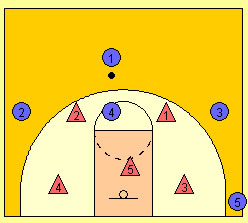
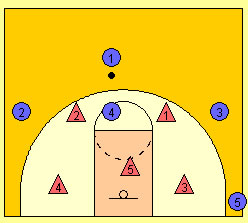
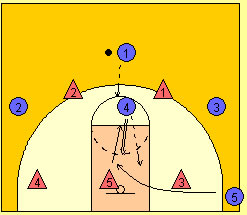
The offense starts with a 1-3-1 offensive set where our offense is already positioned in the weak places of the defense.

Tip:
Your high post O4 might initially be positioned along the lane, and then as the point guard brings the ball into the forecourt, O4 makes a quick flash into the high post at the free-throw line.

The wings must be high and wide, so that the point-to-wing pass is not easily intercepted.

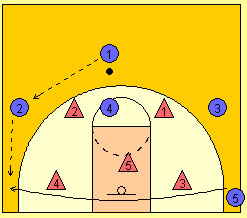
Beat the zone by quick passing and movement, and avoid unnecessary dribbling (which allows the zone to recover).

When we the pass is to the right wing, O5 moves to the right corner.

Each move is to fill a gap in the zone where you can get open for a pass and shot.

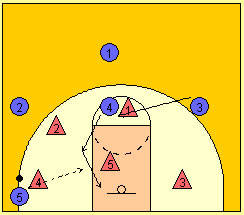
O4 moves to the right lane and O3 moves inside the 3-point arc.

If the ball is passed to the corner, O4 cuts hard down to the low block for the bounce pass from O5.

O3 moves to the free-throw line area because if O4 does not get the ball, then O3 is often wide open.

If O4 does not get the ball he cuts down under the hoop and looks for the ball if O3 gets the ball from the corner player O5 if not he goes to the weak corner.

O3 also cuts down and looks even for a easy lay-up. If not post up to the left wing position.


When the ball is passed back to O2 move into a 1-2-2 offense.


If the ball goes to O1, O4 must post-up to the high post position at the free-throw line


If the ball goes to the left wing O5 cuts to the left corner you can do the play in the other direction.


Option 1:
O1 passes to O4. O4 pivots and faces the basket and can take a shot or go for a drive inside.

Option 2:
Meanwhile, O5 who has been hiding behind the defenders down low, cuts into the paint for the pass from O4, and the O5 makes the lay-up.

O4 makes the decision here\’85 if the middle defender comes up to block the shot, then just fake a shot and bounce pass it to O5 down low. If the middle defender stays low, then just shoot it. If a wing defender moves in, pass off to that wing, O3 or O2.

Basketball Drills 7 Player Shooting

By Brian Williams on August 23, 2012

The drill was submitted by Coach Tomas Canizalez.

It is a good drill to work on conditioning, shooting when tired, and shooting under time pressure.

Below this drill are some links to other basketball shooting drills on this site.

You can time the drill to put more pressure on the shooters.


Basketball Drills

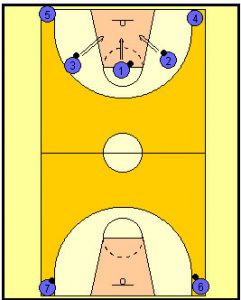
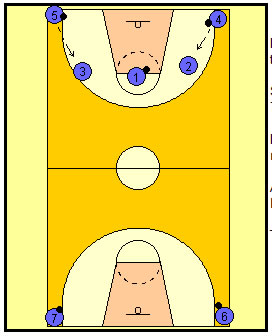
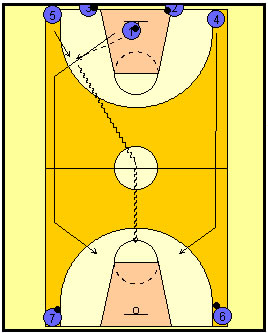
7 players, 5 balls.

Positions 3 players on the court and a ball at the man in the middle (1, 2 and 3).

At each corner of the court there is a player with a ball (4,5,6 and 7)

The drill starts with a pass from 4 to 2 and 5 to 3.


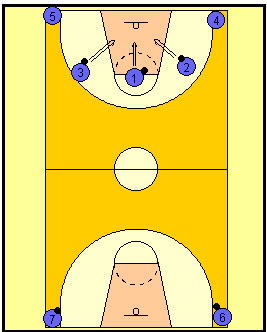
Basketball Drills

Players 1,2 and 3 take a jump shot and go for the rebound.


Basketball Drills

1 gives an outlet pass to 5 and runs behind 5.

5 dribbles through the middle to the other side of the court.

4 and 1 run along the sideline.


Basketball Drills

6 and 7 pass to 1 and 4.

Players 1,4 and 5 make a jump shot and go for the rebound.

Drill repeats itself.


Basketball Coaching Don Meyer Definite Dozen

By Brian Williams on August 22, 2012

This is the Definite Dozen used by Don Meyer when he was at Lipscomb.

Pat Summitt had a different version of the definite dozen which are very good as well.

The Definite Dozen of Bison Basketball

TO STAY HERE:

  1. BE COMMITTED TO YOUR ACADEMICS – Know your catalog … make a plan … get a degree. Go to class every day. Be on time. Sit up front. Take good notes. Do all extra work possible. Plan ahead and talk to professor when we travel or you are having a problem. Get tutors when you need them.
  2. BE COMMITTED TO HAVING CLASS – Treat teachers, trainers, support staff, chapel workers, Marriott workers, and all you meet with respect. Treat other people the way you want to be treated. Moody people are rude. Remember to smile, to say please, thank you, yes sir, and yes ma’am, and give people the benefit of the doubt.
  3. BE COMMITTED TO DOING THE RIGHT THING – We have plenty of school rules … know them. Realize if you just try to do the right thing you will be OK. Try to do the next right thing right and you are as close to perfect as any person can be.
  4. BE COMMITTED TO THE PROGRAM – We realize that our players are in a fish bowl at lipscomb. Every word and action will be watched. Our program’s reputation provides many opportunities yet brings many responsibilities. We must be committed to build on to the tradition of our program and respect those that have gone before us and paid the, price to build the program.

TO PLAY HERE:

  1. BE COMMITTED TO HARD WORK – Our program is built on the concept that hard work pays off. We believe that we work harder than anyone else … and because of that we always deserve to win. There is a reason we are the best … we work at it.
  2. BE COMMITTED TO BECOMING A SMART PLAYER – Our players must be ready to learn. We believe we work smarter than anyone else … We must develop players who understand the game. Our players must be good listeners andlearn by watching. We must make good decisions, we must play with poise. We prepare mentally for practice and games.
  3. BE COMMITTED TO OUR TEAM ATTITUDE CONCEPT – We must have players who believe in our team concept. Our program is built on the concept that the team/program is bigger than anyone player … We need unselfish players.
  4. COMMIT YOURSELF TO A WINNING ATTITUDE – Our players must be-committed to winning but understand we don’t measure our success by winning alone. Each time we play we evaluate ourselves on reaching our potential. The test for our team is to play against the game not just our opponent. We never quit. We always are looking for a way to win.

TO WIN HERE:

  1. BELIEVE IN OUR SYSTEM – commit yourself to our philosophy, to our system of play. Be a sponge and soak up the con cepts of how we play. learn your role … then accept your role and do it the best you can.
  2. BELIEVE IN YOURSELF – Play with confidence … think positive … realize you are a great player in a great program. Don’t get down when you play poorly … you were chosen to be here … be a leader. lead by example.
  3. BELIEVE IN YOUR TEAMMATES – Communicate with each other … help each other. Remember the strength of the pack is the wolf and the strength of the wolf is the pack. Encourage each other and support each other. Don’t ever forget the importance of the shell around the team. Be a friend. We understand that we are all different – be tolerant of team mates and others.
  4. BELIEVE IN YOUR COACHES – Understand that your coaches are trying to help make you better people and players. Ask questions … don’t whine and complain. learn to take tough coaching.You must believe that the coaches are doing what they think is right for the team and you.

Basketball Defense Beliefs Philosophy

By Brian Williams on August 21, 2012

Defensive Beliefs

These are some of my beliefs about playing a pack style defense.

Regardless of the style of defense that you play, I hope these thoughts might help you to define and refine your defense.

When you try to stop everything, you stop nothing.

The number one goal of our defense is to allow a low defensive field goal percentage.

Control the dribbler. Determined to keep him out of lane.

Keep the ball out of the lane by gapping (that keeps us from having to rotate and miss block outs).

Gapping is more important than gambling for steals.

Be a high energy defensive team every night and outlast the opponent every possession

Make them shoot contested shots 18’ and out, then block out, pursue the ball, and chin the rebound

Defense involves continually performing one responsibility after another, until we have the ball.

Players who do not play defense as hard as possible do not play.

Any player with desire and determination can learn to be an adequate defensive player.

Playing hard will make up for a lot of defense mistakes.

We use both our defense and our offense to control the tempo of the game and the number of possessions.

Individual concentration, awareness, anticipation, recovery, and communication are vital.

Defense is successful when each player concentrates each possession on recognizing, anticipating, and executing.

A defensive attitude is essential. The players need to feel that they are difficult to score against and must take pride in the defensive aspect of the game.

Great defensive teams cover up mistakes.

You recover as soon the ball is picked up. Help as far outside the lane as possible. Same on screens.

Teams don’t get beat the help they get beat on better recovery—so we must practice and stress recovery.

Ball is more important—talk the switch—no penetration.

STANCE knees bent—feet wide) Tail down, Weight on balls of feet. Heels slightly up.

POSITION Do not go for a steal and take yourself out of a play. That is false hustle and it hurts our team.

VISION AND AWARENESS (see the ball and man—sink to see). Be ready to help on the ball.

Trace the ball with other hand. Hands off. Don’t foul the game away or put yourself on the bench with foul trouble.

Know the man’s strengths and play the appropriate gap. Our scouting report will make what that exactly is clear to the players.

FORCE OUTSIDE. When the man with the ball spins, or turns his back we trap him.

When the dribble is picked up, we apply pressure—“Up” is our call so everyone knows the ball is up. Make the ball uncomfortable.

Forward pivots, hands above shoulders on block outs.

You can only do two of the three from: deny, help, recover. We choose to not deny and place our defenders in the help gap to begin with.

Foul only for profit. Switch for profit.

Great defensive teams take charges and don’t reach or swing.

Take the charge in front of the basket, in the lane, and on the baseline. It is impossible to get a charge call in the middle of the floor.

Help across and down—never from the basket out.

Guard two places at once by using defensive fakes.

Give quick help with early recovery. Helper sees own man.

When we recover, we recover to the ball or to a gap, not to a man (unless he has the ball or is in the post)

Don’t deny past the level of the ball.

  • « Go to Previous Page
  • Page 1
  • Interim pages omitted …
  • Page 252
  • Page 253
  • Page 254
  • Page 255
  • Page 256
  • Interim pages omitted …
  • Page 288
  • Go to Next Page »

Primary Sidebar

  • Twitter
  • Facebook
  • Linkedin
coachestoolbox
personaldevelopmenttoolbox
basketballplayerstoolbox
basketballtrainer
athleticperformancetoolbox
coachingbasketball

© Copyright 2026 Coaching Toolbox

Privacy Policy