• Skip to primary navigation
  • Skip to main content
  • Skip to primary sidebar

  • Basketball Plays
    • Ball Screen Sets
    • Horns Sets
    • Man to Man Post Up
    • Man to Man Isolations
    • Backdoor Plays
    • Man to Man 3 Point Shot Plays
    • 2-3 Zone Attack
    • Baseline Inbound Plays
    • Sideline Inbound Plays
    • Combination Defense Attack
  • Drills
    • Defensive Drills
    • Offensive Drills
    • Competitive Drills
    • Passing Drills
    • Rebounding Drills
    • Shooting and Scoring Drills
    • Toughness Drills
    • Transition & Conversion Drills
    • One on One Drills
  • Blueprint
  • Practice
  • Mental Toughness
  • Skill Development
  • Offense
  • Defense
  • Store

Basketball Drills Finishing

Basketball Drills Finishing

By Brian Williams on December 12, 2012

These basketball finishing drills are from the Xavier Men’s Basketball Newsletter.

You can see the archives of the newsletter here:

Xavier Newsletter Archives

Scroll down the page to see the three basketball finishing drills.


2 vs. 1 Finishing Toughness
Basketball Drills

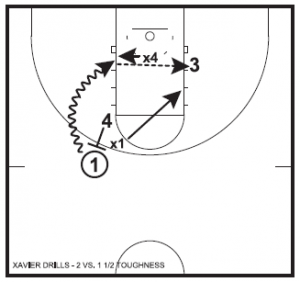
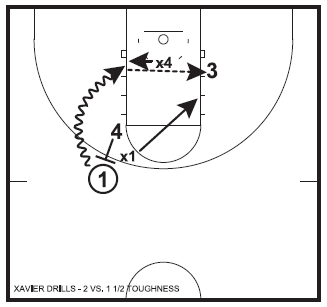
Screener hands the ball to the offense.

Defensive man starts next to the offensive man.

Once the ball is handed to the offensive player, the offensive player uses the screen to shakd the defender.

Offensive player looks to score on the help defender or to dish to #3 (probably a bounce pass on the baseline side of the defense. We fake the pass in front, but don’t throw the ball away in front of the defense

X1 can rotate to #3

Keys: Bounce pass is usually the best pass because X4 will probably close out with high hands.

Get tight off the screen. Work on both sides of the floor.

Big Finishing Toughness
Basketball Drills

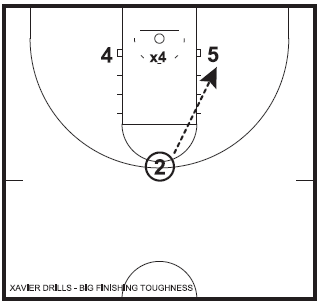
The defender in the middle plays to block the shot or alter the shot.

Offensive player tries to make a strong intelligent move.

Don’t use a dribble unless absolutely necessary.


Move and Counter Move Toughness
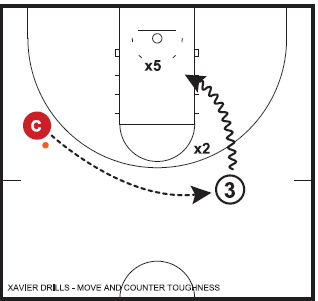
Basketball Drills

Coach throws a high arcing pass to the offense.

Offense rips the ball while defense gets into the shirt of the offense.

Offense drives by the defense (the defense cannot move laterally.

Offense finishes over the help defender at the rim, use a counter move if needed.

Keys:

Be tough with the initial rep and with the finish

Use counter move on a big defender.
Zone Attack Dribble Chest

By Brian Williams on December 10, 2012

Coach Vonn Read has submitted several plays from his playbook series The Basketball Encyclopedia of Plays to the Coaching Toolbox.

Vonn has a wealth of Coaching Experience:

NBA: Advanced scout for the Orlando Magic
WNBA Assistant Coach with the Phoenix Mercury, Orlando Miracle, and San Antonio Silver Stars.
Women’s College Assistant: Syracuse, Houston, Memphis

Good play against a 2-3 Zone.

Diagrams created with FastDraw


Basketball Plays


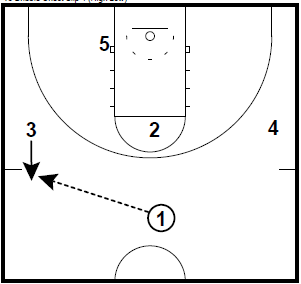
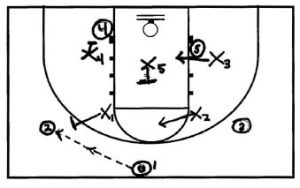
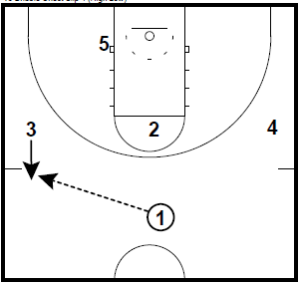
1 Passes to the 3 player.

The 2 player is the shooter in the middle.


Basketball Plays

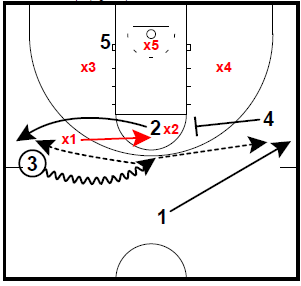
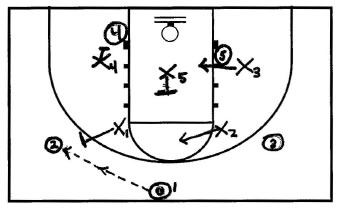
3 Drives the ball hard to the top of the key to draw X1 and X2 defenders together.

1 flares for the shot on the wing, coming off a Flare screen set by the 4 player!!

The 2 player drags opposite for a shot on the wing. This action forces X3 and X4 to play the shooters on the wings.

Basketball Plays

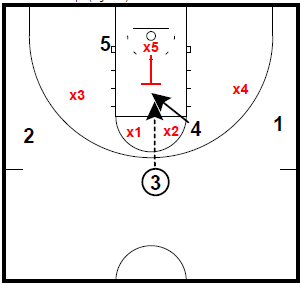
After setting the Flare Screen, the 4 player will slip into the middle for the Pass for a Shot or High Low.

When the pass goes to the 4 player, X3 and X4 cannot pinch down quick enough to stop the high low because they are out on the wings playing the shooters!!

If they do recover, the kick out pass to the wing is open for a 3-pointer!!

Basketball Plays


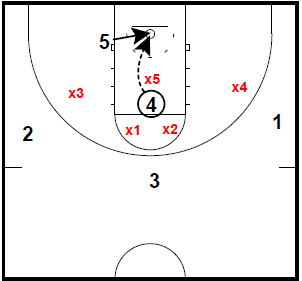
High Low Action!!

If the ball is passed to the wing, play the Short Corner Game!!


Coach Read has also put together The Basketball Encyclopedia of plays. You can check them out here: The Basketball Encyclopedia of Plays or read more about the books:

Any coach looking for the latest and innovative plays from the Professional, College, or High School levels can stop looking. With a compilation of over 7,700 different plays, you will never need to purchase another basketball playbook again. These playbooks can be used as a great reference tool for years to come. This 2 Volume Book includes plays from 19 different play categories, and they are the most extensive playbooks on the market.

The Basketball Encyclopedia of Plays (Platinum Series) contains over 7,700 Plays (Both Volumes combined) from the NBA, WNBA, USBL, and College levels from someone who has worked as an Advanced Scout or Coach on each level!!! This book has been intensely compiled over the last 21 years, with plays taken from a lot of NBA Coaches (past and present), WNBA coaches, and College coaches (Men’s and Women’s) from around the country.

Any coach that is serious about improving their knowledge of the game from an X and O standpoint will benefit tremendously from these books. These Books can be used to discover New Quick hitters, add a New Package to your playbook, or develop an entire Offensive System. There are a lot of new ideas and concepts in these books to study, and the Basketball Encyclopedia of Plays can be a great resource for coaches on all levels!!! This book is definitely for those X and O junkies who are always looking to improve as a Coach.

“THE GAME IS ALWAYS CHANGING? ARE YOU?” Vonn Read

Here is the link: The Basketball Encyclopedia of Plays

Four Secrets to Great Post Play

By Brian Williams on December 6, 2012

Randy Brown www.coachrb.com

Search any library, bookstore, or the internet on the topic of basketball and you will find thousands of choices. The most popular titles will deal with offense and the art of shooting and scoring points. Defense will also be represented as will rebounding, pressing, and fundamentals. Among the popular titles you will find an amazing amount of information on is post play.

Since the 70’s, good post play has been equated to winning. Jabbar, Chamberlain, Unseld, Russell, and Hayes are names that put post play on the map in the NBA. The fascination with these back-to-the-basket giants has not decreased and is a big part of a team offense. Post play can be broken down into dozens of categories. Coaches with time and energy can help improve a player’s game year round. How much is too much, is the question. Young players are able to concentrate and take in only so much teaching at one time.

Do coaches force-feed their post players with too much information? At times I believe they do and this article will address a hidden key that coaches and players can add to their game with great results. When breaking down the art of post play there are several components to consider.

Post moves, footwork, physical play, ball handling, shooting, and positioning are all required. Coaches would all agree that these are the parts that must be taught and learned. There is a big part of the post puzzle missing, though. You must have the ball if you are going to do anything in the post. Knowing how to get open, catch the ball, use your feet, be physical opens the door to a whole new world in the paint! Read on

4 Keys In Gaining Possession Of The Ball

  1. Stay Off the Blocks. Kids are done a disservice by being taught that the blocks are the place for big guys to go. It is such an automatic habit for kids and one that is hard to break. I’ve coached many college players who thought that posting up right on the block was the way big guys play. Nothing could be more from the truth. Many times I’ve threatened to sand the block off the floor to keep players from gravitating to this sacred spot. What is the advantage of assuming a position 6 feet from the basket with your back to it while being guarded? Realistically, that is not a good position to be in at all. As if a powerful magnetic force draws the player’s body to this spot, by nature big players run there every time. Here’s the truth about good post players—they use the block only as landmarks and post up wherever the defense will allow them to post up. As a coach, I encourage you to teach young players to concentrate much more on ball location and defender location than that silly painted rectangle on the floor.
  2. Focus on your defender. Teach young players to assume their position around the basket based on where their defender is. The goal is to post up your opponent as close to the basket as possible. If the defender is out of position, take advantage by stepping at the defender and posting up where he is. Use the phrase, “Take your post up to the defense.” You allow the post up position to be your choice, not the defenders. This technique must be worked on because players are not familiar with this skill. Like changing your grip on the golf club, the golfer must work hard to establish a new grip and become comfortable with it. In time your players will buy into the advantages of focusing on the defender because the rewards will be positive and immediate.
  3. Initiate the contact. This is a new concept to many coaches, but a crucial technique for posting up in prime spots on the floor. Usually the defender is the one who delivers most of the blows in hand-to-hand combat on the block. Offensive post players gain a decided advantage when they are quick to initiate the contact, which enhances their post up position on the floor. This is another concept that must be taught in concentrated practice sessions and through repetition.
  4. Let the Ball Find You. In every gym across America, you can witness a common site. As if mesmerized, post players stare at the ball as they follow its path around the perimeter. Most kids are taught to do this and are simply doing what they are told. This may shock you, but good post players are never guilty of doing this. Good post players actually play away from the ball on the weak side more than they follow it. If rule #2, Focus On YourDefender, if followed, the ball will actually find YOU! This is a concept that is implemented at all levels by coaches that understand the elements of quality post play.

    As a player, when you focus on the defender and your position on the floor relative to the ball, you will improve greatly. As a general rule, tell your players, “Don’t find the ball, let the ball find you”. If you commit to this technique you will find the ball in prime scoring areas on the floor on a consistent basis. The result will be increased post scoring and more fouls committed by the defense. In essence, your post players will become very “hard to guard”. In my experience coaching players from grade school to college, I have seen many players improve drastically over a short period of time.

    I’ve seen skill deficient post players become all-league performers by committing their time and game to the four keys above. Becoming proficient around the basket has a lot less to do with skill and jumping ability than it does knowing how to play. Maximizing your position, physical play, and knack for the ball will make you an excellent low post player.

Focus on your strengths, work on these keys, and watch your game elevate like never before. As you begin to catch the ball more and increase your scoring, your confidence will skyrocket.

Coaching Basketball Winning

By Brian Williams on December 5, 2012

This article was contributed by Kyle Ohlman of basketballhq.com The site is a workout resources for coaches and players with hundreds of videos for ideas for skill development workouts.

As basketball coaches we are always thinking about the different strategies that we can use to win games. We spend hours and hours of time picking the right plays, budgeting practice time, working on defense schemes, etc. These are all things that need to be done, but what if you are already shooting yourself in the foot before you ever really even get started? Coaches can diagram the best plays in the world but a player still has to be the one that puts the ball in the basket.

As much as coaches may hate to admit it, players ultimately win games. The great coaches recognize this and that is why they spend the time not only on strategy but also on each individual player and the team as a whole.

This article isn’t going to give you the play of all plays that no team can guard but in my opinion without the three areas that are going to be covered below it doesn’t matter what plays your team runs. It is up to the coach to evaluate their team and figure out a strategy that is going to give their team the best chance to win games. Whether you play an up and down style or you walk it up the floor and run sets it is up to you, but what your team can’t afford to be without are the three keys below.

Coaches need to get everyone headed in the same direction.

The coach needs to make sure that everyone is on the same page. Once you decide on a game plan for your team you need to make sure that everyone is doing their best to accomplish it. If you are going to walk the ball up the floor and run offense then you can’t have that one player on the floor that jacks up a bad shot every time they touch the ball. You have got to find your identity and then get your team to buy in. This goes for assistant coaches as well. Whether you believe in the head coaches philosophy or not you must do your best to support the head coach and get on board, especially with the players. You can suggest ideas to the coach in private but ultimately it is the head coach that makes the final call. You have most likely heard this analogy before, but think about being in a row boat. The only way it works is if everyone is rowing at the same time, same strength, and same direction. This is how your team must be to have success.

Coaches need to be able to motivate and get the best out of their players.

Be willing to spend the time on and off the floor learning about your players. Learn what makes them tick, what motivates them, and ultimately build a personal relationship with them. That is the only way that you will be able to get the best out of each player. Not every player responds the same way so it is your job to find out the best way to handle each player. You also need to spend the time with your players teaching them the game and developing their individual skills. If your team is hitting shots it makes up for a lot of mistakes. If you spend all your time working on executing different plays and then you don’t have players that are skilled enough to put the basketball in the hoop at the end of the play, it doesn’t really make sense. Developing your players will also help them to trust you more because they know that you are spending time to help benefit them personally.

Coaches need to build a winning culture that is built upon each year and where the returning players pass it on to the new players.

Once you spend all the time getting everyone bought in and heading in the same direction don’t waist it and start over again every year. Encourage your players that are returning to take on the responsibility of helping the incoming players to buy in. This is called building a winning culture. I had a player that I coached in high school go to Butler University on a recruiting trip and he told me that he watched the team play pick up without any coaches around. The team wasn’t playing hard enough and wasn’t executing the right way so the players called an early morning practice for the next day. No coaches were around but because these kids were bought in, they wanted to do things the right way. This is almost unheard of, but Butler did go to back to back national championships with a team whose individual skill level was no where near some of the teams that they beat. In my opinion you can’t do anything truly special without having specific players that are bought in and willing to lead the team from a player’s standpoint.

Here are Basketball HQ’s Social Media links:

Twitter: https://twitter.com/BasketballHQ
Facebook: http://www.facebook.com/Basketballhq

Basketball Plays Butler Zone

By Brian Williams on November 30, 2012

I found this on one of Creighton Burns’ newsletters.

It is a simple play that Butler University ran against a zone when Brad Stevens was there.

This is a quick hitter that you can save for a time when you need a basket.

It is probably not going to work more than once or twice each game.


Basketball Plays


The play starts with1 passing to 2.

That forces X1 to guard the wing.


Basketball Plays


#1 makes a shallow cut through the lane.

#2 dribbles to the top of the key to take #1 away from his area.
 

Basketball Plays

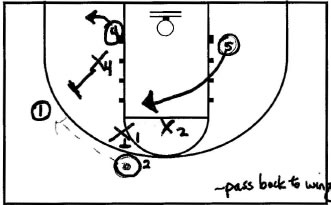
#2 passes back to #1

That forces x4 to step up to guard #1.

#4 steps to the short corner.

#5 cuts to the high post.

#1 has option to drive or pass to the short corner.

If the ball goes to #4 in the short corner, #5 makes a basket cut.

8 Ways to Maximize Basketball Practice

By Brian Williams on November 29, 2012

By Alan Stein, Pure Sweat Basketball

They say, ‘you play the way you practice.’

Assuming that’s true, and I have full confidence it is, then coaches and players alike should do everything in their power to maximize every practice.

8 Things PLAYERS should do to maximize every practice:

1) Be well fueled, well hydrated, well rested, and take care of your body.  Do exercises like these 2-3 times per week:

2) Get to practice early. Don’t wait for practice to start, prepare for it. Making 100 extra shots before every practice will have an enormous compound effect over the course of the season.

3) Approach practice with a ‘game like’ mentality. After all, how you do anything is how you do everything. Want to play well in games? Then practice well every day.

4) Listen with your eyes. Your coach won’t say it if it’s not important. Absorb everything your coaching staff and teammates say by having great eye contact.

5) Leave your comfort zone every practice. Leave it mentally. Leave it physically. Leave it emotionally. You should be drained at the end of every practice. Leave it on the floor!

6) Make your enthusiasm contagious. Raise the level of those around you with constant energy. Be vocal.

7) Be a ‘Glue Guy’ (or ‘Glue Girl’). By definition, glue binds and holds things together. Be the glue on your team.

8) Value the ball for the entire practice. Every drill. Every scrimmage. Every play. Don’t take bad shots or make sloppy passes.

8 Things COACHES should do to maximize every practice:

1) Have a practice plan. Have written out to the minute, the entire practice. You will certainly need to make tweaks and adjustments but stick as close to the plan as you can. Plan your work and work your plan!

2) Have a theme for the day. Will today focus more on offense? Defense? Drill work? Conditioning? Instruction? Don’t try to do everything every practice.

3) Coach in bullet points, not paragraphs. Keep practice flowing!

4) What 3 things do you want your team to be known for this season? Rebounding? Pressure defense? 3-point shooting? Whatever they are, emphasize them every day.

5) Do NOT allow bad attitudes or poor body language… ever. Those things are understandable, but never acceptable. Nip them in the bud quickly.

6) Focus on quality over quantity. Time efficiency is important. If you can do it in 90 minutes, don’t take 2 hours.

7) Get up shots! The name of the game is to put the ball in the cup. Make sure your players get up a few hundred quality shots every practice.

8) Have fun! While I respect Gene Hackman’s line in Hoosiers, ‘My practices aren’t designed for your enjoyment’… I wholeheartedly disagree. If you find ways to make practice fun, your players will give a better effort. If they give a better effort, you’ll get better results. Then everyone wins!

  • « Go to Previous Page
  • Page 1
  • Interim pages omitted …
  • Page 245
  • Page 246
  • Page 247
  • Page 248
  • Page 249
  • Interim pages omitted …
  • Page 288
  • Go to Next Page »

Primary Sidebar

  • Twitter
  • Facebook
  • Linkedin
coachestoolbox
personaldevelopmenttoolbox
basketballplayerstoolbox
basketballtrainer
athleticperformancetoolbox
coachingbasketball

© Copyright 2026 Coaching Toolbox

Privacy Policy