• Skip to primary navigation
  • Skip to main content
  • Skip to primary sidebar

  • Basketball Plays
    • Ball Screen Sets
    • Horns Sets
    • Man to Man Post Up
    • Man to Man Isolations
    • Backdoor Plays
    • Man to Man 3 Point Shot Plays
    • 2-3 Zone Attack
    • Baseline Inbound Plays
    • Sideline Inbound Plays
    • Combination Defense Attack
  • Drills
    • Defensive Drills
    • Offensive Drills
    • Competitive Drills
    • Passing Drills
    • Rebounding Drills
    • Shooting and Scoring Drills
    • Toughness Drills
    • Transition & Conversion Drills
    • One on One Drills
  • Blueprint
  • Practice
  • Mental Toughness
  • Skill Development
  • Offense
  • Defense
  • Store

Basketball Coaching Fueling Performance

Basketball Coaching Fueling Performance

By Brian Williams on March 5, 2013

By Alan Stein, Stronger Team Blog (re-posted with permission)

Last week I had an unparalleled opportunity to spend 48 hours in Houston, Texas as a member of an exclusive Gatorade Sports Science Institute Basketball Task Force. It was an honor to take part and a thrill to meet and learn from some of the brightest minds on the planet regarding nutrition, hydration and performance enhancement.

I wanted to share some of the highlights of what I learned from the speakers:

If you want to gain muscular size and/or muscular strength, you must consume adequate protein after your workouts.

Your body can only use approximately 20 grams of quality protein in one meal, so taking in less is inadequate and taking in more is unnecessary for muscle growth.

You should aim to take in 20 grams of quality protein every 4-5 hours for the 24 hours following your workout (with the first 30 minutes after you workout being the most important).

Chocolate milk or an appropriate recovery shake are perfect for post workouts.

Age appropriate strength training is extremely beneficial for youth and adolescents because the body’s connective tissue finishes developing by age 17 (NOTE: not muscle development, connective tissue development).

As bodyweight increases (primarily in the form of body fat), the occurrence of injury increases.
Proper nutrition isn’t just about fueling your body. It is also about fueling your mind. Can you make correct game speed decisions when you are fatigued? You can’t play if you can’t think.

Nutritional success depends on your ability to plan ahead and prepare.

“A proper diet can’t make an average player elite. But a poor diet can make an elite player average.”

Recommend daily protein requirements for elite level athletes: 1.3-1.8 grams of protein per KG of bodyweight

Dehydration impairs cognition and mental readiness.

As little at 2% dehydration will (negatively) affect performance.

How do you know if you are dehydrated?

o You are thirsty

o Your urine is dark yellow

o You see a slight drop in normal body weight

Main causes of cramping:

o Fatigue

o Electrolyte deficiency

o Dehydration

The most underrated recovery technique to aid in max performance is sleep!

Teenagers need 9-10 hours of quality sleep (very few every get that).

Checklist for quality sleep:

o You fall asleep within 30 minutes

o You sleep through the night with minimal interruptions

o You feel refreshed upon waking up

How to get quality sleep:

o Keep your room cool, dark, and quiet

o Remove all electronics (computers, phones, TV’s, etc.)

o Have a consistent routine (certain bed time, etc.)

Naps are an excellent way to aid in rest and recovery:

o Do NOT nap within 2 hours of a game (you will feel groggy)

o Do NOT nap after 4pm (it will throw off that night’s sleep)

o Do NOT nap longer than 30-45 minutes

I hope you found these nuggets as helpful as I did. Just following the basics when it comes to proper nutrition, hydration and rest & recovery can play a huge role in your performance on the court.

Train hard. Fuel smart.

Alan Stein
http://www.About.me/AlanStein

Basketball Workouts Guards

By Brian Williams on March 4, 2013

These four guard basketball workout drills are from a back issue of the Xavier Men’s basketball newsletter. If you would like to see the archives and/or sign up for their newsletter, you can here: Xavier Newsletter

The first drill is a toughness and finishing drill.

Drill #2 is a drill for guards to work on scoring in the post.

The third drill is a competitive shooting drill that works on the skill of penetrating and kicking for a shot.

The final drill works on speed dribble while being chased from behind.

At the end of the post, I have linked to some other skill development workout drills.

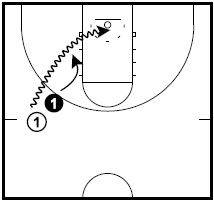
30 Second War Drill

Diagrams created with FastDraw

Basketball Workouts

In addition to working on ball handling, this is a great short conditioning drill.

RULES:
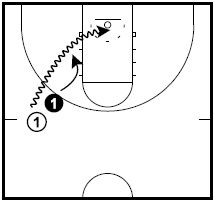
-Guard has the ball on the wing.
-The defender is guarding tightly. (Reaching and light fouling are allowed)
-Guard must keep his dribble and face the post for 30 seconds – no spins or back to the basket is allowed.
-It is a good idea to use a hop back to create space when needed.
-After 30 seconds, a coach blows the whistle and the guard can then drive, attempting to score

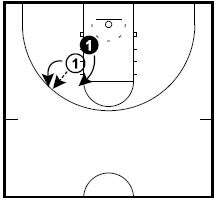
Guard Scoring in Post

Basketball Workouts

This drill stresses the ability to score quickly out of the post, in addition to being a good defensive drill.

RULES:
-Player 1 spins the ball out of the post to himself. He must catch, turn and shoot before the defender can get there to block the shot.
-The defender cannot move or challenge the shot until the ball hits the floor on the toss.

-With the sound of the ball hitting the floor, the defender can then attempt to guard and block the shot.

-The guard must be very quick to turn around and shoot.

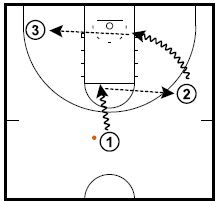
Guard Penetration

Basketball Workouts

Great drill to stress the drive and kick.

RULES:
-3 players start on the perimeter.
-There must be two drive and kicks before a shot.
-Alternate shooters each time.
-First player to 5 makes wins.

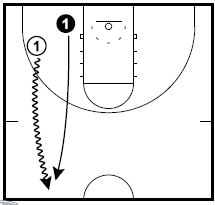
Guard Court Sprint

Basketball Workouts

This is a great guard drill that stresses quickness.

RULES:
-Guard begins on the baseline.
-Defender is 3 feet to his side and 3 feet behind.
-On the whistle, the guard attempts to sprint while dribbling the length of the floor, while the defender tries to catch up and cut him off.
-The guard must try to prevent this by riding off of the defender as he is dribbling at maximum speed.
-The guard must keep the ball tight to his body while going full speed.

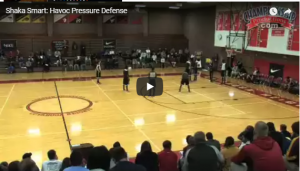
Basketball Shaka Smart Pressure Defense

By Brian Williams on March 1, 2013

These are some notes from Shaka Smart, on their pressure defense.

5 Core Values:

Appreciation
Enthusiasm
Competitiveness
Unselfishness
Accountability

Havoc style of play
Want to force turnovers through pressure – want live ball turnovers
Do your players know what you want out of defense? Team stops not individual stops, force quick bad shots is what we want
Create easy offensive opportunities
Force the opposing team to play different than they practice every day

Take players out of their comfort zone
Be in better shape than opposition to fatigue them
Who wins the battle when you’re tired?
“Fatigue makes a coward of us all”
Pressure D has become their Brand – their Identity

Energy: must have 5 guys flying around at all times
Fouling: have to be careful, play smart not stupid
Communication: talking makes your reaction quicker
Transition: have to transition quickly from offense into your press
Deflections: must measure

Trapping Fundamentals – 3 things that make a good trap
o Ball handlers level of control – better trap = less control
o Element of surprise
o Where you are on the floor – corners, sideline

Who do we trap?
o Do not trap good defensive matchups
o Trap the smaller guards
o Never trap the 5 man

How do we trap?
o Closeout to the trap – short choppy steps, high hands
o Be elastic –as the offensive player moves, defense moves
o Force an obvious pass by making them pivot
o Foul with lower body, never with hands

Other 3 players have to think like a trapper
Back player has to be deep as the deepest

If your trappers force the obvious pass by making them pivot:
o Interceptors must read the obvious pass
o If the ball is passed ahead of you tip from behind

Against 2 on 1 stunt the ball handler
Learn how to play when they are outnumbered
Ability to defend multiple positions
Must be close enough to touch

The video below is a segment of Coach Smart teaching a portion of his pressure defense. You can see more information about the DVD that the sample video came from by clicking this link: Shaka Smart: Havoc Pressure Defense

Basketball Drills Navy Shooting

By Brian Williams on February 28, 2013

This technique shooting drill came from Fast Model’s Plays and Drills Library. It was contributed by Bert DeSalvo the top assistant for the women’s basketball program at Clarion University. DeSalvo spent four years as the head coach at Penn State-Beaver.

You can access the page for more Drills and Plays here: Fast Model Library

This is a warm up drill that we used almost every day when I was the head coach at Penn State Beaver. I got this drill from Billy Lange when I worked his camp at the Naval Academy in 2008.


Basketball Drills

This simple, but effective, drill worked on our mechanics and emphasized all aspects of great shooting technique.

Players are able to keep alignment, get on their toes when shooting and holding follow through in this drill. In addition, they really can see which way they are missing because of the use of hte side of the backboard.

Description:

This drill can be used for time (2 minutes) or amount of shots or makes.

I would also work on our two step layups or add another shooter at the front of the rim to utilize my players and the rims more efficiently.

Players line up on the baseline with perfect alignment in reference to the backboard.

If right-handed, players will align thier right foot, knee, hip, elbow and follow through with the thin portion of the backboard.

Players shoot “on their toes” and accentuate their follow through to work on their mechanics.

Players will shoot 25-50 makes (straight bounce back to shooter) on each side.

“Makes” will bounce straight backs, while misses will graze, miss or move to the side.

They’re Called Coach

By Brian Williams on February 27, 2013

This is old enough that it is written in the masculine gender. Certainly, it applies to both men and women who coach…

This was written by Bill Libby as a preface to his book about coaches. Thanks to Coach Mike Smith for that information!

He’s called a coach and it’s a different job. There is no clear way to succeed. One cannot copy another who’s a winner, for there seems to be some subtle secret chemistry of personality that enables a person to lead successfully and no one really knows what it is. Those who have succeeded and those who have failed represent all kinds.

They are young, old, experienced, they are soft, tough, good natured, foul tempered, proud and profane. They are articulate and even inarticulate. Some are dedicated and some casual. Some are even more dedicated than others. Intelligence is not enough, and dedication is not enough.

They all want to win, but some want to win more than others and just wanting to win is not enough. Losers almost always get fired, but winners get fired also. He is out in the open being judged publicly for six or seven months out of the year by those who may or may not be qualified to judge him. Every victory and every defeat is recorded constantly in print. The coach, this strange breed has no place to hide. He cannot just let the job go for a while or do a bad job and hope no one will notice as most of us can. He cannot satisfy everyone, seldom can he even satisfy very many, and rarely does he even satisfy himself. If he wins once, he must win the next time also.

They plot victories-, they suffer defeats; they endure criticism from within and without; they neglect their families, they travel endlessly and they live alone in the spotlight surrounded by others. Theirs may be the worst profession in the world. It’s unreasonably demanding, poor pay, insecure, full of unrelenting pressures and I ask myself: Why do coaches put up with it? Why do they do it? I’ve seen them fired with pat phrases such as, “Fool”, “Incompetent”, or “He couldn’t get the job done”.

I’ve wondered about that, having seen them exalted by victory, and depressed by defeat. I’ve sympathized with them having seen some broken by the job and others die from it. One is moved to admire them and to hope that someday the world will understand them; this strange breed they call coach.


You can read more from this book by clicking the cover above and to the left and then arriving at Amazon.com then click on the cover where it says “Look Inside.” Or you can click the link below.

The Coaches

Basketball Plays Wake Forest

By Brian Williams on February 26, 2013

This play is run against a man to man defense.

From Coach Creighton Burns’ newsletters. If you are interested in receiving his newsletter, contact us and we will put you in touch with Coach Burns.


basketball plays

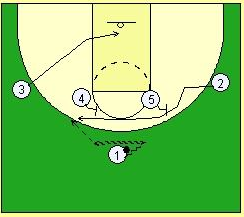
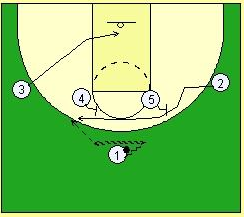
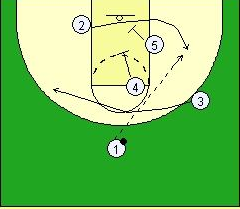
1 – 4 high across to begin.

#1 takes it on the dribble towards #2 on the right wing.

When that happens, #2 comes across the top off of screens from both #5 and #4.

#1 takes the ball back in the direction #2 is cutting.

#3 cuts down towards the middle of the lane, underneath the basket area.

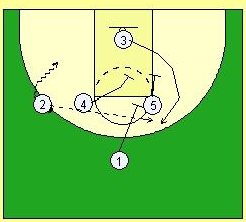
basketball plays


Once #2 has the ball on the wing, #4 and #5 set a double down screen for #3 underneath the basket.

If you wish, you may even add #1 to complete the triple staggered screen.


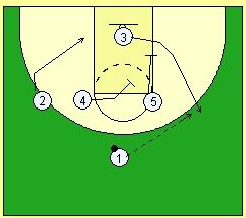
basketball plays

We will assume that #2 was not open in the beginning.

If that is the case, #4 and #5 would still continue down and screen for #3 underneath the basket.

#2 would continue down to the low block area, ready to replace #3 underneath the basket.

#1 can hit #3 off the double staggered screen if he is open.

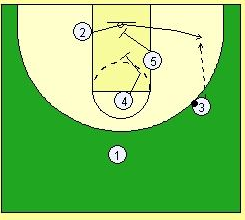
basketball plays

Let’s assume #3 was open.

When he receives the ball, #4 and #5 continue moving in that direction and find #2’s defender for a double screen or a double staggered screen.


basketball plays

If #3 wasn’t open on that play, he would continue cutting and curl around and out of the play while #4 and #5 would set the double or double staggered screen for #2.

Great continuous screen action from your post people trying to free your perimeter people for a jump shot.

  • « Go to Previous Page
  • Page 1
  • Interim pages omitted …
  • Page 238
  • Page 239
  • Page 240
  • Page 241
  • Page 242
  • Interim pages omitted …
  • Page 288
  • Go to Next Page »

Primary Sidebar

  • Twitter
  • Facebook
  • Linkedin
coachestoolbox
personaldevelopmenttoolbox
basketballplayerstoolbox
basketballtrainer
athleticperformancetoolbox
coachingbasketball

© Copyright 2026 Coaching Toolbox

Privacy Policy